
June 16, 2026
The Infrastructure Threshold: Why Remote First Nations Road Access Defines Mine Development Viability
Across northern Canada, the economics of resource extraction and the lived realities of remote Indigenous communities are increasingly converging around a single variable: permanent ground transportation. For decades, seasonal road systems have served as the primary surface link between fly-in and winter-road-dependent communities and regional service centres. However, these corridors operate under strict time constraints, climate vulnerabilities, and logistical ceilings that compound disadvantage year after year. As winters shorten due to climate change and the cost of air freight continues to pressure household budgets, the case for all-season road infrastructure has shifted from aspirational to urgent. It is within this context that the Cat Lake First Mining all-season road deal carries significance far beyond the two parties who signed it.
When big ASX news breaks, our subscribers know first
Understanding the Infrastructure Gap Driving This Agreement
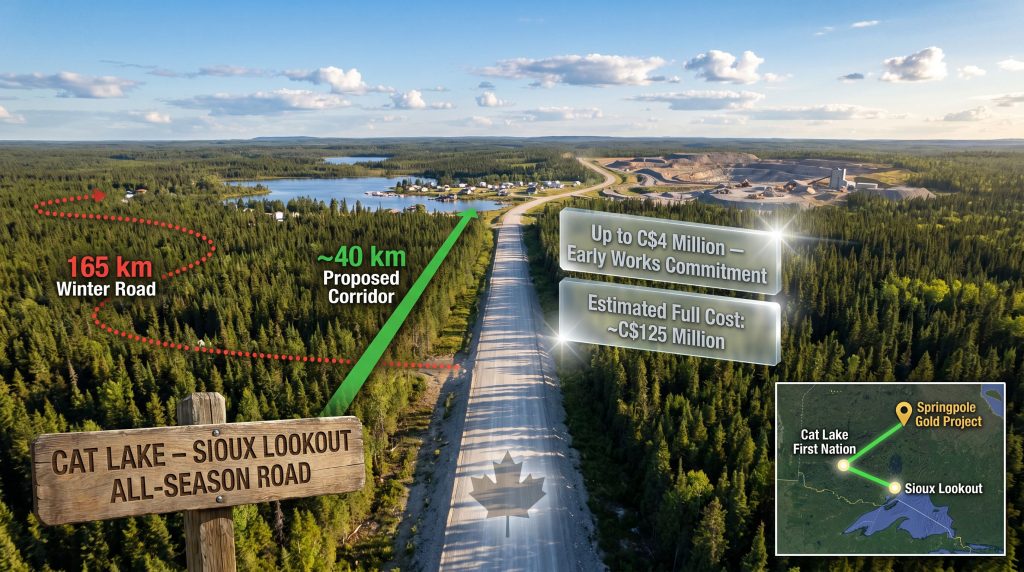
Cat Lake First Nation is an Anishinaabe community situated approximately 180 kilometres north of Sioux Lookout, Ontario. With an on-reserve population of 649 residents recorded in the 2021 Census and a total registered membership exceeding 700, the community's geographic isolation is acute. For most of the calendar year, the only surface access to Cat Lake runs through a seasonal winter road corridor of approximately 165 kilometres connecting it to Sioux Lookout. This road operates on frozen lakes, rivers, and muskeg terrain for a window that typically spans just six to eight weeks annually, depending on ice thickness and weather conditions.
The consequences of this seasonal dependency are measurable and severe:
- Food prices in remote northern Ontario First Nations communities can be two to three times higher than in southern urban centres, with the cost of a standard nutritious food basket in some fly-in communities exceeding C$400 per week for a family of four, according to Nutrition North Canada data
- Emergency medical response is structurally compromised, with medevac flights replacing ground ambulance for time-sensitive health events
- Employment mobility, access to post-secondary education, and participation in regional economies are constrained by the cost and infrequency of air travel
- Climate change is progressively shortening operational windows for winter roads across northern Ontario, increasing the frequency of supply disruptions
Federal and provincial policy frameworks have long classified all-season road access as a foundational prerequisite for remote community development. Ontario's Northern Highways Program, the Northern Ontario Multimodal Transportation Strategy, and the federal National Trade Corridors Fund all identify inadequate ground transportation as a structural barrier to equitable economic participation. In this policy environment, all-season road investment is not framed as an amenity but as a development threshold condition.
The C$4 Million Agreement: Scope, Structure, and Limitations
The Cat Lake First Mining all-season road deal formalises a commitment by First Mining Gold to fund up to C$4 million for the early-stage development of a permanent all-season road connecting Cat Lake First Nation to Sioux Lookout, Ontario. Construction activities are targeted to begin in summer 2026, following a Band Council Resolution passed by Cat Lake in May 2026 that formally designated the road as a community priority.
The C$4 million commitment represents the pre-construction development phase only. It is not a construction guarantee, and full road construction is estimated to require approximately C$125 million in total capital, which remains unfunded.
The early-works funding covers four primary workstreams:
- Permitting and regulatory approvals under Ontario's Environmental Assessment Act and relevant federal legislation, including coordination with the Impact Assessment Agency of Canada. Furthermore, mining permits and approvals at both provincial and federal levels must be secured before physical works can begin.
- Vegetation clearing and site preparation along the proposed corridor alignment
- Geotechnical investigation and soil analysis, including borehole drilling, test pits, material sampling, and assessment of muskeg, permafrost, and groundwater conditions critical to roadbed engineering
- Engineering design and route planning, encompassing corridor selection, drainage structure placement, bridge identification, and design standards suitable for year-round heavy vehicle use
Geotechnical work in this terrain is not a formality. Northern Ontario's boreal and muskeg environment presents conditions where saturated soils and differential frost heave can cause significant structural damage if the subgrade is not engineered to account for seasonal freeze-thaw cycling. These investigations — similar in rigour to a definitive feasibility study in their importance to cost certainty — inform every subsequent design and costing decision, making them genuinely prerequisite to any credible construction estimate.
How This Road Connects to the Springpole Gold Project
The Strategic Infrastructure Logic Behind First Mining's Investment
The Springpole Gold Project is located approximately 110 kilometres northeast of Red Lake in northwestern Ontario and represents First Mining Gold's flagship development asset. According to the company's 2021 pre-feasibility study, Springpole hosts a probable reserve of approximately 3.8 million ounces of gold and 20.5 million ounces of silver, within a broader measured and indicated resource of approximately 4.6 million ounces of gold and 24.1 million ounces of silver. Pre-production capital was estimated at roughly US$718 million (approximately C$900 million at 2021 exchange rates), with a projected mine life of 11.3 years and average annual gold production of 287,000 ounces during the first nine years of operation.
At that scale, logistics costs are not a peripheral consideration. Year-round road access is a fundamental requirement for economically viable open-pit mine operations, enabling continuous heavy equipment movement, consistent reagent and consumable delivery, and reliable workforce rotation. Without a permanent road, the operational risk profile of Springpole is materially elevated.
The proposed all-season road corridor between Cat Lake and the Springpole project area covers approximately 40 kilometres, a dramatically shorter route than the existing 165-kilometre winter road. This compression in distance is not just logistically convenient; it reshapes the fundamental supply chain economics of the project, reducing fuel consumption, transport time, and maintenance exposure across the life of the mine.
The Estimated Full Cost Gap and Funding Uncertainty
The financial gap between the early-works commitment and full construction is the most significant unresolved variable in the deal's architecture. The following table summarises the key metrics:
| Infrastructure Metric | Detail |
|---|---|
| Estimated full road construction cost | ~C$125 million |
| First Mining's committed early-works funding | Up to C$4 million |
| Existing winter road corridor length | ~165 kilometres |
| Proposed Cat Lake to Springpole corridor | ~40 kilometres |
| Construction commencement target | Summer 2026 |
| Cat Lake registered population | ~700+ members |
| Springpole probable gold reserve | ~3.8 million oz |
| Springpole projected annual production (Years 1–9) | ~287,000 oz gold |
Per-kilometre cost benchmarks from comparable northern Canadian road projects suggest figures in the range of C$1 to C$2 million per kilometre for gravel all-season roads through boreal and muskeg terrain, with costs climbing sharply where bridge structures or extensive drainage engineering is required. The Tlicho All-Season Road in the Northwest Territories, a 97-kilometre corridor completed in 2021 connecting Whati to the territorial highway system, came in at approximately C$213 million through a public-private partnership.
Comparable examples from other jurisdictions are instructive. Manitoba's Freedom Road, a 24-kilometre all-season connection to Shoal Lake 40 First Nation completed at approximately C$30 million, was jointly financed by the federal government, the Province of Manitoba, and the City of Winnipeg. Research on communities that transitioned from winter road or fly-in status to all-season access in Manitoba suggests freight cost reductions of 30 to 50 percent following road completion, along with measurable improvements in employment participation and healthcare access.
The 35 Conditions Governing the Springpole Authorization
The Anishinaabe-Led Impact Assessment Framework
The authorization enabling the Springpole Gold Project to advance was issued jointly by Cat Lake First Nation and Lac Seul First Nation following a structured Anishinaabe-led impact assessment process. This process is structurally distinct from a standard federal environmental review in a critical respect: it was designed, directed, and governed by the affected Indigenous nations themselves, with the Impact Assessment Agency of Canada providing support rather than directing the outcome. The result is an authorization that reflects Indigenous-defined criteria rather than solely regulatory benchmarks.
That authorization is conditional. The Springpole project was approved subject to 35 negotiated terms, not on an unconditional basis. The conditions span three broad categories:
- Environmental protections: Ecological corridor safeguards, water quality monitoring requirements, and habitat preservation protocols that any corridor work, including road development, must satisfy
- Economic participation: Revenue sharing mechanisms, procurement preferences directed toward community-owned enterprises, and binding employment commitments tied to project activity
- Community healing and social investment: Dedicated funding allocations for community wellbeing programmes, recognising that resource development can generate social disruption alongside economic opportunity
The authorization does not represent final project approval. A binding project agreement incorporating all 35 conditions must still be fully negotiated and executed. Until that agreement is signed, the Springpole project cannot advance to construction, regardless of road development progress.
This conditionality is not a technicality. It reflects a governance model in which Indigenous communities hold substantive veto capacity over project terms, not just consultation rights. The road development agreement must itself align with the full suite of 35 cultural and ecological conditions, meaning that geotechnical corridor planning and route selection are subject to Indigenous oversight from the earliest stages. Furthermore, mining claims and First Nations governance frameworks across Canada are increasingly shaping how these oversight structures are formalised.
Cat Lake First Nation's Position: From Legal Conflict to Structured Partnership
Chief Russell Wesley's Mandate and the 2024 Injunction
Chief Russell Wesley has framed the all-season road as the central commitment of his leadership mandate: to end the geographic isolation that has shaped Cat Lake's economic and social circumstances for generations. In his public characterisation of the agreement, he has emphasised that what distinguishes this arrangement from prior engagement processes is that actual capital has been committed to begin engineering work, rather than promises contingent on future development milestones.
The 2026 agreement did not emerge from a relationship built on goodwill alone. In 2024, Cat Lake First Nation successfully obtained an injunction that paused First Mining Gold's temporary winter road construction activities, pending judicial review. This legal action demonstrated the community's capacity and willingness to deploy formal legal mechanisms to protect its interests when engagement processes were perceived as inadequate. Consequently, the injunction created a period of uncertainty for the Springpole project timeline and likely accelerated the structural recalibration of the relationship that produced the 2026 agreement.
This legal history is not incidental. It helps explain why the 2026 agreement is structured around an upfront capital commitment rather than a conditional future payment. The community's demonstrated ability to enforce its position through the courts fundamentally changed the negotiating dynamic, shifting the arrangement from one where the company controls the pace of engagement to one where the community has codified its requirements in formal governance instruments including the Band Council Resolution.
The next major ASX story will hit our subscribers first
How This Deal Remodels Indigenous-Mining Partnership in Canada
From Consultation Obligations to Co-Investment Architecture
The evolution of Indigenous engagement in Canadian mining has moved through identifiable phases over the past three decades. Early frameworks centred on statutory consultation requirements under the Crown's honour of the Crown doctrine, which created process obligations without guaranteeing substantive outcomes. Impact Benefit Agreements became the dominant mechanism through the 2000s and 2010s, typically structured around employment quotas, procurement targets, and cash payments tied to production milestones.
The Cat Lake First Mining all-season road deal represents something structurally different from either of these models. It deploys upfront capital for community infrastructure before a final project agreement is executed, before production begins, and before any revenue is generated. This sequence matters for several reasons:
- It creates a tangible, visible commitment that exists independently of mine performance
- It aligns company capital expenditure with community infrastructure priorities rather than treating them as separate streams
- It generates trust capital during the negotiation phase, when relationships are most fragile and contested
- It establishes a precedent that infrastructure delivery can precede, rather than follow, project sanction
The Ring of Fire parallel in northern Ontario is relevant context here. Proposed all-season roads to Webequie First Nation and Marten Falls First Nation, associated with that mineral belt's development, have similarly been framed as both mining enablers and standalone community infrastructure priorities. Environmental assessment documents for those proposed corridors explicitly cite improved healthcare access and reduced living costs as primary community benefits. The Cat Lake model reinforces this framing and potentially accelerates its adoption as a standard template for northern Ontario mine development negotiations. In addition, drilling programs and exploration commitments in these regions are increasingly being tied to parallel infrastructure planning from the outset.
Unresolved Questions and Scenario Analysis
Key Uncertainties Shaping the Road's Future
Despite the significance of the C$4 million commitment, a series of material uncertainties remain unresolved:
- Full construction financing: The pathway to C$125 million remains undefined. Will it be embedded in a final Springpole project agreement, pursued through federal infrastructure programmes, or assembled through a hybrid model?
- Route finalisation: Geotechnical findings from the early-works phase will directly influence the final corridor alignment, and challenging muskeg or drainage conditions could increase cost estimates substantially
- Binding agreement timeline: The final project agreement incorporating all 35 Springpole conditions has not been executed, and its timeline introduces the most significant binary risk to both the road and the mine
- Mine dependency risk: If the Springpole project stalls or is abandoned, the road's funding rationale is significantly weakened, potentially leaving Cat Lake dependent on government programmes to complete construction
- Federal commitment specificity: While federal policy frameworks express openness to all-season road investment for remote First Nations communities, no specific funding commitment for this corridor has been announced
Furthermore, geological logging codes and geotechnical data gathered during the early-works phase will be critical inputs for refining cost estimates and reducing engineering uncertainty in the project's next stage.
Three Possible Outcomes: A Scenario Framework
| Scenario | Description | Key Driver |
|---|---|---|
| Integrated mine-road model | Road built as embedded component of Springpole development agreement | Execution of final binding project agreement |
| Standalone government-funded road | Federal infrastructure programme finances construction independently of mine | Federal budget allocation and political commitment |
| Delayed or partial build | Early works completed but full construction stalled | Failure to finalise Springpole binding agreement or funding gap |
Disclaimer: The scenario analysis above is speculative and intended for illustrative purposes only. It does not constitute financial advice or a prediction of outcomes for any party involved.
Frequently Asked Questions: Cat Lake All-Season Road and First Mining Gold
What is the Cat Lake all-season road project?
It is a proposed permanent road connecting Cat Lake First Nation to Sioux Lookout, Ontario, designed to replace seasonal winter road dependency. First Mining Gold has committed up to C$4 million for early-stage development, with construction targeted to begin in summer 2026.
Why is First Mining Gold funding road infrastructure for Cat Lake First Nation?
The road is strategically essential to the Springpole Gold Project. Year-round access is a prerequisite for viable mine operations, making the infrastructure investment a mutual-interest commitment rather than a philanthropic one. The alignment between community need and project logistics creates a shared-value rationale for early capital deployment.
Has Cat Lake First Nation given final approval to the Springpole Gold Project?
Cat Lake and Lac Seul have authorised the Springpole project subject to 35 negotiated conditions established through an Anishinaabe-led impact assessment. A final binding project agreement has not yet been executed, meaning formal construction approval remains pending.
What does the C$4 million commitment actually fund?
The commitment covers permitting, land clearing, geotechnical investigations, and engineering design. It does not fund full road construction, which is estimated at approximately C$125 million.
What was the 2024 legal conflict between Cat Lake and First Mining?
Cat Lake First Nation obtained a court injunction in 2024 that halted First Mining's temporary winter road construction activities pending judicial review. This legal action preceded and materially shaped the terms of the 2026 partnership agreement.
Will the road be completed if the Springpole mine does not proceed?
This remains an open question. The road's full funding pathway is closely tied to the Springpole project agreement. Federal interest in all-season road infrastructure for remote First Nations exists at a policy level, but no specific funding commitment for this corridor has been confirmed.
Key Takeaways for Northern Ontario Mining and Indigenous Infrastructure
The Cat Lake First Mining all-season road deal is most accurately understood not as a bilateral corporate-community arrangement, but as a structural precedent for how resource development and Indigenous infrastructure investment can be synchronised in northern Canada. Several lessons emerge from its architecture:
- Upfront capital deployment, before project sanction, is becoming a meaningful differentiator in Indigenous-mining relationships and a practical trust-building mechanism
- All-season road access is consolidating as a central, non-negotiable variable in northern Ontario mine development negotiations, not a peripheral community benefit
- Anishinaabe-led assessment frameworks are establishing substantive conditions, not just process requirements, that reshape project terms from the ground up
- The C$121 million gap between early-works funding and full construction cost remains the most significant risk to the road's completion timeline
- Federal infrastructure policy will be the decisive factor in whether Cat Lake secures permanent road access independently of Springpole's development trajectory
For investors and project analysts tracking First Mining Gold, the road agreement signals momentum in the Springpole permitting and social licence pathway while also highlighting that a substantial capital and negotiation journey lies ahead before construction can begin. The project's geological fundamentals, anchored by a 3.8 million ounce probable gold reserve and projected annual production of 287,000 ounces, provide a strong underlying rationale for the infrastructure investment. Whether that rationale translates into a funded, constructed road within a commercially viable timeline depends on the resolution of the binding agreement, the geotechnical findings from the 2026 early-works phase, and the federal government's appetite for co-investment in remote northern infrastructure.
This article contains forward-looking statements and scenario analysis that involve assumptions and uncertainties. It does not constitute financial or investment advice. Readers should conduct independent research before making any investment decisions.
Want to Stay Ahead of Significant ASX Gold and Mineral Discoveries?
Discovery Alert's proprietary Discovery IQ model delivers real-time alerts the moment significant mineral discoveries hit the ASX, transforming complex geological and project data into clear, actionable insights for investors at every level — explore historic discovery returns on the Discovery Alert discoveries page to see what early positioning in major finds has historically delivered, then begin your 14-day free trial at Discovery Alert to secure your market-leading edge.