
August 20, 2026
When the Ground Gives Way: Understanding the Zamboye Gold Mine Disaster
Across sub-Saharan Africa, millions of people descend into hand-dug shafts every day with little more than basic tools and the hope of finding gold. This is the reality of artisanal and small-scale mining, a sector that sustains rural economies but operates almost entirely beyond the reach of formal safety oversight. When the conditions are right, and tragically they often are, the consequences are catastrophic. The Central African Republic gold mine collapse at Zamboye village is the latest, and reportedly deadliest, expression of a structural crisis that has been building for decades across the continent.
When big ASX news breaks, our subscribers know first
The Zamboye Disaster: What Is Known
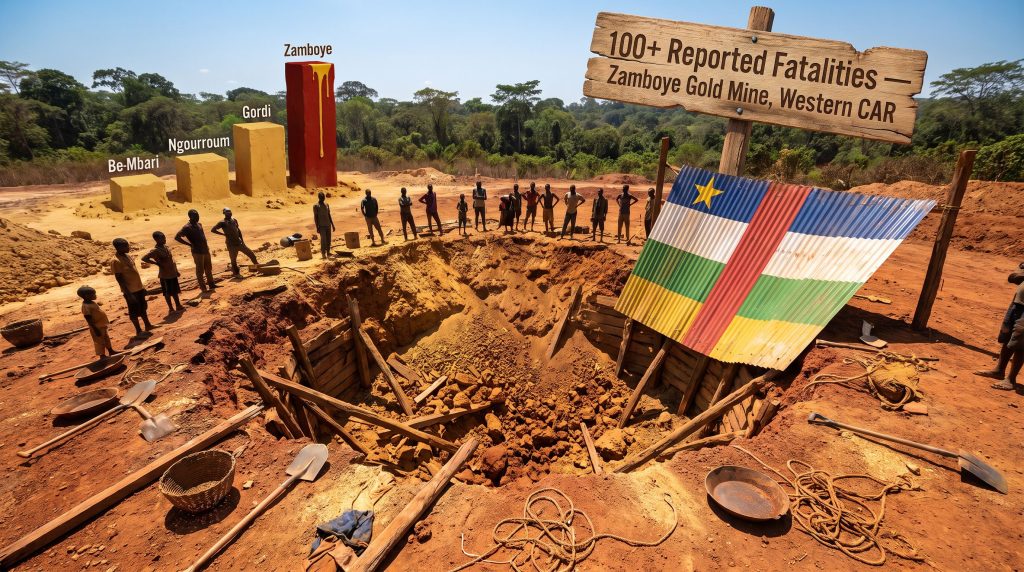
The collapse occurred on a Tuesday at an artisanal gold mining site in the village of Zamboye, located in western Central African Republic near the border with Cameroon, in the jurisdiction of the town of Boaur. A senior official from a local mining association stated that more than 100 people lost their lives. The regional prosecutor's office confirmed multiple fatalities, injuries, and missing persons but declined to issue a specific verified figure while rescue operations remained active.
A Red Cross volunteer working on the ground reportedly confirmed the recovery of more than 100 bodies, though this figure had not been formally authenticated by government authorities at the time of reporting. According to NBC News, at least 30 miners were initially confirmed killed, with the toll rising significantly as rescue operations continued. An investigation was opened by the regional prosecutor to determine contributing factors.
| Detail | Information |
|---|---|
| Location | Zamboye village, western Central African Republic |
| Proximity | Near the CAR-Cameroon border, Boaur jurisdiction |
| Reported Fatalities | 100+ (unverified final toll) |
| Mine Type | Artisanal/informal gold mining operation |
| Status at Reporting | Rescue operations ongoing; investigation opened |
| Key Sources | Local mining association official; regional prosecutor |
Why Artisanal Gold Mines Collapse: The Technical Reality
Understanding why these disasters happen requires looking at the mechanics of artisanal mining itself. Unlike formally engineered mines, which use geotechnical assessments, reinforced shaft linings, ground support systems, and real-time monitoring, artisanal operations rely almost entirely on manual excavation. Furthermore, understanding mineral exploration importance highlights just how stark the contrast is between formal and informal extraction methods.
Workers use hand tools to dig vertical shafts and horizontal tunnels called adits, often following gold-bearing quartz veins or alluvial deposits without any formal geological mapping.
The Engineering Failures Hidden Underground
The absence of structural shoring is among the most critical risk factors. In formal mining, timber sets, rock bolts, or steel mesh are installed progressively as excavation advances to prevent wall failure. In artisanal settings, these measures are either absent or improvised with whatever materials are locally available.
The result is that tunnel walls and ceilings are effectively self-supporting, relying entirely on the natural cohesion of the surrounding rock or soil, which can be severely compromised by:
- Water infiltration from rainfall, which saturates the ground and dramatically reduces shear strength
- Overburden pressure from accumulated spoil heaps piled above or adjacent to open pits
- Vibration from nearby blasting or heavy activity, which can trigger sudden, unannounced collapse
- Subsurface voids created by lateral tunnelling, which undermine surrounding ground without visible surface warning signs
In regions near the CAR-Cameroon border, the geology includes a mix of Precambrian basement rocks and alluvial sediments, both of which can contain gold but present very different stability profiles. Alluvial workings in unconsolidated sediments are particularly prone to sudden wall collapse, especially in the wet season when water content in the soil increases dramatically. The timing and location of the Zamboye collapse is consistent with this pattern, though the precise geotechnical cause had not been officially confirmed at the time of reporting.
Why Casualty Numbers Are So High
One factor that distinguishes artisanal mine collapses from industrial accidents is the extreme concentration of people in a confined area. Artisanal sites frequently draw large informal populations including not just miners, but also traders selling food and equipment, ore processors, family members, and seasonal workers. Hundreds of people can be present on a single site simultaneously.
Field evidence suggests that the Zamboye site hosted hundreds of workers at the time of the collapse, with additional informal support populations on or near the surface. This human density means that even a partial structural failure can trap or kill large numbers of people in seconds.
Rescue operations in these environments carry their own significant risks. Secondary collapse is a constant threat when ground stability is already compromised, and access to remote sites with heavy rescue equipment is often physically impossible given road conditions in rural CAR. Terrible footage captured the moment the collapse unfolded, illustrating just how rapidly catastrophic ground failure can occur with no warning.
A Pattern of Recurring Disasters Within a Single Year
The Central African Republic gold mine collapse at Zamboye is not an isolated incident within the country's recent history. Multiple fatal mine failures were recorded across different CAR locations within the same calendar year, including sites at Be-Mbari, Ngourroum, and Gordi. When multiple structurally similar events occur across different geographic locations within a compressed timeframe, the explanation is almost never coincidence. It points to a systemic failure of oversight rather than a sequence of unrelated accidents.
| Location | Incident Type | Context |
|---|---|---|
| Be-Mbari | Mine collapse | Fatalities recorded |
| Ngourroum | Mine collapse | Part of broader pattern |
| Gordi | Mine collapse | Recurring hazard identified |
| Zamboye | Gold mine collapse | Largest reported toll, 100+ deaths |
The Governance Vacuum That Makes Disaster Inevitable
The Central African Republic ranks among the world's most fragile states by virtually every governance index. Persistent armed conflict, limited state revenue, and significant territorial control by non-state actors have left the government with minimal capacity to enforce regulatory standards, particularly in remote border regions where artisanal mining activity is concentrated. In addition, mining permitting basics that are standard practice in developed mining jurisdictions are essentially non-existent in these environments.
Three Interlocking Failure Modes
- Licensing gaps — The vast majority of artisanal mining operations in CAR function without formal permits, meaning there is no registration system, no baseline data on workforce size, and no mechanism for pre-emptive safety inspection.
- Enforcement absence — Even where mining regulations technically exist on paper, the physical infrastructure to enforce them, including inspectors, transport, communication systems, and legal mechanisms, is severely underdeveloped in conflict-affected regions.
- Post-accident accountability deficits — Historical precedent in CAR suggests that even when investigations are formally opened following mine disasters, prosecutorial outcomes are rare. The regional institutions lack capacity, resources, and in some cases jurisdiction over informal operators who may have no legal existence in the formal economy.
This three-layer failure means that the sector essentially operates in a regulatory vacuum, where workers bear the full physical risk of extraction while operators face minimal legal consequence even when fatal collapses occur.
How the Zamboye Toll Compares Regionally
If the reported figure of more than 100 fatalities is confirmed, the Zamboye disaster would rank among the deadliest single artisanal mine collapse events recorded on the African continent. Comparable incidents across the region illustrate that this problem is continental in scale.
| Country | Year | Estimated Fatalities | Mine Type |
|---|---|---|---|
| Central African Republic (Zamboye) | 2026 | 100+ | Artisanal gold |
| South Africa (zama-zamas) | 2024 | 87+ | Illegal deep-level gold |
| Democratic Republic of Congo | Multiple years | Varies (10–200+) | Artisanal coltan/gold |
| Tanzania | 2019 | 22 | Artisanal gold |
| Ghana | 2019 | 17+ | Illegal gold (galamsey) |
The pattern across five countries and multiple years confirms what researchers working in this field have argued consistently: artisanal mining safety is a continental-scale policy failure. Each incident that occurs without meaningful regulatory consequence effectively signals to informal operators that the risk calculus remains acceptable.
The next major ASX story will hit our subscribers first
The Informal Economy Dimension: Why Workers Keep Entering Dangerous Mines
A question that often goes unasked in the immediate aftermath of disasters like Zamboye is why so many people were present in such a high-risk environment. The answer is economic rather than irrational.
Gold, even at artisanal grades, represents one of the only accessible pathways to cash income for rural populations in western CAR. The country has extremely limited formal employment opportunities outside of government, NGOs, and a small commercial sector. For a worker without education credentials or capital, artisanal mining offers the possibility of meaningful daily earnings in a context where alternatives are structurally absent.
This economic reality has several important implications that are rarely discussed in post-disaster reporting:
- Workers typically have full awareness of the risks involved but make a rational calculation that the income potential outweighs the danger
- Prohibiting artisanal mining without providing alternative livelihoods would not eliminate the activity but would drive it further underground, reducing even the limited oversight that currently exists
- Formalisation, not prohibition, is the framework most likely to improve safety outcomes while preserving the livelihoods of workers who have no viable alternatives
Consequently, considerations around natural capital in mining and long-term environmental stewardship remain largely inaccessible concepts for communities whose immediate survival depends on informal extraction.
Pathways Forward: Three Scenarios for Reform
Scenario A: Status Quo Continuation
Without active intervention, the death toll from artisanal mining in CAR and comparable nations will continue to rise. Rural populations have no incentive to abandon the sector, and operators face no consequence for safety failures. Casualty events will recur at scale.
Scenario B: Incremental Formalisation
Countries including Tanzania and, to a lesser extent, Burkina Faso have demonstrated that incremental formalisation through cooperative mining structures, basic training programmes, and simplified licensing pathways can measurably reduce fatality rates. Translating these models to CAR requires political stability and sustained state investment, both of which remain uncertain. However, interpreting drilling results and formalising geological data collection are precisely the kinds of foundational steps that distinguish safer, regulated operations from informal ones.
Scenario C: Multilateral Framework Engagement
Bodies including the Intergovernmental Forum on Mining, Minerals, Metals and Sustainable Development (IGF) and the United Nations Environment Programme (UNEP) have produced detailed governance frameworks specifically designed for artisanal and small-scale mining reform in fragile states. These frameworks exist. The challenge is converting policy documents into operational outcomes in environments where state capacity is severely limited. Furthermore, mine reclamation importance is entirely overlooked in contexts where basic survival safety has not yet been addressed.
None of these scenarios delivers results in isolation. Effective reform requires simultaneous action on regulatory design, livelihood diversification, and international technical support, coordinated over a timeframe measured in years, not months.
Frequently Asked Questions
What caused the Zamboye gold mine collapse in the Central African Republic?
The precise structural cause had not been officially confirmed at the time of reporting. The regional prosecutor opened a formal investigation. Collapses of this type are typically associated with unsupported excavation walls, water infiltration into unconsolidated ground, or sudden overburden failure.
How many people died in the Central African Republic gold mine collapse?
A local mining association official reported more than 100 fatalities. The regional prosecutor confirmed multiple deaths, injuries, and missing persons without issuing a verified specific figure while rescue operations continued.
Where exactly is Zamboye located?
Zamboye is a village in western Central African Republic, near the border with Cameroon, within the jurisdiction of the town of Boaur.
Has CAR experienced other mine collapses recently?
Yes. Multiple fatal collapses were recorded at different CAR locations, including Be-Mbari, Ngourroum, and Gordi, within the same year as the Zamboye disaster, indicating a persistent systemic safety crisis rather than isolated events.
What international organisations address artisanal mining safety in CAR?
The IGF, UNEP, and several humanitarian organisations have published frameworks relevant to ASM governance reform. However, direct enforcement capacity over artisanal sites in CAR remains extremely limited given the country's security and institutional challenges.
Disclaimer: Casualty figures and operational details referenced in this article reflect information available at the time of initial reporting and may be subject to revision as official investigations progress. Readers should consult current news sources for the most updated verified information.
Want to Understand How Major Mineral Discoveries Create Extraordinary Returns?
While the Zamboye disaster underscores the stark contrast between informal artisanal mining and regulated exploration, Discovery Alert's proprietary Discovery IQ model sits at the opposite end of the spectrum — delivering real-time alerts on significant ASX mineral discoveries and transforming complex geological data into actionable investment insights. Explore Discovery Alert's dedicated discoveries page to see how historic finds have generated substantial returns, and begin your 14-day free trial to position yourself ahead of the broader market.