
June 7, 2026
Central banks worldwide are reshaping the global monetary landscape through unprecedented central bank gold buying programs that signal fundamental shifts in reserve management strategies. Monetary systems face unprecedented stress from persistent inflation, currency debasement, and shifting geopolitical power structures. Central banks, traditionally conservative institutions focused on price stability and financial system integrity, now confront fundamental questions about the composition of their reserve portfolios. The traditional framework of holding primarily U.S. Treasury securities and major currency reserves appears increasingly inadequate given the structural forces reshaping global finance.
Modern portfolio theory, when applied to sovereign wealth management, suggests diversification across uncorrelated assets becomes essential during periods of elevated systemic risk. Gold represents the only universally accepted monetary asset that cannot be printed, devalued through policy decisions, or frozen during geopolitical conflict. This unique characteristic profile explains why institutional buyers have sustained their accumulation programs despite record‑high gold prices that would typically deter retail investors.
The scale of this institutional demand shift creates market dynamics unprecedented in modern precious metals trading. When sovereign entities commit multi-billion dollar allocations toward strategic reserve rebalancing, traditional price discovery mechanisms face structural disruption. Understanding these forces requires examining both the quantitative evidence of central bank purchasing patterns and the qualitative factors driving long-term institutional strategy.
What Drives Unprecedented Institutional Gold Accumulation?
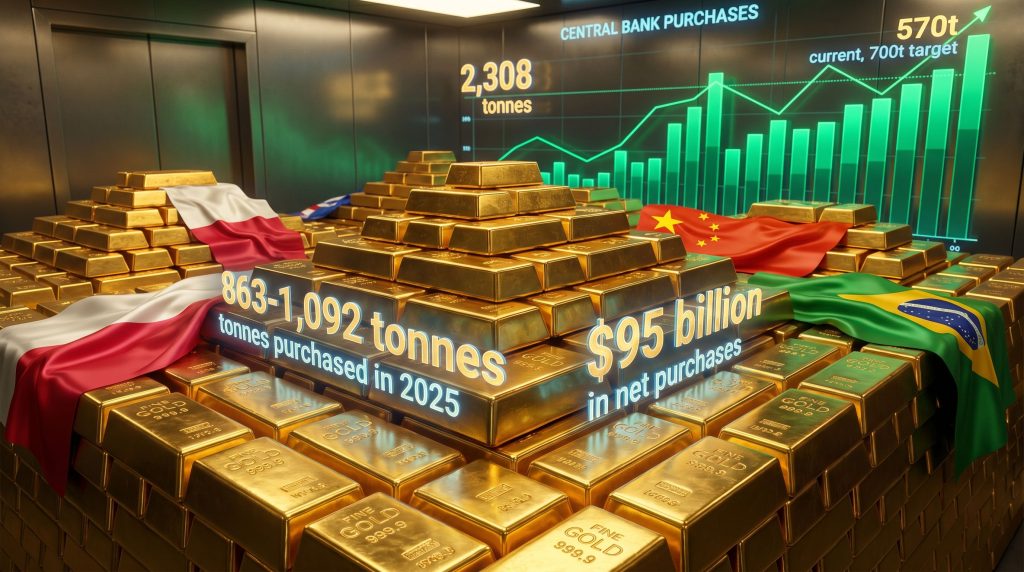
The magnitude of central bank gold buying since 2022 represents a paradigm shift in global reserve management. According to World Gold Council data, central banks purchased 863 tonnes of gold in 2025, marking a moderation from the extraordinary period of 2022-2024 when annual purchases exceeded 1,000 tonnes each year. This sustained institutional demand compares starkly against the pre-2022 historical baseline of 400-500 tonnes annually, representing more than double the traditional purchasing pace.
The aggregate financial commitment reflects institutional price insensitivity. At current price levels near $4,752 per ounce as of April 2026, the 863 tonnes purchased in 2025 represented approximately $95 billion in capital deployment across global central banks. This sustained investment occurred even as gold reached an intraday all-time high of approximately $5,589 per ounce on January 28, 2026, demonstrating that institutional buyers operate under fundamentally different mandates than retail or hedge fund investors.
Institutional Demand Patterns Reshape Market Structure
Central banks have maintained net purchasing positions for 16 consecutive years since 2010, according to World Gold Council analysis. This structural reversal from the 1990s and early 2000s reflects a strategic realignment of global reserve architecture. Unlike cyclical investment demand that exhibits price sensitivity, central bank purchases remain relatively consistent regardless of gold price movements, reflecting balance sheet reallocation mandates rather than opportunistic positioning.
The distinction between price-sensitive and price-insensitive buying behavior creates unique market dynamics. Traditional investment demand typically demonstrates inverse correlation with price movements, while central bank purchasing maintains consistency across different price environments. This behavior pattern removes the demand elasticity that characterises retail precious metals markets, creating a structural floor beneath prices that institutional analysts incorporate into their forward projections.
Key Market Impact Metrics:
- Central bank purchases represented approximately 25% of total annual gold supply in 2025
- Global mining production yields roughly 3,000-3,500 tonnes annually
- Institutional demand concentration from single buyer category unprecedented since 1960s
- Price correlation coefficient between central bank monthly purchases and gold prices approaches zero
Supply-Demand Imbalance Creates Structural Foundation
The intersection of fixed geological supply constraints with expanding institutional demand creates fundamental market tension. Gold mining production faces increasing technical challenges as accessible deposits become depleted, while central bank gold buying continues at levels well above historical norms. This supply-demand dynamic supports higher equilibrium pricing independent of speculative or cyclical factors.
J.P. Morgan projected approximately 755 tonnes of central bank purchases for 2026, still nearly double pre-2022 norms despite the moderation from peak 2022-2024 levels. Goldman Sachs maintained its year-end 2026 target of $5,400 per ounce even through gold's sharp March 2026 correction, suggesting institutional analysts view central bank demand as providing durable market support.
When big ASX news breaks, our subscribers know first
Which Nations Lead the Strategic Reserve Transformation?
Emerging market economies drive approximately 95% of global central bank gold purchasing activity, representing a strategic divergence between developed economies that maintain legacy holdings and emerging markets executing systematic accumulation programs. This geographic distribution reflects broader geopolitical and economic realignment as developing nations reduce dependence on traditional reserve arrangements centred around major developed market currencies.
China's Systematic Accumulation Strategy demonstrates the most significant scale among major central banks. Chinese authorities maintained consistent gold purchasing for 16 consecutive months, accumulating approximately 2,308 tonnes across this systematic buying program. This represents the largest central bank gold reserve expansion program and continues to anchor global institutional demand patterns.
Poland's Transparent Reserve Diversification Model
Poland exemplifies methodical, transparent central bank behaviour through its publicly announced accumulation targets. Current Polish gold holdings stand at 570 tonnes against a stated strategic objective of 700 tonnes, indicating a planned acquisition of an additional 130 tonnes through ongoing multi-year purchasing. This systematic approach provides market predictability that institutional analysts can model into forward projections while demonstrating confidence in the accumulation thesis.
Poland's strategy reflects broader NATO member concerns about strengthening sovereign monetary positions independent of traditional reserve currency arrangements. The transparency of this program contrasts with other central banks that maintain more discrete purchasing strategies, providing valuable insight into institutional decision-making processes.
February 2026 Activity Breakdown:
| Country | Net Position | Strategic Rationale |
|---|---|---|
| Poland | +20 tonnes | Target 700t total reserves |
| Turkey | -8 tonnes | Tactical rebalancing |
| Russia | -6 tonnes | Sanctions impact |
| Brazil | Active buyer | BRICS diversification |
| Kazakhstan | Active buyer | Regional stability hedge |
Regional Distribution Patterns and Strategic Objectives
The concentration of buying activity among emerging markets reflects several converging factors. Developed economies including the United States (8,133 metric tonnes of official reserves) accumulated substantial gold holdings during the Bretton Woods era when gold served as the primary international monetary reserve. Emerging economies with smaller legacy positions now engage in systematic accumulation to reach allocation targets aligned with modern portfolio theory applications.
BRICS nations particularly demonstrate coordinated interest in gold accumulation as part of broader de-dollarisation strategies. Brazil, Russia, India, China, and South Africa have all increased gold reserves in recent years, though through different mechanisms and with varying degrees of public transparency about their strategic objectives.
The distinction between developed market consolidation and emerging market accumulation creates asymmetric market dynamics. Supply remains distributed among multiple emerging central banks while demand flows concentrate within this emerging market cohort, creating structural pressure that supports elevated pricing levels.
How Do Geopolitical Forces Drive Reserve Strategy Evolution?
The post-2022 geopolitical environment fundamentally altered central bank calculations regarding reserve asset composition and geopolitical vulnerability. The implementation of severe financial sanctions and threats of SWIFT (Society for Worldwide Interbank Financial Telecommunication) exclusion demonstrated that substantial foreign exchange reserve holdings in developed market government securities create concentration risk during geopolitical conflict.
Russia's experience with asset freezes and financial system exclusion following the Ukraine conflict created a visible demonstration effect for other geopolitically positioned central banks. The vulnerability of foreign exchange reserves held within Western financial infrastructure accelerated institutional interest in gold accumulation among nations seeking to reduce geopolitical exposure.
Dollar Diversification and Multipolar Monetary Architecture
Central bank policymakers increasingly anticipate a multipolar monetary order as alternative payment and settlement systems develop outside the U.S. dollar architecture. The ongoing development of the BRICS Payment System and various bilateral trade settlement arrangements in non-dollar currencies suggests institutional preparation for reduced dependence on traditional reserve currency systems.
Gold ownership represents universally accepted reserve asset functionality in such an environment, whereas concentrations of foreign exchange reserves in any single currency or payment system create systemic concentration risk. This strategic consideration explains why central bank gold buying persists despite elevated price levels that would typically deter price-sensitive investors.
U.S. M2 money supply expansion to approximately $22.7 trillion as of February 2026 illustrates the currency debasement pressures that motivate central bank diversification. When compared against fixed U.S. gold reserves of 8,133 metric tonnes, the mathematical relationship demonstrates persistent monetary base expansion without corresponding hard asset backing.
Inflation Hedge Mechanisms and Real Return Protection
Central bank gold allocation provides protection against currency devaluation that fiat-based reserve assets cannot match. When Treasury yields remain below inflation rates, creating negative real yields, gold's inflation-matching properties become particularly valuable for institutional portfolios focused on purchasing power preservation rather than short-term returns.
Historical analysis suggests gold has provided real return preservation during periods of elevated monetary expansion and currency debasement. The price appreciation from approximately $280 per ounce in 2000 to current levels near $4,752 represents an annualised return of approximately 7.2% over 26 years, demonstrating long-term purchasing power maintenance during periods of significant monetary base expansion.
The structural realignment of the global reserve system reflects central bank recognition that traditional reserve composition models require updating for modern geopolitical and monetary conditions.
What Economic Fundamentals Support Continued Institutional Demand?
Modern portfolio theory applications in sovereign wealth management suggest optimal diversification across uncorrelated assets during periods of elevated systemic risk. Gold represents approximately 25% of global reserves by value at end-2025 price levels, indicating institutional recognition of appropriate allocation percentages for universally accepted, inflation-hedging assets within sovereign reserve portfolios.
The supply-demand mathematics create structural market tension independent of cyclical factors. Global gold mining production of approximately 3,000-3,500 tonnes annually faces increasing technical challenges and cost pressures, while institutional demand from central banks alone accounts for roughly 25% of total annual supply based on 2025 purchasing levels.
Reserve Composition Targets and Risk Management Framework
Central banks operate under long-term mandate structures that prioritise capital preservation and purchasing power maintenance over short-term performance metrics. This institutional framework creates demand patterns that remain consistent across different market environments, providing market stability that speculative buyers cannot replicate.
The correlation benefits of gold within traditional fixed-income heavy reserve portfolios become particularly valuable during periods when bond markets face simultaneous inflation and interest rate pressure. Gold's historical low correlation with financial assets provides diversification benefits that justify allocation increases even at elevated price levels.
Key Portfolio Metrics for Institutional Analysis:
- Gold/M2 ratio: Compressed to approximately 5 by early 2026
- Historical range: From 20 (deeply undervalued) to 2 (extremely expensive)
- Current positioning: Middle of historical range despite price increases
- Real yield environment: Negative Treasury returns below inflation rates
Interest Rate Environment and Opportunity Cost Calculations
When government bond yields fail to exceed inflation rates, the traditional opportunity cost argument against gold holdings weakens substantially. Central banks recognise that nominal yields below inflation rates create negative real returns in traditional fixed-income assets, making gold's inflation-hedging characteristics comparatively attractive for institutional portfolios.
The Federal Reserve's monetary policy framework continues to prioritise employment objectives alongside price stability, suggesting institutional expectation that interest rates may remain below inflation rates for extended periods. This environment reduces the opportunity cost of holding non-yielding assets like gold while providing inflation protection that nominal yield assets cannot match.
How Are Market Dynamics Shifting Under Institutional Influence?
Traditional gold market structure operated primarily through retail investment demand, industrial applications, and jewellery consumption patterns. The emergence of central bank gold buying as a dominant demand category creates structural changes in price discovery mechanisms and market liquidity patterns that institutional analysts must incorporate into their forecasting models.
Large-block institutional transactions require different execution strategies than retail market activity. Central banks typically employ dollar-cost averaging approaches and tactical positioning to minimise price impact, creating more predictable demand patterns than the volatile retail sentiment cycles that historically characterised precious metals markets.
Price Discovery Under Sovereign Buyer Influence
The predictable nature of institutional demand creates a market floor effect that supports higher equilibrium pricing levels. Unlike retail investors who demonstrate price sensitivity and cyclical behaviour, central banks maintain purchasing programs based on strategic allocation targets rather than short-term price movements.
J.P. Morgan upgraded its year-end 2026 gold price target from $5,055 per ounce to $6,300 per ounce in February 2026, specifically citing ongoing institutional demand as justification for the upward revision. This significant target increase reflects analyst recognition that structural demand changes require updated valuation frameworks.
Goldman Sachs similarly demonstrated conviction by maintaining its $5,400 per ounce year-end 2026 target through gold's sharp March correction rather than revising downward, suggesting institutional analysts view central bank demand as providing fundamental market support during temporary price weakness.
Storage Infrastructure and Sovereignty Considerations
Central bank purchasing patterns increasingly favour domestic storage arrangements over traditional London and New York vault systems. This preference reflects both security considerations and sovereignty objectives as institutions seek to maintain physical control over strategic reserve assets.
The repatriation trend among central banks creates additional demand for domestic storage infrastructure while potentially reducing available supply in traditional trading centres. Poland's systematic accumulation program specifically emphasises domestic storage as part of its broader reserve independence strategy.
Market Structure Evolution:
- Shift from retail-driven to institution-dominated demand
- Reduced price volatility due to predictable buying patterns
- Enhanced market floor effects from strategic allocation mandates
- Geographic distribution changes in physical storage preferences
What Do Forward Projections Reveal About Structural Demand?
Survey data from central banks indicates 95% plan reserve increases in their gold holdings, with J.P. Morgan projecting approximately 755 tonnes of institutional purchases for 2026. This forward guidance suggests the structural demand shift that began in 2022 represents a multi-year reallocation trend rather than a cyclical phenomenon.
The persistence of elevated institutional demand despite record-high prices demonstrates that central banks operate under different optimisation criteria than retail or hedge fund investors. Strategic reserve allocation decisions focus on decades-long time horizons and purchasing power preservation rather than short-term performance metrics.
Structural versus Cyclical Demand Components
Central bank gold buying represents structural demand because it stems from long-term portfolio diversification goals rather than short-term price speculation. Unlike cyclical investment demand that fluctuates with economic conditions and price movements, institutional purchases continue regardless of market volatility, creating persistent market support.
The integration of gold accumulation with broader reserve management evolution reflects institutional preparation for monetary system changes. Digital currency development, trade settlement diversification beyond dollar systems, and regional monetary union considerations all support continued central bank interest in gold as a universally accepted reserve asset.
Budget allocation trends among emerging market central banks suggest systematic commitment to multi-year purchasing programs. The transparency of Poland's 700-tonne target and China's consistent monthly purchasing demonstrate institutional confidence in long-term accumulation strategies despite elevated current pricing levels.
Regional Monetary System Development and Gold's Role
The development of alternative payment systems and bilateral trade arrangements outside traditional dollar-based infrastructure creates ongoing demand for universally accepted settlement mechanisms. Gold's historical role as the ultimate international monetary asset positions it favourably within evolving multipolar monetary architecture.
BRICS nations continue developing payment system alternatives that reduce dependence on Western financial infrastructure, while ASEAN explores regional monetary cooperation mechanisms. These developments support continued institutional interest in gold accumulation as preparation for reduced dependence on traditional reserve arrangements.
The next major ASX story will hit our subscribers first
How Should Portfolio Strategy Incorporate Institutional Behaviour Patterns?
The institutional validation of gold's monetary role through sustained central bank gold buying provides important signals for individual portfolio allocation decisions. When sovereign wealth managers with access to comprehensive economic data and professional risk assessment capabilities demonstrate consistent gold accumulation, retail investors can extract valuable insights about appropriate allocation percentages and timing strategies.
Central banks typically target 10-20% gold allocation within total reserve portfolios, though specific percentages vary based on geopolitical positioning and existing legacy holdings. This institutional benchmark provides guidance for individual investors considering gold allocation within diversified portfolios designed for long-term wealth preservation.
Signal Analysis and Investment Timing Considerations
The consistency of central bank purchasing through various market environments suggests that institutional buyers focus on strategic positioning rather than tactical market timing. This approach provides a framework for individual investors who seek to build positions systematically rather than attempting to time market entry points based on short-term price movements.
Poland's systematic accumulation approach from 2019-2026 exemplifies methodical institutional strategy that individual investors can adapt for personal portfolio construction. The gradual building of positions over multi-year periods reduces timing risk while maintaining consistent exposure to gold's portfolio diversification benefits.
Individual Investor Applications:
- Allocation targets: 10-20% based on institutional benchmarks
- Timing strategy: Dollar-cost averaging similar to central bank approaches
- Storage considerations: Physical allocation for sovereignty benefits
- Long-term focus: Decades-long time horizons like institutional mandate structures
Long-term Wealth Preservation Lessons from Sovereign Practice
Central bank gold accumulation demonstrates professional risk management principles applied at sovereign level. The emphasis on purchasing power preservation, diversification across uncorrelated assets, and preparation for monetary system evolution provides instructive examples for individual wealth preservation strategies.
The institutional confidence demonstrated through continued purchasing at record price levels suggests professional analysis supports higher equilibrium pricing than historical models would indicate. Individual investors can consider this institutional validation when evaluating appropriate allocation levels within their own portfolio construction frameworks, particularly when considering strategic gold investment approaches.
What Are the Key Questions About Central Bank Gold Strategy?
Why do central banks buy gold when prices are at record highs?
Central banks operate under strategic mandate structures focused on decades-long purchasing power preservation rather than short-term performance optimisation. Their allocation decisions reflect long-term portfolio diversification objectives and preparation for potential monetary system evolution, making current price levels less relevant than strategic positioning requirements.
Which countries are buying the most gold currently?
China leads global central bank gold buying with approximately 2,308 tonnes accumulated through 16 consecutive months of purchasing. Poland maintains systematic accumulation toward its 700-tonne target, while other BRICS nations including Brazil and Kazakhstan execute expansion programs as part of broader reserve diversification strategies.
How does central bank buying affect gold prices for investors?
Institutional purchasing creates structural market support by removing supply from available inventory while providing predictable demand that operates independently of retail sentiment cycles. This institutional activity establishes higher equilibrium pricing levels and reduces downside volatility compared to retail-dominated market periods. Furthermore, the gold market performance reflects this institutional influence.
What percentage of reserves do central banks typically hold in gold?
Central bank gold allocation percentages vary significantly based on historical legacy positions and current strategic objectives. Developed economies like the United States maintain higher percentages due to Bretton Woods era accumulation, while emerging markets typically target 10-20% allocation as they build reserves toward modern portfolio theory optimal percentages.
Are central bank purchases sustainable at current price levels?
Survey data indicates 95% of central banks plan continued reserve increases despite elevated pricing, with J.P. Morgan projecting 755 tonnes of institutional purchases for 2026. The sustainability reflects strategic allocation mandates rather than price-sensitive investment decisions, suggesting continued demand independent of short-term price movements. This supports positive gold price forecast expectations.
The Strategic Transformation of Global Reserve Architecture
The evolution of international monetary arrangements creates ongoing institutional demand for universally accepted reserve assets that operate independently of any single national currency or payment system. Gold's historical role as the ultimate international settlement mechanism positions it favourably within developing multipolar monetary architecture that reduces concentration risk in traditional reserve arrangements.
Central bank gold buying since 2022 represents structural realignment rather than cyclical investment behaviour. The scale, consistency, and geographic distribution of institutional purchases demonstrate professional recognition that traditional reserve composition models require updating for modern geopolitical and economic conditions. According to central bank research, this trend continues to influence global monetary policy decisions.
Investment Strategy Integration with Institutional Frameworks
Individual investors can extract valuable insights from central bank behaviour patterns, particularly regarding allocation percentages, timing strategies, and long-term wealth preservation approaches. The institutional validation of gold's portfolio role through sustained sovereign purchasing provides professional endorsement of allocation strategies focused on purchasing power maintenance and systemic risk hedging.
The systematic nature of institutional accumulation suggests that individual portfolio construction can benefit from similar methodical approaches rather than attempting tactical positioning based on short-term market movements. Central bank behaviour demonstrates the value of consistent positioning and patient capital deployment for long-term wealth preservation objectives, reinforcing prudent investment strategies for portfolio diversification.
Disclaimer: This analysis is provided for informational and educational purposes only and does not constitute investment advice. Market conditions, central bank policies, and geopolitical factors can change rapidly and unpredictably. All investment decisions should be based on individual financial circumstances and consultation with qualified financial advisors. Past performance of gold prices and central bank purchasing patterns does not guarantee future results.
Want to Stay Ahead of ASX Discovery Opportunities?
Discovery Alert's proprietary Discovery IQ model provides real-time notifications when significant ASX mineral discoveries are announced, helping investors identify actionable opportunities ahead of the broader market. Begin your 14-day free trial today to position yourself strategically alongside institutional investors who recognise the value of early discovery identification.