August 6, 2026
The Quiet Architecture of a Monetary Shift Decades in the Making
Monetary systems rarely collapse overnight. They erode gradually, through incremental policy decisions, shifting institutional preferences, and the slow accumulation of alternatives by those who manage the longest-horizon capital in the world. Understanding the current wave of central bank gold buying and de-dollarization requires looking past the day-to-day noise of gold price charts and geopolitical headlines, and instead examining the structural logic that drives sovereign reserve managers toward an asset that pays nothing, stores nothing digitally, and cannot be conjured by a central bank printing press.
The institutions making these decisions are not reacting to short-term fear. They are repositioning in response to a fundamental question that every sovereign treasurer now faces: in a world where financial infrastructure can be weaponized, what does genuine reserve security actually look like?
When big ASX news breaks, our subscribers know first
What Central Bank Purchasing Patterns Are Actually Telling Us
Beyond the Headlines: The Institutional Signal in Gold Demand
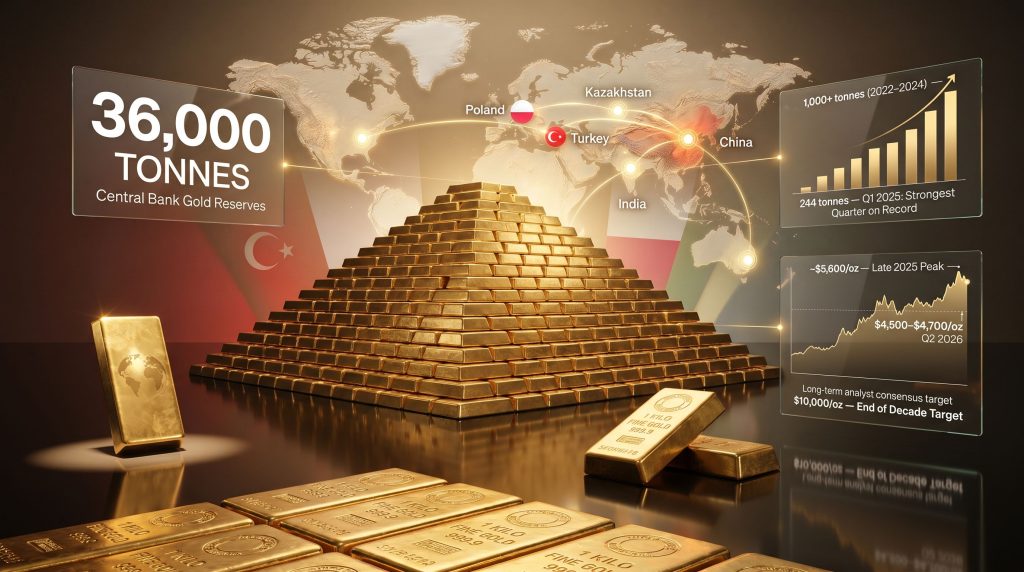
According to World Gold Council data cited in early 2026, central bank gold demand collectively reached 244 tonnes in Q1 2026 alone, the strongest opening quarter in recent history. More revealing than any single quarter figure is the consistency of the trend: official institutions have now purchased more than 200 tonnes in ten of the last eleven quarters, representing a sustained accumulation pattern that cannot be explained by short-term market positioning.
Net purchases exceeded 1,000 tonnes annually from 2022 through 2024, more than double the average pace of the prior decade. Even as the annual run rate moderated toward approximately 863 tonnes in 2025, the directional signal remained intact. Roughly 70% of central banks surveyed by the World Gold Council in 2024 indicated plans to increase gold's share of reserves over the following five years.
The institutions with the longest time horizons are increasing exposure to an asset that pays no yield and sits outside the liability structure of the financial system. The question is not whether gold is old money. The question is why so many official institutions are treating it like future money.
The Zero-Yield Paradox That Isn't Actually a Paradox
Critics frequently cite gold's lack of yield as a structural weakness. In a conventional portfolio context, that critique has merit. However, it misunderstands the reason sovereign institutions are buying.
The primary risk these institutions are managing is not yield loss. It is accessibility. Specifically, it is the risk that a reserve asset becomes inaccessible, frozen, or politically neutralised at precisely the moment it is needed most. Gold eliminates that risk entirely. It cannot be frozen through the international banking system. It carries no counterparty liability. It cannot be devalued by a foreign government's monetary policy decision. And critically, it requires physical seizure to confiscate, not a legal mechanism or a keystroke.
In that framing, the zero-yield critique becomes secondary to a far more important characteristic: unconditional availability.
Central Bank Gold Buying and De-Dollarization: Separating the Trend from the Noise
What De-Dollarization Actually Means
One of the most persistently misunderstood concepts in contemporary finance is de-dollarisation. It does not describe the imminent collapse of the US dollar as the world's reserve currency. It describes a more measured process: the gradual reduction of exclusive dependence on dollar-denominated assets by sovereign institutions seeking to hedge against sanctions exposure, currency weaponisation, and long-term fiat debasement.
China, for example, continues to hold more than $3 trillion in US dollar-denominated assets despite years of reducing its Treasury holdings. The dollar remains deeply embedded in global trade invoicing, financial market infrastructure, and cross-border settlement. What is changing is the composition of the layer sitting alongside those dollar holdings, and gold in the monetary system is the primary beneficiary of that reallocation.
The 2022 Catalyst That Changed the Calculation for Every Sovereign Treasurer
The acceleration in central bank gold accumulation can be traced to a single inflection point. When the United States froze Russian US dollar assets following the 2022 invasion of Ukraine, every sovereign treasurer managing significant dollar reserves faced an unavoidable question: could this happen to us?
The answer, for a growing number of nations, was that the possibility could no longer be dismissed. The dollar, for all its liquidity advantages, had been demonstrated to be a political instrument as well as a monetary one. That realisation accelerated a diversification process that had actually been building since at least 2015, and transformed gold from a legacy reserve relic into an essential component of modern sovereign risk management.
Who Is Buying: The Geographic Footprint of Sovereign Gold Accumulation
The Silk Road Concentration
When examining which nations are driving this accumulation cycle, a striking geographic pattern emerges. Setting aside a small number of outliers, the overwhelming majority of active sovereign buyers sit along or within the broader Silk Road economic corridor and the Shanghai Cooperation Organisation (SCO). This global monetary shift is reshaping the architecture of reserve management in ways that are only beginning to be fully appreciated.
| Country | Recent Activity | Geopolitical Context |
|---|---|---|
| China | Ongoing accumulation; official figures significantly understated | World's largest producer and importer; zero exports |
| Turkey | Top buyer in 2024; some moderation in Q1 2026 | Straddles NATO and Eurasian trade architecture |
| Kazakhstan | Consistent accumulation | SCO member; major domestic gold producer |
| Kyrgyzstan | Active buyer | Silk Road corridor nation |
| Tajikistan | Active buyer | SCO member |
The SCO now encompasses approximately 40% of the world's total land surface, roughly 30% of its population, and around 20% of global GDP. These are not peripheral economies managing marginal reserves. They represent a substantial and growing share of global economic activity, and their collective pivot toward gold is a structural development rather than a temporary allocation shift.
Poland: The Western Outlier That Proves the Rule
Poland's gold strategy deserves particular attention because it operates from a fundamentally different geopolitical context than the SCO buyers. It is a NATO member, deeply integrated into EU trade frameworks, and yet its reserve management decisions reflect a level of monetary independence that distinguishes it from most of Western Europe.
Poland purchased approximately 31 tonnes in Q1 2025 and a further 20 tonnes in February 2026 alone. It retained its own currency rather than adopting the euro. Its per capita GDP trajectory has outpaced several established Western European economies over the past two decades, a remarkable transformation from its post-communist starting point in 1990.
The logic behind Poland's gold accumulation is best understood through the lens of institutional memory. A nation that has experienced currency destruction, territorial occupation, and the seizure of its central bank reserves by invading forces does not treat gold as a theoretical hedge. It treats gold as a national security instrument, because history has demonstrated precisely what happens when you rely entirely on assets that can be captured, frozen, or devalued by others.
During World War II, Polish gold reserves were evacuated ahead of the Nazi invasion in a sequence that took the bullion through Romania, Beirut, Lebanon, and eventually to the French Empire and beyond. The gold survived the war through extraordinary logistical effort. That history is not abstract for Polish monetary policymakers. It is foundational.
Is China's True Gold Position the Most Significant Unreported Story in Global Finance?
The Data Gap Between Official Figures and Physical Flows
China's gold market dominance is perhaps best illustrated by the significant gap between official declarations and physical flows. China officially declares approximately 2,300 tonnes of gold in state reserves through the People's Bank of China. However, analysts who track physical gold flows rather than official declarations arrive at a vastly different picture.
| Data Source | Estimated Volume |
|---|---|
| Official PBOC Declaration | ~2,300 tonnes |
| Shanghai Gold Exchange withdrawals (cumulative, 21st century) | ~30,000 tonnes |
| Domestic mining output (2000 to present) | ~8,000 tonnes |
| Pre-existing holdings (estimated year 2000 baseline) | ~4,000 tonnes |
| Additional imports through Dubai, London, Switzerland (undeclared) | Significant but unquantified |
It is critical to distinguish between total gold within China's borders and gold directly controlled by the state. The 30,000+ tonne figure represents all gold in China across private ownership, jewellery holdings, and commercial use. At an estimated state ownership share of 20-25% minimum, official reserves could be four to five times larger than declared. At a more conservative estimate of around one quarter state ownership, the implied figure still approaches or exceeds 7,000-8,000 tonnes, rivalling the United States' claimed reserves at Fort Knox.
Notably, the US gold reserve has not undergone a comprehensive independent audit since the 1950s, a fact that adds further complexity to any comparison of the two nations' relative monetary positions. Furthermore, central bank gold reserves globally are subject to varying degrees of transparency, making direct comparisons inherently uncertain.
Why Beijing Has Compelling Reasons to Say Nothing
The strategic case for deliberate understatement is straightforward. If China were to formally declare a gold reserve position equal to or exceeding that of the United States, the signal to global dollar markets would be immediate and destabilising. It would represent, in effect, a direct challenge to the credibility of the existing dollar-based monetary architecture.
China still holds more than $3 trillion in dollar-denominated assets. Voluntarily triggering a collapse in the value of those holdings by announcing a superior gold position serves no strategic purpose in normal conditions. The deliberate understatement preserves optionality while avoiding an action that would function as a financial declaration of conflict.
The People's Bank of China also prefers to accumulate gold through channels that bypass the Shanghai Gold Exchange's tracking mechanisms. The PBOC favours 400-ounce bars rather than kilo bars, and these transactions route through Switzerland, Dubai, and London without formal declaration. This is not incidental. It reflects a deliberate architecture for building a reserve position that remains opaque to outside analysis.
Signals That Would Precede Any Disclosure
Rather than a sudden announcement, observers should watch for incremental normalisation:
- Acceleration in Shanghai Gold Exchange withdrawal volumes beyond historical patterns
- Shifts in gold import routing with unusual volumes through secondary markets
- Yuan-denominated gold settlement mechanisms gaining traction in bilateral trade
- A return to monthly reserve update policies that gradually normalise higher figures
The most likely scenario for a full disclosure would involve direct geopolitical confrontation with the United States, at which point financial system weaponisation would make the gold position strategically relevant to declare. Short of that threshold, Beijing's optimal strategy is to continue accumulating while saying as little as possible.
The Triffin Dilemma Revisited: When Reserve Currency Status Becomes a Domestic Problem
The Structural Contradiction at the Heart of Dollar Dominance
Robert Triffin, the Belgian-American economist, identified a fundamental paradox in reserve currency systems long before it became a live policy debate. Any nation that issues the world's primary reserve currency must supply enough of that currency to meet global demand, which necessarily requires running persistent trade deficits. Those deficits, over time, hollow out domestic manufacturing, incentivise financialisation over production, and create a structural tension between serving global monetary needs and rebuilding domestic industrial capacity.
The United States has navigated this tension for decades. The growth of Wall Street relative to Main Street, the offshoring of manufacturing, and the deep integration of the US economy into global financial markets are all, at least partially, consequences of dollar reserve status rather than independent policy choices. Research from the Federal Reserve on central bank gold purchases further illuminates how these structural dynamics interact with sovereign reserve decisions.
The current political pressure in the US to reshore industrial capacity puts this contradiction into sharp relief. Rebuilding domestic manufacturing requires a fundamentally different economic orientation: lower trade deficits, less reliance on imported goods, and a rebalancing of incentives away from financial engineering and toward physical production. These objectives are structurally in tension with maintaining the dollar's role as the exclusive global reserve currency.
Gold as the Neutral Settlement Layer
Both the United States and China hold substantial gold reserves. Gold carries no national allegiance. It cannot be weaponised by either party's monetary policy. This positions it as a politically viable neutral reserve anchor in a world where the two largest economies are simultaneously competing and interdependent.
A partial shift toward gold-backed settlement mechanisms would not require either party to abandon existing dollar infrastructure. It would simply add a neutral layer beneath it, one that both sides can accept precisely because neither controls it.
The next major ASX story will hit our subscribers first
The Historical Precedent: Every Major Reserve Currency Started as Gold
A Pattern That Has Never Had an Exception
A review of every major international reserve currency across recorded monetary history reveals a consistent pattern: without exception, each achieved reserve status by beginning as a currency directly interchangeable with gold or silver. From the coinage of Alexander the Great and the ancient Lydians, through the Venetian ducat, the Florentine florin, the Spanish silver dollar on which the US dollar itself was based, to the British pound and the original dollar, the gold and silver foundation was always present at the origin.
Every system that subsequently severed that link eventually faced debasement, loss of confidence, or replacement. The Romans debased their currency progressively until it became functionally worthless. More recent examples followed the same arc.
No global reserve currency in recorded history achieved that status without an initial foundation in gold or silver convertibility. Every system that severed that link eventually faced debasement, loss of confidence, or replacement. This pattern does not guarantee a return to a classical gold standard, but it does suggest gold will play a structural role in whatever monetary architecture emerges next.
Why a True Gold Standard Is Unlikely But Partial Backing Is Plausible
Physical gold standards, in their classical form, required citizens to handle gold and silver directly. That condition no longer exists in a digital payments environment. The 20th-century gold standards were inherently compromised because gold was withdrawn from active circulation even while the theoretical backing remained in place. Those arrangements fell apart precisely because the backing was not genuine.
What is more plausible as an outcome from the current monetary stress environment is a payment system built on top of a gold reserve layer, where gold functions as the store of value and sovereign backing, while digital payment infrastructure handles day-to-day transactions. This is architecturally different from a classical gold standard, but it would restore a meaningful link between reserve assets and monetary credibility.
Custody, Repatriation, and the Politics of Physical Possession
The Wartime Origins of Western Gold Custodial Arrangements
The concentration of European gold reserves in New York during the 20th century was not a voluntary financial optimisation. It was a direct consequence of World War II, during which invading German forces made the seizure of central bank gold their first operational priority on the day of each invasion, including in Austria, Czechoslovakia, and the Netherlands.
Poland's experience was particularly dramatic. Its central bank reserves were evacuated just hours ahead of the Nazi advance, eventually travelling through Romania, Beirut, Lebanon, West Africa, and finally to France before portions were dispersed further. The sheer logistical effort required to preserve those reserves under occupation conditions explains why subsequent generations of Polish monetary policymakers regard gold custody as a genuine security matter.
Multiple European nations transferred reserves to New York for safekeeping under these wartime conditions. Decades later, Germany and the Netherlands both encountered significant friction when attempting repatriation, raising questions about whether custodial arrangements had evolved beyond simple storage.
The French Case: A Technical Transaction With Structural Implications
The Bank of France recently sold 129 tonnes of gold held in the United States and repurchased equivalent bullion within Europe, reportedly realising approximately $15 billion in profit in the process. The transaction has been characterised as technical reserve management rather than a political statement.
However, the choice to sell and repurchase rather than simply request physical repatriation through conventional channels raises a question worth examining. If the gold were straightforwardly available for transfer, the more efficient path would be direct repatriation. The roundabout mechanism of selling and rebuying suggests either that direct repatriation faces practical obstacles, or that the custodial arrangement itself has become a consideration in reserve management decisions.
Gold Price Structure and What the Current Consolidation Phase Implies
Reading the Technical Landscape After the 2025 Rally
Gold peaked at approximately $5,600 per ounce in late 2025 following an extraordinary rally. It has since consolidated into a range of approximately $4,500 to $4,700 per ounce through mid-2026. Framed in isolation, that retracement looks like deteriorating momentum. Framed against the prior bull market cycle, it looks structurally familiar.
During the 2000s bull market, gold peaked in 2006, failed to establish new highs until after the 2008 financial crisis, then accelerated sharply through 2011. The current pattern, a series of lower highs without new lower lows, mirrors that mid-cycle consolidation structure. Analysts at Deutsche Bank project gold could reach $8,000 on the back of continued de-dollarisation momentum, suggesting the longer-term structural case remains firmly intact.
| Metric | Level or Observation |
|---|---|
| Peak (late 2025) | ~$5,600/oz |
| Current trading range (Q2 2026) | ~$4,500-$4,700/oz |
| Long-term analyst consensus target | ~$10,000/oz by end of decade |
| Technical signal | Lower highs forming; no lower lows established |
The structural case for holding through consolidation rests on the demand floor provided by ongoing central bank accumulation, ETF inflows running approximately 40% above year-prior levels, and sovereign purchasing programmes that show no sign of reversal. The current period is best understood as the market digesting prior gains rather than pricing in new stress.
Silver at $73: Confirming the Thesis But Demanding Respect
Silver's current position at around $73 per ounce places it more than 50% above its previous all-time high of $50, set in both 2011 and 1980. That is a genuinely extraordinary statistic that often gets lost amid short-term frustration about silver's failure to sustain its early 2026 highs near $115.
It is important to understand silver's structural role accurately. Unlike gold, silver does not carry a store-of-value mandate in central bank reserve frameworks. No central bank accumulates silver as a monetary reserve in the way it accumulates gold. Historically, silver functioned primarily as a medium of exchange rather than a store of value, which is precisely why central banks held it to issue currency rather than vault it as wealth preservation.
Silver's behaviour in precious metals bull cycles is well-documented: it tends to outperform gold significantly in the later stages, driven by a combination of industrial demand growth and speculative participation. Its volatility profile means it can deliver extraordinary gains and equally extraordinary disappointments within short timeframes.
Portfolio Expression: Matching Risk Tolerance to Market Structure
A Framework for Different Investor Profiles
The question of how to express conviction in the gold thesis is not one-size-fits-all. The appropriate vehicle depends entirely on the investor's primary objective.
| Investor Profile | Preferred Expression | Core Rationale |
|---|---|---|
| Capital preservation | Physical bullion | No counterparty risk; direct unconditional ownership |
| Moderate growth with exposure | Senior royalty companies | Revenue leverage to spot price without operational risk |
| Growth with higher risk tolerance | Major established producers | Operational leverage amplifies spot price gains |
| Speculative upside | Junior miners | High risk/reward ratio; requires deep due diligence |
For miners specifically, the current gold price environment above $4,000 per ounce represents historically favourable operating conditions. Any producer failing to generate strong margins at these price levels faces questions about deposit quality, extraction methodology, and management competence that go beyond the macro gold narrative.
Digital Assets, Stablecoins, and Gold as Collateral Infrastructure
Why Tether's Gold Position Is More Than a Balance Sheet Curiosity
Tether, the issuer of the world's largest stablecoin by volume, has accumulated approximately 100+ tonnes of physical gold held in Switzerland, representing nearly $20 billion in bullion reserves. In Q1 2026, it purchased an additional six tonnes, continuing a pattern of systematic accumulation.
The strategic logic mirrors sovereign reserve management. Tether operates inside the dollar system, holding US Treasuries and earning the interest that stablecoin holders do not receive. The gold allocation sits beneath that structure as a non-correlated, non-confiscatable asset layer. It is not incidental balance sheet diversification. It reflects the same institutional recognition that drives central bank gold buying and de-dollarization: an acknowledgement that operating within dollar infrastructure while holding a hedge outside it is simply sound risk architecture.
Stablecoins have functioned as a dollar extension mechanism, bringing dollar-denominated transactions to populations and jurisdictions that lack conventional banking access. Gold as the backstop beneath that system creates a dual architecture that acknowledges both the dollar's current dominance and the practical value of an uncorrelated reserve beneath it.
The Fiscal Pressure Variable: How Government Revenue Stress Strengthens the Hard Asset Case
The Structural Erosion of the Income Tax Base
Income taxes represent approximately 50% of government revenue worldwide. That figure faces a structural challenge that has nothing to do with gold prices or monetary policy, and everything to do with the changing nature of work itself.
The fastest-growing employment category globally is the contingent workforce: freelancers, gig economy participants, multi-income-stream workers, and digital nomads. This shift has measurable tax implications. Workers in these categories statistically pay lower effective tax rates than equivalently compensated salaried employees, because tax is not deducted at source, payment happens after the fact, and there is broader scope for legitimate deductions as well as compliance gaps.
Add to this the accelerating impact of AI on the taxable labour base, the rise of jurisdictional ambiguity for remote workers, and the structural impossibility of taxing digital corporations under analogue tax architectures, and the long-term trajectory for income tax revenue becomes genuinely uncertain.
When conventional income tax revenues come under structural pressure, sovereign governments historically broaden their definition of taxable wealth. Wealth levies, transaction taxes, capital gains expansions, and inheritance restructuring tend to follow fiscal stress, often framed through moral language around fairness and contribution. Investors should monitor the language governments use when introducing new fiscal measures, as rhetorical framing often precedes structural policy shifts.
When the rhetoric of duty, fairness, and asking the wealthy to contribute their share begins appearing in policy discussions, it historically signals that the state is preparing the public to accept a broader claim on private savings and accumulated assets. Hard assets held outside the conventional financial system represent a meaningful hedge against that trajectory.
Gold's Enduring Nature: An Asset That Predates Every System That Has Tried to Replace It
The Deepest Fundamentals of an Extraordinary Metal
Gold's demand profile is unique in the history of commodity markets. Approximately 6% of annual gold demand comes from industrial applications, including electronics, aerospace, dentistry, and advanced technology uses. The remaining 94% is driven by the desire to store and display wealth, a function that has remained essentially unchanged for roughly 50,000 years, with evidence of gold use in Palaeolithic caves in Spain predating the Bronze Age by tens of thousands of years.
What humans used gold for 50,000 years ago is structurally identical to what central banks, private investors, and sovereign wealth funds use it for today. It was placed around necks, given as prizes, used as expressions of gratitude, and employed as a medium of barter. It is not the utility of gold that makes it valuable. It is precisely its relative lack of industrial utility that ensures it is never consumed, always available, and perpetually capable of fulfilling its monetary function.
Gold predates the Earth's solar system. It was formed in stellar events before the planet existed. In all that time, it has not tarnished, corroded, or chemically transformed. Every gram of gold that has ever been mined still exists in some form. That inertness is not a weakness. It is the physical foundation of its role as nature's monetary constant, the asset that has outlasted every empire, every monetary system, and every reserve currency that human civilisation has yet produced.
The current decade's sovereign accumulation cycle, driven in large part by central bank gold buying and de-dollarization, is not a departure from that history. It is, in the most precise sense, a return to it.
Frequently Asked Questions: Central Bank Gold Buying and De-Dollarization
Is the US Dollar at Risk of Losing Its Reserve Currency Status?
The dollar remains dominant across global trade invoicing, foreign exchange reserves, and financial market infrastructure. Its exclusive dominance is, however, gradually eroding. Gold's share of global reserve inflows has reached levels not seen since the 1960s, not because nations are abandoning the dollar, but because they are adding a non-correlated, non-confiscatable layer alongside it.
Why Are Central Banks Buying Gold If It Pays No Yield?
In a world where the primary risk is asset accessibility rather than yield optimisation, gold's characteristics become distinctly superior to yield-bearing alternatives that can be frozen, sanctioned, or devalued by foreign policy decisions. Sovereignty of access matters more than income when the stakes involve national financial security.
What Would Force China to Disclose Its True Gold Reserves?
Direct geopolitical confrontation with the United States, specifically one involving financial system weaponisation, represents the most analytically plausible trigger. Short of that threshold, the more probable pathway is incremental normalisation through periodic reserve updates that gradually accustom markets to higher figures, preserving optionality without triggering a destabilising signal.
Is the Current Gold Price Already Pricing In Monetary Stress?
Gold trading approximately 18% below its late 2025 peak suggests a consolidation phase rather than new stress pricing. Structural demand from central banks, elevated ETF inflows, and sovereign accumulation programmes provide a durable demand floor. The absence of new lower lows in the current technical structure is a constructive signal for the longer-term thesis.
How Does Silver Fit Into a De-Dollarization Portfolio?
Silver does not carry the same reserve mandate as gold and is not accumulated by central banks as a monetary store of value. Its role is better understood as an industrial and speculative vehicle that amplifies precious metals bull cycles in their later stages. At current levels near $73 per ounce, more than 50% above its previous all-time high, it reflects genuine structural strength. Its volatility profile, however, makes it unsuitable as a primary hedge against monetary system stress, and its capacity to disappoint investors who become overconfident in its momentum is historically well-established.
Disclaimer: This article is intended for informational and educational purposes only. It does not constitute financial, investment, or legal advice. All forecasts, price targets, and analytical projections referenced represent the views of named commentators and analysts and should not be relied upon as investment guidance. Past performance of any asset class does not guarantee future results. Readers should conduct their own research and consult qualified financial advisers before making any investment decisions.
Want to Track the Next Major ASX Mineral Discovery Before the Market Moves?
Discovery Alert's proprietary Discovery IQ model delivers real-time alerts on significant ASX mineral discoveries, instantly converting complex geological data into actionable investment insights for both short-term traders and long-term investors — explore the historic returns major discoveries have generated and begin your 14-day free trial today to position yourself ahead of the broader market.