August 23, 2026
The Slow Erosion Nobody Talks About
Reserve currency transitions are not dramatic events. They unfold across decades, measured in fractions of a percentage point, invisible quarter by quarter but consequential across generations. Central bank gold buying and dollar reserve decline is not on the verge of a sudden rupture. It is undergoing a structural shift that most commentary either catastrophises or dismisses entirely, and both reactions miss what is actually happening.
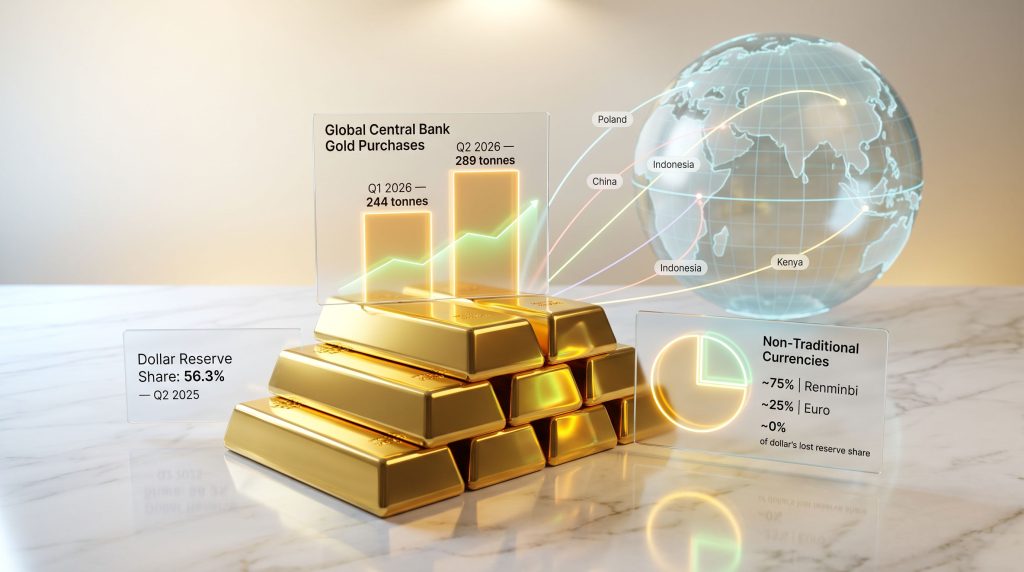
The data is precise. At the turn of the century, the U.S. dollar accounted for roughly 71% of global foreign exchange reserves. By early 2025, IMF COFER data placed that figure at approximately 57.7%, falling to an estimated 56.3% by mid-2025. That is a loss of around half a percentage point per year across 25 years, slow by design, but significant in aggregate. Levels not seen in approximately three decades.
The dollar is not collapsing. It is eroding slowly, structurally, and across multiple fronts simultaneously.
When big ASX news breaks, our subscribers know first
Where the Dollar's Lost Ground Is Actually Going
The most common assumption about dollar reserve decline is that the euro or the Chinese renminbi is picking up the slack. The data says otherwise.
The euro, the world's second-largest reserve currency, has captured essentially zero net ground from the dollar's retreat across the entire 21st century. The renminbi has absorbed roughly one quarter of what the dollar has lost. The remaining three quarters has dispersed into a category most financial commentary overlooks entirely.
That missing three quarters has been absorbed by the currencies of smaller, well-governed economies, including Australia, Canada, New Zealand, Singapore, South Korea, and the Nordic nations. These are countries with strong institutional frameworks, independent inflation-targeting central banks, deep rule-of-law traditions, and political stability. Their currencies do not feature prominently in reserve allocation discussions precisely because the IMF historically bundled them under an undifferentiated "other" category in its reserve composition data.
Reconstructing the full picture required researchers to compile annual reports from more than 80 central banks individually. When that data is assembled, the finding is striking: the diversification of global reserves is not a story about the rise of rival powers. It is a story about capital quietly seeking quality.
| Reserve Currency | Share of Dollar's Lost Ground (21st Century) |
|---|---|
| Euro | ~0% |
| Chinese Renminbi | ~25% |
| Non-traditional currencies (AUD, CAD, SGD, KRW, etc.) | ~75% |
Why This Pattern Matters for Investors
The scattering of reserve flows into smaller, well-managed currencies reflects a portfolio logic that mirrors what individual investors apply in diversification decisions. Reserve managers are not making political statements when they allocate to the Singapore dollar or the Norwegian krone. They are seeking liquidity, institutional quality, and predictability in returns — the same variables that drive any rational long-duration asset allocation. Furthermore, with the world increasingly losing trust in the US dollar, these allocation shifts are becoming more pronounced across emerging markets.
Why the Renminbi Has Stalled as a Contender
The renminbi internationalisation push is roughly a decade old, measured against the U.S. dollar's century-long institutional entrenchment. The gap is not simply one of time. It is structural.
China still maintains capital controls that limit the free flow of funds across its borders. The People's Bank of China operates without the institutional independence that reserve managers in other jurisdictions treat as a baseline requirement for currency safety. Economic growth has decelerated from double-digit rates to approximately 4%, removing one of the most powerful tailwinds behind renminbi adoption.
Additional headwinds are compounding the picture:
- Demographic pressures are creating long-term fiscal stress
- The legacy of a major real estate bubble and bust has weighed on financial sector credibility
- Trade friction with Europe, the United States, and other partners is intensifying
- Capital flight in 2015, following an attempt to open financial markets, prompted Beijing to reverse course and tighten controls
Research into which central banks actually hold renminbi reserves reveals a telling pattern. Holders tend to be economies with excess reserves well beyond IMF-recommended liquidity thresholds — countries that can afford the relative illiquidity of parking funds in Shanghai and navigating the approval processes required to access them. The renminbi's share of global reserves has actually been declining, not growing. This is the opposite of what most mainstream commentary assumes.
The Euro's Structural Ceiling
The euro's failure to capture any of the dollar's lost reserve share over a quarter century reflects a fundamental constraint: a chronic shortage of AAA-rated euro-denominated sovereign bonds.
Only three eurozone governments carry AAA ratings from all major agencies. The combined outstanding bond stock of those governments totals approximately €4 trillion, roughly one-tenth the size of the U.S. Treasury market. Much of that supply is absorbed domestically by national banks and insurance companies meeting regulatory obligations, leaving minimal inventory available to international reserve managers.
Structural Comparison: The U.S. Treasury market offers approximately $40 trillion in outstanding bonds accessible to global investors. The eurozone's comparable AAA-rated supply totals roughly $4 trillion, a 10-to-1 disadvantage in reserve asset depth.
European financial markets remain siloed along national lines. German institutions hold German bonds. Dutch insurers hold Dutch bonds. A proposed EU-level bond issuance mechanism, which could create a unified AAA-rated asset at scale, has faced sustained political resistance from member states unwilling to delegate fiscal authority to Brussels. Until this changes, the euro's international reserve role will remain flat regardless of the size of the eurozone economy.
Central Bank Gold Buying: The Two-Phase Story
Central bank gold buying and dollar reserve decline have been closely intertwined since 2009. Understanding it properly requires separating two distinct phases with different motivations.
Phase 1: Structural Catchup (2009 to approximately 2022)
The 2008–2009 global financial crisis demonstrated that concentrated holdings in any single asset class, including U.S. Treasuries, carried real balance sheet risk. Emerging market central banks, many of which had inherited very little gold and held heavily concentrated positions in foreign government securities, began systematic gold accumulation as a basic portfolio construction decision. Consequently, central bank gold reserves expanded substantially across this period as institutions sought meaningful diversification.
Russia's acceleration of gold purchases and domestic repatriation around the time of the 2014 Crimea annexation represented an early geopolitical overlay on this otherwise structural trend.
Phase 2: Geopolitical Risk Premium (approximately 2022 to present)
A second motivational layer has emerged more recently. The number of entities sanctioned by the U.S. government has risen by an order of magnitude over the past two decades. Research examining central bank behaviour finds statistical evidence that sanctions exposure is a meaningful predictor of which institutions have increased their gold allocation. Gold held in domestic vaults cannot be frozen by foreign authorities. That property has become more valuable as the use of financial sanctions has expanded.
A World Gold Council survey conducted in 2026 found that 89% of reserve manager respondents expected global central bank gold holdings to increase over the following 12 months. The same survey found 74% of reserve managers anticipated the U.S. dollar's share of reserves would decline over the next five years. According to research from The Conversation, central bank gold holdings are now at a 50-year high, underscoring how significant this structural shift has become.
Critical Distinction: Central bank gold buying is not a unified vote against the dollar. It reflects a combination of basic portfolio construction, sanctions risk mitigation, and growing uncertainty about U.S. fiscal and institutional stability. These motivations are layered, not interchangeable.
The Scale of Official Sector Accumulation
The numbers are material. In addition, central bank gold demand has shown no signs of slowing, with the following figures illustrating the pace of accumulation:
- Central banks purchased a net 289 tonnes of gold in Q2 2026, a record for any second quarter
- Q1 2026 saw 244 tonnes in net purchases, sustaining an elevated pace
- In peak years, official sector buying has absorbed close to a quarter of all newly mined gold globally
Recent buyers have included countries that had not purchased gold in decades, or had never done so: Guatemala, Indonesia, Malaysia, Cambodia, Uganda, and Kenya. This broadening of participation is consistent with the structural catchup thesis. Emerging market central banks historically inherited minimal gold exposure and were over-concentrated in a narrow class of foreign financial securities.
Gold Repatriation and the Sanctions Defence Logic
A growing number of central banks have moved to physically repatriate gold previously stored in New York or London vaults. Russia's repatriation ahead of the Crimea annexation established a template that others have followed. France, Germany, and the Netherlands subsequently repatriated significant holdings, driven partly by domestic political pressure from nationalist movements and partly by institutional risk management considerations.
What central banks give up when they repatriate gold:
- The ability to use gold as collateral in international financial transactions
- Access to gold lending markets, which generate interest income when gold is vaulted in major financial centres
- Operational flexibility for foreign exchange market intervention
This trade-off is made with clear eyes. Central banks that hold reserves significantly in excess of their immediate liquidity requirements can afford to bring gold home, forgo lending income, and accept reduced operational flexibility. For central banks that may need to intervene actively in currency markets, gold in a domestic vault is a comparatively illiquid asset.
The cost-benefit calculus of financial sanctions creates a structural policy tension that deserves more attention than it typically receives. As more countries diversify away from dollar-denominated assets in response to sanctions risk, the dollar's reach as a sanctions enforcement tool diminishes proportionally.
The next major ASX story will hit our subscribers first
What Gold Can and Cannot Do in the Modern Monetary System
The monetary functions of any asset are well-established: a store of value, a unit of account, and a means of payment. Gold's performance across these three functions is uneven.
| Monetary Function | Gold's Capability | Assessment |
|---|---|---|
| Store of Value | Strong historically, with price volatility caveat | Viable for long-duration holdings |
| Unit of Account | Weak, price volatility makes gold-denominated contracts impractical | Not functional at scale |
| Means of Payment | Very weak, physical transfer is costly, slow, and operationally complex | Unsuitable for modern trade finance |
Gold's disconnection from the international monetary system has been effectively complete since 1971. The end of the gold standard severed the dollar-gold link definitively, and no government currently backs its currency with gold. Furthermore, the role of gold in the monetary system today is more nuanced — functioning primarily as a portfolio hedge rather than a transactional anchor.
What gold actually delivers for both central banks and long-term investors is more modest and more durable than its advocates often claim:
- Portfolio diversification with low correlation to equities and bonds in stress scenarios
- A commodity allocation that carries institutional legitimacy within reserve management frameworks
- Psychological and political value: physical possession provides a form of monetary sovereignty that financial securities cannot replicate
Gold functions best as an investment tranche asset, suitable for institutions holding reserves in excess of their immediate liquidity needs, not as a substitute for liquid, deployable foreign exchange.
The Bull Case and the Bear Case: A Structured Framework
| Asset Class | Direction of Travel | Primary Driver |
|---|---|---|
| U.S. Treasuries | Gradual reduction as reserve share | Diversification, sanctions risk |
| Gold | Sustained accumulation | Portfolio construction, geopolitical hedging |
| Non-traditional currencies (AUD, CAD, SGD, KRW, etc.) | Steady increase | Institutional quality, liquidity |
| Renminbi | Stalled or slight decline | Capital controls, institutional concerns |
| Euro | Flat | Safe asset scarcity, market fragmentation |
The bull case for dollar continuity rests on the absence of any existing alternative with the combination of market depth, institutional credibility, and liquidity that the dollar provides. The U.S. Treasury market remains the world's largest and most liquid sovereign bond market by a significant margin. Historical precedent shows the dollar has survived multiple predicted crises.
The bear case for accelerating erosion points to a rising U.S. debt-to-GDP ratio, visible diminishment of investor confidence in Treasuries as a risk-free asset, questions about central bank independence and the rule of law, systematic expansion of financial sanctions creating structural diversification incentives, and the risk of losing the competition to define next-generation cross-border payment infrastructure. Indeed, Yahoo Finance reporting confirms that central banks forecast more gold purchases and fewer U.S. dollar reserves in the years ahead.
The most intellectually honest position sits between these poles. The dollar is not being displaced by a superior alternative. It is being gradually hedged against by institutions that have learned, through successive financial crises and geopolitical shocks, that concentration in any single asset class carries risks that compounding diversification can reduce.
FAQ: Central Bank Gold Buying and the Dollar's Reserve Role
Why are central banks buying so much gold right now?
Central bank gold buying and dollar reserve decline are increasingly linked phenomena. Purchases reflect a combination of structural portfolio rebalancing by emerging market institutions that historically held little gold, sanctions risk mitigation following the expansion of U.S. financial sanctions, and growing uncertainty about U.S. fiscal sustainability and institutional stability. Approximately 89% of reserve managers surveyed in 2026 expected global gold holdings to increase over the following 12 months.
Is central bank gold buying a signal that the dollar is collapsing?
Not according to the available evidence. The dollar's reserve share has declined gradually at approximately half a percentage point per year across 25 years. Gold buying is better understood as portfolio diversification and risk management than as a coordinated move away from the dollar. The pace of concern among reserve managers has, however, visibly accelerated since early 2025.
Where is the dollar's lost reserve share actually going?
Contrary to popular assumption, the largest beneficiary is not the euro or the renminbi. Approximately three quarters of the dollar's lost reserve share has flowed to smaller, well-governed economies including Australia, Canada, Singapore, South Korea, and the Nordic nations. This finding required manual compilation of data from more than 80 central bank annual reports and remains largely invisible in standard IMF reporting.
Can gold ever replace the dollar as a reserve currency?
No credible evidence supports this scenario. Gold functions effectively as a store of value and a portfolio diversification tool but fails as a unit of account and means of payment at the scale required by modern international trade. Its disconnection from the monetary system has been complete since 1971. Central bank gold accumulation reflects portfolio management decisions, not a return to gold-standard thinking.
This article is intended for informational purposes only and does not constitute financial or investment advice. Past performance of any asset class is not indicative of future results. Readers should conduct their own due diligence before making investment decisions.
Want to Capitalise on the Next Major Mineral Discovery Before the Broader Market?
As central banks quietly rebalance reserves and institutional capital seeks quality assets, Discovery Alert's proprietary Discovery IQ model delivers real-time alerts on significant ASX mineral discoveries, turning complex data into actionable opportunities for both short-term traders and long-term investors. Explore historic discoveries and their exceptional returns, then begin your 14-day free trial to position yourself ahead of the market.