July 27, 2026
The Four-Pillar Architecture Most Gold Investors Never Think About
Gold is rarely analysed the way fixed income is. Bond investors dissect yield curves, duration, credit spreads, and issuer categories with precision. Gold investors, by contrast, tend to collapse an enormously complex demand picture into a single variable: the US dollar, or real yields, or Fed policy expectations. That compression creates a persistent analytical blind spot, and in mid-2026, that blind spot is generating significant confusion about where central bank gold buying and the gold price floor genuinely sits.
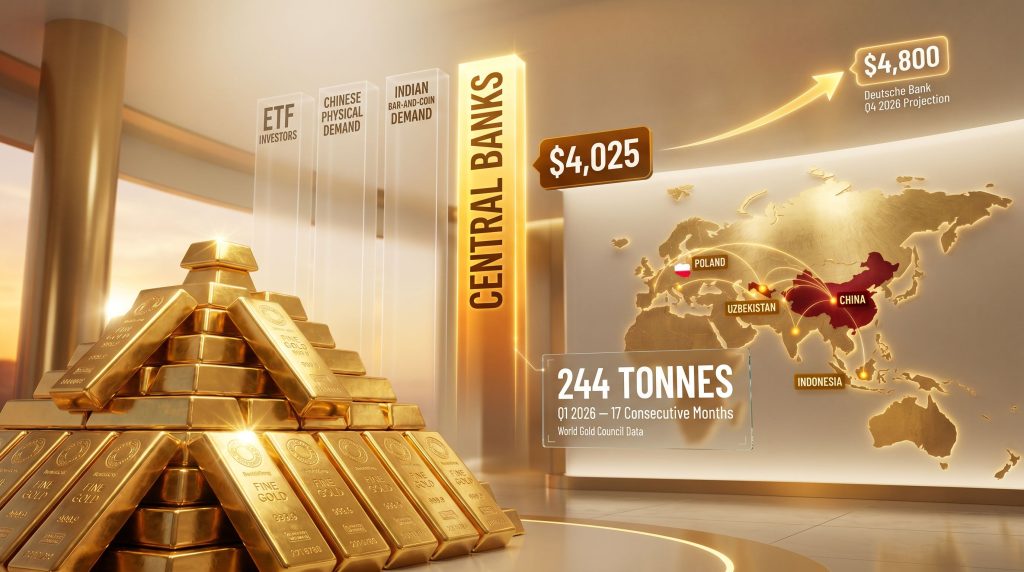
The more useful framework begins not with price targets or macro narratives, but with the structural architecture of gold demand itself. Gold's buyer base is not monolithic. It is composed of four categorically distinct groups, each operating on different time horizons, with different risk mandates, and different sensitivity to monetary policy signals. When all four are purchasing simultaneously, the result is the kind of multi-pillar demand convergence that drove gold to $5,405 per ounce in January 2026.
When three of the four step back at the same time, the characteristics of the remaining buyer become the dominant force shaping the market's floor, not its ceiling. Understanding which pillar is currently doing the structural work is the most important question in gold markets right now. And the answer is one that most rate-cycle analysis consistently underweights.
When big ASX news breaks, our subscribers know first
Dissecting the Four Demand Categories and Why They Move Independently
Institutional and ETF Investors: The Rate-Sensitive Layer
The first demand pillar consists of institutional and retail investors who access gold primarily through exchange-traded funds and futures contracts. This group is acutely sensitive to changes in real yields and monetary policy expectations. When the opportunity cost of holding a non-yielding asset like gold rises alongside rate expectations, this category exits quickly and in volume.
Their activity in 2025 was extraordinary. North America alone recorded $51 billion in gold ETF inflows during the year, the strongest annual total ever documented by the World Gold Council. That momentum extended into early 2026 before reversing sharply when Federal Reserve Chair Kevin Warsh's first FOMC meeting in June 2026 signalled a materially hawkish policy shift. The Taylor rule prescription at that point was running approximately 80 basis points above current rates, giving markets a clear signal that the rate-cut narrative driving ETF accumulation was no longer operative (Deutsche Bank Research, June 23, 2026).
By May 2026, global gold ETF holdings had declined to 4,121 tonnes, with net outflows of $2 billion ending a nine-month inflow streak. COMEX open interest simultaneously fell to what Deutsche Bank described as a 17-year low, with net long positioning near year-to-date lows (World Gold Council, Gold ETF Flows May 2026; Deutsche Bank Research, June 23, 2026).
Chinese Physical Demand: The Shanghai Premium Signal
The second pillar is Chinese physical demand, operating primarily through the Shanghai Gold Exchange. China is the world's largest gold consumer, and the health of this pillar can be read through a single metric: the Shanghai premium over COMEX spot prices. When Chinese buyers are active and importing metal in volume, this premium is positive and often elevated. When demand softens, the premium compresses or inverts.
Earlier in 2026, elevated Shanghai premiums confirmed that physical metal was flowing eastward at pace. That dynamic has since shifted. By June 2026, the premium had compressed into a small discount, a signal interpreted by Deutsche Bank analysts as confirmation that Chinese imports are no longer providing meaningful demand support at current price levels (Deutsche Bank Research, June 23, 2026). Chinese demand had moved from a tailwind to, at best, a neutral.
Indian Bar and Coin Demand: Policy-Interrupted
India represents the world's second-largest gold market and is historically one of the most price-sensitive buyer bases globally. In May 2026, the Indian government raised its basic customs duty on gold from 6% to 15%, adding approximately $700 per ounce to the landed cost of imported metal (India Ministry of Finance, Notification No. 16/2026-Customs).
The World Gold Council estimates this single policy adjustment will suppress Indian jewellery, bar, and coin demand by 50 to 60 tonnes in 2026, representing a year-on-year decline of approximately 10%. (WGC, India Gold Market Update, May 2026)
A useful historical comparison is the 2013 Indian duty cycle, during which similar tariff increases produced prolonged demand suppression lasting several quarters before any meaningful recovery. The near-term trajectory for Indian demand in 2026 is clearly negative, and the reversal timeline is entirely policy-dependent.
Central Banks: The Mandate-Driven Accumulator
The fourth pillar, sovereign reserve managers, is the one that has not moved. Central banks, particularly from emerging market economies, accumulate gold as a reserve diversification tool. They do not have quarterly earnings targets, redemption mechanisms, or mandate constraints tied to yield differentials. Furthermore, when they designate gold as a core reserve asset, they buy through corrections, through record highs, and through rate cycles alike. Central bank gold demand has consequently become the defining feature of gold market structure in 2026.
Why Central Bank Gold Buying Is a Structurally Different Kind of Price Floor
The conceptual error that most rate-cycle analysis makes is treating all demand floors as equivalent. They are not. A floor built by momentum investors is conditional: it holds until a catalyst dislodges it. A hawkish press conference, a stronger-than-expected jobs report, or a repricing of rate expectations can dissolve it within trading sessions.
Central bank gold buying and the gold price floor dynamic does not work this way, and understanding the mechanism behind that distinction matters enormously for assessing where genuine support sits in 2026. The structural catalyst is traceable to a specific geopolitical event. When G7 governments froze Russia's foreign exchange reserves in 2022, sovereign reserve managers across the emerging market world received a direct, empirical demonstration of a risk they had previously treated as theoretical.
Dollar-denominated reserve assets held in foreign custody can be rendered inaccessible by political decision. Gold, held physically, has no issuer, no counterparty, and no freeze mechanism. It cannot be sanctioned away. In addition, gold in the monetary system has taken on renewed strategic significance precisely because of this characteristic.
The accumulation of gold by emerging market central banks since 2022 is not a momentum trade or a rate-cycle bet. It is the institutional response to a permanent reassessment of counterparty risk embedded within the dollar-denominated reserve architecture.
This is the quality that makes sovereign demand a categorically different floor mechanism. Reserve managers are not responding to Fed communications. They are responding to a structural feature of the global monetary system that the 2022 sanctions episode made impossible to ignore.
The Scale of Sovereign Accumulation in 2026: What the Data Confirms
The empirical record through the first quarter of 2026 makes the durability of this pillar quantifiable rather than speculative. According to recent central bank buying trends, the breadth and consistency of sovereign accumulation has expanded well beyond its traditional participants.
| Central Bank | Q1 2026 Net Purchases | Context |
|---|---|---|
| National Bank of Poland | 31 tonnes | Part of a stated 700-tonne national reserve target |
| Uzbekistan | 25 tonnes | Consistent emerging market diversification buyer |
| People's Bank of China | 7 tonnes | More than double its Q4 2025 pace |
| Guatemala, Indonesia, Malaysia, Cambodia | Disclosed volumes | First-time or historically low-volume buyers |
| Global Total (Q1 2026) | 244 tonnes net | 3% above prior year; above the five-year average |
Source: World Gold Council, Gold Demand Trends Q1 2026: Central Banks
Two elements of this data deserve specific attention. First, global central bank net purchases of 244 tonnes occurred while gold prices were near all-time highs, confirming that this buyer category is not price-sensitive in the conventional sense. Second, the buyer list has expanded to include institutions that had never historically participated in volume.
The entry of first-time buyers such as Guatemala and Cambodia is significant: it suggests the reserve diversification motive is spreading to smaller economies that previously lacked the reserve base to make gold accumulation meaningful. Equally important is the duration of this trend. Central banks have now recorded seventeen consecutive months of net purchases, a streak that has run through multiple price environments including the January 2026 peak above $5,400 per ounce.
Survey Data Confirms the Mandate Is Structural, Not Cyclical
The qualitative evidence reinforces the quantitative picture. The World Gold Council's 2025 Central Bank Gold Reserves Survey, which captures forward-looking reserve management intentions across dozens of sovereign institutions, produced three findings that define the current floor dynamic. Furthermore, central bank gold reserves data consistently corroborates the survey's forward-looking signal:
- 95% of surveyed central banks anticipated that global official gold reserves would increase over the following 12 months, the highest reading recorded in the survey's eight-year history.
- 43% of respondents planned to increase their own institution's gold holdings, also a record share.
- Zero surveyed institutions anticipated reducing gold reserves.
(Source: WGC, Central Bank Gold Reserves Survey 2025)
A buyer base where no participant plans to reduce holdings is, by definition, not a buyer base that exits on monetary policy signals. The survey data is structurally incompatible with the idea that Fed rate hikes will dissolve sovereign demand the way they dissolve ETF positioning. According to World Gold Council data on April 2026 central bank activity, sovereign institutions resumed net buying in April after minor fluctuations, reinforcing the durability of this trend.
Mapping the Current Repricing: From $5,405 to $4,025
The correction from January's peak has been material, and the price table below captures the key reference levels that frame the current debate around the gold price floor.
| Price Reference | Level (USD/oz) | Context |
|---|---|---|
| January 2026 Peak | $5,405 | Multi-pillar demand convergence at record highs |
| Spot Price (June 24, 2026) | $4,025 | Post-hawkish Fed repricing |
| Deutsche Bank Q3 2026 Target (revised) | $4,300 | 22% reduction from prior ~$5,500 target |
| Deutsche Bank Q4 2026 Target | $4,800 | Conditional on rate stabilisation |
| Bear Case Floor (3-4 Fed hikes) | $3,800 | Full hiking cycle scenario per Bank of America |
| Structural Support Level (CB-driven) | ~$4,440 | Institutional bid level, Q1 2026 data |
Sources: Deutsche Bank Research, June 23, 2026; World Gold Council, Gold Demand Trends Q1 2026; Bank of America Research, June 22, 2026
The June 23, 2026 Deutsche Bank research note, which cut the bank's Q3 target by 22%, is being interpreted in most financial coverage as a straightforward bearish revision. That reading is accurate but incomplete. The note simultaneously documents which buyer category remains intact, and at what price level sovereign accumulation is providing a functional bid. Central bank demand is acknowledged as the pillar most likely to remain intact through a hiking cycle.
The next major ASX story will hit our subscribers first
Scenario Modelling: Where the Floor Holds Across Different Fed Paths
The scenario framework below synthesises Deutsche Bank and Bank of America projections against the structural central bank buying baseline to map where the gold price floor sits under each monetary policy pathway.
| Fed Scenario | Projected H2 2026 Hikes | Implied Price Floor | Dominant Floor Mechanism |
|---|---|---|---|
| Rates on Hold (Base Case) | 0 | ~$4,300-$4,440 | Central bank demand plus ETF stabilisation |
| Moderate Tightening | 2 hikes (Deutsche Bank) | ~$4,100-$4,300 | Central bank demand absorbs ETF selling |
| Aggressive Tightening | 3-4 hikes (Bank of America) | ~$3,800 | Central bank demand as sole active buyer |
Sources: Deutsche Bank Research, June 23, 2026; Bank of America Research, June 22, 2026; WGC Gold Demand Trends Q1 2026
One underappreciated dynamic within this framework is what a lower price level actually means for sovereign buyers operating on a volume-based reserve mandate. A central bank targeting a specific tonnage allocation to gold achieves greater reserve value per dollar deployed at $4,000 than it does at $5,000. Unlike momentum investors who lose conviction as prices fall, reserve managers on a volume target have a mathematical incentive to accelerate purchases during corrections.
The Reported vs. Unreported Purchasing Gap: A Dimension Most Investors Miss
One layer of complexity that retail analysis rarely engages with is the significant gap between officially reported central bank gold purchases and the World Gold Council's estimated total. Official IMF data for Q1 2026 captured approximately 16 tonnes of net central bank purchases. The WGC's more comprehensive methodology, which accounts for delayed reporting, confidential purchases, and non-IMF-reporting institutions, estimated the actual figure at 244 tonnes for the same period.
That gap of more than 228 tonnes represents a structural feature of the sovereign gold market: a substantial proportion of central bank accumulation is not publicly disclosed in real time. Reserve managers in several jurisdictions have historically built gold positions quietly over multiple quarters before any official acknowledgement appears in IMF data. However, this means that the publicly visible sovereign demand figures consistently understate actual accumulation, and that the real floor being built is larger than the data headlines suggest. How central bank buying impacts gold prices further illustrates why this reporting gap has direct consequences for price discovery.
What the Resistance-to-Support Transition Tells Us About Market Structure
Technical analysis and fundamental demand analysis are converging around a similar price region. The $4,440 level, which corresponds to the approximate structural support identified from Q1 2026 sovereign buying activity, has also been repeatedly defended across multiple sessions in early 2026. Price zones that previously acted as resistance during the upward phase of a cycle tend to transition into support zones once a correction reaches them.
When the buyers defending a price level are sovereign institutions on a volume mandate rather than speculative traders on a momentum signal, the defence of that level is materially more reliable. Reserve managers do not have stop-losses. They do not face margin calls. Furthermore, as the WGC survey confirms, not a single surveyed institution planned to reduce gold holdings, meaning there is no coordinated selling pressure waiting to emerge from the institutional side of the market.
Consequently, gold safe-haven demand continues to underpin gold's appeal beyond the purely monetary policy narrative, reinforcing the multi-layered nature of the support structure.
Frequently Asked Questions: Central Bank Gold Buying and the Gold Price Floor
What is the current gold price floor supported by central bank buying in 2026?
The structural floor generated by sovereign reserve accumulation sits at approximately $4,440 per ounce, reflecting the price level at which institutional buying has been consistently observed in Q1 2026 data. Deutsche Bank's revised base case places a soft floor in the $4,300-$4,800 range for the second half of 2026, conditional on the Fed holding rates steady. The bear case scenario of three to four hikes puts a floor at $3,800, where central bank gold buying and the gold price floor relationship would be tested most severely.
Does central bank gold demand increase when prices fall?
For sovereign institutions operating on a tonnage-based reserve target, a lower gold price increases purchasing efficiency. The same dollar allocation buys more metal at $4,000 than at $5,000, giving reserve managers a mathematical incentive to accumulate more aggressively during corrections. This is structurally opposite to momentum investor behaviour and is one reason why the sovereign demand floor tends to strengthen as prices fall rather than weaken.
How did the 2022 Russia sanctions event change central bank behaviour permanently?
When G7 governments rendered Russia's foreign exchange reserves inaccessible in 2022, reserve managers globally observed that dollar-denominated assets held in foreign custody carry sovereign counterparty risk. Gold held physically carries no such risk. The sustained acceleration in central bank accumulation since 2022 is the direct institutional response to that observation, not a cyclical trend tied to interest rate expectations.
Will Fed rate hikes break the sovereign demand floor?
Historical evidence and forward survey data both indicate that sovereign buying is not meaningfully rate-sensitive. Reserve managers accumulate gold for reserve diversification and monetary sovereignty reasons, not yield optimisation. The WGC's 2025 survey found zero central banks planned to reduce holdings. Deutsche Bank's note explicitly identifies central bank demand as the pillar most likely to remain intact through a hiking cycle.
Which central banks are the largest gold buyers in 2026?
Poland led Q1 2026 purchases with 31 tonnes, part of an ambitious 700-tonne national reserve target. Uzbekistan added 25 tonnes, and China's People's Bank added 7 tonnes, more than doubling its Q4 2025 pace. First-time or historically low-volume buyers including Guatemala, Indonesia, Malaysia, and Cambodia also entered the market during the quarter.
Key Takeaways for Investors Navigating the Current Environment
- Three of gold's four structural demand pillars (ETF investors, Chinese physical buyers, and Indian bar-and-coin demand) have stepped back simultaneously in mid-2026, driven by Fed hawkishness, Shanghai premium compression, and India's customs duty increase respectively.
- Central banks purchased a net 244 tonnes in Q1 2026, 3% above the prior year's pace and above the five-year average, across seventeen consecutive months of net accumulation.
- The sovereign floor near $4,440 is supported by mandate-driven buyers who are structurally insensitive to rate cycle signals, making it categorically more durable than floors established by speculative or momentum-driven participants.
- Projected central bank purchases of approximately 800 tonnes for full-year 2026 would represent roughly 25% of total annual global mine output, a scale sufficient to absorb meaningful supply increases without requiring participation from ETF investors or retail buyers.
- The gap between IMF-reported central bank purchases (
16 tonnes for Q1 2026) and WGC-estimated actual purchases (244 tonnes) highlights that official data significantly understates the true sovereign bid operating beneath the market at any given time. - Survey data showing 95% of central banks expect global official gold reserves to rise, with zero planning reductions, provides the most unambiguous forward demand signal available in the gold market today.
Readers seeking additional context on central bank reserve strategy, gold demand architecture, and precious metals market dynamics can find ongoing analysis at GoldSilver.com's Industry News section, which tracks institutional and sovereign gold market developments on a continuous basis.
Disclaimer: This article is for informational purposes only and does not constitute financial or investment advice. All price references, forecasts, and data points reflect publicly available sources as of the dates cited. Past performance is not indicative of future results. Always consult a qualified financial adviser before making investment decisions.
Want to Track the Next Major ASX Mineral Discovery Before the Broader Market Does?
While sovereign gold dynamics shape the macro floor, Discovery Alert's proprietary Discovery IQ model scans ASX announcements in real time, delivering instant alerts on significant mineral discoveries across gold and more than 30 other commodities — explore the historic returns major discoveries have generated and begin your 14-day free trial today to position yourself ahead of the market.