July 20, 2026
Monetary Policy at the Crossroads: How the Iran War Oil Shock Is Forcing Central Banks to Choose Between Two Kinds of Pain
Every major energy crisis in modern history has arrived with a familiar set of contradictions. Oil prices surge, inflation rises, and central banks find themselves holding instruments designed for demand-side problems while facing a supply-side shock they cannot directly influence. The 1973 oil embargo created the template. The 2022 Russia-Ukraine energy crisis reinforced it. However, the configuration that has emerged from the US-Israel military campaign against Iran presents a structurally distinct version of this challenge — one that arrives at a uniquely dangerous moment in the global inflation cycle. Understanding central banks and Iran war oil shock dynamics requires far more than simply monitoring price movements.
Understanding why monetary policymakers are paralysed requires more than tracking oil price trends. It demands a framework for understanding how energy shocks travel through economies, how human memory accelerates that transmission, and why the tools central banks possess are poorly suited to the problem they currently face.
When big ASX news breaks, our subscribers know first
The Architecture of the Supply Shock: Why This One Is Different
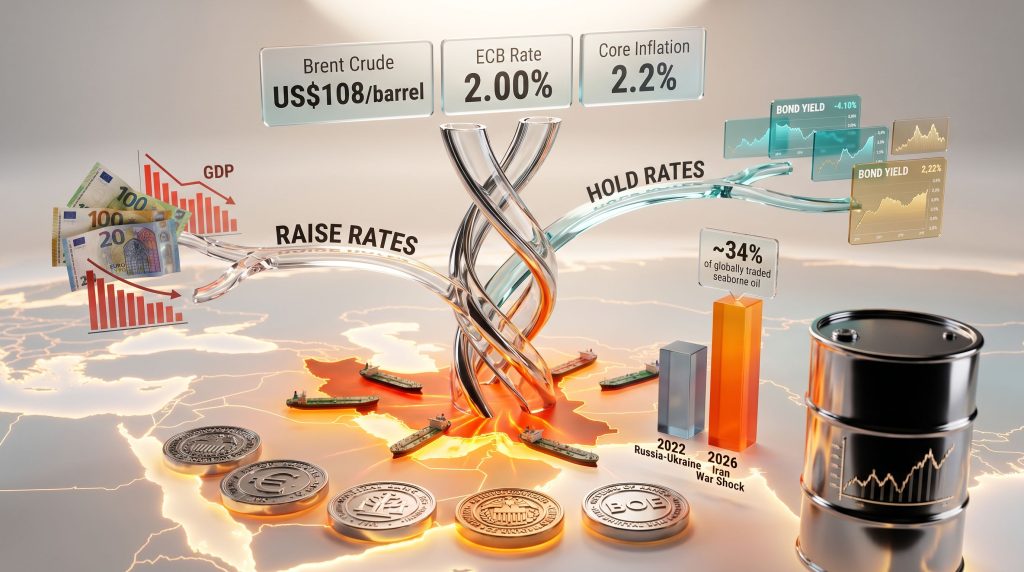
At the centre of the current disruption sits the Strait of Hormuz, a narrow maritime passage connecting the Persian Gulf to the Gulf of Oman. According to the US Energy Information Administration, more than one-third of all globally traded seaborne petroleum transits this chokepoint, making it the single most consequential maritime passage in the global energy system. The US-Israel military campaign against Iran has disrupted this corridor while simultaneously targeting Iranian export infrastructure, removing supply from both ends of the pipeline simultaneously.
Brent crude has surged past US$108 per barrel while US crude benchmarks breached US$98 per barrel, representing a near 50% premium above pre-conflict price levels. Goldman Sachs revised its oil price forecasts sharply upward in response, with markets pricing in a prolonged supply disruption rather than a brief military exchange.
What makes this shock structurally different from previous episodes is the nature of the constraint itself. The Oxford Institute for Energy Studies has documented the distinction between policy-based supply constraints (sanctions, export restrictions) and structural supply rigidity created by physical geographic chokepoints. Sanctions-based disruptions, like those applied during the Russia-Ukraine conflict, permit traders to redirect cargo flows toward alternative suppliers and routes. A chokepoint closure, however, eliminates that routing flexibility entirely. Ultra-large crude carriers rerouted around the Cape of Good Hope add approximately 14 to 21 days to voyage times, effectively reducing global supply availability even when physical oil volumes remain unchanged.
Furthermore, the interplay between oil and geopolitics has rarely been more consequential for how quickly these shocks transmit across global markets.
| Factor | 2022 Russia-Ukraine Shock | 2026 Iran War Shock |
|---|---|---|
| Primary disruption mechanism | Pipeline and export sanctions | Strait of Hormuz disruption |
| Share of global supply affected | ~10-12% | ~34% (Strait transit) |
| Inflation starting point | Near-zero rates, post-COVID surge | Rates already elevated, inflation partially embedded |
| Central bank starting position | Emergency easing in progress | Mid-cycle hold, rate cuts expected |
| Business/worker inflation memory | Low (30-year low inflation era) | High (recent 2021-2023 inflation experience) |
"The 2026 shock arrives at a fundamentally more dangerous juncture in the inflation cycle. Workers and businesses retain fresh institutional memory of rapid price escalation, meaning behavioural second-round effects can emerge far more quickly than in previous energy crises."
Central Banks in Synchronised Stasis
On April 30, 2026, the European Central Bank held its benchmark deposit facility rate at 2.00%, declining to raise rates despite April flash data showing Eurozone headline inflation jumping to 3.0%. One day earlier, the Bank of Canada maintained its policy rate at 2.25% under a baseline scenario projecting oil prices easing from US$100 to approximately US$75 per barrel by mid-2027. The US Federal Reserve held its federal funds rate in the 3.50 to 3.75% range, while the Bank of England similarly maintained a steady stance. Together, these institutions represent approximately two-thirds of global economic output, and all are aligned in a deliberate holding pattern.
Following the ECB announcement, the euro strengthened 0.2% against the US dollar to $1.17, while the 10-year German Bund yield declined 3 basis points to 3.0580%. Bond markets interpreted the hold as a moderately dovish signal even against an inflationary backdrop, suggesting that professional investors understood the growth constraint underpinning the decision.
This coordinated passivity reflects documented Federal Reserve and ECB communication practice: distinguishing between supply-side inflation (which can be partially tolerated) and demand-side inflation (which requires direct policy response). The logic is that raising rates cannot produce more oil, cannot reopen a maritime chokepoint, and cannot reduce the geopolitical risk premium embedded in energy prices. What rate hikes can do is depress domestic demand, which compounds the economic destruction already being delivered by elevated energy costs.
Why the Standard Inflation-Fighting Playbook Fails Here
Eurozone first-quarter GDP growth decelerated to 0.1%, leaving virtually no buffer against a policy-induced contraction. Germany, the Eurozone's largest economy, faces a potential second-quarter contraction if energy costs remain elevated at current levels. This creates the asymmetric dilemma that defines the central banks and Iran war oil shock policy environment.
Scenario A: Raise Rates to Combat Inflation
- Higher borrowing costs compound the demand destruction already caused by elevated energy prices
- With Eurozone growth already at 0.1%, even a modest rate increase risks tipping the bloc into outright contraction
- Germany's potential Q2 contraction would accelerate under a tightening cycle
- Green energy investment costs would rise, as renewable infrastructure manufacturing is itself energy-intensive, paradoxically deepening short-term reliance on fossil fuel supply chains
Scenario B: Hold Rates and Absorb the Shock
- Inflation expectations risk becoming unanchored if the public perceives central banks as indefinitely tolerating above-target inflation
- Second-round wage-price dynamics could embed inflation into services and labour markets
- The longer the hold extends, the more difficult any eventual pivot becomes without triggering market dislocation
- Credibility erosion accumulates with each month that headline inflation sits above target
Neither path is without severe consequence. The optimal outcome depends entirely on a variable no monetary authority can model with precision: the conflict's duration and resolution trajectory.
The Behavioural Transmission Mechanism Central Banks Fear Most
First-round inflation effects are mechanical. Rising oil prices directly increase transport costs, energy bills, and manufactured goods prices. These effects are visible, measurable, and historically understood to dissipate when energy prices eventually fall. Central banks can tolerate first-round effects without tightening, because the inflationary pressure is self-limiting.
Second-round effects operate differently. They travel through human decision-making, and they are far more difficult to extinguish once established. According to Reuters reporting on monetary policy behaviour, because the experience of inflation is so recent, businesses will raise prices faster than they did in 2022, and workers will pursue wage protection more aggressively. This creates a self-reinforcing transmission sequence:
- Businesses pre-emptively raise prices to protect margins, drawing on 2021-2023 inflation memory to anticipate further input cost increases
- Workers accelerate wage demands before real income erosion compounds, shortening the lag between price shocks and labour market responses
- Companies justify further price increases by citing rising labour costs, creating a loop independent of the original energy price signal
- Services inflation becomes entrenched, resisting the natural deflation that occurs when energy prices eventually fall
The critical surveillance metric is core inflation, which excludes volatile food and energy components and serves as the primary indicator of whether second-round effects are developing. Core inflation slowed to 2.2% in April 2026 from 2.3% in March, a directionally positive signal. This single data point is currently functioning as the most important number in global monetary policy.
- If core inflation continues declining through May: the energy shock is classified as a contained first-round effect and central banks maintain their hold
- If core inflation reverses to 2.3% or above: second-round effects are confirmed and the ECB would likely implement a 25-basis-point hike to 2.25% at its June 2026 meeting
The Forward Guidance Problem: When Probability Modelling Breaks Down
Central banks construct forward guidance by assigning probabilities to economic scenarios and communicating expected policy paths conditional on those outcomes. The Iran conflict systematically prevents this process from functioning.
The conflict has cycled through phases of active warfare, ceasefire, peace negotiations, negotiation collapse, naval blockade, and blockade suspension. Each phase reprices energy risk premiums, invalidating the economic projections built around the previous phase. In addition, no central bank can assign a reliable probability to when the Strait of Hormuz will reopen to normal transit volumes. Energy risk premiums cannot stabilise under this uncertainty, which means baseline economic projections remain structurally unreliable regardless of analytical quality.
Bank of Canada Governor Tiff Macklem has explicitly preserved optionality in both directions. If US trade restrictions intensify, the Bank of Canada retains the ability to cut the policy rate further to support growth. If inflation embeds, the tightening pathway remains open. This is not institutional indecision; it is the only rational posture under genuine uncertainty about geopolitical outcomes.
"Policy ambiguity in this environment is a feature, not a failure. Committing to a rate path when the primary variable driving inflation is an active military conflict would represent a more serious analytical error than preserving flexibility."
The next major ASX story will hit our subscribers first
Sector Exposure: Mining Operations at the Intersection of Energy and Commodity Markets
The oil shock does not distribute its costs evenly. Industries with high energy input ratios and limited ability to pass elevated costs to customers face the most acute structural pressure. Consequently, the trade war oil impact on cost structures compounds these vulnerabilities further for energy-intensive operators.
| Sector | Energy as % of Operating Costs | Ability to Pass Through Costs | Margin Compression Risk |
|---|---|---|---|
| Surface mining operations | 20-35% (diesel-dominant) | Low (globally priced commodities) | High |
| Underground mining operations | 15-25% (diesel-dominant) | Low (globally priced commodities) | Moderate to High |
| Chemical manufacturing | 30-50% | Moderate | High |
| Agricultural production | 15-25% | Moderate (food price inflation) | Moderate |
| Road freight and logistics | 25-40% | Moderate to High | Moderate |
| Commercial aviation | 20-30% | Moderate (fuel surcharges) | Moderate |
Mining operations represent a particularly instructive case study in structural energy vulnerability. Diesel fuel accounts for 20 to 35% of total operating costs at surface mines and 15 to 25% at underground operations. A sustained US$25 per barrel increase in oil prices translates to approximately a 10 to 15% rise in all-in sustaining costs (AISC) for diesel-dependent operations.
The structural problem facing miners is a double constraint that does not apply to most other sectors. Unlike manufacturing operations, mining producers cannot rapidly substitute alternative energy sources for diesel-powered mobile equipment on active sites. Equipment fleets represent multi-decade capital commitments with fixed fuel requirements. Simultaneously, commodity prices in globally traded markets are set externally, meaning producers cannot pass elevated input costs to buyers the way a manufacturer or retailer might. Understanding the broader commodity price impact on mining companies helps contextualise just how acute this margin pressure becomes. Producers operating in the third and fourth cost quartiles of their respective commodity cost curves face the sharpest margin compression.
Three Scenarios That Will Determine the 2026 Monetary Policy Trajectory
Scenario 1: Rapid Diplomatic Resolution (Moderate Probability)
Oil prices ease toward the Bank of Canada's US$75 per barrel mid-2027 projection. Headline inflation retreats from its April 3% peak as core inflation continues its downward trajectory. Central banks execute gradual rate reductions through late 2026 and into 2027. The residual risk under this scenario is behavioural inflation persistence: price levels anchored during the disruption may not fully normalise even as energy costs fall, because businesses and workers have already recalibrated their pricing and wage expectations.
Scenario 2: Prolonged Conflict With Periodic Ceasefires (Elevated Risk)
Oil prices remain range-bound between US$85 and US$105 per barrel through 2026. Core inflation stabilises above 2.5%, preventing rate cuts but not yet triggering hikes. Eurozone GDP stagnates with Germany entering a technical recession. Central banks remain in their holding pattern but accumulate credibility risk with each month of sustained above-target inflation. In this environment, gold safe-haven demand typically intensifies as investors seek protection from currency and inflation uncertainty.
Scenario 3: Full Strait of Hormuz Closure (Tail Risk)
Oil prices spike toward US$130 to US$150 per barrel, generating a global inflationary shock comparable in structural severity to the 1973 oil embargo, which saw crude prices surge approximately 300% in a matter of months. Central banks face an acute stagflation scenario with no clean policy response. According to analysis of conflict-driven energy shocks, recession probability across major economies rises sharply under this scenario, while commodity markets enter extreme volatility and energy-intensive sectors face existential operational pressure.
What to Monitor Before the June 2026 ECB Decision
For investors, commodity producers, and macro analysts, four data streams will determine whether June brings a hike, a hold, or the beginning of a cut cycle:
- May 2026 core inflation release: The single most decisive indicator. Continued decline confirms containment; any reversal toward 2.3% or above triggers the June hike scenario and reprices portfolios positioned for rate cuts
- Strait of Hormuz weekly transit volumes: Tanker movement intelligence provides the earliest available signal of supply normalisation, well ahead of price data
- Eurozone services inflation: Services prices reflect labour cost pass-through more directly than goods prices and serve as the most reliable leading indicator of wage-price spiral emergence
- US trade policy developments: Additional trade restrictions targeting energy-exporting nations could compound the supply shock, potentially forcing the Bank of Canada to cut rates further to offset growth headwinds independently of inflation dynamics
Frequently Asked Questions: Central Banks and the Iran War Oil Shock
Why aren't central banks raising rates to fight 3% inflation?
Eurozone headline inflation reached 3% in April 2026, but central banks are making a critical analytical distinction between mechanical first-round energy price effects and behavioural second-round wage-price effects. Raising rates aggressively against a supply-side shock risks triggering a recession without meaningfully addressing the underlying cause: oil prices determined by geopolitical events, not domestic monetary conditions.
What would force the ECB to raise rates in June 2026?
A reversal in core inflation from its April 2026 level of 2.2% back toward 2.3% or higher would signal that the energy shock is spreading into wages and services. This is the definition of second-round effects becoming established, and it would likely prompt a 25-basis-point increase to 2.25% at the June ECB meeting.
What does this mean for mining companies specifically?
Mining operations face simultaneous pressure from diesel cost inflation increasing AISC by 10 to 15% for every sustained US$25 per barrel oil price increase, while commodity prices set in globally traded markets do not automatically adjust to offset those cost increases. Third and fourth quartile producers face the most acute risk of margin compression or operational curtailment under a prolonged oil shock.
Could central banks cut rates if growth deteriorates sharply?
Yes, and this is the optionality that institutions like the Bank of Canada are explicitly preserving. The holding pattern is not a commitment to inaction; it is a deliberate preservation of flexibility. Rate cuts remain on the table if trade restrictions intensify or growth deteriorates sharply, just as rate hikes become available if inflation embeds into wages and services.
The One Number That Governs Everything
Across all scenarios, all sectors, and all central bank deliberations, a single figure currently functions as the policy tripwire for the global economy: the May 2026 core inflation reading.
At 2.2% in April, declining from 2.3% in March, it represents the narrow margin between a contained energy shock that central banks and Iran war oil shock policymakers can look through and an embedded inflation spiral that forces their hand. Central banks representing two-thirds of global GDP have positioned themselves at this junction, refusing to pre-commit to either direction while the geopolitical variable driving the entire calculation remains outside their control.
Investors and commodity producers positioning for a single expected outcome in this environment are accepting a level of analytical confidence that the central banks themselves have explicitly declined to express. Modelling across all three scenarios is not caution for its own sake. It is the only framework consistent with the structural uncertainty the Iran conflict has introduced into global monetary policy.
Disclaimer: This article is intended for informational purposes only and does not constitute financial advice. Forward-looking statements, scenario projections, and economic forecasts involve inherent uncertainty and should not be relied upon as predictions of future outcomes. Readers should consult qualified financial advisers before making investment decisions.
Want to Stay Ahead of Commodity Discoveries Amid Energy Market Volatility?
As supply shocks reshape mining cost structures and commodity markets, Discovery Alert's proprietary Discovery IQ model delivers real-time ASX mineral discovery alerts, transforming complex market data into actionable investment insights — begin your 14-day free trial today, or explore historic discovery returns to understand how major mineral finds have generated substantial market gains even through periods of significant macro uncertainty.