July 24, 2026
The Structural Forces Reshaping U.S. Primary Aluminium Production
The story of American industrial metals capacity is, in many ways, a story of slow erosion followed by urgent reassessment. Over the past two decades, the United States watched a significant portion of its primary aluminium smelting infrastructure go dark, driven by a combination of high energy costs, cheaper overseas competition, and a regulatory environment that made domestic production increasingly difficult to justify on purely commercial terms. The result was a nation that became heavily reliant on imported primary aluminium for industries where supply chain security is not a luxury but a strategic necessity.
Against that backdrop, the Century Aluminum Mt. Holly expansion represents something more consequential than a single corporate milestone. It is a data point in a larger argument about whether the United States can meaningfully reverse the decline of domestic primary metals production, and under what conditions that reversal becomes economically viable.
When big ASX news breaks, our subscribers know first
What Decades of Smelter Closures Actually Cost the U.S.
To appreciate the significance of what is happening at Mt. Holly, it helps to understand just how hollowed out U.S. primary aluminium capacity became. At its peak, the United States operated dozens of primary aluminium smelters. Today, the number of operational facilities can be counted on one hand.
Primary aluminium, unlike recycled or secondary aluminium, is produced directly from alumina through an energy-intensive electrolytic process called the Hall-Heroult process. Each smelter requires enormous quantities of reliable, low-cost electricity to remain economically viable. As electricity costs rose in many U.S. states and global aluminium prices remained volatile, the economics of keeping ageing smelters operational became increasingly difficult to justify for shareholders.
The downstream consequences of this contraction are significant. Primary aluminium is the feedstock for:
- Defence and aerospace components, including airframe structures, armour plating, and military vehicle bodies
- Transportation manufacturing, where lightweighting aluminium is critical to fuel efficiency and electric vehicle range targets
- Infrastructure construction, including electrical transmission lines, bridge components, and structural panels
- Consumer goods and packaging, where aluminium's combination of light weight, formability, and corrosion resistance makes it irreplaceable
When domestic supply contracts, each of these sectors becomes more exposed to the pricing and availability risks of imported material, a vulnerability that takes on additional weight when geopolitical tensions disrupt global trade flows. Furthermore, the global steel market outlook offers a useful parallel, illustrating how quickly strategic dependencies can develop when domestic production capacity is allowed to erode.
Inside the Century Aluminum Mt. Holly Expansion
Facility Profile and Historical Significance
The Mt. Holly smelter sits in Goose Creek, South Carolina, within Berkeley County, an area with a long association with heavy industrial production. Century Aluminum, which holds the distinction of being the largest primary aluminium producer in the United States and the second-largest primary aluminium producer in Iceland, operates Mt. Holly as its flagship domestic facility.
Prior to the expansion, the smelter was operating with partially idled potline capacity. A potline is the core production unit of an aluminium smelter, consisting of a series of electrolytic reduction cells where alumina is converted into molten aluminium. Keeping potlines idle is a common industry response to unfavourable power economics, but restarting them is neither quick nor cheap, requiring careful thermal management and significant capital expenditure.
The Power Agreement That Changed the Equation
The commercial trigger for the Mt. Holly expansion was a power supply agreement with Santee Cooper, South Carolina's state-owned electric utility. Energy costs typically represent between 30% and 40% of primary aluminium production costs globally, making the terms of a power agreement the single most important variable in any smelter's operating economics.
The Santee Cooper deal provided the cost certainty needed to justify reactivating the idled potline, unlocking a capacity increase of approximately 25% at the plant level. The employment impact of that decision was immediate, with the Santee Cooper-enabled restart creating more than 100 new positions at the facility before the broader expansion was complete.
Production Timeline: From First Metal to Full Output
| Milestone | Date |
|---|---|
| First hot metal produced | April 16, 2026 |
| Full production target | End of June 2026 |
| Official inauguration ceremony | July 27, 2026 |
The relatively compressed timeline between first metal and full production reflects the fact that this was a restart of existing infrastructure rather than a greenfield construction project. However, the technical complexity of bringing a cold potline back to full operating temperature should not be understated. According to Century Aluminum's official announcement, the milestone of first hot metal marked a pivotal moment in the facility's return to full capacity.
How Much Does a 10% Output Increase Actually Mean?
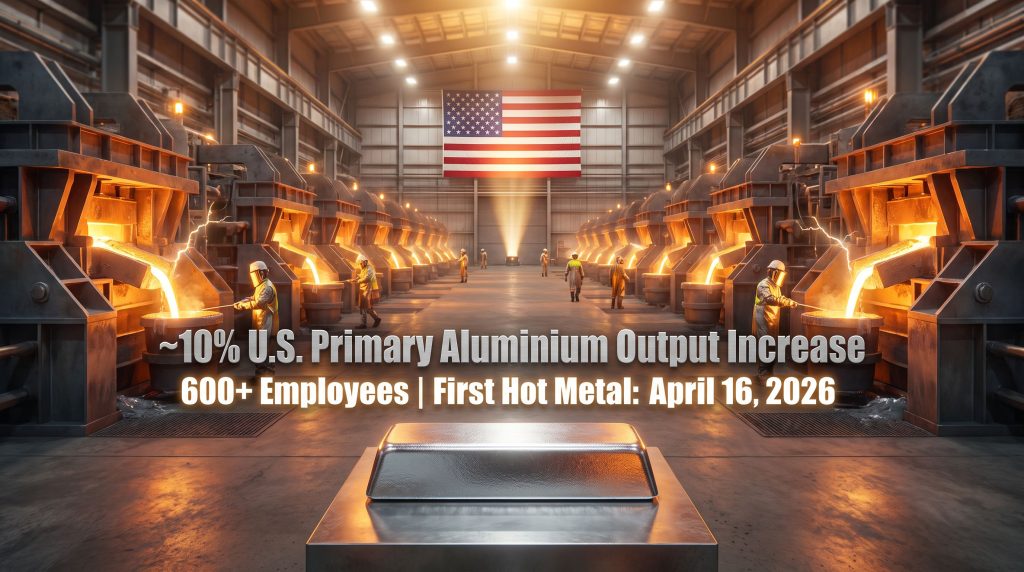
The Century Aluminum Mt. Holly expansion is projected to increase total U.S. primary aluminium production by approximately 10%, making it one of the most consequential single capacity additions to the domestic industry in recent memory.
To put that figure in context: U.S. primary aluminium production has been running at historically depressed levels for years. The U.S. Geological Survey has consistently reported American primary aluminium output at roughly 700,000 to 900,000 metric tonnes per year in recent years, a fraction of the country's peak production capacity from earlier decades. A 10% national output increase from a single facility restart underscores just how concentrated the remaining operational capacity has become.
Workforce Impact and Regional Economic Multipliers
The employment picture at Mt. Holly following the full expansion ramp-up is substantial:
- Total workforce at the facility: more than 600 employees
- Jobs directly created by the expansion project: more than 125 positions
- Broader economic multiplier effects extending across Berkeley County and the greater Charleston metropolitan area
In regional economic terms, smelter jobs tend to generate strong multiplier effects. Each direct manufacturing position in primary metals production typically supports multiple indirect and induced jobs across the local supply chain, from maintenance contractors and logistics providers to retail and service businesses serving the expanded workforce. Consequently, the wider economic benefit to South Carolina extends well beyond the facility's direct headcount.
The Trade Policy Architecture Enabling the Expansion
Section 232 Tariffs: How Import Costs Reshape Domestic Economics
Section 232 of the Trade Expansion Act of 1962 grants the U.S. President authority to impose trade restrictions on imports that threaten national security. The Trump administration applied this authority to aluminium, implementing tariffs that increased the landed cost of imported primary aluminium into the United States. The broader aluminium tariff impact across the industry has been significant, reshaping the competitive dynamics of domestic versus imported supply.
The mechanism by which tariffs support domestic smelter economics is straightforward: when import costs rise, the price gap between domestically produced aluminium and imported material narrows, improving the commercial viability of domestic production. For facilities like Mt. Holly, where the decision to restart a cold potline requires a credible long-term view on price realisations, tariff-driven import cost increases can represent the margin of difference between a project that stacks up financially and one that does not.
It is also worth considering how us tariffs on aluminum and steel have interacted with broader industrial policy objectives, reinforcing the case for domestic capacity investment across multiple metals sectors simultaneously.
It is important to note that trade policy environments can change, and any smelter restart premised on the continuation of current tariff structures carries inherent policy risk. If Section 232 tariffs were to be significantly reduced or eliminated, the economics underpinning domestic capacity restarts could deteriorate materially.
Government Stakeholders at the July 27 Inauguration
The roster of officials attending the Mt. Holly ribbon-cutting ceremony on July 27, 2026, provides its own form of market signal:
- Howard Lutnick — U.S. Secretary of Commerce
- Tim Scott — U.S. Senator, South Carolina
- Henry McMaster — Governor of South Carolina
- Jesse Gary — President and CEO, Century Aluminum
Cabinet-level attendance at a smelter inauguration is unusual enough to merit attention. It communicates that domestic primary aluminium production occupies a position of genuine political salience, not merely rhetorical priority. For investors and downstream industrial buyers, the level of governmental engagement also provides some degree of signal regarding the political durability of the policy environment that enabled the expansion, though no formal commitment to policy continuity should be inferred from ceremony attendance alone.
Is Mt. Holly the Opening Act of a Broader U.S. Aluminium Rebuild?
Century's Greenfield Ambition With Emirates Global Aluminum
In January 2026, Century Aluminum announced a partnership with Emirates Global Aluminum (EGA), one of the world's largest aluminium producers, to develop a new greenfield primary aluminium smelter in the United States. If completed, this facility would be the first new primary aluminium smelter built in the United States in nearly 50 years, and has been characterised by the company as potentially the largest single investment in a critical metal in U.S. history.
The Mt. Holly expansion functions as an important operational reference point for this more ambitious project. A successful restart that demonstrably improves plant economics, expands employment, and attracts senior government attention strengthens the case that Century Aluminum has the operational capability and stakeholder relationships to execute at a significantly larger scale. In addition, the top aluminium companies globally will be watching this development closely as a potential signal of where the industry's centre of gravity is shifting.
Mt. Holly vs. the EGA Greenfield: A Comparative View
| Dimension | Mt. Holly Expansion | EGA Greenfield Project |
|---|---|---|
| Project type | Restart and capacity uplift | New construction |
| Timeline | Completed mid-2026 | Development phase |
| National output impact | Approximately 10% increase | Potentially transformational |
| Capital intensity | Moderate (restart economics) | High (greenfield build costs) |
| Policy dependency | Section 232 tariff environment | Long-term policy certainty required |
The contrast between the two projects illustrates a fundamental distinction in aluminium industry investment strategy. Restarts leverage existing infrastructure and can be executed on compressed timelines when power economics align. Greenfield smelters, however, require multi-billion dollar capital commitments, decade-long construction and ramp-up periods, and a high degree of confidence in the long-term policy and energy cost environment.
The next major ASX story will hit our subscribers first
Downstream Sectors and Supply Chain Implications
Who Benefits From Greater Domestic Primary Aluminium Supply
Increased domestic primary aluminium output has cascading effects across the industrial economy. The sectors with the most direct exposure to supply chain improvements include:
- Defence and aerospace: Primary aluminium is a foundational material in aircraft fuselages, military vehicle structures, and naval applications. Reducing import dependency in this category has direct national security implications, independent of commercial pricing considerations.
- Automotive and transportation: The ongoing shift toward vehicle lightweighting, driven by both fuel economy regulations and electric vehicle battery range optimisation, has made aluminium one of the most demand-growth-positive industrial metals in the transportation sector.
- Electrical infrastructure: High-voltage transmission lines rely heavily on aluminium conductors. Grid expansion programmes tied to electrification and renewable energy build-out represent a structurally growing demand source for domestically produced aluminium.
- Consumer goods and packaging: Aluminium packaging, particularly beverage cans, represents one of the highest-volume end uses for the metal, and manufacturers have strong commercial incentives to source domestically when tariffs make imported material more expensive.
Century Aluminum's Competitive Position
Century Aluminum's dual identity as both the largest U.S. primary aluminium producer and a significant international operator through its Icelandic facilities gives the company an unusual strategic vantage point. Its domestic market leadership means it captures disproportionate benefit from any policy environment that improves the economics of U.S. primary production. Furthermore, its international exposure provides operational diversification against domestic energy cost volatility.
The critical minerals tariff landscape more broadly also plays into Century's strategic positioning, as primary aluminium increasingly features in discussions around critical materials security alongside more traditionally designated minerals. Industry analysts have noted that the 10% increase in U.S. primary aluminium production resulting from this expansion represents a meaningful structural shift in the domestic supply picture.
Frequently Asked Questions: Century Aluminum Mt. Holly Expansion
What is the Century Aluminum Mt. Holly expansion?
The Mt. Holly expansion is a capacity restart and production uplift project at Century Aluminum's primary aluminium smelter in Goose Creek, South Carolina. It involved reactivating a previously idled potline, enabled by a power supply agreement with Santee Cooper, with first hot metal produced on April 16, 2026.
How much will the expansion increase U.S. aluminium production?
The project is projected to lift total U.S. primary aluminium production by approximately 10%, one of the largest single capacity additions to the domestic industry in recent years.
How many jobs has the expansion created?
More than 125 jobs have been directly created by the expansion project, bringing total Mt. Holly employment to more than 600 workers at full ramp-up.
What role did trade policy play in enabling this project?
Section 232 aluminium tariffs introduced by the Trump administration raised the cost of competing imports, improving the relative economics of domestic primary aluminium production and supporting the commercial case for restarting idled smelter capacity.
When is the official inauguration?
The ribbon-cutting ceremony is scheduled for July 27, 2026, at the Mt. Holly smelter in Goose Creek, South Carolina.
Is Century Aluminum building an entirely new smelter?
In January 2026, Century Aluminum announced a separate partnership with Emirates Global Aluminum to develop what would be the first new primary aluminium smelter built in the U.S. in nearly 50 years, a project distinct from and more ambitious than the Century Aluminum Mt. Holly expansion.
Key Takeaways for Industry Observers and Investors
The Century Aluminum Mt. Holly expansion does not exist in isolation. It is the most visible current expression of a structural shift in how the United States thinks about domestic primary metals capacity, driven by the convergence of national security policy, energy economics, and trade architecture.
Several broader conclusions are worth drawing from this development:
- Stranded capacity is not dead capacity. Idled smelter potlines can be reactivated when energy and policy conditions align, and the timeline from restart decision to first metal can be significantly shorter than greenfield alternatives.
- Energy agreements are the linchpin. The Santee Cooper power deal was the proximate cause of the Mt. Holly expansion, reinforcing the principle that primary aluminium investment decisions are ultimately energy investment decisions.
- Policy dependency is a double-edged variable. The same tariff environment that enabled this restart introduces risk if the political winds shift. Investors and downstream buyers should monitor the durability of Section 232 measures as a key variable in the medium-term outlook.
- Mt. Holly is a proof of concept, not an endpoint. Century Aluminum's parallel pursuit of a greenfield smelter with EGA suggests the company views the current policy environment as a multi-year window of opportunity, not a temporary anomaly.
Disclaimer: This article contains forward-looking statements and references to industry forecasts that involve inherent uncertainty. Nothing in this article constitutes financial or investment advice. Readers should conduct independent research and consult qualified advisors before making investment decisions.
Want to Stay Ahead of Major Mineral Discoveries Driving the Next Industrial Metals Surge?
The structural shifts reshaping U.S. primary aluminium production are just one signal of how quickly commodity supply chains can reorder — and Discovery Alert's proprietary Discovery IQ model delivers real-time alerts on significant ASX mineral discoveries, turning complex data across more than 30 commodities into clear, actionable insights for investors at every level. Explore historic discoveries and their returns to understand what early positioning can mean, then begin your 14-day free trial at Discovery Alert to secure your market-leading advantage.