July 24, 2026
When Geography Becomes Destiny: The Trap at the Heart of Central Asian Oil
Few situations in global energy markets illustrate the concept of infrastructure sovereignty as starkly as the position Kazakhstan finds itself in today. Ukraine's drone war and Kazakhstan oil exports have become inextricably entangled, exposing how producers can be devastated by conflicts they play no part in. Yet Kazakhstan, possessing some of the world's most substantial crude reserves and holding unsanctioned barrels that European refiners actively want, is watching its export capacity erode in real time because of a war being fought hundreds of kilometres away on someone else's territory.
This is not a production story. Kazakhstan's reservoirs remain full. Its fields, though troubled by recurring operational failures, retain enormous throughput potential. The crisis is architectural: the physical corridors that connect Kazakh crude to paying customers were built during a different geopolitical era and now pass through, or terminate inside, an active conflict zone. Understanding the connection requires tracing the infrastructure logic baked into Central Asian energy development three decades ago. The broader geopolitical oil market dynamics shaping today's energy landscape make this case study all the more instructive.
When big ASX news breaks, our subscribers know first
The CPC Pipeline: Soviet-Era Engineering, 21st-Century Exposure
A Corridor Built for Efficiency, Not Resilience
After the Soviet Union's dissolution, the newly independent state of Kazakhstan faced a fundamental commercial problem: its most productive oil-bearing geology sat in the country's west, nowhere near a functional export route. The Caspian Pipeline Consortium was the answer. Constructed to connect the Tengiz field and surrounding western Kazakh production basins directly to international maritime trade lanes, the CPC pipeline runs over 1,500 kilometres from the Caspian basin to a dedicated export terminal near Novorossiysk on Russia's Black Sea coast.
The routing made perfect economic sense at the time. It was the shortest viable path from wellhead to deep water, minimising both construction costs and per-barrel transportation expenses. What the architects of that system could not have priced in was the possibility that the terminal's host country would one day be engaged in a sustained conventional and drone war making the entire Black Sea littoral a contested operational environment.
The Concentration Problem in Numbers
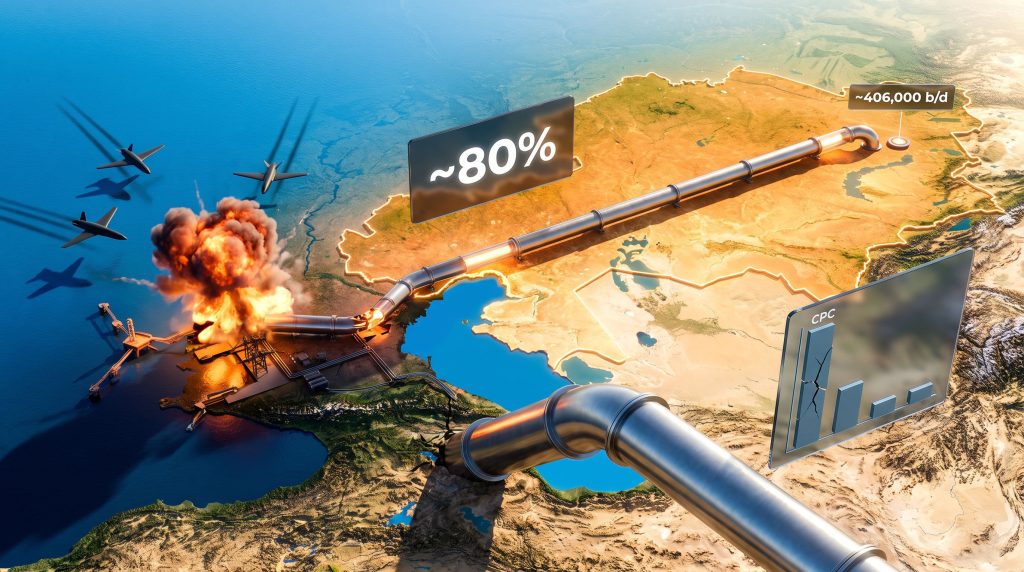
The scale of Kazakhstan's dependence on the CPC corridor is difficult to overstate. According to reporting by commodity analyst Natalia Katona for OilPrice.com, CPC exports averaged approximately 1.7 million barrels per day in the three months preceding the July 2026 disruption, with roughly 1.42 million b/d directed toward European buyers and approximately 280,000 b/d reaching Asian markets. That single corridor accounts for around 80% of Kazakhstan's total crude export volume.
| Export Route | Approximate Volume (b/d) | Share of Total Exports |
|---|---|---|
| CPC Pipeline (Novorossiysk) | ~1.42M (Europe) + 280,000 (Asia) | ~80% |
| Atyrau-Samara (Transneft) | ~220,000 | ~13% |
| Kazakhstan-China Pipeline | Up to 400,000 capacity | Partially utilised |
| Trans-Caspian / BTC Route | ~30,000 current | less than 2% |
An 80% concentration in a single export artery transforms any disruption from a manageable inconvenience into a systemic crisis. When CPC falters, Kazakhstan does not simply lose one option from a diversified portfolio. It loses the structural foundation of its entire oil trade.
How Drone Warfare Reached Kazakhstan's Export Terminal
The Escalation Architecture of Ukraine's Strategic Campaign
Ukraine's drone warfare capability has undergone a profound evolution since the early phases of the conflict. What began as tactically oriented operations has matured into a strategic campaign capable of reaching Russian rear-area logistics, energy infrastructure, and port facilities at considerable distance from the front lines. Consequently, the geopolitical risk in resources sectors has expanded well beyond traditional conflict boundaries.
The Novorossiysk CPC terminal sits firmly within this expanded threat envelope. A naval drone strike in November 2025 inflicted serious damage on one of CPC's single-point mooring systems — the specialised offshore loading buoys that allow tankers to receive crude without entering shallow coastal waters. These moorings are engineering-intensive assets that require months to repair and cannot simply be improvised around.
Through 2026, repeated attacks on tankers operating in the Black Sea region generated a second-order effect that proved equally damaging to Kazakhstan's export volumes as physical infrastructure destruction.
The Dual Mechanism: Physical Damage and Commercial Paralysis
What makes Ukraine's drone strategy particularly effective against Kazakhstan's export position is that it operates through two reinforcing channels simultaneously:
- Direct infrastructure damage targeting mooring systems, terminal equipment, and loading facilities, requiring costly repairs and creating extended operational gaps.
- Commercial deterrence that causes shipowners, charterers, and insurers to withdraw from terminal operations even when physical infrastructure remains technically functional.
By July 21, 2026, CPC had ceased accepting crude intake from Kazakhstan following a suspension of loadings at the terminal. As of July 23, no confirmed restart timeline had been established. The critical detail here is that terminal infrastructure remained nominally intact at that point. What had collapsed was the commercial ecosystem around it. Major vessel operators including ExxonMobil and Chevron withdrew from terminal calls, unwilling to expose crews and assets to the elevated and unpredictable risk environment.
The drone war does not need to destroy the CPC terminal to halt Kazakhstan's exports. It only needs to make the terminal commercially unusable. That threshold had already been crossed by mid-July 2026.
This distinction carries significant analytical weight. It means that even successful repair operations cannot restore normal export flows if the commercial deterrence effect persists. War risk insurance premiums, operator liability concerns, and corporate risk frameworks create a ceiling on operational recovery that physical reconstruction alone cannot overcome.
European Refining Markets and the Supply Gap
The Mediterranean Exposure Chain
Europe's dependence on CPC Blend is geographically concentrated in ways that amplify the disruption's downstream impact. Italy's port of Trieste functions as the primary European entry point for CPC crude, receiving approximately 300,000 b/d that subsequently feeds inland refiners in Austria, the Czech Republic, and Germany via pipeline connections through the Transalpine Pipeline system. France, the Netherlands, Spain, and Greece represent additional significant import markets.
Taken together, CPC and KEBCO (Kazakhstan Export Blend Crude Oil, transported through Russia's Transneft system) accounted for close to 15% of total EU crude imports in June 2026, as reported by OilPrice.com. That is a large enough share to generate meaningful Mediterranean supply tightness if deliveries are suspended for any extended period. Furthermore, this disruption illustrates the broader pattern of oil markets under conflict conditions producing cascading effects far from the original flashpoint.
Why CPC Blend Is Not a Simple Substitution
A widespread assumption in commodity markets is that crude grades are broadly interchangeable given sufficient price adjustment. CPC Blend's specific quality profile complicates that logic considerably:
- API gravity: approximately 45 degrees, classifying it as a light crude
- Sulphur content: approximately 0.6%, placing it in medium-sour territory
- This combination sits in an awkward middle position: lighter than most medium-sour grades, but sourer than premium light-sweet alternatives like Azeri Light or Saharan Blend
Refineries configured to process CPC Blend typically need functional desulphurisation capacity. European plants with limited hydrotreating infrastructure cannot simply switch to Azeri Light or Saharan Blend without processing adjustments, and those that do substitute face quality mismatches that reduce yield efficiency. Longer-haul Atlantic Basin alternatives are technically available but introduce both higher freight costs and extended delivery lead times.
Pricing Dynamics and Who Actually Benefits
Before the July 2026 loading suspension, CPC Blend was trading at a discount to Dated Brent of approximately $3 per barrel, which had narrowed to around $2 per barrel over the preceding four months, partly reflecting Middle East price dynamics and partly the supply overhang created by the 2025 Tengiz field expansion.
A prolonged loading suspension would be expected to compress Mediterranean crude availability and push regional differentials higher. However, the cruel paradox for Kazakhstan is that it cannot capture any of this price upside if its barrels cannot reach market. The primary beneficiaries of a CPC supply gap would instead be alternative regional producers. Libya and Azerbaijan are best positioned to absorb displaced demand volumes and capture the resulting differential widening.
Why Alternative Export Routes Cannot Fill the Gap
Assessing the Options with Precision
Kazakhstan's non-CPC export alternatives are frequently cited in energy policy discussions as potential diversification pathways. A rigorous assessment of their actual capacity reveals why near-term substitution is effectively impossible at the scale required.
Atyrau-Samara Pipeline (Transneft System)
This route handled approximately 220,000 b/d in 2025 against a nominal capacity of roughly 350,000 b/d. Barrels marketed under the KEBCO designation still transit Russian pipeline infrastructure and exit via Russian ports, exposing them to essentially the same drone strike risk as CPC volumes. Operating this route at full capacity provides partial volume relief without eliminating the underlying geographic vulnerability.
Kazakhstan-China Pipeline
Nameplate capacity sits at approximately 400,000 b/d, but this corridor is already integrated into established regional trade flows and partially used to transit Russian crude eastward. Redirecting significant incremental Kazakh volumes would require substantial commercial renegotiation and logistical restructuring that cannot be accomplished quickly.
Trans-Caspian / Baku-Tbilisi-Ceyhan (BTC) Route
This is the alternative most frequently discussed as Kazakhstan's strategic escape valve. Its current scale illustrates the depth of the infrastructure problem:
- Current operational volumes: approximately 30,000 b/d
- The Caspian Sea's extreme shallowness limits vessel size to approximately 15,000 tonnes per ship, representing roughly 10% of a standard Suezmax cargo
- The port of Aktau lacks sufficient storage infrastructure and loading capacity
- The Caspian tanker fleet is severely constrained in size
A particularly overlooked technical constraint deserves emphasis here. Because the Caspian is geologically a landlocked saltwater lake rather than a true sea, no external vessel can be sailed in from global shipbuilding markets. Every tanker operating there must be constructed locally, at significantly higher cost and with longer lead times than equivalent vessels built at major international yards. This single factor represents a structural ceiling on how rapidly the Trans-Caspian corridor can be scaled.
Kazakhstan and Azerbaijan have discussed lifting BTC route throughput to approximately 140,000 b/d by 2027, contingent on coordinated port expansion and fleet growth. Even achieving that ambitious target would replace only around 10% of CPC's European export volume. In this context, the Ukraine minerals strategic implications debate reflects a similar pattern of supply chain vulnerability forcing urgent strategic reassessment.
Scenario check: If the BTC route reaches 140,000 b/d by 2027 and the Atyrau-Samara pipeline operates at full 350,000 b/d capacity, combined non-CPC throughput would still cover less than 30% of Kazakhstan's current total export requirement.
Field-Level Disruptions Compounding the Infrastructure Crisis
Tengiz: Repeated Operational Failures at the Nation's Largest Field
Kazakhstan's largest producing field, Tengiz, operates at a normal rate of approximately 900,000 to 925,000 b/d. A fire and power failure in January 2026 cut output from that level to approximately 360,000 b/d, forcing operator Tengizchevroil to declare force majeure on CPC Blend supplies. Total CPC throughput fell to roughly 880,000 b/d that month. A secondary operational incident in May 2026 caused another sharp, though shorter-lived, production decline.
Following the July 2026 loading suspension, Tengiz output was halved to approximately 406,000 b/d, from a July average of roughly 925,000 b/d. Total Kazakh crude production fell to approximately 1.63 million b/d during the disruption week, against a July average of approximately 2.07 million b/d, according to OilPrice.com analysis.
Karachaganak: The Cross-Border Processing Trap
Less widely understood than the CPC infrastructure problem is Kazakhstan's Karachaganak field dependency. Karachaganak produces both oil and gas condensate alongside large volumes of sour associated gas. The critical operational constraint is that this associated gas cannot be fully processed within Kazakhstan's existing domestic infrastructure. It must be piped across the border to Russia's Orenburg gas processing plant for handling.
When Orenburg reduces its intake capacity for any reason, Karachaganak has no alternative processing outlet and must curtail gas production accordingly. Since the field's liquids output is physically linked to its gas production rates, a reduction in gas throughput directly reduces oil and condensate volumes.
A drone strike on the Orenburg facility on June 24, 2026 caused Karachaganak's liquids production to decline from approximately 34,000 tonnes per day to 25,000 tonnes per day — a reduction equivalent to roughly 70,000 b/d, according to reporting cited from Interfax Kazakhstan. While modest relative to total CPC flows, that figure demonstrates how a single strike on Russian territory can cascade into Kazakh production losses without touching Kazakhstan directly.
| Crisis Layer | Mechanism | Volume Impact |
|---|---|---|
| CPC Export Route | Drone attacks and commercial deterrence | Up to ~1.42M b/d European exports suspended |
| Tengiz Field Operations | Fire, power failures, force majeure | Output halved to ~406,000 b/d (July 2026) |
| Karachaganak Gas Processing | Cross-border Orenburg plant dependency | ~70,000 b/d liquids reduction per strike event |
The next major ASX story will hit our subscribers first
The Fiscal and Geopolitical Stakes
Kazakhstan's Budget at Risk
Oil and gas revenues support approximately half of Kazakhstan's national state budget. A prolonged CPC disruption does not merely reduce export volumes; it compresses government fiscal capacity with direct implications for public expenditure, currency stability, and sovereign credit metrics. The particularly acute dimension of Kazakhstan's predicament is that it simultaneously bears the downside of a supply disruption while being unable to capture any of the price upside that such a disruption would normally generate for producers with functional market access.
Europe's Structural Vulnerability
The near-15% share of EU crude imports represented by CPC and KEBCO volumes is large enough that any sustained interruption creates measurable tightening across Mediterranean refining markets. European refiners dependent on Trieste-delivered CPC Blend face a compounded challenge: securing replacement crude of comparable quality while managing the processing adjustments that grade differences require.
The disruption also reinforces a broader structural concern about European crude import concentration. Replacing Russian supply with CPC Blend seemed like diversification, but routing approximately 15% of EU imports through infrastructure that terminates on Russian territory has reproduced a version of the same geographic dependency in a different form. This is consistent with the wider pattern of geopolitical trade disruption reshaping supply chains across multiple sectors.
The Modern Drone Warfare Lesson for Energy Markets
Ukraine's demonstrated ability to disrupt Kazakhstan's oil export revenues through strikes on Russian territory reveals a dimension of modern drone warfare that energy risk frameworks have not yet fully absorbed. Non-combatant third parties with infrastructure routed through or adjacent to conflict zones now carry quantifiable exposure to operational and commercial disruption without being parties to the underlying conflict.
For Kazakhstan, the long-deferred cost of post-Soviet infrastructure integration with Russia has finally arrived as a concrete fiscal and operational reality. Resolving that dependency is a decade-long infrastructure undertaking. None of those projects can be accelerated in response to an acute export crisis. In the interim, Ukraine's drone war and Kazakhstan oil exports remain hostage to the trajectory of a conflict the country plays no part in fighting.
Frequently Asked Questions
Why does Ukraine attacking Russia affect Kazakhstan's oil exports?
Kazakhstan routes approximately 80% of its crude exports through the CPC pipeline, which terminates at a Russian Black Sea port near Novorossiysk. Ukrainian drone strikes targeting Russian energy and port infrastructure create both physical and commercial disruptions to this shared export corridor.
How much of Kazakhstan's oil production has been affected?
During the July 2026 disruption, total Kazakh crude production fell from a monthly average of approximately 2.07 million b/d to approximately 1.63 million b/d, while Tengiz field output was halved to around 406,000 b/d, according to Reuters reporting on the Novorossiysk disruptions.
Can Kazakhstan quickly switch to alternative export routes?
No. The BTC route currently carries only around 30,000 b/d, the Atyrau-Samara pipeline still transits Russian territory, and the Kazakhstan-China pipeline requires significant commercial restructuring. Even the most optimistic 2027 BTC expansion scenario of 140,000 b/d would replace less than 10% of CPC's European throughput.
Which European countries are most exposed to a CPC supply disruption?
Italy, via the port of Trieste at approximately 300,000 b/d, carries the most direct exposure, with downstream impacts on Austrian, Czech, and German inland refiners. France, the Netherlands, Spain, and Greece are also significant CPC import markets.
What is KEBCO and how does it differ from CPC Blend?
KEBCO (Kazakhstan Export Blend Crude Oil) is Kazakh crude transported through Russia's Transneft pipeline system and exported via Russian ports. It is commercially distinct from CPC Blend but carries similar geographic exposure to Russian infrastructure risk and the commercial deterrence effects generated by drone warfare in the region.
Who benefits from a CPC supply disruption?
Alternative regional suppliers with functional export infrastructure, particularly Libya and Azerbaijan, are best positioned to absorb displaced Mediterranean demand volumes. Kazakhstan itself cannot benefit from elevated prices while Ukraine's drone war and Kazakhstan oil exports remain in a state of effective suspension.
Disclaimer: This article is intended for informational purposes only and does not constitute financial or investment advice. Forecasts, volume estimates, and price projections involve inherent uncertainty and should not be relied upon as the basis for investment decisions. Readers should consult qualified advisers before making energy market or investment decisions.
Want to Stay Ahead of Major Resource Discoveries Before the Market Reacts?
While geopolitical disruptions reshape global energy supply chains, Discovery Alert's proprietary Discovery IQ model scans ASX announcements in real time, delivering instant alerts on significant mineral discoveries directly to subscribers — explore Discovery Alert's discoveries page to see how historic finds have generated substantial returns, and begin your 14-day free trial to position yourself ahead of the broader market.