
July 24, 2026
When Public Health Policy Becomes a Geopolitical Liability
The global race to secure critical minerals supply chains has never been straightforward. History shows that the most carefully constructed trade and investment frameworks are rarely undone by rival nations or market forces alone. More often, the unexpected variables — natural disasters, disease outbreaks, logistical disruptions — reshape the competitive landscape faster than any diplomatic negotiation can anticipate.
This dynamic is now playing out in real time across one of the world's most strategically important mineral corridors. The Democratic Republic of Congo holds a mineralogical endowment that is, by any measure, irreplaceable on the current timeline of the clean energy transition. Yet a public health emergency and the travel restrictions it triggered are placing serious friction on an investment partnership that Washington spent considerable diplomatic capital to secure. The intersection of Ebola curbs strain US-Congo minerals pact dynamics with broader geopolitical competition is creating a situation where the cost of inaction may ultimately exceed the risk the restrictions were designed to prevent.
When big ASX news breaks, our subscribers know first
Why the DRC Is Structurally Non-Negotiable for Critical Mineral Supply Chains
To understand the stakes, it helps to start with the geology. The natural resources in the DRC are not merely abundant — they are uniquely concentrated in ways that make substitution effectively impossible within the current decade.
- The DRC accounts for approximately 70–75% of global cobalt mine production, a share so dominant that no other producing nation, or combination of nations, can compensate at scale
- The Katanga Copperbelt, straddling the DRC and Zambia, represents one of the highest-grade copper deposits on earth, with average grades significantly exceeding most comparable global operations
- Lithium deposits in the DRC, particularly in the Manono region, are still being delineated but represent a long-term asset of material significance for battery supply chains
Cobalt is worth understanding in particular depth, because its market dynamics are unlike most other battery metals. Unlike lithium or nickel, cobalt has a very narrow primary production base, and a large share of global supply comes as a byproduct of copper mining rather than as the primary target of any mine. This byproduct economics model means that cobalt supply is partly determined by copper demand cycles, creating compounding volatility in availability. The DRC's dominance is therefore structural, not merely circumstantial.
"The DRC's cobalt position is not comparable to situations where market incentives can redirect capital toward alternative sources. The geology does not exist at equivalent scale anywhere else on the planet within a commercially relevant timeframe."
The December 2024 Agreement: What the US-Congo Partnership Was Built to Do
The US-Congo minerals partnership formalised between Washington and Kinshasa in December 2024 was designed against this geological backdrop. The core of the arrangement provided US-headquartered companies with preferential access to the DRC's copper, cobalt, and lithium reserves, creating a commercial counterweight to the entrenched position Chinese state-linked enterprises had built across Congolese mining assets over the preceding two decades.
The agreement's architecture was built around several key pillars:
- Preferential investment terms for US-based mining and exploration firms seeking DRC project exposure
- Joint development frameworks for copper, cobalt, and lithium extraction designed to accelerate project timelines
- A mechanism to reduce Western supply chain dependence on Chinese-controlled refining and mining operations within the DRC itself
China's footprint in the DRC is worth understanding in its full context. Chinese companies, many with direct state backing through entities such as China Molybdenum and affiliates of Zijin Mining, have progressively accumulated controlling or significant interests across major Congolese copper-cobalt operations over the past fifteen years. Furthermore, China also controls the majority of global cobalt refining capacity, meaning that even ore extracted by non-Chinese operators frequently passes through Chinese processing infrastructure before reaching battery manufacturers. The DRC cobalt export ban and the US-Congo pact were both explicitly designed to begin disrupting this dependency chain.
Ebola Curbs Strain US-Congo Minerals Pact: How the Outbreak Is Freezing Investment Momentum
The Scale of the Public Health Crisis
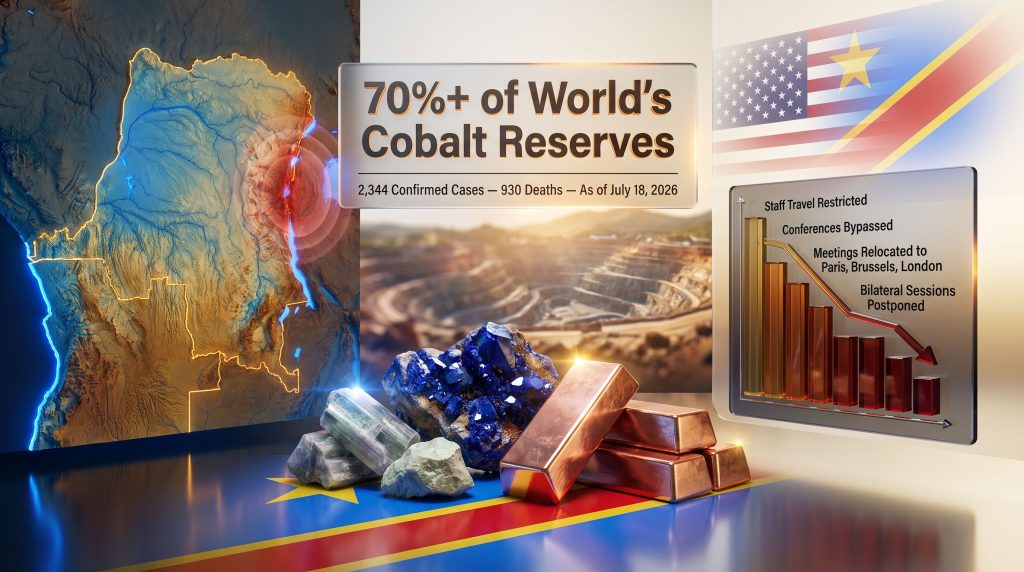
The Ebola outbreak declared in May 2026 had recorded 2,344 confirmed cases and 930 deaths as of July 18, 2026, according to DRC government data reported by Bloomberg News. The case fatality rate of approximately 39.7% reflects the severity of the Sudan strain, which historically carries higher mortality than the Zaire strain that caused the 2014–2016 West African crisis.
| Metric | Data |
|---|---|
| Confirmed Cases (as of July 18, 2026) | 2,344 |
| Recorded Deaths | 930 |
| Case Fatality Rate | ~39.7% |
| Outbreak Declaration Date | May 2026 |
| Geographic Origin | Remote eastern DRC |
The geographic origin in a remote eastern region is a critical detail that Kinshasa has been pressing in its diplomatic conversations with Washington. The outbreak is not centred in the major mining provinces of Katanga or the Copperbelt corridor, where the bulk of copper and cobalt production occurs. This geographic specificity is central to the DRC's argument for targeted rather than blanket travel restrictions.
How the 21-Day Quarantine Rule Operates in Practice
The US government's travel restriction mechanism works as follows:
- Any individual who has been present in the DRC, regardless of which region they visited, must complete a 21-day waiting period outside Congo before being permitted to enter the United States
- The rule applies whether the traveller visited the specific outbreak zone or spent their entire time in Kinshasa or the Katanga mining region
- All quarantine accommodation and associated logistics costs are borne by the traveller personally
- Washington subsequently widened the rule to cover US citizens in addition to non-citizens, as reported by Bloomberg News in July 2026, significantly expanding its commercial impact
- The US Embassy in Kinshasa issued formal travel advisories urging Americans to avoid travel to the DRC entirely
The commercial implication of this framework is straightforward to model. A standard exploratory business visit of five to seven days in Kinshasa effectively becomes a minimum 26-day commitment when the mandatory quarantine period is factored in. For senior investment personnel, legal advisors, and technical consultants operating across multiple jurisdictions simultaneously, this timeline is operationally incompatible with normal business cadences.
"A single site visit that would normally consume less than a working week now demands a calendar month of personal commitment from any US-based professional. The compounding effect across an entire investment ecosystem is commercially paralysing."
Investor Behaviour and the Operational Disruption Cascade
Conference Withdrawals and Restricted Field Operations
The commercial consequences of Ebola curbs straining the US-Congo minerals pact are already visible in investor behaviour. Multiple participants in the DRC's national mining conference held in June 2026 were absent due to the quarantine requirement, including KoBold Metals, the high-profile US-backed exploration company with active Congolese operations.
KoBold's local operations chief, Benjamin Katabuka, confirmed publicly that the company had formally restricted staff travel to the DRC to support its exploration programme. This is a meaningful operational disclosure: field exploration in early-stage mineral projects is not something that can be effectively substituted with remote management. Geological sampling, drill programme supervision, and community liaison require physical presence, and restrictions on that presence directly translate into delayed milestones.
The Meeting Relocation Problem
A secondary disruption pattern has emerged alongside the outright conference absences. Key bilateral meetings that would ordinarily occur in Kinshasa have been relocated to European cities including Paris, Brussels, and London. However, while this workaround preserves some diplomatic continuity, it introduces its own distortions:
- Decision-makers lose direct access to on-the-ground context that only in-country engagement provides
- Logistical costs increase materially for all parties
- The symbolic signal of relocation — that the DRC is currently too difficult to visit — creates a dampening effect on investor sentiment beyond those directly subject to the travel restriction
| Disruption Type | Downstream Consequence |
|---|---|
| Staff travel restrictions | Delayed field exploration and drilling programmes |
| Conference absences | Reduced deal-flow and investor network degradation |
| Meeting relocations | Higher transaction costs, reduced operational context |
| Postponed bilateral sessions | Slower development of the partnership framework |
| Broader investor hesitancy | Capital deployment delays across the DRC project pipeline |
Congo's Diplomatic Strategy: Seeking Modifications Without Rupturing the Relationship
Kinshasa's response to the travel restrictions has been calibrated to maintain the relationship while applying pressure for practical adjustments. DRC Foreign Minister Therese Kayikwamba Wagner travelled to Washington for World Cup and UN engagements after personally completing the full 21-day quarantine requirement — a gesture that signals Kinshasa's respect for US health protocols while demonstrating the impracticality of those protocols for senior diplomats.
Wagner characterised the diplomatic dialogue as involving frank exchanges on the restrictions, framing the disruption as a mutual commercial setback rather than a one-sided burden on the DRC. This rhetorical positioning is strategically deliberate: by emphasising that US companies seeking DRC investment exposure are equally disadvantaged by the quarantine requirements, Kinshasa aligns American commercial interests with the case for policy modification.
The State Department, for its part, has publicly maintained Washington's commitment to supporting US business interests in the DRC while emphasising the parallel priority of addressing the outbreak. As of the time of reporting, no imminent relaxation of the travel restriction framework had been signalled by the administration.
The next major ASX story will hit our subscribers first
The China Dimension: Asymmetric Advantage in a Window of Western Hesitation
Perhaps the most strategically consequential dimension of the current disruption is what it means for the competitive balance between US and Chinese operators in the DRC. The US-China cobalt rivalry is intensifying precisely because Chinese mining companies and their affiliated trading and processing entities operating in the Congo face no equivalent quarantine requirement, allowing them to maintain full operational continuity during a period when US and broader Western investors are effectively sidelined.
This creates a structural asymmetry that compounds over time:
- Chinese operators can continue advancing project development, community engagement, and technical delineation work
- US-backed companies cannot deploy field staff at normal cadence, creating relative delays in project advancement
- Investment committees evaluating DRC project allocations in the US face a quarantine-related friction cost that their Chinese counterparts do not
Historical evidence from the 2014–2016 West African Ebola crisis is instructive here. Research from that period indicates investor re-engagement following outbreak containment took 12 to 24 months to fully materialise, even after health agencies declared the emergency over. The psychological residue of a health emergency in an investment jurisdiction tends to outlast the biological emergency itself. Applied to the current DRC situation, this suggests that even rapid outbreak containment may not immediately restore the investment momentum the December 2024 agreement was designed to generate.
"The strategic irony is acute: a domestic public health policy designed to protect American citizens from an African disease outbreak may be inadvertently accelerating the precise supply chain dependency on China that Washington's minerals diplomacy was specifically constructed to reduce."
Scenario Analysis: Three Pathways for the US-Congo Pact
| Scenario | Required Conditions | Estimated Probability | Partnership Impact |
|---|---|---|---|
| Rapid Containment | Outbreak controlled by Q4 2026, restrictions lifted | Moderate | Partnership resumes with limited structural damage |
| Prolonged Outbreak | Cases persist into 2027, restrictions maintained | Moderate to High | Significant capital deployment delays; Chinese operators consolidate positions |
| Targeted Exemption Framework | US grants sector-specific waivers for mining and investment professionals | Lower but achievable | Partial restoration of momentum; precedent-setting for future health emergencies |
A targeted exemption framework is worth examining in more detail because it represents the most actionable near-term policy lever. Precedents exist from the COVID-19 era, when several governments constructed essential worker travel corridors and tested "travel bubble" frameworks that preserved economic activity in critical sectors while maintaining health security protocols. A similar architecture — combining rigorous testing requirements with professional credentialing for mining industry personnel — could restore investor mobility without relaxing broader public health protections.
Such a framework would require coordination between the State Department, the Centers for Disease Control and Prevention, and relevant trade agencies. The complexity is real, but so is the strategic cost of inaction. Consequently, every week of delayed engagement represents incremental consolidation by operators who face no equivalent restriction.
What Kinshasa Must Do to Accelerate Resolution
Congo's diplomatic strategy will be more effective if paired with concrete actions that build Washington's confidence in the containment trajectory:
- Transparent, real-time data sharing with US health authorities on case counts, geographic spread, and containment progress
- Demonstrated geographic ring-fencing of the outbreak zone to support the argument that mining provinces pose a materially different risk profile than the eastern region where cases are concentrated
- Continued high-level engagement in Washington to maintain the political visibility necessary for an exemption framework to receive serious consideration
Key Takeaways
- The US-Congo Strategic Investment Agreement, signed in December 2024, is Washington's primary instrument for securing preferential access to the DRC's copper, cobalt, and lithium reserves as part of a broader effort to diversify critical mineral sourcing away from Chinese-dominated supply chains
- Ebola curbs straining the US-Congo minerals pact have emerged as a material impediment to the agreement's implementation, with a 21-day mandatory quarantine applying nationally regardless of whether travellers visited the outbreak zone
- The DRC recorded 2,344 confirmed cases and 930 deaths from the outbreak as of July 18, 2026, with the crisis declared in May 2026
- KoBold Metals has formally restricted staff travel to the DRC, directly delaying field exploration activities; multiple investors bypassed the June 2026 national mining conference
- China's continued operational presence during the period of Western hesitation represents the most significant strategic risk embedded in the current disruption
- A targeted exemption framework for credentialed mining and investment professionals remains the most viable near-term policy pathway to restore momentum without compromising public health objectives
This article contains forward-looking analysis, scenario modelling, and strategic assessments that involve assumptions about future events. Readers should treat probabilistic assessments as analytical frameworks rather than predictions. Investors should conduct independent due diligence before making any decisions related to DRC-focused critical mineral projects or companies.
Want to Stay Ahead of Critical Mineral Discoveries as Supply Chains Shift?
While geopolitical disruptions reshape access to the world's most strategic mineral corridors, Discovery Alert's proprietary Discovery IQ model scans ASX announcements in real time, instantly identifying significant mineral discoveries across cobalt, copper, lithium, and more than 30 other commodities — turning complex data into actionable investment insights. Explore historic examples of major mineral discoveries and their market returns, then begin your 14-day free trial to position yourself ahead of the market.