
July 24, 2026
How Tariff-Rate Quotas Are Reshaping Global Steel Trade Flows
Tariff-rate quota systems represent one of the most technically intricate tools in the international trade policy toolkit. Unlike flat tariffs, which apply a uniform duty to all imports regardless of volume, a TRQ operates in two distinct tiers: imports below the quota ceiling enter at a preferential or zero rate, while volumes above that threshold attract a punishing out-of-quota levy. For steel, where marginal pricing can determine whether a cargo is commercially viable or economically ruinous, the difference between these two tiers is not academic — it is the entire basis on which export strategy is built.
The European Union's steel safeguard regime is precisely this kind of two-tier architecture, and understanding its mechanics is essential to understanding why the India EU HRC quota to exhaust quickly narrative has become one of the most closely watched dynamics in global flat steel markets during the second half of 2025. Furthermore, the broader global crude steel outlook provides critical context for why these quota dynamics are generating such acute commercial pressure.
When big ASX news breaks, our subscribers know first
What the EU's Revised Steel Safeguard Framework Actually Does
The EU's steel safeguard has been in operation in various forms since 2018, originally introduced as a protective response to trade diversion triggered by US steel and aluminum tariffs. The framework allocates country-specific tariff-free import volumes on a quarterly basis across a range of steel product categories. When a country's allocation is exhausted, further shipments attract a 50% out-of-quota duty — a rate so prohibitive that it effectively terminates most commercial trade flows until the next quarterly reset.
From 1 July, a revised version of the regime came into force, introducing material reductions to allocated volumes across multiple product categories. For hot-rolled coil specifically, the changes have proven more disruptive than headline figures alone would suggest.
The HRC Quota Reduction: Beyond the Headline Number
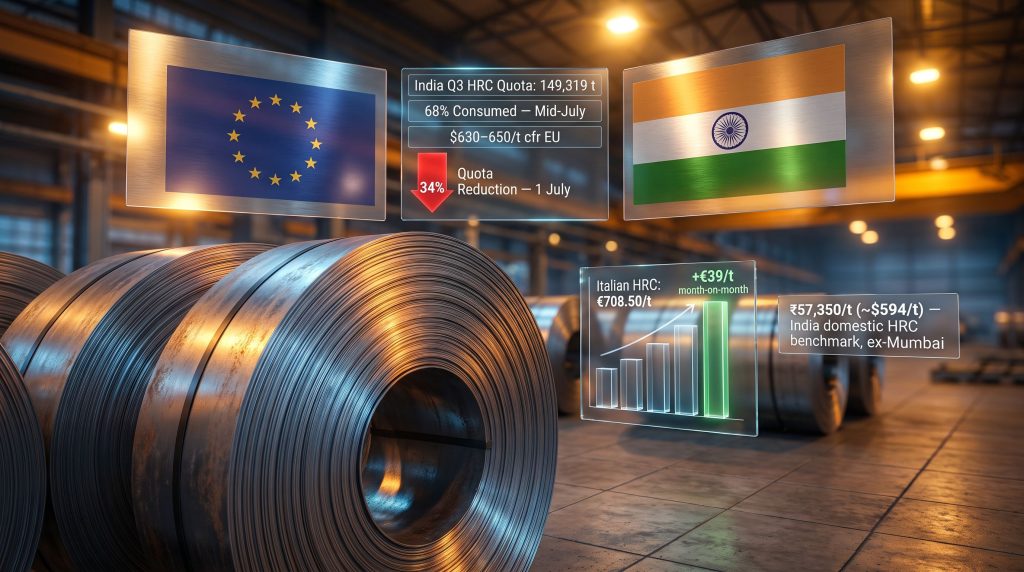
India's country-specific tariff-free HRC allocation was reduced by approximately 34% under the new regime, bringing the quarterly ceiling to around 149,319 tonnes. On the surface, this represents a significant but manageable constraint. In practice, the usable volume is considerably lower.
Italian steel association Assofermet flagged a structural inefficiency embedded within the quota architecture: small per-country sub-allocations within broader product categories cannot be aggregated or transferred between origin groups. This fragmentation means that the effective usable quota for HRC is materially below the nominal figure. Assofermet projected the new safeguard measures would result in a 60–70% decline in usable import volumes across the affected steel categories — a strikingly more severe outcome than the headline quota cuts would imply.
The plate category experienced an even sharper headline reduction — allocations fell by 46% to approximately 1.2 million tonnes per year — but the distribution of those volumes proved more favourable to market participants. The HRC cut, though smaller in percentage terms at 33% to 5.2 million tonnes per year, generated far greater commercial disruption precisely because of how the volumes were fragmented across origin countries. Indeed, reports on EU HRC quota filled by India confirm how rapidly these allocations are being consumed.
The contrast between plate and HRC market reactions illustrates a broader principle in trade policy design: the distribution of quota volumes can matter as much as the absolute quantity allocated, particularly when sub-allocations are too small to support commercially viable shipping consignments.
India's Export Calculus: Why the EU Has Become the Default Outlet
To understand why Indian mills are racing to fill EU quota windows with such intensity, it is necessary to examine what has happened to their alternative export corridors simultaneously. In addition, the China steel market outlook reveals how Chinese overcapacity is further displacing Indian exporters from key regional markets, intensifying the focus on European quota windows.
The Collapse of Alternative Markets
Three markets that previously offered Indian HRC exporters meaningful commercial outlets have deteriorated in parallel:
-
Vietnam has lost attractiveness as a destination, with shifting price dynamics and softening local demand compressing the margins that once justified the longer haul from Indian ports.
-
The Middle East has seen regional benchmark prices slide, eroding the premium that Gulf buyers had historically offered relative to the cost of supply from Indian mills.
-
India's domestic market is experiencing its seasonal monsoon trough, with consumption typically softening between June and September, eliminating the home-market absorption buffer that mills rely on during export slowdowns.
The Argus weekly domestic HRC assessment for 2.5–4mm material stood at approximately ₹57,350 per tonne (~$594/t) ex-Mumbai as of mid-July, having retreated from a multi-year high of ₹59,000/t reached in early April. The compression in domestic realisations has made the arithmetic of EU-bound exports increasingly compelling by comparison.
| Export Destination | Current Status | Primary Constraint |
|---|---|---|
| European Union | Active but quota-limited | 34% quota reduction; 50% out-of-quota tariff |
| Vietnam | Declining attractiveness | Compressed price premiums |
| Middle East | Weakening | Sliding regional benchmark prices |
| India (domestic) | Oversupplied | Monsoon-season demand trough; ~$594/t benchmark |
At confirmed transaction levels of $630–650/t cfr EU, the premium commanded by quota-eligible Indian HRC over the domestic benchmark is approximately $36–56/t — a meaningful spread that more than justifies the logistical complexity of European shipments, provided the cargo clears customs within the tariff-free window.
The Quota Burn Rate: How Fast Is India's Q3 Allocation Disappearing?
As of mid-July, approximately 68% of India's Q3 tariff-free HRC allocation had already been consumed, leaving around 47,000 tonnes of headroom within the current quarter. This pace of consumption is significantly faster than seasonal norms would predict and reflects a deliberate front-loading strategy by Indian mills seeking to maximise access before the window closes.
Market participants reported that EU importers had booked between 125,000 and 200,000 tonnes of Indian HRC over a compressed multi-week window, with the majority targeting July and August shipment windows. Negotiations for additional volumes were reportedly still active at the time these figures were circulating.
Most strikingly, at least 100,000 tonnes of Indian HRC was already positioned to clear EU customs at the opening of the October–December quota period — meaning the Q4 allocation was already being pre-committed before Q3 had even concluded.
Why Front-Loading Is Rational: The Regulatory Arbitrage Dynamic
The behaviour of Indian exporters is not irrational exuberance — it is a textbook response to regulatory asymmetry. Several forces converge to make front-loading the dominant strategy:
-
Policy uncertainty as an accelerant: credible expectations of further quota tightening in future periods incentivise maximum utilisation in current windows, as future allocations may be even more constrained.
-
Binary cost exposure: the gap between a zero-duty tariff-free shipment and a 50% out-of-quota levy is so extreme that any delay in registration risks catastrophic margin destruction on individual cargoes.
-
Seasonal surplus: India's monsoon period creates a structural window during which domestic demand softens, mills generate exportable surplus, and the commercial logic of aggressive EU targeting intensifies.
-
Competitive pre-emption: in a first-come, first-served allocation system, being second means paying 50% more. There is no mechanism for orderly sharing of quota access.
Market participants broadly characterise the current export surge as a tactical opportunistic response to a specific regulatory window, not a structural realignment of trade flows. The window is expected to narrow as Q4 quotas fill and European buyer activity slows during the summer holiday period.
The Turkey Factor: Competition for the Shared FTA Pool
Beyond the country-specific allocation, the EU safeguard framework includes a shared residual pool available to free-trade agreement partners on a first-come, first-served basis. For Indian exporters who exhaust their country-specific allocation, this pool represents a secondary pathway to tariff-free access — but it is contested territory.
Turkey holds a structural competitive advantage in this competition. Its geographic proximity to EU ports translates into shorter shipping lead times, meaning Turkish cargoes can be registered against quota openings faster than shipments originating from Indian ports. Turkey also benefits from established EU buyer relationships and a history of high utilisation of the shared pool in prior quarters.
Scenario Analysis: India's Q4 Shared Pool Access
Scenario A — Turkey dominates the pool: If Turkish shipment volumes in Q4 mirror Q3 patterns, the shared pool may be substantially consumed before Indian cargoes arrive. Indian exporters would face a binary choice: absorb the 50% out-of-quota tariff or redirect volumes to alternative destinations.
Scenario B — Pool access opens for India: If Turkish volumes moderate due to domestic demand recovery, logistical constraints, or EU buyer diversification toward alternative origins, residual pool capacity could become accessible. Indian mills positioned with ready cargoes and confirmed EU contracts could capture this window rapidly given the booking velocity already demonstrated.
The outcome of this competition will serve as a meaningful indicator of whether the EU's shared quota mechanism is functioning as intended or creating systematic concentration effects that favour geographically proximate suppliers over more distant — but commercially competitive — exporters. Furthermore, India's potential restrictions on the residual quota for HRC imports adds another layer of complexity to this already contested landscape.
How European Prices Are Responding to Import Compression
The consequences of rapid quota exhaustion are not confined to exporters. European steel buyers are already experiencing the downstream effects of constrained import availability.
Italian HRC prices rose by approximately €39/t month-on-month following the introduction of the new quota regime, with the daily Italian HRC index assessed at €708.50/t ex-works in late July. Perhaps more structurally significant is that HRC has moved to trade at a premium over hot-rolled plate (HRP) for the first time in more than four years — an inversion driven by the asymmetric impact of quota tightening across the two product categories.
While HRC prices climbed on supply tightness fears, plate prices moved in the opposite direction. The Italian plate index fell by approximately €25/t over the same monthly period, as declining slab prices removed cost pressure from plate re-rollers and high buyer inventories kept demand subdued. Some market participants have linked the fall in slab prices directly to the safeguard measures, reasoning that non-EU suppliers who could no longer access the HRC import window shifted production toward semi-finished material, where EU trade restrictions are less extensive.
The rerouting of HRC cargoes was also reported: trading firms redirected shipments away from European ports toward North Africa and other alternative destinations to avoid triggering the 50% out-of-quota exposure.
The next major ASX story will hit our subscribers first
EU Safeguard vs. US Section 232: A Comparative Framework
For trade strategists and policy analysts, the EU safeguard and the US Section 232 steel tariff represent two distinct philosophical approaches to the same underlying challenge of managing import competition in domestic steel markets. Consequently, understanding both frameworks — alongside the broader EU steel action plan — is essential for any stakeholder navigating the current trade environment.
| Policy Dimension | EU Steel Safeguard | US Section 232 |
|---|---|---|
| Mechanism | Tariff-rate quota (TRQ) with tiered duty structure | Flat 25% tariff with bilateral country exemptions |
| Country differentiation | Yes — country-specific quarterly allocations | Yes — negotiated exemptions and quota deals |
| Quarterly reset | Yes — creates cyclical booking surges | No — continuous application |
| Out-of-quota rate | 50% (post-July revision) | 25% flat rate |
| Structural incentive | Front-loading and quota racing | Predictable cost uplift; less timing dependency |
The quarterly reset feature embedded in the EU's TRQ design is particularly consequential. By creating a predictable calendar of fresh allocation windows, it structurally generates surges in shipment registration at the start of each new period. This means quota exhaustion speed is partly an artefact of the policy architecture itself, rather than purely a reflection of underlying steel demand. However, the relationship between tariffs and iron ore markets adds a further dimension, as upstream raw material pricing is itself influenced by these shifting trade flows.
What Stakeholders Should Monitor Going Forward
For Indian steel mills and exporters:
-
Prioritise early cargo registration at the opening of the October–December window, as forward bookings suggest the India EU HRC quota to exhaust quickly dynamic will be under pressure from day one.
-
Model the financial break-even point for out-of-quota shipments at the 50% duty rate against prevailing cfr EU pricing to determine whether above-quota volumes can remain commercially viable.
-
Develop contingency routing plans for volumes that cannot be placed within the EU quota framework, including reassessment of Middle East and Southeast Asian market economics.
For EU steel buyers and importers:
-
Recognise that the current booking surge is compressing available Q4 quota faster than historical norms, and plan procurement timelines accordingly.
-
Evaluate domestic European supply alternatives and origins not subject to the same quota constraints as a hedge against the possibility of quota exhaustion before year-end.
-
Factor the structural HRC-to-plate price inversion into product sourcing and substitution decisions, as this spread dynamic may persist while the asymmetric quota architecture remains in place.
For trade policy analysts:
-
The post-July safeguard architecture has demonstrably accelerated quota exhaustion cycles. This feedback loop — where tighter quotas generate faster exhaustion, which in turn validates tighter future quotas — may prompt further regulatory review as market distortion evidence accumulates.
-
The India-Turkey competition for residual pool access will provide a real-world test case for whether geographic proximity bias is an intended or unintended feature of the first-come, first-served allocation mechanism.
Disclaimer: This article contains forward-looking analysis, market projections, and scenario modelling based on publicly available information and reported market intelligence. Steel trade flows, pricing benchmarks, and quota utilisation rates are subject to rapid change. Nothing in this article constitutes financial or investment advice. Readers should conduct independent verification before making commercial or strategic decisions based on the information presented here.
Want to Stay Ahead of the Next Major Mineral Discovery on the ASX?
While global steel trade flows and quota dynamics reshape commodity markets worldwide, the opportunities emerging from significant mineral discoveries on the ASX demand equally rapid attention. Discovery Alert's proprietary Discovery IQ model delivers real-time alerts on significant ASX mineral discoveries — explore the historic returns major discoveries have generated and begin your 14-day free trial today to position yourself ahead of the broader market.