
July 24, 2026
The Structural Forces Reshaping US Aluminium Supply
Few industrial transitions reveal themselves through a single data point, yet the January 2026 US aluminium scrap recovery figures carry a weight that transcends routine monthly statistics. When secondary metal recovery accelerates at more than twice the pace of recent annual averages, it signals something deeper than seasonal variation. It points to a convergence of price mechanics, policy architecture, and supply chain reorientation that is actively reshaping how the United States sources one of its most strategically critical metals.
Understanding why US aluminium scrap recovery posted a 14% year-on-year jump in January 2026 requires looking beyond the headline number and examining the interlocking systems that make recycled metal increasingly attractive as a primary feedstock for American industry.
When big ASX news breaks, our subscribers know first
What the January 2026 USGS Data Actually Reveals
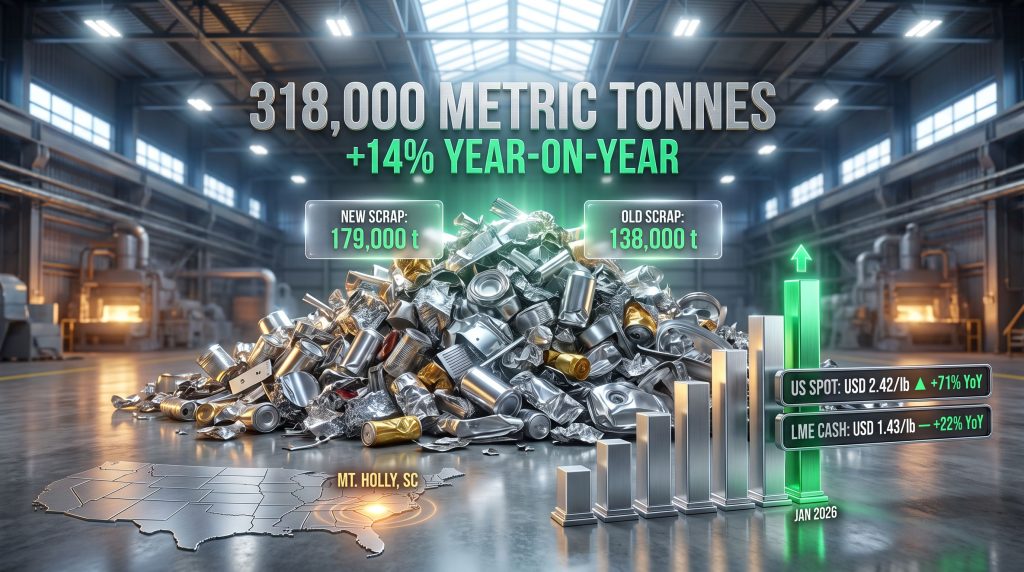
According to the USGS Mineral Industry Survey, total US aluminium scrap recovery reached 318,000 metric tonnes in January 2026. This represents a 14% increase compared to January 2025, when recovery volumes stood at approximately 297,000 metric tonnes, and a 3% rise from the revised December 2025 figure.
Breaking down the composition of that recovery total is instructive:
- New scrap: 179,000 metric tonnes (approximately 56% of total recovery)
- Old scrap: 138,000 metric tonnes (approximately 44% of total recovery)
New scrap originates from manufacturing and fabrication processes, including trimmings, offcuts, and production waste from downstream aluminium processors. Old scrap, by contrast, is recovered from end-of-life products such as vehicles, packaging, construction materials, and consumer goods. The current split suggests that industrial production remains the dominant driver of scrap generation, though the old scrap stream is growing in relevance as collection infrastructure matures.
Simultaneously, primary aluminium production in the US totalled just 58,000 metric tonnes in January 2026, with average daily output of 1,860 metric tonnes unchanged from December 2025 and only 1% higher than January 2025. The divergence between flat primary output and surging scrap recovery is the defining characteristic of the current supply moment.
Placing the 14% Surge in Historical Context
To appreciate the significance of the January 2026 figure, it must be measured against the broader arc of US aluminium recycling performance over recent years.
| Period | Recovery Volume | YoY Change |
|---|---|---|
| 2020-2021 | ~3.30 Mt (annual) | +8% |
| 2023-2024 | 3.31 Mt to 3.47 Mt (annual) | +4.83% |
| August 2024 (monthly) | Not disclosed | +6.07% |
| Jan-Apr 2025 vs Jan-Apr 2024 | Not disclosed | +2.7% |
| January 2026 (monthly) | 318,000 t | +14% YoY |
The 14% monthly year-on-year figure significantly outpaces the 2% to 8% range that has characterised most prior annual and monthly comparisons. Historically, US aluminium scrap recovery has grown steadily but incrementally, driven by gradual improvements in collection networks and modest price incentives.
The January 2026 acceleration suggests something qualitatively different is underway. Monthly snapshots can diverge from annual averages due to seasonal factors, one-off demand spikes, or inventory restocking cycles. However, when the divergence is this pronounced and coincides with identifiable structural catalysts, the case for a sustained trend rather than an anomaly strengthens considerably. Furthermore, according to recent market analysis, the US aluminium scrap trade is facing a significant shake-up amid shifting tariffs and global demand patterns.
A single month of 14% growth does not confirm a structural shift on its own. But when that growth occurs against a backdrop of rising price incentives, tariff-driven substitution effects, and capacity restarts, the probability that this represents a cyclical acceleration rather than noise increases substantially.
How Section 232 Tariffs Are Redirecting Aluminium Scrap Demand
On 2 April 2026, the US administration announced revised Section 232 tariff rules covering aluminium, steel, and copper imports. The key provisions affecting aluminium include:
- A 50% duty on primary aluminium imports, applied to the full customs value of imported goods rather than only the metal content
- A 25% duty on selected derivative aluminium products, also applied to full customs value
The distinction between taxing full customs value versus metal content alone is not a technical footnote. It is a structural amplifier. Because customs value includes freight, insurance, processing, and other costs layered above the raw metal price, the effective tariff burden on imported primary aluminium is materially higher under the revised framework than headline rates might initially suggest. The broader implications of US aluminium tariffs have been reshaping procurement strategies across the domestic supply chain.
By broadening the tariff base to encompass total customs value rather than metal content alone, the revised Section 232 framework dramatically increases the real cost of imported primary aluminium, creating a price gap that domestically recovered scrap is well positioned to fill.
This substitution dynamic is fundamental to understanding the scrap recovery surge. When the landed cost of imported primary aluminium rises sharply, downstream manufacturers and foundries face an economic incentive to source domestically recovered secondary metal instead. Scrap processors and recyclers benefit from the widened spread between scrap acquisition costs and primary metal reference prices, accelerating collection efforts and processing throughput. In addition, the combined effect of aluminium and steel tariffs has created ripple effects across multiple downstream industries.
Price Signals: The Economic Engine Behind Record Recovery
The price environment in January 2026 created near-ideal conditions for scrap recovery acceleration. The data tells a compelling story:
| Price and Inventory Metric | January 2026 Value | Month-on-Month Change | Year-on-Year Change |
|---|---|---|---|
| US Spot Price (Primary Aluminium) | USD 2.42/lb | +10% | +71% |
| LME Cash Price | USD 1.43/lb | +9% | +22% |
| LME US Warehouse Inventory | 6,239 tonnes | -24% | N/A |
| Aluminium Alloy Stocks | 120 tonnes | Unchanged | N/A |
The 71% year-on-year rise in the US spot price for primary aluminium is perhaps the single most powerful driver of the scrap recovery surge. At USD 2.42 per pound, primary aluminium is expensive enough to make secondary metal an attractive substitute across a wide range of applications.
The simultaneous 24% decline in LME US warehouse inventories to just 6,239 tonnes reinforces the tightness in the primary supply picture. When exchange inventories fall sharply, it typically signals that physical demand is drawing down available stocks faster than they are being replenished, a condition that tends to sustain elevated spot prices and, by extension, strong scrap collection incentives.
The price-recovery feedback loop works as follows: higher primary prices widen the margin available to scrap collectors and processors, who respond by increasing collection intensity and processing volumes. This self-reinforcing dynamic can sustain elevated recovery rates well beyond the initial price shock, particularly when tariff structures lock in a portion of the cost differential that drives substitution.
Century Aluminum's Mt. Holly Restart and Its Market Implications
On 16 April 2026, Century Aluminum announced the restart of previously idled production lines at its Mt. Holly smelter in South Carolina. The facility carries an annual production capacity of 229,000 metric tonnes and was targeting a return to full production by June 2026.
The Mt. Holly restart carries dual significance for the scrap recovery market:
- Demand amplification: Restarted smelters increase total aluminium demand within the domestic supply ecosystem. As overall production volumes grow, feedstock requirements expand for both primary and secondary inputs.
- Confidence signalling: A capacity restart of this scale reflects producer confidence in sustained elevated prices and favourable policy conditions, which in turn encourages further investment across the broader aluminium supply chain, including scrap processing infrastructure.
Some analysts question whether domestic smelter restarts compete with or complement scrap recovery growth. The more accurate framing is that they are complementary in the near term: expanded domestic capacity creates additional demand that scrap recovery must help meet, particularly when imported primary metal faces elevated tariff costs. Consequently, shifts in the broader aluminum and alumina markets are adding further complexity to the supply outlook. Over the longer term, however, the balance between primary and secondary supply will depend on how collection infrastructure, alloy quality requirements, and energy economics evolve.
The next major ASX story will hit our subscribers first
New Scrap Versus Old Scrap: Why the Feedstock Mix Matters
The composition of scrap recovery streams carries significant implications for processing economics, alloy quality, and long-term recycling capability.
New scrap generated during manufacturing tends to be chemically consistent, relatively uncontaminated, and easy to reintroduce into production with minimal sorting. Foundries and rolling mills often prefer new scrap precisely because its alloy composition is predictable, reducing the metallurgical uncertainty that can compromise downstream product quality.
Old scrap, recovered from end-of-life products, presents greater complexity. Vehicles, packaging, and construction materials contain aluminium in dozens of different alloy grades, often mixed with other metals, coatings, and contaminants. Separating and sorting old scrap to achieve consistent alloy specifications requires more sophisticated processing technology, including:
- Shredding and magnetic separation to remove ferrous contamination
- Eddy current separation for non-ferrous metal sorting
- X-ray fluorescence (XRF) and laser-induced breakdown spectroscopy (LIBS) for real-time alloy identification
- De-coating systems to remove paints, lacquers, and surface treatments before melting
The current recovery split (179,000 tonnes new vs 138,000 tonnes old) reflects a supply chain that still leans on manufacturing-derived scrap as its primary feedstock. However, as end-of-life collection systems improve and processing technology advances, the old scrap share is expected to grow, particularly as the large volumes of aluminium embedded in the existing vehicle and construction stock approach end-of-life. The lessons being learned from the battery recycling process in adjacent industries are also informing how complex material streams can be more effectively sorted and recovered.
A growing share of old scrap in the recovery mix is generally a positive indicator for recycling system maturity, but it also demands greater investment in sorting and processing technology to maintain the alloy integrity that downstream manufacturers require.
The Environmental Calculus: Why Secondary Aluminium Is a Decarbonisation Priority
Beyond price and policy, the environmental economics of aluminium recycling are compelling enough to sustain long-term structural demand for scrap recovery even in lower-price environments.
Secondary aluminium production requires approximately 95% less energy than primary smelting from bauxite ore. This energy differential translates directly into a substantially lower carbon footprint per tonne of metal produced. For industries with ambitious decarbonisation targets, including automotive, aerospace, and packaging, sourcing recycled aluminium is not merely a cost decision but a supply chain sustainability imperative. Indeed, the decarbonisation benefits of secondary metal use are increasingly being recognised at both the corporate and policy level.
Applying this lens to the January 2026 recovery figure: 318,000 metric tonnes of recovered aluminium represents an enormous avoided energy and emissions burden compared to producing the equivalent volume through primary smelting. As aluminium recycling shifts from a green initiative to a necessity, corporate sustainability commitments are hardening and carbon pricing mechanisms are expanding globally. Consequently, the premium placed on low-carbon aluminium feedstocks is likely to intensify further, adding another layer of structural support to scrap recovery economics.
Frequently Asked Questions: US Aluminium Scrap Recovery
What does aluminium scrap recovery measure?
Aluminium scrap recovery refers to the total volume of aluminium metal reclaimed from new and old scrap streams, measured in metric tonnes on a monthly or annual basis by the USGS Mineral Industry Survey. It captures the output of secondary smelters and refiners that process scrap into reusable metal.
Why did US aluminium scrap recovery jump 14% year-on-year in January 2026?
The acceleration reflects a convergence of factors: a 71% year-on-year rise in US primary aluminium spot prices, revised Section 232 tariff structures applying a 50% duty on imported primary aluminium based on full customs value, declining LME warehouse inventories, and growing downstream demand for domestically sourced secondary metal.
Is the 14% jump likely to be sustained through 2026?
While January 2026 may represent a cyclical peak rather than a new baseline, the structural drivers underpinning the surge, including elevated tariff costs for imported primary metal and high spot prices, are unlikely to reverse quickly. Recovery rates through 2026 will depend on how these factors evolve and whether scrap collection infrastructure can sustain increased throughput volumes.
How do Section 232 tariffs affect scrap recovery specifically?
By increasing the effective landed cost of imported primary aluminium, Section 232 tariffs widen the price advantage of domestically recovered scrap, incentivising greater collection, processing, and utilisation of secondary metal across US manufacturing and foundry operations.
What is the significance of the new scrap versus old scrap distinction?
New scrap is cleaner, more consistent in alloy composition, and easier to reprocess. Old scrap requires more sophisticated sorting and processing but represents a larger long-term resource as end-of-life aluminium products accumulate. The current split of 179,000 tonnes new to 138,000 tonnes old reflects the current state of US collection infrastructure.
Key Takeaways for Industry Observers and Investors
- The 14% year-on-year monthly recovery surge in January 2026 is the strongest short-term growth signal in recent US aluminium recycling data and significantly exceeds the 2% to 8% annual growth rates observed across 2021 to 2025
- Tariff architecture is playing a structural rather than merely symbolic role, with the full customs value basis for Section 232 duties materially raising the effective cost of imported primary aluminium
- Price dynamics are simultaneously reinforcing scrap economics, with US spot prices up 71% year-on-year and LME US warehouse inventories declining 24% month-on-month
- Primary production remains effectively flat at 58,000 tonnes per month, making secondary recovery the most accessible near-term source of domestic aluminium supply growth
- The Century Aluminum Mt. Holly restart adds 229,000 tonnes of annual primary capacity but also expands overall aluminium demand, reinforcing rather than undermining the case for continued scrap recovery growth
- The environmental premium on low-carbon secondary aluminium is becoming an independent driver of demand, separate from near-term price and tariff dynamics
Disclaimer: This article is intended for informational purposes only and does not constitute financial or investment advice. Forecasts and projections referenced herein are subject to material uncertainty. Readers should conduct independent research before making any investment or commercial decisions related to the aluminium industry.
Want to Stay Ahead of the Next Major Resource Discovery?
Discovery Alert's proprietary Discovery IQ model delivers real-time alerts on significant ASX mineral discoveries — including opportunities across the commodities driving today's most critical supply chain shifts — instantly transforming complex data into actionable insights for investors of all experience levels. Explore why historic mineral discoveries have generated substantial returns and begin your 14-day free trial today to position yourself ahead of the broader market.