June 10, 2026
The 45-Year Production Gap That Makes Century Aluminum's Expansion Historically Significant
The last time a greenfield primary aluminum smelter was constructed on U.S. soil, the world was running on rotary phones and analog television. That was 1980. In the four-and-a-half decades since, domestic primary aluminum production has contracted steadily while import dependency has deepened, leaving U.S. industrial and defence supply chains increasingly exposed to geopolitical volatility. Understanding the Century Aluminum stock expansion outlook requires stepping back into that long structural decline before examining what a reversal might mean for investors.
Primary aluminum production is not a commodity business in the conventional sense. It is an energy-intensive, capital-heavy industrial process where smelter construction costs run into the billions, where power contracts define competitive viability, and where gestation periods between investment decision and first metal pour can span a decade. The barriers to entry are extraordinary, which is precisely why the United States has not attempted a greenfield smelter project in over four decades.
When big ASX news breaks, our subscribers know first
Understanding the Structural Context Behind U.S. Aluminum Underinvestment
The hollowing out of U.S. primary aluminum capacity was not a sudden event. It unfolded gradually across decades, accelerated by a combination of rising domestic energy costs, globally subsidised competition from Chinese and Middle Eastern smelters, and a lack of sustained industrial policy commitment to domestic metal production.
At peak production in the early 1980s, the United States operated more than 30 primary aluminum smelters with combined output approaching 4.5 million metric tons per year. By the mid-2020s, that number had collapsed to a handful of operating facilities producing roughly 700,000 to 800,000 metric tons annually, representing a fraction of total U.S. aluminum consumption of approximately 5 to 6 million metric tons per year.
The gap between what is made domestically and what is consumed is filled almost entirely by imports, with Canada, the United Arab Emirates, and China being among the primary source countries. Furthermore, the broader U.S. supply chain strategy across critical materials has increasingly highlighted the risks of this dependency, intensifying policy interest in domestic capacity restoration.
This structural dependency creates vulnerabilities that extend well beyond commercial pricing risk:
- Aerospace and defence manufacturers requiring traceable, domestically sourced supply chains face growing qualification constraints
- Automotive supply chains pursuing near-shoring strategies encounter bottlenecks when domestic primary metal availability is limited
- Packaging and construction sectors remain price-exposed to Midwest premium fluctuations driven by import logistics and tariff policy
- Strategic metal stockpiling requirements for national security applications become increasingly complex when domestic production is minimal
The convergence of reshoring policy momentum, energy transition demand, and trade protection measures has repositioned domestic aluminum production as a strategic industrial priority. Consequently, U.S. aluminium tariffs have played a central role in creating the environment in which Century Aluminum's expansion thesis has gained traction among institutional analysts.
What the Century Aluminum Expansion Plan Actually Involves
The Century Aluminum stock expansion outlook rests on two distinct but complementary capacity initiatives operating across different time horizons. The near-term bridge is the Mt. Holly restart, while the transformational long-term catalyst is the planned Inola, Oklahoma smelter. Among aluminium industry leaders, this dual-track approach is relatively uncommon and signals meaningful strategic ambition.
The Inola, Oklahoma Smelter: Parameters and Strategic Significance
The proposed Inola facility represents the most ambitious domestic aluminum infrastructure project in modern U.S. industrial history. Developed in partnership with Emirates Global Aluminium (EGA), one of the world's largest aluminum producers, the project carries technical credibility that a purely domestic initiative might lack. Indeed, Century Aluminum is building a $4 billion smelter that would mark the first greenfield primary smelter development in the country in over four decades.
| Project Parameter | Detail |
|---|---|
| Location | Inola, Oklahoma |
| Development Partner | Emirates Global Aluminium (EGA) |
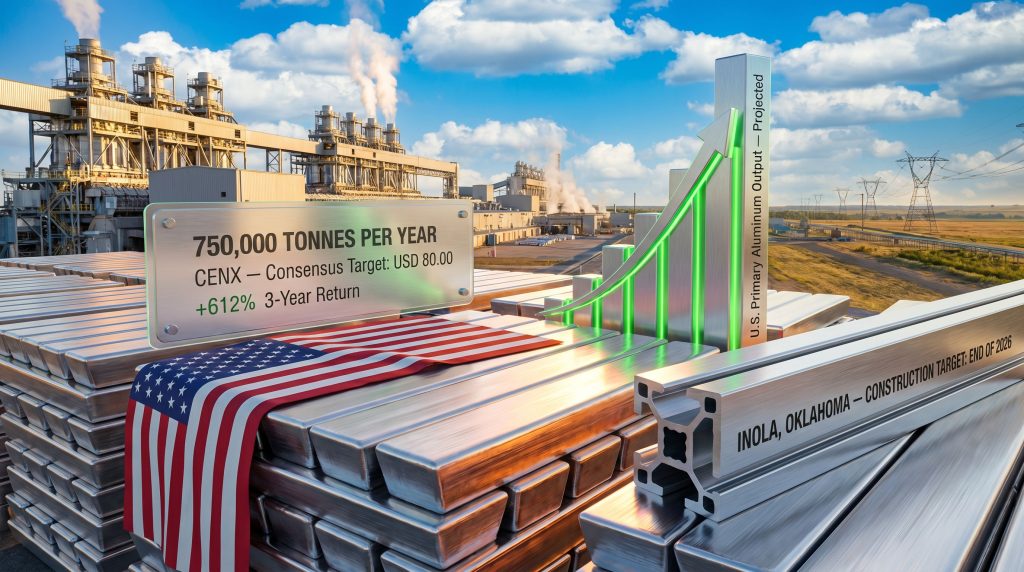
| Planned Annual Output | 750,000 tonnes per year |
| Impact on U.S. Output | Expected to approximately double current domestic primary production |
| Construction Start Target | End of 2026 |
| First Production Estimate | Post-2028 (later in the decade) |
The EGA partnership is worth examining more closely than most coverage suggests. EGA operates the Al Taweelah alumina refinery and the Jebel Ali smelter complex in the UAE, with total production exceeding 2.6 million tonnes per year. Its involvement brings not only financial capacity but operational expertise in building and commissioning large-scale smelters, a capability that is genuinely scarce in the North American industrial landscape.
At 750,000 tonnes per year, the Inola smelter would structurally transform the domestic supply equation. To put the scale in perspective, 750,000 tonnes represents roughly the equivalent of current total U.S. primary aluminum output, meaning successful completion would approximately double the country's domestic production base.
The downstream implications are significant:
- Domestic fabricators and rollers would gain access to locally produced primary metal, reducing reliance on imported ingot
- The Midwest premium could structurally normalise as domestic supply increases
- Aerospace and defence manufacturers pursuing domestic supply chain qualification would gain a meaningful new source of primary metal
- Long-term, the project could attract downstream processing investment to Oklahoma, creating an aluminum industrial cluster effect
The Mt. Holly Restart: The Near-Term Revenue Bridge
While the Oklahoma smelter dominates the long-term narrative, the Mt. Holly restart in South Carolina is the operational catalyst that matters most to investors with a 12 to 36-month horizon. The restart adds more than 50,000 metric tons of previously idled primary aluminum capacity, generating incremental revenue and improving fixed cost absorption across Century's operational base.
The economics of smelter restarts follow a relatively predictable pattern. Fixed costs do not scale linearly with production volume, meaning restarting idled capacity spreads those fixed costs across a larger production base. This mechanically compresses the per-unit cost of production even before any aluminum price improvement is factored in. This dynamic closely mirrors how aluminium power costs have shaped smelter economics globally, reinforcing why energy efficiency underpins financial viability.
The Mt. Holly restart functions as a dual proof-of-concept: it generates incremental near-term cash flow while simultaneously demonstrating that Century's operational team can execute complex smelter recommissioning, a capability that becomes central to credibility as the far larger Oklahoma project moves through development phases.
Management's Q2 2026 EBITDA guidance has been interpreted by analysts as a forward indicator of operational momentum. Execution quality at Mt. Holly is being watched as a proxy for confidence in the longer-dated Inola project.
Century Aluminum Stock Valuation: What the Numbers Reveal
The Century Aluminum stock expansion outlook from a valuation standpoint presents a genuinely complex picture that rewards multi-framework analysis rather than reliance on any single metric.
| Valuation Metric | Century Aluminum (CENX) | U.S. Metals & Mining Industry Avg. | Peer Group Avg. |
|---|---|---|---|
| Recent Share Price | USD 56.82 | N/A | N/A |
| Analyst Consensus Price Target | USD 80.00 | N/A | N/A |
| Implied Upside to Consensus | ~40.8% | N/A | N/A |
| Widely Cited Fair Value Estimate | USD 79.33 | N/A | N/A |
| DCF-Implied Intrinsic Value | ~USD 229 per share | N/A | N/A |
| Price-to-Earnings (P/E) Ratio | 16.1x | 21x | 13.4x |
The divergence between the DCF-implied value of approximately USD 229 per share and the current trading price of USD 56.82 is striking. However, sophisticated investors should treat this gap with analytical caution. DCF models for long-dated capital-intensive projects are highly sensitive to discount rate assumptions, terminal value calculations, and production timeline estimates, meaning small changes can produce dramatically different outputs.
The P/E positioning at 16.1x tells a more grounded story. Century trades at a premium to its direct peer group average of 13.4x, yet remains below the broader U.S. metals and mining industry average of 21x. This suggests the market has partially, but not fully, priced in execution success on the Oklahoma project. Furthermore, analyst consensus as of mid-2026 is constructively positioned:
- 4 Buy ratings across covering analysts
- 1 Strong Buy rating providing additional conviction signal
- Consensus price target of USD 80.00, implying approximately 40.8% upside from the recent USD 56.82 trading price
- Widely cited fair value estimate of USD 79.33, closely aligned with the analyst consensus target
The prevailing view among analysts is that the current market price does not yet fully reflect the long-term value embedded in Century's domestic expansion pipeline. However, this potential is explicitly conditional on execution quality, tariff policy continuity, and energy cost management. For additional context, analyst estimates for CENX reflect a range of scenarios that investors should review as part of their own due diligence.
Q1 2026 Financial Results: Parsing the Mixed Signals
Century Aluminum reported net sales of USD 649.2 million in Q1 2026, representing a 2.4% increase quarter-on-quarter, which came in ahead of revenue consensus estimates. However, the adjusted earnings per share figure fell short of analyst expectations, creating the mixed-signal dynamic that contributed to near-term share price weakness.
| Performance Metric | Reading |
|---|---|
| Q1 2026 Net Sales | USD 649.2 million |
| Quarter-on-Quarter Revenue Change | +2.4% |
| Adjusted EPS vs. Consensus | Below expectations |
| 1-Day Share Price Movement | -7.52% |
| 1-Month Share Price Movement | -8.71% |
| 90-Day Share Price Movement | +23.41% |
| 3-Year Cumulative Return | +612%+ |
The Q1 earnings miss on an adjusted EPS basis, whilst contributing to short-term price weakness, needs to be contextualised against the broader performance trajectory. A three-year cumulative return exceeding 612% reflects a fundamental re-rating of the business as the domestic expansion thesis gained credibility. In addition, the Alcoa strategic partnership model demonstrates how major aluminum producers are increasingly structuring large-scale ventures to share risk on transformational projects, a precedent relevant to evaluating Century's EGA arrangement.
Key Risk Factors That Could Undermine the Century Aluminum Growth Thesis
Balanced analysis of the Century Aluminum stock expansion outlook requires direct engagement with the risk framework rather than a focus solely on upside scenarios.
Execution Risk on Long-Dated Capital Projects
Greenfield smelter development is among the most execution-intensive industrial projects in the materials sector. Cost overruns on projects of this scale are historically common rather than exceptional. The Inola smelter, targeting construction commencement by end of 2026 and first production later in the decade, carries substantial timeline and budget risk. Even a 12 to 18-month delay in first production would materially alter the near-to-medium-term earnings trajectory.
Energy Cost Exposure: The Structural Achilles Heel of Aluminum Production
Aluminum smelting is among the most electricity-intensive industrial processes in existence. A modern smelter producing 750,000 tonnes per year will consume enormous volumes of power, with electricity typically accounting for 30% to 40% of total production costs. The United States does not have a uniformly low-cost power grid, and Oklahoma's industrial power pricing does not match the subsidised electricity rates available to smelters in the Gulf region or hydropower-advantaged facilities in Canada and Iceland.
Should U.S. industrial electricity prices escalate — driven by grid modernisation costs, renewable transition expenses, or demand competition from data centres and EV charging infrastructure — Century's cost competitiveness could erode even in a favourable LME pricing environment.
Section 232 Tariff Policy Risk: The Single Largest External Variable
The Section 232 tariffs on aluminum imports, which impose a 10% base tariff on most aluminum imports, have been a critical support mechanism for domestic primary aluminum producers. These tariffs inflate the Midwest premium above what pure supply-demand dynamics would generate, directly benefiting Century's realised revenue per tonne.
Any reduction or removal of these tariffs would compress Midwest premiums and potentially render the Oklahoma smelter project economically marginal at prevailing LME prices. This policy dependency represents a binary risk that cannot be fully hedged through operational improvements alone.
The next major ASX story will hit our subscribers first
Macro Forces Amplifying the Domestic Aluminum Production Thesis
Three structural forces are converging to support the longer-term aluminum demand environment in ways that extend well beyond current aluminum price levels:
- Energy Transition Infrastructure Demand: Aluminum is a critical material for solar panel frames, wind turbine nacelles, transmission infrastructure, and electric vehicle body structures. Some estimates suggest clean energy applications could account for 15% to 20% of total aluminum demand by 2035, up from single-digit percentages today.
- LME vs. SHFE Pricing Divergence: A notable dynamic has emerged where the London Metal Exchange aluminum price has been outperforming the Shanghai Futures Exchange price. This reflects tightening ex-China supply conditions and signals that outside-China producers, including U.S. domestic smelters, operate in a structurally tighter supply environment than the global headline price might suggest.
- Reshoring and Supply Chain Reconfiguration: The broader industrial policy environment favouring domestic manufacturing reinvestment has elevated aluminum, alongside semiconductors and pharmaceuticals, as a sector where import dependency is viewed as a strategic liability. This creates a durable tailwind for domestic capacity investment independent of short-term commodity price cycles.
Bull, Base, and Bear: A Structured Scenario Framework
Investors evaluating the Century Aluminum stock expansion outlook should consider the full range of outcomes rather than anchoring on a single projection.
Bull Case
- Mt. Holly restart completes on schedule, adding 50,000+ metric tons to near-term production
- Inola, Oklahoma smelter breaks ground by end of 2026 and progresses without material delays
- Section 232 tariffs remain in place, sustaining Midwest premium support
- Energy transition demand growth and ex-China supply tightness support LME aluminum prices
- Potential outcome: Material earnings re-rating, stock converges toward the upper range of analyst targets over a multi-year horizon
Base Case
- Mt. Holly restart proceeds with manageable friction; Oklahoma project encounters a 12 to 18-month delay
- Trade policy remains broadly supportive with some uncertainty premium embedded in valuations
- Aluminum prices stabilise at current levels without significant further upside
- Potential outcome: Stock progresses toward the USD 79 to 80 analyst consensus target range over 12 to 24 months
Bear Case
- Significant cost overruns or delays emerge at Mt. Holly or Inola
- Section 232 tariff reduction or removal compresses Midwest premiums materially
- U.S. industrial electricity price escalation erodes margin improvement from higher production volumes
- Potential outcome: Valuation multiple compression, share price retraces toward or below current levels with downward analyst target revisions
Frequently Asked Questions
What makes the Inola, Oklahoma smelter historically significant?
No new primary aluminum smelter has been built in the United States since 1980. The proposed Inola facility, developed with Emirates Global Aluminium, would be the first greenfield primary smelter project in the country in over 45 years. At 750,000 tonnes per year of planned capacity, it would approximately double current U.S. primary aluminum production.
Why does the EGA partnership matter beyond financial credibility?
Emirates Global Aluminium brings direct operational experience in constructing and commissioning large-scale modern smelters, a capability that is genuinely scarce in North America given the multi-decade absence of new smelter development. This technical expertise reduces, though does not eliminate, execution risk compared to a purely domestic development effort.
How should investors interpret the gap between the USD 56.82 trading price and the USD 229 DCF-implied value?
DCF valuations for long-dated infrastructure projects are highly sensitive to input assumptions and should be treated as illustrative of potential upside rather than reliable price targets. The more actionable signal is the analyst consensus target of USD 80.00, which implies roughly 40.8% upside and reflects a more grounded assessment of near-to-medium-term value realisable contingent on execution quality and policy continuity.
What is the single most important variable to monitor in the Century Aluminum growth thesis?
Energy cost trajectory at the Inola facility is arguably the most underappreciated long-term variable. Whilst tariff policy and execution risk attract most analytical attention, the long-term economics of the Oklahoma smelter will ultimately be determined by the power purchase agreements secured for a facility consuming power at industrial scale for decades. The terms of those agreements, which have not yet been publicly disclosed in detail, will be foundational to the project's long-term competitiveness.
Disclaimer: This article is for informational purposes only and does not constitute financial advice or a recommendation to buy or sell any security. All financial projections, analyst targets, and valuation estimates referenced are subject to change and carry inherent uncertainty. Readers should conduct their own due diligence and consult a qualified financial adviser before making any investment decisions. Past share price performance is not indicative of future results.
Want to Catch the Next Major Mineral Discovery Before the Market Does?
While Century Aluminum's historic expansion highlights the transformative potential of major industrial investments, the next significant opportunity could emerge from an ASX mineral discovery announced today. Discovery Alert's proprietary Discovery IQ model delivers real-time alerts on significant ASX mineral discoveries, turning complex data across 30+ commodities into clear, actionable insights — explore the historic returns major discoveries have generated and start your 14-day free trial to position yourself ahead of the broader market.