May 23, 2026
The Aluminium Value Chain Is Shifting — and Africa Is at the Centre of It
For decades, the global aluminium industry operated on a familiar geographic logic: resource-rich developing nations exported raw ore, while refining and smelting capacity remained concentrated in industrialised economies or, increasingly, in China. That model is now under measurable strain. Rising input costs, supply chain concentration risks, and growing pressure from resource-holding nations to capture more domestic value are collectively reshaping where alumina gets made and who controls that process. The Chalco alumina project in Guinea sits squarely at the intersection of these forces.
When big ASX news breaks, our subscribers know first
Understanding the Bauxite-to-Aluminium Value Chain
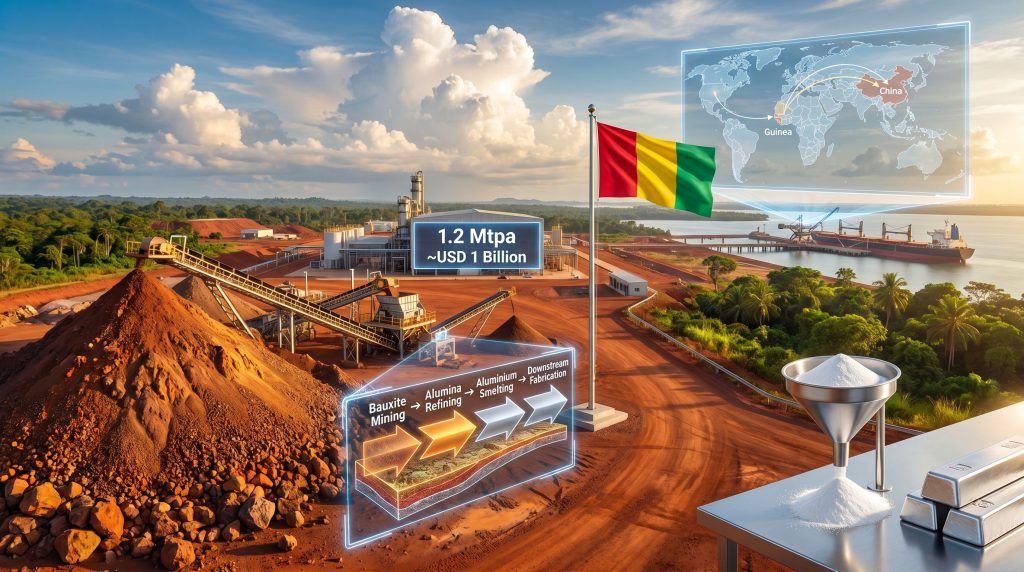
Before examining what Chalco is building in Guinea, it helps to understand the production architecture that makes this project strategically significant. Aluminium does not come directly from mining. It passes through three distinct transformation stages before it reaches industrial or consumer applications.
The step-by-step aluminium production chain works as follows:
-
Bauxite Mining – Raw ore is extracted from open-cut or shallow deposits. Guinea has historically served almost exclusively in this role, exporting unprocessed ore.
-
Alumina Refining – Bauxite is processed into aluminium oxide powder using the Bayer process, which involves dissolving crushed bauxite in sodium hydroxide at elevated temperatures and pressures. Critically, this conversion is inefficient by weight: it takes roughly 4 to 5 tonnes of bauxite to produce a single tonne of alumina.
-
Aluminium Smelting – Alumina is converted into primary aluminium metal through electrolytic reduction, a process that is exceptionally energy-intensive.
-
Downstream Fabrication – Primary aluminium is rolled, extruded, cast, or alloyed into finished products for construction, packaging, transport, and electronics.
Each step up this value chain represents a significant multiplication of economic output per tonne of raw material. Guinea has long been stuck at step one. That is precisely what makes the Chalco investment noteworthy.
Guinea's Position in Global Bauxite Supply
Guinea is not merely a significant bauxite producer. It is, by most geological assessments, one of the most important repositories of high-grade bauxite on the planet. The country holds an estimated one-quarter of the world's known bauxite reserves, with deposits characterised by exceptionally high aluminium oxide content and relatively shallow overburden, making them both high-quality and economically accessible.
Guinean bauxite is also notable for its low levels of reactive silica, a mineralogical quality that directly affects refinery efficiency. In bauxite processing, reactive silica consumes caustic soda during the Bayer process and reduces alumina recovery yields. Lower reactive silica content translates to lower processing costs and higher output per tonne of ore refined, which makes Guinean feedstock particularly attractive to refinery operators seeking operational efficiency.
Furthermore, these geological advantages explain why Guinea has attracted sustained Chinese investment over the past decade and why China's aluminium majors view the country as a long-term upstream anchor. Understanding global bauxite production trends helps contextualise just how central Guinea has become to the industry's future supply strategy.
What the Chalco Alumina Project in Guinea Involves
The Chalco alumina project in Guinea is structured as a 1.2-million-tonne-per-year (Mtpa) alumina refinery, developed through Chalco's Hong Kong-based subsidiary. It represents the company's first overseas alumina refining operation, a distinction that underscores its strategic rather than purely commercial motivation.
| Parameter | Detail |
|---|---|
| Planned Refinery Capacity | 1.2 million tonnes per year |
| Total Estimated Investment | Approximately USD 1 billion |
| Project Vehicle | Chalco Hong Kong subsidiary |
| Guinean Equity Option | Up to 35% local shareholding |
| Board Approval Date | 26 June 2025 |
| Disclosure Timing | Deferred post-approval due to active negotiations |
| Amended Agreement Signed | Thursday (week of disclosure) |
| Existing Bauxite Rights | Boffa North and South deposits (secured 2018) |
Three of Chalco's subsidiaries signed an amended and restated mining agreement with the Guinean government in conjunction with the project announcement. However, the investment remains conditional: it still requires approval from Chalco shareholders and sign-off from relevant Guinean government agencies before construction can formally begin.
How Chalco Built Its Guinea Platform
Chalco's position in Guinea did not emerge suddenly. The groundwork was laid in 2018, when the company's Hong Kong subsidiary and its Guinea-based mining and ports subsidiaries secured bauxite mining rights over the Boffa North and South deposits under an initial mining agreement with the Guinean government.
The Boffa operation subsequently shipped its first cargo in early 2021, with ramp-up targets pointing toward approximately 12 million tonnes per year of bauxite output. This operational track record is significant: it means Chalco already has demonstrated logistics infrastructure, port relationships, and regulatory familiarity in Guinea before attempting a far more complex downstream investment.
Building a refinery in-country without that operational foundation would carry substantially higher execution risk. Chalco's sequencing of resource rights first, then extraction operations, then refinery development reflects a disciplined approach to overseas mineral investment that is characteristic of large Chinese state-owned enterprises managing long-horizon resource strategies.
The deferred disclosure of the board's June 26 approval is also worth noting. Chalco cited concerns that premature public announcement could have disrupted the still-active negotiation process with Guinean counterparts, suggesting the final structure of the amended mining agreement involved genuine bilateral negotiation rather than simply rubber-stamping a predetermined arrangement.
Guinea's Equity Stake: What 35% Local Ownership Means
The option for Guinean parties to hold up to 35% equity in the alumina project is not a minor footnote. It reflects a structural shift in how resource-holding African nations are renegotiating the terms of foreign mineral investment.
Guinea has, like several other major African resource producers, progressively increased its demands for in-country value addition, local employment, and equity participation as conditions for approving large-scale projects. A 35% Guinean stake, if exercised, would give local stakeholders meaningful economic exposure to the refinery's operating cash flows rather than simply receiving royalties and export taxes on raw ore shipments.
The difference between exporting raw bauxite and exporting refined alumina is not merely technical. Alumina trades at a substantial premium to bauxite on a per-tonne basis, and retaining refining margin within the country fundamentally changes the economics of resource extraction for the host nation.
This dynamic is worth watching closely. If the Chalco project succeeds in demonstrating a viable in-country refining model, it could accelerate similar demands from Guinea toward other bauxite operators. In addition, other leading bauxite mines across the continent may face comparable pressure from their host governments in the years ahead.
The next major ASX story will hit our subscribers first
Competitive Landscape: Other Players in Guinea's Bauxite and Alumina Sector
Chalco is not the only significant operator in Guinea's bauxite corridor. However, what distinguishes this project from the majority of existing operations is its downstream refining ambition.
| Project | Developer | Current Status | Scale |
|---|---|---|---|
| Boffa Bauxite Mine | Chalco (existing operation) | Operational | ~12 Mtpa bauxite target |
| Chalco Guinea Alumina Refinery | Chalco (new project) | Pending approvals | 1.2 Mtpa alumina |
| Boké Bauxite Export Facility | Guinea Alumina Corporation | Operational (first ore 2019) | Export-scale bauxite |
The Guinea Alumina Corporation, backed by Emirates Global Aluminium among other stakeholders, has operated in the Boké region since shipping its first ore in 2019. However, that operation, like the majority of Guinea's bauxite activity, remains focused on raw ore export rather than in-country processing. Chalco's refinery proposal, if completed, would be a meaningful structural departure from the established model.
Why Global Commodity Markets Are Paying Attention
The alumina market is not as widely followed as aluminium metal prices, but it is arguably more important as a leading indicator of supply chain stress. Alumina spot prices are sensitive to refinery outages, shipping disruptions, and changes in Chinese domestic production capacity, all of which can create significant price volatility upstream of primary aluminium production.
China currently dominates global alumina refining capacity. Developing 1.2 Mtpa of overseas refining capacity in Guinea serves a dual function: it secures a geographically diversified source of alumina supply for Chinese smelters and simultaneously reduces the risk concentration associated with relying entirely on domestic Chinese refining infrastructure.
The 2.86% rise in Chalco's share price on the day of disclosure suggests that equity markets interpreted the announcement positively, viewing the investment as strategically coherent rather than financially reckless. Consequently, a USD 1 billion commitment to a first-of-kind overseas refinery is not a trivial capital allocation decision, and the market's response reflects confidence that Chalco's Guinea platform provides a credible foundation for the project's success. For broader context, the top aluminium miners globally are increasingly pursuing similar upstream diversification strategies.
Key Risks and Outstanding Hurdles
Despite the strategic rationale and existing operational footprint, the Chalco alumina project in Guinea faces a meaningful list of outstanding risks and approval requirements.
The primary risk categories include:
-
Shareholder approval – Chalco investors must formally approve the investment, which introduces the possibility of conditions being attached or timelines being adjusted.
-
Guinean regulatory sign-offs – Multiple Guinean government agencies are required to approve the project before construction can commence, and Guinea's regulatory environment has been subject to change following its 2021 military-led transition.
-
Infrastructure requirements – Constructing a 1.2 Mtpa refinery requires substantial energy supply, water access, and logistics infrastructure. Guinea's power grid outside of major urban centres is limited, and industrial-scale refinery operations are among the most energy-intensive processes in the mining sector.
-
Political environment – Guinea has been governed by a transitional military authority since the September 2021 coup. While foreign investment has continued to flow into the country's mining sector, the political transition introduces governance uncertainty that long-duration infrastructure projects must account for.
-
Execution complexity – This is Chalco's first overseas alumina refinery. The technical, logistical, and community engagement challenges of building refining infrastructure in West Africa are distinct from operating in China's well-developed industrial environment.
What This Signals for Alumina Supply Through the Decade
If the Chalco alumina project in Guinea reaches full production, its 1.2 Mtpa output would represent a meaningful addition to global alumina supply outside of China. For context, global alumina production sits in the range of 130 to 140 million tonnes per year, with China accounting for roughly half of that total. A single West African refinery is not a market-moving volume on its own, but as a template it carries outsized significance.
The more consequential scenario is one in which Chalco's project demonstrates that large-scale in-country alumina refining in Guinea is technically and commercially viable. That proof of concept could attract further aluminium sector investment from other producers seeking to diversify their upstream supply chains, potentially accelerating Guinea's transition from raw ore exporter to a more integrated node in the global aluminium production system.
Furthermore, recent examples of bauxite mine expansion elsewhere underscore a broader industry trend toward securing and upgrading upstream assets in anticipation of rising long-term aluminium demand.
Whether Guinea ultimately becomes a meaningful alumina processing hub will depend as much on infrastructure investment, energy development, and governance stability as it will on any single refinery project.
Frequently Asked Questions: Chalco's Guinea Alumina Project
What is the Chalco alumina project in Guinea?
It is a proposed 1.2-million-tonne-per-year alumina refinery to be built in Guinea by the Aluminium Corporation of China through its Hong Kong subsidiary. It would be Chalco's first overseas alumina production facility.
How much will Chalco invest in the Guinea alumina project?
Total investment is estimated at approximately USD 1 billion.
Does Guinea have an ownership stake in the project?
The updated mining agreement includes an option for Guinean parties to hold equity, with total Guinean shareholding permitted up to 35%.
Has the project been formally approved?
Chalco's board approved the project on 26 June 2025. The investment remains conditional on Chalco shareholder approval and sign-offs from relevant Guinean government agencies.
What bauxite assets does Chalco already operate in Guinea?
Chalco holds mining rights over the Boffa North and South deposits secured under a 2018 mining agreement. The Boffa operation shipped its first cargo in early 2021 and was targeting ramp-up toward 12 million tonnes per year of bauxite output.
Why is Guinean bauxite considered high-quality?
Guinea's bauxite deposits are characterised by high aluminium oxide content and low reactive silica levels. Lower reactive silica reduces caustic soda consumption and improves alumina recovery during the Bayer refining process, making Guinean feedstock economically attractive for refinery operators.
Why is this project strategically important beyond its production volume?
It represents the first attempt to establish large-scale alumina refining capacity inside Guinea, potentially shifting value capture up the aluminium production chain from raw ore royalties to refined product economics for the host country.
Disclaimer: This article is intended for informational purposes only and does not constitute financial or investment advice. References to share price movements, project timelines, and investment figures are drawn from publicly available sources and company disclosures. All investments involve risk, and readers should conduct their own due diligence before making any financial decisions.
Want to Know When the Next Major Mineral Discovery Hits the ASX?
Discovery Alert's proprietary Discovery IQ model delivers real-time alerts on significant ASX mineral discoveries, turning complex commodity data into actionable insights for investors at every experience level — start your 14-day free trial today, or explore historic discovery returns to understand just how transformative early positioning on major finds can be.