
June 15, 2026
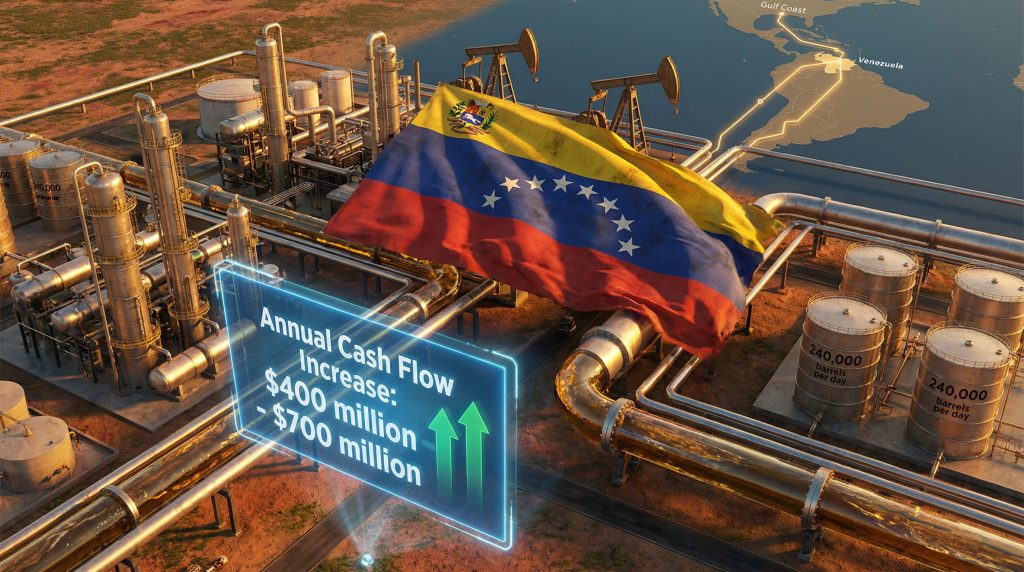
Global energy markets face unprecedented structural shifts as heavy crude supply chains undergo fundamental realignment. The world's largest proven oil reserves, concentrated in Venezuela's Orinoco Belt, represent a critical component of Western Hemisphere energy security infrastructure. Complex geopolitical dynamics, combined with decades of operational challenges, have created unique market opportunities for international oil companies positioned to navigate both technical and political risk factors in South American crude production. Furthermore, the Chevron cash flow increase Venezuela scenario demonstrates how strategic positioning can yield substantial returns.
Strategic Market Positioning in Venezuelan Heavy Crude Operations
The Venezuelan oil sector presents a distinctive competitive landscape where operational expertise intersects with geopolitical access privileges. Current market structure reflects significant consolidation, with Chevron maintaining exclusive positioning as the only U.S. oil major currently operating in Venezuela. This monopolistic advantage creates differentiated cash flow opportunities unavailable to peer companies seeking Latin American production growth.
Heavy crude processing capabilities represent a critical technical barrier to entry in Venezuelan operations. The Orinoco Belt produces predominantly 8-14 API gravity crude, requiring specialized refining infrastructure with hydrocracking, coking, and hydrogen treatment capabilities. Companies with existing Gulf Coast heavy crude processing assets maintain significant operational synergies, reducing feedstock costs and optimising refinery utilisation rates.
Production Scale and Joint Venture Economics
Current Venezuelan operations demonstrate substantial production volumes despite infrastructure constraints. Joint venture arrangements produce approximately 240,000 barrels per day, with production sharing agreements allocating roughly 50% to international partners and 50% to Petróleos de Venezuela SA (PDVSA). This structure creates operational leverage opportunities where production optimisation can yield disproportionate cash flow improvements.
The joint venture model provides several strategic advantages:
- Shared operational risk exposure with state-owned partners
- Access to established production infrastructure without greenfield development requirements
- Proven regulatory framework for international operations
- Existing crude offtake and transportation arrangements
Venezuela's proven crude oil reserves exceed 300 billion barrels, representing the world's largest documented reserves. However, production capacity remains significantly below historical peaks due to infrastructure deterioration and investment constraints. This creates substantial upside potential for companies capable of deploying optimisation capital and operational expertise.
When big ASX news breaks, our subscribers know first
Cash Flow Enhancement Projections and Financial Analysis
Financial analysts project substantial Chevron cash flow increase Venezuela contributions, with estimates ranging from $400 million to $700 million annually. These projections represent approximately 1% to 2% of total company cash flow from operations, indicating meaningful but non-transformational contribution to consolidated financial performance.
| Cash Flow Scenario | Annual Increase | % of Total Operations | Implied Production Growth |
|---|---|---|---|
| Conservative | $400 million | 1.0% | ~25,000 bpd |
| Base Case | $550 million | 1.5% | ~35,000 bpd |
| Optimistic | $700 million | 2.0% | ~45,000 bpd |
The cash flow enhancement calculations reflect several key operational assumptions:
- Current baseline production: 240,000 bpd through joint ventures
- Chevron working interest: Approximately 120,000 bpd net production
- Optimisation potential: 20-40% production increase from existing assets
- Heavy crude pricing: Venezuelan heavy crude trades at 15-25% discount to Brent
Production Scaling Economics Without Major Capital Deployment
Industry analysis suggests a measured approach to production expansion, prioritising optimisation over major capital commitments. This strategy reflects both political risk management and capital allocation discipline in uncertain regulatory environments. Additionally, the oil price rally factors indicate broader market conditions supporting Venezuelan operations.
Existing production infrastructure operates significantly below nameplate capacity due to deferred maintenance and equipment degradation. Historical production peaks exceeded 2.2 million bpd nationally (2016), compared to current total Venezuelan production of approximately 750,000-800,000 bpd. This indicates substantial idle capacity that could be restored through targeted maintenance and optimisation programmes.
Analysts expect companies will be hesitant to invest material incremental capital until there is a stable government and fiscal regime in place.
The optimisation-first approach offers several financial advantages:
- Higher return on invested capital from maintenance versus development spending
- Reduced political risk exposure through limited new capital deployment
- Faster cash flow realisation from production restoration versus greenfield development
- Operational flexibility to scale investment based on political stability
Infrastructure Constraints and Investment Risk Assessment
Venezuelan oil infrastructure reflects decades of underinvestment and operational challenges. Critical production facilities, pipeline networks, and refining capacity require substantial rehabilitation to achieve historical production levels. These constraints represent the primary risk factor limiting near-term production scaling potential.
Technical Infrastructure Assessment
Key infrastructure challenges include:
- Aging pipeline networks with limited maintenance and replacement programmes
- Production facility degradation affecting well performance and processing capacity
- Refinery capacity limitations constraining domestic crude processing
- Port and terminal infrastructure requiring upgrades for increased export volumes
- Power grid instability affecting production facility operations
The Orinoco Belt's heavy crude production requires specialised infrastructure for extraction, processing, and transportation. Heavy crude upgrading facilities convert extra-heavy crude (6-10 API) into synthetic crude suitable for conventional refining. Many upgrading facilities operate below capacity due to maintenance backlogs and equipment failures.
Political Stability and Regulatory Framework Considerations
Investment decisions in Venezuelan operations must account for significant political and regulatory uncertainty. Companies require stable fiscal regimes and contractual enforceability to justify major capital commitments in long-term development projects. Consequently, the trump tariffs' global impact adds another layer of complexity to investment calculations.
Historical precedent demonstrates substantial political risk in Venezuelan energy operations:
- Nationalisation actions in the 2000s affecting international oil companies
- Sanctions regimes limiting operational flexibility and financial transactions
- Currency controls creating challenges for capital repatriation and operational funding
- Production sharing modifications through administrative and legislative changes
Risk mitigation strategies focus on:
- Operational leverage from existing assets rather than major new investments
- Phased capital deployment contingent on political stability milestones
- Insurance and political risk coverage for critical infrastructure investments
- Diversified production portfolios reducing Venezuelan concentration risk
Heavy Crude Processing Integration and Refinery Optimisation
Venezuelan heavy crude integration with Gulf Coast refining infrastructure creates substantial operational synergies. Heavy crude refinery configurations optimise margins through integrated feedstock sourcing and processing efficiency improvements. Meanwhile, oil price trade war impact considerations influence pricing dynamics.
Refining Economics and Margin Enhancement
Heavy crude processing requires specialised refinery units:
- Hydrocracking units for heavy hydrocarbon conversion
- Coking facilities for residue processing and upgrading
- Hydrogen production for hydrotreating and desulfurisation
- Vacuum distillation for heavy crude fractionation
Companies with existing heavy crude processing capabilities maintain significant competitive advantages in Venezuelan crude monetisation. Integrated supply chains reduce feedstock transportation costs and optimise refinery utilisation rates compared to lighter crude alternatives.
The heavy crude discount to benchmark prices creates attractive refining margins. Venezuelan heavy crude typically trades 15-25% below Brent crude prices, providing feedstock cost advantages for refiners with appropriate processing capability. This discount reflects both crude quality characteristics and transportation logistics requirements.
Market Differentiation and Competitive Positioning
Venezuelan heavy crude access provides unique market positioning unavailable to competitors lacking operational presence. First-mover advantages in re-establishing Venezuelan operations could create sustainable competitive differentiation as production levels recover.
Key competitive advantages include:
- Established operational relationships with PDVSA and Venezuelan regulatory authorities
- Proven production infrastructure requiring optimisation rather than development
- Heavy crude processing expertise and refining integration capabilities
- Political risk tolerance and operational flexibility in challenging environments
Global Energy Market Implications and Supply Chain Dynamics
Venezuelan production recovery affects global crude oil supply balances and pricing dynamics. Western Hemisphere heavy crude supplies contribute to regional energy security and reduce dependence on Middle Eastern and African crude imports. However, oil price stagnation trends may impact profitability.
OPEC+ Market Dynamics and Production Coordination
Venezuela's OPEC membership creates complex interactions with global production coordination policies. Increased Venezuelan output could affect OPEC+ production sharing arrangements and influence global crude price stability mechanisms. Furthermore, the opec production impact remains a critical factor in market dynamics.
Current Venezuelan production represents a small fraction of global supply, but recovery to historical levels could significantly impact heavy crude markets:
- Historical peak production: 3.2 million bpd (1998)
- Current production levels: ~750,000 bpd
- Recovery potential: 1.5-2.0 million bpd over 5-10 year timeframe
Regional Energy Security Considerations
Venezuelan crude production contributes to Western Hemisphere energy independence and supply chain resilience. Reduced transportation distances to U.S. Gulf Coast refineries provide logistical advantages compared to intercontinental crude imports.
Strategic considerations include:
- Reduced import dependence on politically unstable regions
- Shorter supply chains improving delivery reliability and reducing transportation costs
- Regional economic integration supporting hemispheric energy cooperation
- Currency and trade balance benefits from reduced crude import requirements
Investment Analysis and Risk-Adjusted Return Projections
Venezuelan oil operations require sophisticated risk assessment frameworks accounting for political, operational, and market uncertainties. Investment returns must compensate for elevated political risk premiums while generating adequate cash flows under various scenario outcomes. According to Seeking Alpha's analysis, Venezuelan operations may have limited impact despite potential upside.
Portfolio Diversification and Strategic Asset Valuation
Venezuelan assets provide portfolio diversification benefits through:
- Geographic diversification reducing concentration in traditional production regions
- Heavy crude exposure complementing light crude production portfolios
- Growth optionality with substantial upside potential under favourable scenarios
- Operational leverage generating cash flow improvements from existing asset base
Risk-adjusted valuation models must account for multiple scenario outcomes:
Base Case (60% probability): Gradual production optimisation with limited political disruption
Upside Case (25% probability): Accelerated production growth with political stabilisation
Downside Case (15% probability): Production decline with increased political instability
Timeline Considerations and Investment Phasing
Venezuelan investment strategies require careful phasing based on political and operational milestones. Sequential capital deployment reduces risk exposure while maintaining strategic optionality for production expansion. Industry experts suggest that Chevron could potentially add significant cash flow from Venezuelan operations.
Phase 1 (Years 1-2): Infrastructure optimisation and maintenance programmes
Phase 2 (Years 2-4): Targeted production enhancement and facility upgrades
Phase 3 (Years 4-7): Major development programmes contingent on political stability
This phased approach allows companies to capture near-term cash flow improvements while preserving flexibility for larger capital commitments as risk factors evolve. Capital allocation discipline remains critical given the substantial political and operational uncertainties inherent in Venezuelan operations.
The next major ASX story will hit our subscribers first
Strategic Outlook for Venezuelan Energy Operations
Venezuelan oil sector development represents a complex intersection of technical capability, political risk management, and market opportunity assessment. Companies positioned to navigate these challenges effectively can capture substantial Chevron cash flow increase Venezuela opportunities while contributing to regional energy security objectives.
Success factors include operational expertise in heavy crude production, political risk tolerance, refining integration capabilities, and disciplined capital allocation frameworks. The Venezuelan energy sector offers significant long-term potential for companies capable of managing near-term uncertainties while building sustainable operational platforms.
Market participants must balance opportunity recognition with prudent risk management, ensuring investment strategies remain viable across multiple political and economic scenarios. Strategic patience combined with operational excellence will likely determine success in this complex but potentially rewarding market environment. In addition, the Chevron cash flow increase Venezuela scenario demonstrates how measured approaches to volatile markets can yield substantial returns for patient investors.
Looking for Early Access to Significant Energy Market Opportunities?
Discovery Alert's proprietary Discovery IQ model delivers real-time alerts on significant ASX mineral discoveries, instantly empowering subscribers to identify actionable opportunities ahead of the broader market. Begin your 30-day free trial today and secure your market-leading advantage.