
June 15, 2026
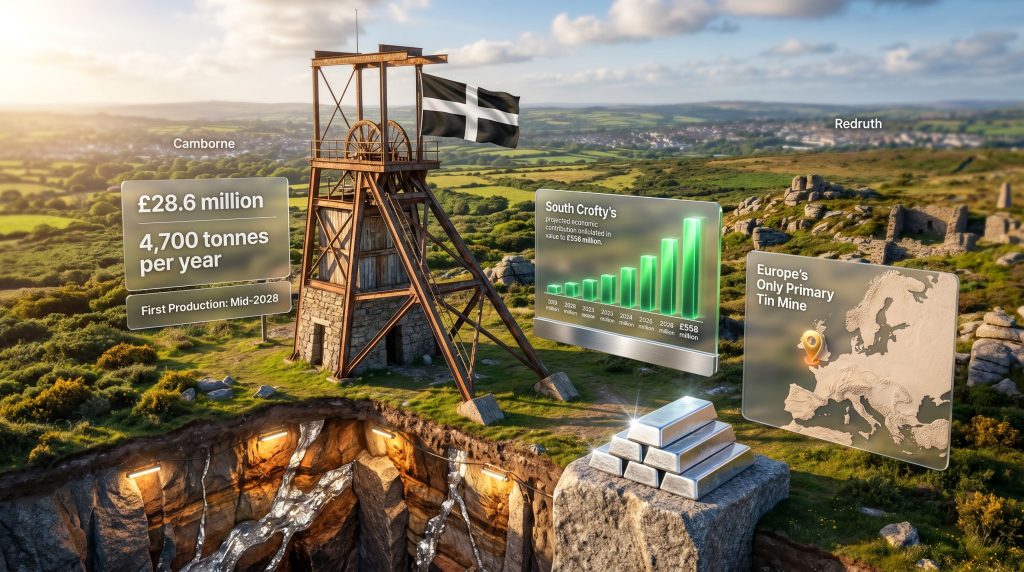
The Invisible Metal Holding the Modern World Together
Every circuit board manufactured today contains tin. Every solar panel, every electric vehicle battery pack, every smartphone screen relies on this often-overlooked metal as a fundamental binding agent in electronics assembly. Tin's role as the default soldering material in modern manufacturing is so deeply embedded that the global electronics industry simply cannot function without a reliable supply of it. Yet despite this structural indispensability, the Western world has watched its domestic tin production capacity erode almost entirely over the past three decades, concentrating supply risk in politically sensitive regions far from where the metal is actually consumed.
That vulnerability has brought renewed focus to a remarkable piece of industrial heritage sitting beneath the hills of southwest England. The South Crofty tin project in Cornwall represents something genuinely rare in the modern mining industry: a historically proven deposit, sitting within a stable Western jurisdiction, now being developed at precisely the moment when global demand for its output is accelerating fastest.
When big ASX news breaks, our subscribers know first
Why Europe's Tin Supply Problem Is More Serious Than Most People Realise
The supply concentration problem in global tin markets is stark when laid out numerically. Production today is dominated by a handful of countries, many of which carry meaningful geopolitical risk from a Western supply chain perspective.
| Region | Approximate Share of Global Tin Production |
|---|---|
| China | ~30% |
| Indonesia | ~20% |
| Myanmar | ~15% |
| Peru & Bolivia | ~10% |
| Rest of World | ~25% |
Myanmar's contribution is particularly concerning for European and American buyers. The country has experienced significant political instability since the 2021 military coup, and its mining sector operates under conditions that are increasingly difficult to reconcile with responsible sourcing standards demanded by Western manufacturers. Furthermore, Myanmar tin supply risks extend beyond political instability, with natural disasters adding further pressure to an already fragile supply chain. Yet Myanmar accounts for roughly one in every seven tonnes of tin produced globally.
The structural problem extends beyond political risk. Europe currently operates zero primary tin production facilities. Every tonne of tin used in European electronics manufacturing, renewable energy infrastructure, and industrial processes must be imported. This is not a minor procurement inconvenience; it is a systemic vulnerability in a supply chain that underpins virtually every technology sector on the continent.
The absence of any European primary tin producer means that a single supply disruption from a key exporting nation could directly affect the continent's electronics manufacturing capacity within weeks, not months.
Tin's applications are expanding beyond its traditional soldering role. Researchers and manufacturers have identified its utility in lithium-ion battery anodes, where tin-based compounds offer theoretical energy density advantages over conventional graphite. The broader critical minerals demand surge is also layering additional consumption growth on top of an already tight baseline supply picture, as tin oxide coatings become increasingly common in thin-film photovoltaic panels.
Four Centuries of Production History: Understanding the Deposit
Geology That Made Cornwall Famous
The mineralisation at South Crofty is a product of granite intrusion geology that defines the entire Cornish peninsula. When large granitic bodies cool deep within the Earth's crust, they create hydrothermal systems that drive metal-bearing fluids outward through fracture networks. These fluids deposit metallic minerals as they cool, forming the steeply dipping lode systems that have been the hallmark of Cornish mining for centuries.
What makes Cornwall's geology particularly productive is the vertical zonation of its mineralisation. Copper tends to crystallise at shallower depths and higher temperatures, while tin mineralisation forms deeper in the system at lower temperatures. This is why South Crofty's earliest recorded production, traceable to 1592, was centred on copper extraction. As shallow copper deposits were progressively exhausted through the 17th, 18th, and 19th centuries, operations pushed deeper and transitioned naturally into richer tin mineralisation.
This geological progression is not unique to South Crofty; it follows a predictable pattern observed across the entire Cornish granite batholith. The deposit's scale is substantial:
- The orebody extends more than 2.5 miles horizontally across the strike length
- Mineralisation descends to approximately 3,000 feet (910 metres) below surface
- The system contains more than 40 distinct lodes, developed and documented across four centuries of active mining
- The deposit sits beneath the village of Pool, positioned between Camborne and Redruth in Cornwall's historic mining heartland
What Closing a Mine for 27 Years Actually Does to a Deposit
One of the least-discussed technical dimensions of the South Crofty revival is what a 27-year closure period means for the underground workings. When South Crofty ceased operations in March 1998 following the sustained collapse of international tin prices, the dewatering pumps were eventually switched off. Groundwater, which is always present at depth in Cornwall's fractured granite geology, began filling the mine progressively.
After more than two decades of flooding, the underground infrastructure exists in an unknown state of preservation. Shaft linings, particularly in areas of geological complexity or historical construction variability, may have deteriorated. Timber supports used in older workings will have degraded. Ventilation infrastructure, electrical systems, and ore handling equipment all require comprehensive assessment before any production activity can recommence.
This is not a simple matter of reopening a door. It is closer to a forensic engineering exercise conducted 900 metres underground, in a flooded environment, across a mine that was constructed in multiple phases spanning four centuries of evolving engineering practice.
The Economic Case: From Closure Economics to Revival Economics
Why 1998 Happened and Why 2025 Is Different
The 1985 collapse of the International Tin Council's price buffer mechanism was one of the most significant commodity market failures of the 20th century. The ITC had maintained artificially elevated tin prices through a combination of strategic stockpile management and production quotas. When the mechanism failed, prices fell by roughly 50% within weeks, destroying the economics of high-cost deep underground operations across the Western world almost instantly.
South Crofty survived for thirteen years after that collapse through a combination of cost reduction, selective high-grade mining, and periodic restructuring. By March 1998, however, the arithmetic had become irreversible. The mine closed, ending what had been nearly continuous commercial tin production in Cornwall stretching back over 400 years.
The structural forces that make revival viable today are fundamentally different from anything that existed during South Crofty's previous operating periods:
- Post-2020 tin price recovery driven by electronics demand growth and supply constraints has materially improved project economics at depth
- Geopolitical supply chain anxiety has elevated the strategic value of Western domestic production beyond pure commodity economics
- Green technology demand growth in batteries, solar panels, and EV components is creating new demand vectors that did not exist in 1998
- Environmental and social governance frameworks have created a premium market for responsibly sourced tin that Cornish production would naturally qualify for
In addition, comparable projects across Europe are also emerging. For instance, Spanish tin development at the Oropesa project reflects a wider continental push to rebuild domestic tin supply capacity, further validating the strategic rationale behind South Crofty's revival.
Production Economics and Mine Life
The project's economic parameters, as currently planned, are significant for both the company and the broader UK economy.
| Economic Metric | Projected Figure |
|---|---|
| Annual tin production (steady-state) | ~4,700 tonnes |
| Projected mine life | 14 years |
| Total UK economic contribution | £558 million (~US$759 million) |
| Direct employment | 300+ jobs |
| Indirect and supply chain employment | ~1,000 roles |
| Total regional employment impact | Up to 1,300 positions |
To contextualise the production volume: global tin consumption runs at approximately 350,000 to 380,000 tonnes annually. South Crofty's projected output of 4,700 tonnes represents roughly 1.2 to 1.3% of global annual demand. In absolute terms, that figure appears modest. In European terms, however, it represents the entirety of the continent's primary tin production. That distinction matters enormously for supply chain planners and policymakers.
The Development Timeline and Where the Project Stands Today
Key Milestones From Closure to Planned Production
| Year | Development Milestone |
|---|---|
| 1998 | Mine closure following prolonged low tin prices |
| 2018 | Funding secured for water treatment plant construction |
| June 2020 | Underground test drilling programme commenced |
| 2024/2025 | U.S. Export-Import Bank (EXIM) issues non-binding Letter of Interest |
| January 2025 | UK government announces £28.6 million investment commitment |
| 2025 | Dewatering permit granted |
| Mid-2028 | Targeted first tin production |
The Dewatering Challenge: The Gatekeeper to Everything Else
Dewatering is the single most operationally critical step in the entire South Crofty restart sequence. Until the flooded underground workings are drained, nothing else can progress. No rehabilitation drilling, no infrastructure assessment, no resource confirmation, no production development.
The process is technically complex for several reasons specific to Cornish geology:
- Cornwall's granite is highly fractured, meaning groundwater connectivity between adjacent mine systems and the surrounding rock mass is significant
- Pumping rates must be managed carefully to avoid destabilising surface structures or affecting neighbouring water tables
- All extracted water must be treated to the required environmental standard before discharge, which is why the water treatment plant funded in 2018 was a prerequisite investment rather than an optional infrastructure component
- The dewatering permit granted in 2025 represents a regulatory milestone that authorises this controlled extraction and treatment process
The pace at which dewatering can be completed will directly determine whether the mid-2028 first production target remains achievable.
Financial Architecture: What Has Been Committed and What Remains Outstanding
The UK Government's £28.6 Million Commitment
In January 2025, the UK government announced a £28.6 million investment in the South Crofty tin project in Cornwall. This commitment reflects the project's alignment with the UK's Critical Minerals Strategy, which formally identifies tin as a priority resource given its role in electronics manufacturing, defence systems, and clean energy infrastructure.
It is important for investors and observers to understand what this commitment represents and what it does not. Government investment of this scale provides meaningful capital support and signals policy-level confidence in the project's strategic rationale. However, bringing a deep underground mine of South Crofty's complexity into production requires a substantially larger capital package. The government's £28.6 million is a significant contribution, but it is not a complete financing solution.
The U.S. EXIM Bank Letter of Interest
The U.S. Export-Import Bank issued a non-binding Letter of Interest indicating potential financial support for South Crofty, conditional on the project supplying a verified responsible tin concentrate to the United States. This development reflects the broader Minerals Security Partnership framework, through which allied Western nations are actively seeking to develop non-Chinese critical mineral supply chains.
Investor Caution: Non-binding letters of interest from export credit agencies carry no financing guarantee. They indicate strategic alignment between a project's output and national supply chain objectives, but they are not committed capital. Investors should track binding financial milestones rather than preliminary expressions of interest when assessing project advancement.
The strategic logic is clear. American electronics manufacturers and defence contractors consume significant volumes of tin. A verified, responsibly sourced supply from a stable Western jurisdiction aligns directly with both U.S. industrial policy objectives and the sourcing requirements of American technology companies. Consequently, this mirrors interest seen in other Western tin projects, where Bisie tin mine volatility in the DRC has reinforced the appeal of stable, transparent supply alternatives.
Cornish Metals Inc.: The Developer
The project is owned and being advanced by Cornish Metals Inc., a Canadian mining development company formerly known as Strongbow Exploration. The company is listed on the TSX Venture Exchange under the ticker symbol TIN, a designation that efficiently communicates both the commodity and the project identity to potential investors.
Cornish Metals has positioned the project within the strategic supply chain narrative rather than purely as a commercial mining venture. This framing has proven important for accessing government support and engaging with export credit agencies, both of which assess projects against strategic criteria that extend well beyond pure financial returns. Furthermore, ongoing efforts around tin recovery improvements across the broader industry are helping to raise the technical benchmarks that South Crofty's own processing operations will need to meet.
The next major ASX story will hit our subscribers first
Cornwall's Regional Stakes: Economics, Identity, and Social Licence
An Economy That Needs Industrial Investment
Cornwall consistently ranks among England's most economically disadvantaged regions. GDP per capita sits significantly below the national average, and the region has lacked large-scale industrial employers since the collapse of its mining and fishing industries across the 20th century. The creation of 300+ direct jobs and up to 1,300 total employment positions in the Camborne-Redruth-Pool corridor represents a genuinely transformative economic intervention at the local level.
Cornish Metals' commitment to local workforce recruitment and skills training addresses both the immediate employment need and a longer-term challenge that is often underappreciated: an entire generation has passed since professional tin mining was practised in Cornwall. The pool of workers with direct underground hard-rock mining experience in the region is rapidly diminishing through age and attrition. Rebuilding that skills base requires structured apprenticeship programmes, technical partnerships with regional educational institutions, and a deliberate knowledge transfer effort.
Heritage, Identity, and the Social Licence Challenge
Tin mining's relationship with Cornish identity is unlike almost any other industry-region relationship in the United Kingdom. The UNESCO World Heritage designation of the Cornwall and West Devon Mining Landscape recognises the profound cultural and industrial significance of the region's mining heritage. The Cornish Miner archetype, the engine houses that still dot the landscape, and the distinctive Cornish dialect terms for mining practices all reflect how completely mining shaped the region's cultural DNA.
This heritage context creates both an advantage and a challenge for South Crofty's revival. The cultural resonance of reactivating what was historically one of Britain's most productive mines generates genuine community support that cannot be manufactured. At the same time, the UNESCO heritage landscape designation creates specific sensitivities around surface infrastructure, visual impact, and the relationship between modern industrial operations and the protected heritage features of the broader district.
Maintaining the social licence to operate in this environment requires authentic community engagement, heritage-sensitive design, and transparent communication about environmental management, all of which are ongoing rather than one-time obligations.
Key Milestones to Monitor Before Mid-2028
For investors, industry observers, and regional stakeholders tracking the South Crofty tin project in Cornwall, the following milestones represent the critical decision points that will determine whether the mid-2028 production target is achievable:
Near-term operational priorities:
- Completion of the underground dewatering programme to a depth that permits safe shaft inspection and infrastructure assessment
- Finalisation of a binding, fully funded project financing package that bridges the gap between committed government support and total capital requirements
- Commencement of systematic underground rehabilitation across shafts, drives, and ore handling infrastructure
Medium-term development benchmarks:
- Publication of updated mineral resource and reserve estimates incorporating data from post-dewatering infill drilling
- Execution of binding offtake agreements for tin concentrate, potentially including a U.S.-directed supply arrangement linked to EXIM financing
- Launch of structured local workforce recruitment and training programmes targeted at the Camborne-Redruth-Pool employment corridor
Broader strategic indicators:
- South Crofty's development trajectory will be closely watched across European mining circles as a potential proof-of-concept for brownfield critical mineral revival
- Tin price trajectory and demand growth from electronics and battery technology sectors will remain key external variables influencing the project's financial viability throughout the development period
South Crofty's path to production is technically credible and strategically well-positioned. The project's ultimate success, however, depends on converting government commitments and strategic interest into binding financial instruments while executing a technically demanding mine rehabilitation programme within a compressed four-year timeline. Those two challenges, capital certainty and execution pace, are the variables that will define this project's outcome.
This article contains forward-looking statements and projections that are inherently subject to uncertainty. Production targets, economic impact estimates, and financing timelines are based on current project plans and may change as development progresses. This content is for informational purposes only and does not constitute financial or investment advice. Independent professional advice should be sought before making any investment decision.
Want to Stay Ahead of the Next Major Mineral Discovery?
Discovery Alert's proprietary Discovery IQ model delivers real-time alerts on significant ASX mineral discoveries across more than 30 commodities, turning complex mineral data into clear, actionable insights for both short-term traders and long-term investors — explore Discovery Alert's dedicated discoveries page to understand how historic finds have generated substantial returns, and begin your 14-day free trial today to position yourself ahead of the broader market.