June 15, 2026
The Geology Beneath the Controversy: Understanding Brazil's Hard-Rock Lithium Boom
Long before individual projects attract headlines, the geological foundations that make a region worth fighting over are quietly being established. In Brazil's Minas Gerais state, decades of pegmatite mapping have revealed one of the most lithium-dense geological corridors outside of Australia's Pilbara region. The so-called Lithium Valley, concentrated in the eastern portion of Minas Gerais, sits atop a network of lithium-bearing spodumene pegmatites that formed during the Neoproterozoic era, roughly 600 to 900 million years ago. These structures are notable not just for their lithium content, but for their relative accessibility, shallow depth, and proximity to existing mining infrastructure.
It is within this context that the Lithium Ionic project in Brazil amid Canada litigation has become one of the most closely watched and analytically complex stories in junior mining circles. The asset itself commands serious attention on its own merits. The legal and regulatory friction surrounding it, however, has introduced a dimension of risk that prospective investors and project finance teams cannot afford to overlook.
When big ASX news breaks, our subscribers know first
What Makes the Bandeira Project Geologically and Economically Significant
Hard-Rock Lithium vs. Brine: Why the Source Type Matters
Understanding the Bandeira project's appeal requires some grounding in lithium geology. The global lithium supply comes from two primary sources: continental brine deposits, concentrated in South America's Lithium Triangle (Chile, Argentina, Bolivia), and hard-rock spodumene deposits, dominant in Australia and increasingly Brazil. For a deeper understanding of these differences, hard-rock vs brine lithium are not equivalent in processing terms.
Hard-rock spodumene ore must be crushed, concentrated, and then chemically converted into either lithium carbonate or lithium hydroxide. This adds processing complexity, but it also delivers several advantages:
- Spodumene extraction produces a tradeable commodity with established spot pricing, giving producers optionality on downstream conversion timing.
- Hard-rock operations typically carry more predictable extraction rates compared to evaporation-dependent brine systems.
- Battery-grade lithium hydroxide derived from spodumene is increasingly preferred by cathode manufacturers for high-nickel NMC and NCA chemistries used in performance electric vehicles.
Minas Gerais pegmatites tend to host spodumene with lithium oxide (Li2O) grades that are competitive on a global basis. While specific grade data for Bandeira's resource has not been fully disclosed in public filings reviewed for this article, peer projects in the same geological corridor have reported measured and indicated resources with Li2O grades ranging from approximately 1.2% to 1.8%, which compare favourably against Australian benchmarks.
Feasibility Economics at a Glance
The Bandeira project has completed a feasibility study, a critical milestone that distinguishes it from earlier-stage exploration assets still seeking resource definition. A completed definitive feasibility study is, furthermore, an important signal to potential financiers and institutional investors.
| Metric | Reported Figure |
|---|---|
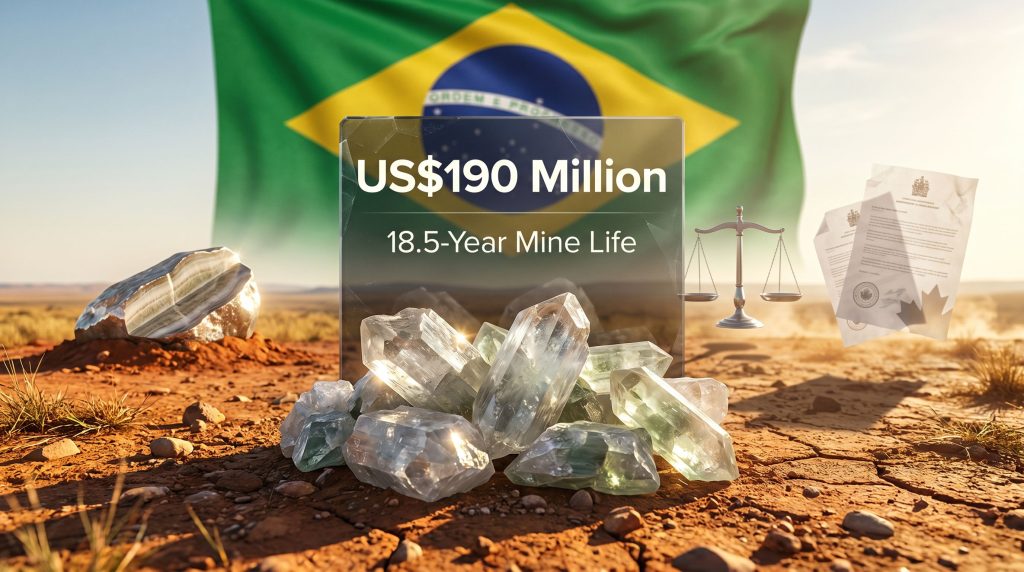
| Estimated Capital Expenditure | US$190 million |
| Projected Mine Life | 18.5 years |
| Project Stage | Pre-construction / Feasibility Completed |
| Jurisdiction | Minas Gerais, Brazil (Lithium Valley) |
| Primary Output | Hard-rock lithium (spodumene / downstream products) |
An 18.5-year mine life is not a figure that emerges from marginal deposits. It suggests a resource with sufficient volume and grade continuity to sustain long-term production at commercially meaningful throughput rates. For institutional investors evaluating project-level net present value, mine life is one of the most sensitive inputs in any discounted cash flow model. Longer mine lives extend the period over which capital can be amortised and allow operators to absorb early-year commissioning costs more efficiently.
Brazil's Position in the Global Lithium Supply Chain
Brazil is increasingly positioned as a significant lithium jurisdiction, not merely a peripheral one. The country holds some of the world's largest known hard-rock lithium reserves, and Minas Gerais alone accounts for a substantial share of Brazil's identified lithium resources. Critically, Brazil offers infrastructure connectivity that landlocked Andean brine producers cannot easily replicate, including road and rail corridors to Atlantic export terminals.
As battery supply chain diversification has moved up the agenda for manufacturers in Europe, Japan, and North America, Brazil's attractiveness as a source of non-Australian, non-Chinese hard-rock lithium has grown meaningfully. The broader lithium carbonate market dynamics further reinforce this narrative. Projects like Bandeira sit within this structural story, even if the company has not received any confirmed project-specific designation or formal support from Brazilian authorities.
The Legal and Regulatory Disputes Surrounding the Bandeira Project
Ontario Securities Commission Proceedings: What Is Actually Alleged
The most consequential legal development affecting the Lithium Ionic project in Brazil amid Canada litigation involves proceedings before the Ontario Securities Commission (OSC). The OSC matter centres on allegations against individuals connected to the project's history, with the core concern being the alleged diversion of assets from a predecessor exploration entity into structures that subsequently became associated with the current project.
Lithium Ionic has publicly stated that the company itself is not named as a respondent in the OSC proceedings and that no regulatory orders have been sought directly against it. This distinction carries legal significance, but it does not fully neutralise the practical implications.
Regulatory proceedings targeting associated individuals do not automatically create legal liability for the operating entity. However, they can materially complicate financing timelines, create lender due diligence barriers, and erode the confidence of institutional capital allocators who apply governance screens to prospective investments.
Cross-Border Shareholder Litigation: The Dual-Jurisdiction Strategy
Separately, a shareholder group has mounted a coordinated legal campaign spanning both Ontario and Brazilian courts. The strategic architecture of this approach is worth understanding, as dual-jurisdiction litigation in mining disputes is a relatively sophisticated tactic with specific objectives:
- Ontario proceedings target the Canadian securities law framework, which governs how assets and rights associated with a TSX-listed entity are held and transferred.
- Brazilian civil and mining law proceedings target the underlying project rights directly, since the physical asset and its regulatory permits are governed by Brazilian law.
The shareholder claimants allege that the project's underlying rights were improperly transferred from a predecessor entity, and they are seeking recovery of those rights through both legal systems simultaneously. The logic is that even if one jurisdiction's courts move slowly, the other may provide interim relief or asset preservation orders that effectively constrain the company's freedom to progress development or raise finance. For further context on how Lithium Ionic's Brazil operations are advancing despite these pressures, reporting from BNAmericas provides useful background.
Brazilian Permitting Scrutiny: A Third Layer of Complexity
In 2025, Brazilian prosecutors raised formal objections to the project's licensing process, introducing a third and distinct layer of regulatory complexity. Environmental and operational permitting in Brazil's mining sector follows a staged process governed by state-level environmental agencies (SUPRAM and SEMAD in Minas Gerais) as well as federal oversight from IBAMA where applicable.
When prosecutors raise objections to licensing procedures, it does not necessarily indicate that permits will be revoked. However, it can trigger review processes, require additional environmental impact assessments, or result in permit issuance being paused pending resolution. In a project already carrying legal uncertainty in Canada, this Brazilian-side complication compounds the risk profile considerably.
How Multi-Jurisdictional Litigation Reshapes a Project's Development Timeline
The Financing-Litigation Nexus
Project finance for mining assets, particularly at the US$190 million capex scale, typically involves a combination of senior secured debt (often from specialised mining-focused lenders or multilateral development finance institutions), streaming or royalty arrangements, and equity capital raises. Each of these financing channels has its own due diligence requirements, and each is sensitive to unresolved title or regulatory disputes in different ways.
Senior lenders will typically require a clean title opinion as a condition precedent to financial close. If active litigation questions the chain of custody for the project's underlying rights, obtaining that title opinion becomes either impossible or prohibitively qualified. Streaming counterparties face similar constraints. Even equity investors on public markets tend to apply a discount to assets carrying unresolved litigation overhang.
Scenario Modelling: Three Possible Outcomes for Bandeira
| Scenario | Probability Driver | Impact on Project Timeline |
|---|---|---|
| Legal disputes resolved in Lithium Ionic's favour | OSC findings clear company; Brazilian courts dismiss recovery claims | Construction proceeds; financing secured within 12-24 months |
| Prolonged litigation with no near-term resolution | Multi-year proceedings in both jurisdictions | Project delayed 2-5 years; financing stalled |
| Asset recovery order granted | Courts rule in favour of claimants | Ownership restructured; development timeline reset entirely |
Historical Precedents in Latin American Mining Disputes
Cross-jurisdictional legal battles involving junior miners in Latin America are not without precedent. Several development-stage projects across Peru, Argentina, and Colombia have faced multi-year delays when title disputes, community rights claims, or regulatory objections intersected simultaneously. A particularly instructive pattern is the tendency for financing windows to close during prolonged legal uncertainty, even where the underlying geological asset retains its value.
By the time disputes are resolved, commodity price cycles may have shifted, lender appetite may have changed, and competing projects will have advanced. This is the deeper risk embedded in the Bandeira situation: not simply whether litigation is ultimately won or lost, but whether the project can maintain its competitive positioning within an increasingly crowded field of global lithium development assets seeking capital during overlapping financing windows.
Investor Risk Framework: Decomposing the Bandeira Risk Stack
Four Distinct Risk Categories
Sophisticated resource investors typically decompose project-level risk into discrete categories rather than treating risk as monolithic. For Bandeira, at least four risk dimensions require separate assessment:
- Legal risk: Active OSC proceedings involving associated parties, plus cross-border shareholder litigation seeking asset recovery in both Ontario and Brazilian courts.
- Regulatory risk: Formal prosecutorial objections to the Brazilian licensing process, introducing potential delays to environmental permit finalisation.
- Market risk: Lithium price volatility has been pronounced since 2023, with spodumene concentrate prices falling sharply from their 2022 peaks. A US$190 million capex commitment requires sustained lithium pricing above certain thresholds for project economics to remain robust.
- Title risk: The central question of whether the chain of custody for the project's underlying mining rights is unimpeachable remains partially unresolved while litigation is active.
ESG Screening and Governance Disputes
There is an often-underappreciated dimension to governance disputes in mining: their interaction with ESG-screened capital. A growing share of institutional capital is now deployed under mandates that require assets to meet minimum governance standards before inclusion. Projects carrying unresolved disputes about how underlying rights were acquired, or how predecessor entities were treated, can trigger exclusion from ESG-compliant investment vehicles even where the operating company is not a direct respondent in any proceeding.
Projects with unresolved governance or title disputes frequently face a financing premium or outright exclusion from ESG-screened mandates, regardless of whether the operating company is formally named in proceedings. Resolution of underlying disputes is increasingly treated as a precondition, not merely a risk factor.
The Role of Canadian Securities Regulators in Governing Internationally Operating Junior Miners
Canada's TSX and TSX-V exchanges have historically served as the primary listing venues for junior mining companies with operations across Latin America, Africa, and Southeast Asia. The OSC, as Ontario's primary securities regulator, therefore exercises supervisory reach over companies whose physical operations may be entirely outside Canada. This creates a dynamic where regulatory proceedings in Toronto can have direct consequences for assets located thousands of kilometres away in Brazil.
The OSC's mandate includes protecting investors from misleading disclosure and from conduct that disadvantages shareholders, including the alleged misappropriation of assets that originally belonged to predecessor entities. When such proceedings are initiated, even against individuals rather than the listed company itself, the reputational and financing consequences for the listed entity can be material. Furthermore, an understanding of the Bandeira project's technical scope is useful context when evaluating how these regulatory pressures interact with project development plans.
The next major ASX story will hit our subscribers first
Current Development Status and the Path Forward
Where Bandeira Stands Operationally
The project has cleared the feasibility study milestone, which is meaningful. Feasibility completion represents a transition from geological exploration into engineering and project execution planning. However, the gap between feasibility completion and construction commencement is precisely where financing must be assembled, permits must be finalised, and legal encumbrances must be resolved.
Additionally, innovative approaches such as direct lithium extraction technology are reshaping how the industry thinks about processing optionality, though Bandeira's hard-rock focus places it within a more conventional processing pathway. With prosecutorial objections active in Brazil and shareholder litigation active in two jurisdictions, the project currently sits in a legally complex holding pattern. The company has indicated an intention to advance toward construction, but the pathway involves resolving multiple concurrent legal and regulatory processes rather than a single linear development sequence.
Frequently Asked Questions: Lithium Ionic's Bandeira Project and the Canada Litigation
What is the Bandeira lithium project?
A hard-rock lithium development asset located in Brazil's Minas Gerais state, within the region commonly referred to as Lithium Valley. The project has completed a feasibility study projecting an 18.5-year mine life and a capital requirement of approximately US$190 million.
Is Lithium Ionic a respondent in the Ontario Securities Commission proceedings?
The company has publicly stated that it is not named as a respondent in the OSC regulatory matter and that no orders have been sought directly against it, though proceedings involve individuals with connections to the company.
What are shareholders seeking through the cross-border legal action?
A shareholder group has pursued legal proceedings in both Ontario and Brazil aimed at recovering the underlying project rights, alleging that the asset was improperly transferred from a predecessor entity into structures connected to Lithium Ionic.
What permitting issues has the project faced in Brazil?
In 2025, Brazilian prosecutors raised formal objections to the project's licensing process, introducing an additional regulatory complexity separate from the Canadian litigation.
How does the litigation affect the project's construction timeline?
While the company has indicated its intention to advance toward construction, unresolved legal proceedings in two jurisdictions introduce material uncertainty around financing, title, and permitting progress.
Key Takeaways: Balancing Asset Quality Against Legal Complexity
The Bandeira project presents a genuinely uncommon tension in resource investment analysis. The underlying geological asset, situated in one of the world's most prospective hard-rock lithium corridors, supported by a completed feasibility study and an 18.5-year projected mine life, carries clear intrinsic merit. A US$190 million capex commitment is neither trivial nor unmanageable for a project of this quality, and the macro tailwinds favouring Brazilian lithium exports remain structurally intact.
Against that, the convergence of OSC proceedings involving associated individuals, dual-jurisdiction shareholder litigation targeting asset recovery, and Brazilian prosecutorial objections to the licensing process creates a risk overlay that cannot be wished away through optimistic project economics. For the Lithium Ionic project in Brazil amid Canada litigation to unlock mainstream institutional financing, the critical path almost certainly runs through legal resolution before construction readiness.
Investors monitoring this asset would be well served by tracking OSC hearing schedules, Brazilian court proceedings, and environmental permit status as leading indicators, rather than focusing exclusively on commodity price movements or resource estimate updates. The geology is not the variable here. The legal architecture around it is.
This article is intended for informational purposes only and does not constitute financial or investment advice. Statements regarding litigation outcomes, project timelines, and financing scenarios involve uncertainty and should not be relied upon as predictions of future events. Readers should conduct independent due diligence before making any investment decisions.
Want to Stay Ahead of the Next Major Lithium Discovery on the ASX?
Discovery Alert's proprietary Discovery IQ model delivers real-time alerts the moment significant mineral discoveries — including lithium — are announced on the ASX, transforming complex geological and market data into clear, actionable investment insights for traders and long-term investors alike. Explore historic examples of major mineral discoveries and the returns they generated, then begin your 14-day free trial to position yourself ahead of the broader market.