August 8, 2026
Libya's Oil Sector at a Crossroads: Understanding the Forces Behind the 2025 Licensing Round
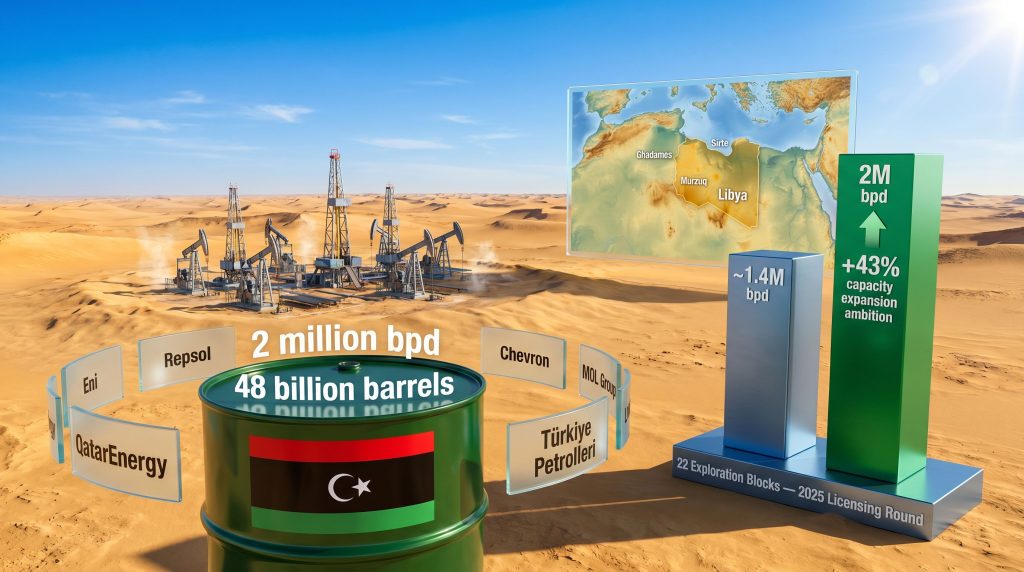
Across the global energy landscape, few investment stories carry the combination of geological promise and political complexity that Libya presents. Africa's largest proven oil reserve holder, sitting on an estimated 48 billion barrels of recoverable crude, has spent nearly two decades largely absent from the competitive upstream licensing market. During this period, international capital that might have flowed toward Libyan exploration instead found its way to more stable jurisdictions in West Africa, the Gulf, and even the more politically turbulent corners of Iraq. The structural forces that created this prolonged absence, and the conditions that have now reversed it, deserve close examination before turning to the specific mechanics of Libya NOC production-sharing deals with foreign firms that are reshaping the country's upstream investment landscape.
What makes the current moment distinctive is not simply that Libya has conducted a licensing round. It is that the round succeeded in attracting credible international counterparties despite ongoing political fragmentation, and that this success has now translated into formal production-sharing agreements signed in June 2026. Understanding why this happened, how these agreements are structured, and what they mean for global oil markets requires engaging with the full complexity of Libya's institutional, geological, and geopolitical environment.
When big ASX news breaks, our subscribers know first
The 18-Year Gap: What Licensing Inactivity Really Costs an Oil Nation
When Libya last conducted a competitive upstream licensing round in 2007, the country was operating within a relatively coherent, if authoritarian, political framework under Muammar Gaddafi. The post-2011 civil conflict dismantled that framework entirely, creating two rival administrations, a proliferation of armed militias with territorial interests in oil infrastructure, and an institutional environment in which contract enforcement became deeply uncertain. The result was an 18-year absence from competitive upstream tendering, a gap with few parallels among major OPEC producers.
The cost of this inaction is measurable in multiple ways. Libya's production capacity stagnated at approximately 1.4 million barrels per day (bpd), well below both its historical pre-2011 average of roughly 1.6 million bpd and its theoretical potential given the scale of its reserve base. During the most acute phases of conflict between 2014 and 2020, production collapsed to as low as 225,000 bpd, inflicting severe fiscal damage on a national economy overwhelmingly dependent on hydrocarbon revenues.
Critical export infrastructure at terminals including Es Sider and Ras Lanuf deteriorated through a combination of physical damage and deferred maintenance. Seismic data collection programmes stalled, leaving significant portions of Libya's offshore Mediterranean acreage and deeper onshore basins geologically undercharacterised relative to comparable frontier provinces elsewhere in North Africa.
The opportunity cost calculation extends beyond infrastructure. During the same 18-year period, advances in directional drilling, enhanced oil recovery techniques, and 3D seismic processing transformed the economics of exploration in carbonate-dominated reservoirs of the type that characterise significant portions of Libya's Sirte Basin. Foreign companies that maintained positions in Libya through legacy concessions had limited appetite to deploy these technologies under conditions of political uncertainty, meaning that productivity improvements that could have been achieved in established fields were systematically deferred.
Key Insight: Libya holds Africa's largest proven oil reserves, estimated at over 48 billion barrels, yet chronic underinvestment over nearly two decades has left vast portions of this resource base geologically undercharacterised and commercially underdeveloped. The 2025 licensing round represents the most consequential structural attempt to address this gap in nearly two decades.
The 2025 licensing round's significance lies precisely in its demonstration that the NOC retains sufficient institutional credibility to attract major international partners even under conditions of political division. That Chevron, Eni, QatarEnergy, and Repsol were willing to accept block awards in February 2025 signals a meaningful shift in the risk-adjusted calculus, driven partly by the scale of Libya's reserve base, partly by its low lifting costs, and partly by the changing European energy security environment following Russia's 2022 invasion of Ukraine. Furthermore, the trade war impact on oil markets has also encouraged energy companies to diversify their upstream exposure across multiple geographies.
What Are Production-Sharing Agreements and How Do They Function in Libya?
The PSA Mechanism: Risk Allocation at Its Core
A production-sharing agreement in the upstream oil and gas sector is a contractual arrangement that separates the financial risk of exploration from the ownership of subsurface resources. Under this framework, the foreign oil company finances and executes all exploration and development activities. If commercial production is established, the company recovers its costs from a designated portion of output, commonly termed "cost oil." The remaining production, the "profit oil," is divided between the NOC and the foreign partner according to a formula negotiated at the contracting stage, which typically incorporates variables such as production volumes, prevailing oil prices, and cumulative investment levels.
This structure is particularly well suited to frontier and post-conflict upstream environments because it transfers the upfront capital risk to the foreign partner while preserving full state ownership of subsurface resources throughout the contract life. For resource-holding governments with constrained fiscal capacity, as Libya has been during its period of political fragmentation, PSAs provide access to international capital and technical expertise without requiring direct sovereign co-investment in high-risk exploration activities.
Libya's Legal Architecture: The NOC as Mandatory Gateway
Under Libyan law, the National Oil Corporation functions as the exclusive state authority governing all upstream oil and gas activities. No foreign company may operate independently within Libya's hydrocarbon sector. All commercial arrangements, whether exploration-focused PSAs, development joint ventures, or technical service contracts, must flow through the NOC's contractual framework. This gatekeeping function provides the NOC with substantial negotiating leverage over fiscal terms, operational conditions, and revenue split structures, while also making the NOC's institutional stability a direct determinant of contract enforceability.
The NOC's dual role as both sovereign regulator and commercial counterparty creates a structural dynamic that foreign investors must navigate carefully. On one hand, it provides a single, technically competent counterparty with clear authority over upstream licensing decisions. On the other, it concentrates institutional risk, meaning that any political interference in NOC governance directly affects the reliability of existing contractual frameworks.
Evolution from EPSA to Modern PSC Structures
Libya's history with foreign participation in its upstream sector is anchored by the Exploration and Production Sharing Agreement framework, known as EPSAs, which governed most foreign company participation from the late 1980s onward. EPSA arrangements allocated exploration risk to foreign partners while granting cost recovery and profit oil entitlements in the event of commercial success, but their specific terms differed meaningfully from the Production Sharing Contract structures being offered in the 2025 licensing round.
The transition from EPSA to newer PSC frameworks signals a deliberate modernisation of Libya's upstream legal architecture, designed to align contractual terms more closely with international investor expectations and comparable regional regimes. This evolution reflects institutional learning within the NOC about what terms are necessary to attract first-tier international capital under post-conflict conditions.
| Agreement Type | Risk Bearer | State Ownership | Revenue Split | Foreign Operator Role |
|---|---|---|---|---|
| EPSA (Historical) | Foreign Partner | NOC retains title | Variable by block | Exploration and Production |
| PSC (2025 Round) | Foreign Partner | NOC retains title | Negotiated per block | Exploration and Development |
| Joint Venture | Shared | Shared equity | Proportional | Operational partnership |
Which Foreign Companies Signed Production-Sharing Deals With Libya's NOC?
The February 2025 Block Awards: Setting the Stage
The formal starting point of the current investment cycle was the award of exploration blocks in February 2025, which marked Libya's first competitive acreage allocation since 2007. The companies receiving block awards in this initial phase included Chevron, Eni, QatarEnergy, and Repsol, four operators that collectively represent a broad cross-section of international upstream capital. That this allocation proceeded despite ongoing political divisions between Libya's eastern and western administrations demonstrated the NOC's capacity to execute complex commercial transactions under adverse institutional conditions.
The June 2026 PSA Signings: Formalising the Commercial Framework
The block awards of February 2025 represented exploration rights, granting companies the ability to conduct seismic surveys, drill exploration wells, and advance toward appraisal activities. The June 2026 Libya NOC production-sharing deals with foreign firms transformed these exploration rights into fully formalised commercial frameworks with defined cost recovery mechanisms, profit oil split arrangements, and operational obligations. NOC Chairperson Massoud Suleman confirmed that agreements were signed with the following parties:
- Repsol (Spain): signed as an independent bilateral PSA counterparty, reflecting the Spanish company's longstanding presence in North African upstream markets
- Türkiye Petrolleri (Turkey): Turkey's state-owned energy company secured a standalone agreement, consistent with the Turkish government's broader strategic engagement in Libya
- Eni and QatarEnergy (Italy and Qatar): formalised as a joint bilateral arrangement, combining Eni's operational expertise and existing Libyan infrastructure with QatarEnergy's capital capacity
- MOL Group, Türkiye Petrolleri, and Repsol (Hungary, Turkey, and Spain): a three-party consortium representing the most structurally complex arrangement in the round
Structural Note: The three-party consortium between MOL, Türkiye Petrolleri, and Repsol reflects a risk-diversification approach increasingly common in frontier and post-conflict upstream environments, where no single operator wishes to carry full financial and operational exposure to a jurisdiction with elevated sovereign risk.
Strategic Rationale by Partner: Why These Companies?
The composition of the partner group is not accidental. Each participating company brings a distinct strategic rationale that explains its willingness to accept Libyan upstream risk at this particular moment.
| Company | Country | Strategic Rationale |
|---|---|---|
| Eni | Italy | Decades of operational presence in Libya; existing pipeline and processing infrastructure; proximity to Italian refining capacity |
| Repsol | Spain | Prior Libyan exploration history; Mediterranean upstream diversification strategy; familiarity with North African regulatory environments |
| QatarEnergy | Qatar | Capital deployment into international upstream through NOC-to-NOC partnership model; portfolio diversification outside the Gulf |
| Türkiye Petrolleri | Turkey | Geopolitical alignment with Tripoli-based Government of National Unity; expanding regional energy footprint |
| MOL Group | Hungary | Central European energy security diversification; appetite for frontier market exposure with high geological upside |
| Chevron | USA | Strategic re-entry into North African upstream following years of reduced exposure; large-cap exploration portfolio expansion |
Eni's position is particularly notable. The Italian company has maintained some form of operational presence in Libya through periods when most other international operators reduced or suspended activities, giving it infrastructure advantages, institutional relationships, and geological data that newer entrants cannot quickly replicate. Its decision to partner with QatarEnergy rather than operate independently suggests a deliberate risk-sharing strategy that combines Eni's operational depth with QatarEnergy's financial firepower.
The NOC's Role: Governance, Gatekeeping, and the Management of Competing Interests
Pre-2025 Partners: The Existing Strategic Landscape
Before the 2025 licensing round layered new entrants into Libya's upstream sector, the NOC maintained established partnerships with a smaller group of international operators. The pre-existing partner base included Eni, TotalEnergies, Repsol, and Wintershall Dea, companies that held shareholdings in legacy concessions and maintained varying levels of operational engagement in producing fields. This existing partner base provided the NOC with institutional continuity during periods of political disruption, as these companies had contractual incentives to maintain baseline production even when security conditions deteriorated.
The addition of Chevron, MOL, QatarEnergy, and Türkiye Petrolleri through the 2025 round significantly broadens the NOC's international partner portfolio, diversifying it geographically across North American, Central European, Gulf, and Turkish capital sources. This diversification reduces Libya's dependence on any single partner group and creates a more balanced distribution of influence over NOC decision-making processes.
Choosing the Right Structure: Joint Ventures Versus PSCs
The choice between a production-sharing contract and a joint venture arrangement carries significant implications for both parties. Under a joint venture, costs, revenues, and operational control are shared proportionally to equity stakes, creating aligned incentives but also requiring the NOC to co-invest alongside foreign partners. Under a PSC, the foreign company bears all exploration risk and recoups costs only through production, with the NOC receiving a share of profit oil without having deployed upfront capital.
Libya's preference for PSC structures in new rounds reflects the NOC's fiscal constraints. Co-investing in high-risk exploration programmes across 22 blocks simultaneously would require capital commitments the NOC cannot currently sustain given its broader infrastructure rehabilitation obligations. PSCs allow the NOC to expand its exploration footprint dramatically while maintaining sovereign ownership and deferring its financial participation to the production phase. Joint ventures, however, remain the preferred structure for brownfield assets with established production profiles, where exploration risk has already been resolved and the primary challenge is optimising recovery from known reservoirs.
The Scale of the 2025 Round: 22 Blocks Across Libya's Key Basins
Geographic Distribution and Geological Significance
The 2025 licensing round offered 22 exploration blocks, making it the largest single offering of Libyan upstream acreage to foreign companies in nearly two decades. The geographic distribution of these blocks spans several of Libya's most significant hydrocarbon provinces:
- Sirte Basin: Libya's most prolific producing province, a Cretaceous-to-Tertiary rift basin responsible for the majority of historical production, with remaining upside in deeper exploration targets
- Murzuq Basin: a Palaeozoic basin in southwestern Libya with established oil production and significant remaining exploration potential in Ordovician and Silurian sandstone reservoirs
- Ghadames Basin: straddling the Algerian and Tunisian borders, characterised by complex structural traps and hydrocarbon systems requiring sophisticated seismic interpretation
- Offshore Mediterranean acreage: frontier blocks with limited prior exploration activity but geological analogies to productive systems in adjacent Italian and Tunisian waters
This geographic breadth is strategically deliberate. Offering blocks across multiple basins with different geological risk profiles allows the NOC to attract operators with varying technical capabilities and risk tolerances. Companies with advanced carbonate reservoir expertise may target Sirte Basin blocks, whilst those with deep seismic interpretation capabilities may find the offshore Mediterranean blocks more compelling.
The 2 Million Barrel Target: What Closing the Gap Actually Requires
Libya's stated production target of 2 million bpd represents a 43% increase over current output levels, a substantial expansion that cannot be achieved through optimisation of existing fields alone. Reaching this target will require:
- Successful exploration results on newly awarded blocks converting to commercial development decisions
- Sustained capital investment in drilling programmes, with typical deepwater wells in the Mediterranean costing $50–100 million and onshore wells in the range of $5–15 million depending on depth and complexity
- Rehabilitation and expansion of pipeline infrastructure connecting new production centres to export terminals
- Capacity expansion at export terminals, particularly at Es Sider and Zawiya, to handle increased throughput volumes
- Stable political conditions permitting uninterrupted construction and commissioning activities over a multi-year development period
The timeline challenge is equally significant. Even with immediately successful exploration results, the typical pathway from exploration drilling through appraisal, development planning, construction, and first production spans five to ten years for greenfield projects. Libya's 2 million bpd ambition therefore requires that the political stabilisation needed to support sustained development activity be maintained over a period measured in years, not months.
| Metric | Value |
|---|---|
| Current production capacity | approximately 1.4 million bpd |
| NOC production target | 2 million bpd |
| Capacity expansion required | approximately 43% increase |
| Years since last licensing round | 18 years (2007 to 2025) |
| Exploration blocks offered (2025) | 22 blocks |
| PSA signatories (June 2026) | 5 companies and consortia |
| Libya's proven oil reserves | approximately 48 billion barrels |
The next major ASX story will hit our subscribers first
Geopolitical Risk: Navigating Libya's Dual-Government Reality
The East-West Division and Its Implications for Contract Enforceability
Libya's political landscape remains bifurcated between the Tripoli-based Government of National Unity in the west, which the NOC's headquarters are aligned with, and the Benghazi-based administration in the east, which exercises authority over significant portions of the country's oil-producing territory. This division creates a structural risk for foreign investors that cannot be fully mitigated through contractual protections alone, as the enforceability of any NOC agreement ultimately depends on the political acquiescence of the administration controlling the relevant territory.
The fact that the 2025 licensing round proceeded and the June 2026 PSA signings occurred despite this ongoing division suggests that international companies have found contractual structures capable of managing, if not eliminating, this exposure. Force majeure clauses, international arbitration provisions, and phased capital commitment structures are among the tools sophisticated operators deploy in this environment. In addition, the continuation of sanctions on Russian oil has redirected European energy procurement strategies, consequently increasing the strategic urgency of securing Libyan supply alternatives.
OPEC Dynamics: Libya's Quota Exemption and Its Future
Libya holds a distinctive position within OPEC. The organisation has historically granted Libya an exemption from production quotas, recognising that the country's output has been constrained by conflict rather than commercial decisions. This exemption has allowed Libya to produce at maximum available capacity without contributing to coordinated supply reductions, a privilege that other OPEC members have sometimes viewed with concern given Libya's potential to disrupt the cartel's production management efforts.
OPEC's market influence over the broader supply environment remains significant, and as Libya's production capacity approaches the 2 million bpd target, the question of quota reintegration becomes increasingly material. If Libya is brought back within the OPEC quota framework at a point when global supply management requires production restraint, the commercial attractiveness of newly developed production capacity could be significantly affected. Foreign companies evaluating long-term investment returns in Libya must incorporate this regulatory uncertainty into their project economics, particularly for fields with development timelines extending well beyond the current OPEC agreement cycle.
How Libya's PSA Terms Compare to Regional Competitors
Benchmarking the Upstream Regulatory Environment
Investors allocating exploration capital across North Africa and the Middle East evaluate Libya's offering against a regional competitive set that includes Algeria, Egypt, Iraq, and the UAE. Each jurisdiction presents a distinct combination of fiscal terms, operational risks, and geological prospectivity that shapes relative attractiveness. Furthermore, monitoring crude oil price trends remains essential for companies modelling project economics across these competing jurisdictions.
| Country | Contract Type | Typical Cost Recovery | Foreign Equity Cap | Stability Clause | Arbitration |
|---|---|---|---|---|---|
| Libya (2025 Round) | PSC | Negotiated per block | NOC retains majority | Present | International |
| Algeria | PSC and JV hybrid | approximately 49% cost recovery | 49% foreign maximum | Strong | ICSID eligible |
| Egypt | PSC | 30 to 40% cost recovery | Variable | Moderate | International |
| Iraq | Technical Service Contract | Cost plus fee | No equity | Moderate | Domestic preference |
| UAE | Concession and PSC | Variable | Minority foreign | Strong | International |
Libya's competitiveness within this regional set rests on several factors that partially offset its elevated political risk. Lifting costs for established Libyan fields have historically ranked among the lowest in OPEC, with some sources citing figures in the range of $4–6 per barrel for onshore production, providing substantial margin headroom even at depressed oil price scenarios. The large block sizes offered in the 2025 round allow economies of scale in exploration programmes that smaller acreage positions in more competitive markets cannot match. Libya's proximity to Southern European refining infrastructure reduces transportation costs and marketing complexity for produced crude, particularly relevant for Eni's Italian operations and Repsol's Spanish refining system.
What the 2025–2026 Investment Cycle Signals for Libya's Future
Reading Institutional Signals from the PSA Announcements
NOC Chairperson Massoud Suleman's characterisation of the June 2026 PSA signings as evidence of growing confidence in Libya's oil and gas sector carries a deliberate dual message. For existing partners already operating in Libya, the statement reinforces contractual stability and signals continued NOC commitment to the commercial frameworks underpinning their investments. For prospective investors, it functions as an institutional credibility signal, indicating that the NOC is capable of executing complex multi-party transactions.
The breadth and diversity of the partner group assembled through the 2025 round and formalised in the 2026 agreements lends this credibility signal additional weight. The participation of a US supermajor in Chevron, a Gulf state NOC in QatarEnergy, established European operators in Eni and Repsol, and Central European capital in MOL Group reflects a consensus across different investor categories that Libya's risk-adjusted return proposition has improved meaningfully. WTI and Brent futures pricing will consequently be worth monitoring as Libyan supply volumes begin to materialise at scale.
Forward-Looking Indicators: What to Monitor
The longer-term significance of the current investment cycle will be determined by a set of observable indicators that investors and analysts should track closely:
- Progress of seismic acquisition and exploration drilling programmes on blocks awarded in February 2025, with first exploration results potentially available within 18 to 36 months of block award
- Chevron's operational engagement level, given its profile as the highest-profile new entrant and its signal value for subsequent investment decisions
- The NOC's institutional continuity and capacity to enforce contractual terms through any future periods of political disruption
- Libya's trajectory within OPEC's production management framework as output capacity approaches the 2 million bpd target
- The potential for a second licensing round if the 2025 round's commercial outcomes demonstrate exploration success
- Rehabilitation progress at Es Sider, Ras Lanuf, and other critical export infrastructure facilities required to handle increased production volumes
Analytical Perspective: The 2025 to 2026 investment cycle represents Libya's most institutionally credible attempt to rebuild its upstream sector since the pre-2011 era. The diversity of international partners, spanning American, European, Gulf, and Central European capital, signals that the risk-adjusted return calculus has genuinely shifted. Whether this translates into sustained production growth will ultimately depend as much on political stabilisation and institutional continuity as on geological outcomes from the exploration programmes now commencing across Libya's basins.
Frequently Asked Questions: Libya NOC Production-Sharing Deals With Foreign Firms
What is a production-sharing agreement in Libya's oil sector?
A production-sharing agreement in Libya is a contractual arrangement between the National Oil Corporation and a foreign energy company under which the foreign partner finances and executes exploration and development activities. If commercial production is achieved, the foreign company recovers its costs from a portion of the output, designated as cost oil, and then shares the remaining profit oil with the NOC according to a pre-agreed formula. Legal title to subsurface resources remains with the NOC throughout the contract life.
Why did Libya conduct its first licensing round in 18 years in 2025?
Libya's competitive upstream licensing activity was effectively suspended following the 2011 civil conflict due to political fragmentation, security instability, and institutional uncertainty that made contractual enforcement unreliable. The 2025 licensing round reflects a calculated decision by the NOC to re-engage international capital markets, driven by the fiscal imperative of funding the infrastructure investment required to raise production capacity from approximately 1.4 million bpd toward the 2 million bpd target.
Which companies signed production-sharing deals with Libya's NOC in June 2026?
Following the 2025 licensing round, Libya NOC production-sharing deals with foreign firms were formalised with Repsol (Spain), Türkiye Petrolleri (Turkey), Eni and QatarEnergy as a joint arrangement (Italy and Qatar), and a three-party consortium comprising MOL Group, Türkiye Petrolleri, and Repsol (Hungary, Turkey, and Spain).
How does the NOC control foreign access to Libya's oil resources?
Under Libyan law, the NOC is the sole state authority governing all upstream oil and gas activities. Foreign companies must enter formal contractual arrangements with the NOC, which functions as both the regulatory gatekeeper and the commercial counterparty in all upstream agreements. Independent operation outside the NOC's contractual framework is not legally permissible.
Is the Libya upstream sector competitive with other regional markets?
Libya offers a combination of very large block sizes, historically low lifting costs, and proximity to European markets that provides genuine competitive advantages relative to some regional peers. These advantages are partially offset by elevated geopolitical risk, infrastructure vulnerability, and contractual uncertainty stemming from the ongoing dual-government situation. Sophisticated international operators have historically managed this risk premium through force majeure provisions, international arbitration clauses, and phased investment structures rather than avoiding Libya entirely.
Disclaimer: This article contains forward-looking statements and projections regarding Libya's oil production targets, investment outcomes, and political developments. These projections are based on publicly available information and do not constitute financial advice. Investment in frontier and post-conflict upstream markets carries significant risks including political instability, infrastructure disruption, contractual uncertainty, and commodity price volatility. Readers should conduct independent due diligence before making any investment decisions.
Want to Stay Ahead of the Next Major Resource Discovery?
Discovery Alert's proprietary Discovery IQ model delivers real-time alerts on significant ASX mineral discoveries, instantly transforming complex data across more than 30 commodities into clear, actionable investment insights — explore historic examples of exceptional discovery returns to understand what early positioning can mean, then begin your 14-day free trial at Discovery Alert to secure your market-leading edge.