July 13, 2026
The Power Curve Beneath the South32 Alcoa Aluminium Deal
There is a structural reality embedded in every aluminium smelter on earth that most commodity market analysis skips past entirely. The metal's production economics are not primarily governed by the LME price, logistics costs, or even the grade of bauxite feeding the refinery. They are governed by a single variable that sits upstream of everything else: the price and reliability of electricity. Understanding this one mechanical truth reframes the entire South32 Alcoa aluminium deal from a story about corporate strategy into something far more precise — a decision about whether a company genuinely controls its own cost position, or merely rents it.
When big ASX news breaks, our subscribers know first
What the Hall-Héroult Process Reveals About Competitive Positioning
Primary aluminium is produced through the Hall-Héroult electrolytic smelting process, a method that has remained essentially unchanged in its core physics since the late 19th century. Alumina dissolved in molten cryolite is reduced by electrical current flowing through carbon anodes, precipitating aluminium metal at the cathode. The process is continuous, energy-intensive, and thermally unforgiving.
The energy consumption figure is the critical number: approximately 13 to 15 MWh of electricity per tonne of metal produced. At that intensity, power typically accounts for 30 to 40 percent of total smelting costs, exceeding the combined expenditure on alumina feedstock, carbon anodes, and labour. The practical consequence is that a smelter's position on the global cost curve is determined less by operational excellence and more by the power contract sitting behind it.
The threshold that separates viable from structurally challenged is approximately USD 50/MWh. Above that level, the economics of primary aluminium production outside China become extremely difficult to sustain across a full price cycle. Almost no operating smelter outside China runs on power priced above that level on a long-term contracted basis, because those that have tried have either closed or mothballed.
The Continuous-Process Constraint and Its Asymmetric Consequences
What makes the power cost exposure particularly severe is a metallurgical reality that distinguishes aluminium smelters from virtually every other commodity processing asset. The electrolytic cells, known as pots, operate continuously at temperatures above 950 degrees Celsius. The electrical current cannot simply be switched off the way a grinding mill can be paused or a mine can reduce its shift schedule.
Partial shutdowns degrade the carbon pot lining. Extended cold shutdowns destroy it entirely. The consequence is that restarting a mothballed smelter is not an operational decision — it is effectively a capital project, requiring new pot lining installation, a multi-month ramp-up period, and significant cash expenditure before a single tonne of metal is produced.
This asymmetry changes everything about how power risk must be assessed in aluminium asset valuation. A mine facing adverse commodity prices can reduce output, preserve ore grade, and resume when conditions improve. A smelter facing adverse power costs has no equivalent flexibility. The choice is binary: absorb the losses or permanently impair the asset.
How the Global Cost Curve Is Actually Structured
| Cost Quartile | Typical Power Source | Approximate Cash Cost Range | Competitive Viability |
|---|---|---|---|
| First Quartile | Captive hydro / long-term renewables | Below USD 1,600/t | Structurally advantaged across all cycles |
| Second Quartile | Contracted renewables / low-cost grid | USD 1,600–1,900/t | Competitive through full price cycles |
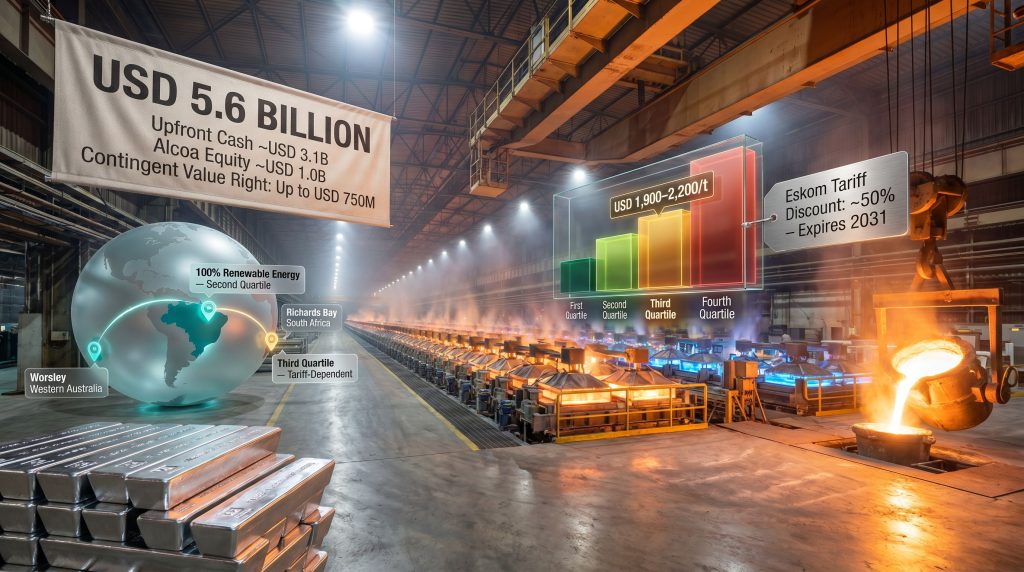
| Third Quartile | Negotiated grid tariffs / coal-dependent | USD 1,900–2,200/t | Viable only at elevated LME prices |
| Fourth Quartile | Spot or unhedged grid power | Above USD 2,200/t | Structurally challenged at most price scenarios |
The distinction between first and second quartile assets versus third and fourth quartile assets is not purely about cost levels. It is about the nature of the cost position. A smelter drawing on captive hydroelectric generation or a decades-long renewable energy contract has a cost position it owns. A smelter operating on a negotiated tariff from a third-party grid operator has a cost position it rents. That distinction has profound implications for long-term asset valuation, and it sits at the heart of the South32 Alcoa aluminium deal.
Anatomy of South32's Aluminium Portfolio: Three Assets, Three Very Different Risk Profiles
Hillside: Scale and Cash Flow Built on a Borrowed Cost Position
Hillside, located at Richards Bay on South Africa's KwaZulu-Natal coast, is the largest aluminium smelter in the Southern Hemisphere. In 2025, it contributed approximately USD 2 billion in revenue and around USD 200 million in EBITDA, making it a significant cash generator by any measure.
On Alcoa's own cost curve analysis, Hillside sits in the third quartile of the 2025 global smelting site cost curve. That positioning is not a fixed characteristic of the asset. It depends critically on an Eskom power tariff that is discounted at approximately 50 percent below the standard large-user rate. That arrangement is scheduled to expire in 2031.
The analytical distinction that matters here is between a cost position derived from geology, infrastructure, or long-term contracted energy, and one derived from a regulatory concession in a single jurisdiction operating a strained national grid. Eskom has faced well-documented financial and operational pressures for years, and the trajectory of South African electricity pricing over the medium term creates a meaningful range of outcomes for Hillside's cost structure post-2031.
A third-quartile smelter running on a negotiated government tariff does not own its cost position. It holds a concession. When that concession expires or is renegotiated under adverse conditions, the smelter's quartile placement can shift within a matter of months.
Mozal: The Clearest Demonstration of What Power Risk Actually Means
Mozal in Mozambique was purpose-built around one of the most attractive power sources in sub-Saharan Africa: hydroelectric generation from the Cahora Bassa dam system. With a designed capacity of approximately 560,000 tonnes, it was conceived as a first-quartile asset grounded in abundant, cheap renewable generation.
The operating reality that emerged in early 2025 demonstrated exactly how rapidly a power thesis can collapse. Following a breakdown in price negotiations involving South32, the Mozambican government, Hidroelectrica de Cahora Bassa (HCB), and Eskom as a cross-border power intermediary, the smelter was placed on care and maintenance in March 2025. Drought conditions had simultaneously reduced hydroelectric output and increased the cost of available power.
The electricity being offered reportedly approached USD 100/MWh, approximately double the level above which Atlantic-basin smelters cannot sustain economically viable operations. No operational efficiency programme, workforce restructuring, or supply chain optimisation can offset a power cost that is structurally twice the viability threshold.
Mozal was excluded from the Alcoa transaction scope precisely because its power risk profile was commercially non-transferable at any rational valuation. The asset remains on care and maintenance, a monument to what happens when a smelter's power thesis depends on hydroelectric availability in a drought-affected river basin and a multilateral negotiation that can deadlock.
Worsley-Boddington and the Brazilian Refining Assets: What an Owned Cost Position Looks Like
The contrast with the mining and refining assets included in the deal is instructive. Worsley Alumina in Western Australia and the Brazilian refining operations at Alumar both sit in the cheaper half of the global alumina refining cost curve. Boddington has been identified as one of the world's lowest-cost bauxite mining operations, with its cost position derived from ore grade, strip ratio, and logistics proximity rather than from any negotiated concession.
These assets represent structurally embedded cost advantages that do not expire in 2031 and do not depend on the pricing decisions of a third-party grid operator. They are the foundation of genuinely durable competitive positioning. Furthermore, the aluminium joint venture dynamics reshaping the broader sector make this kind of embedded cost advantage increasingly valuable.
Transaction Architecture: Reading the Deal Structure as an Analytical Signal
The headline value of the South32 Alcoa aluminium deal reaches up to USD 5.6 billion, but the composition of that consideration communicates as much as the total figure.
| Component | Approximate Value |
|---|---|
| Upfront cash consideration | ~USD 3.1 billion |
| Alcoa equity (stock) | ~USD 1.0 billion |
| Assumed net debt and lease liabilities | ~USD 750 million |
| Contingent value right (price-linked) | Up to USD 750 million |
| Rehabilitation provisions assumed by Alcoa | ~USD 1.2 billion |
Two structural features of the deal carry particular analytical weight. First, the locked-box mechanism from 1 April 2025 with a 5 percent annual ticking fee on the cash component protects South32's economic interests through to completion, confirming this is a commercially structured transaction rather than an expedited exit.
Second, the contingent value right, tied to alumina and aluminium price performance across four annual measurement periods beginning July 2026, ensures South32 retains meaningful exposure to metal price upside. A seller making a bearish call on aluminium prices would seek maximum upfront cash and a clean exit. A seller retaining up to USD 750 million in price-linked contingent consideration is signalling that the exit is driven by structural cost logic, not by a view that the price cycle has peaked.
Moody's placed South32 on review for potential downgrade following the announcement, citing reduced scale and reduced portfolio diversification. That rating action reflects the mechanical consequence of removing what had represented approximately 37 percent of South32's underlying earnings contribution across the five years to FY25. It is the anticipated cost of portfolio simplification, not evidence of strategic error.
The Market Context: Selling Into Strength, Not Retreat
The timing of the South32 Alcoa aluminium deal is worth examining carefully against the prevailing market conditions, because the instinctive framing of a distressed seller does not survive contact with the data. The commodity price impact on deal timing is rarely straightforward, and this transaction is no exception.
- LME three-month aluminium prices reached approximately USD 3,750 per tonne in early June 2026, a four-year peak
- A subsequent correction of approximately 9 percent, attributed to geopolitical de-escalation in the Gulf region, brought prices back above USD 3,100 per tonne
- Year-on-year price appreciation at the time of the deal announcement was approximately 21 percent
- LME warehouse stocks had fallen below 300,000 tonnes for the first time since 2022
- Macquarie estimated the aluminium market in deficit of approximately 930,000 tonnes for 2025
- Alumina spot prices held near USD 330 per tonne
- South32's own realised alumina prices had risen by approximately 45 percent through 2025
South32 did not exit aluminium at the bottom of the price cycle. LME aluminium was trading near four-year highs at the time of the deal announcement, and the alumina market was well-supported. The decision was driven by cost curve positioning and power risk exposure, not by pessimism about metal prices.
Classifying the Exit: A Decision Framework
| Decision Type | Price Environment | Cost Position | Typical Signal |
|---|---|---|---|
| Cycle exit (mistimed) | Low prices | Competitive | Selling at the bottom |
| Cycle exit (well-timed) | High prices | Competitive | Taking profits at the peak |
| Structural exit (correct) | High prices | Rented / contingent | Selling risk, not metal |
| Distressed exit | Low prices | Uncompetitive | Forced seller |
The South32 divestment maps unambiguously to the structural exit category: a strong price environment, a cost position resting on a negotiated tariff concession with a known expiry date, and price-linked contingent consideration retained by the seller. Selling risk rather than metal, at the optimal moment in the price cycle to do so.
How Alcoa's Cost Curve Transforms Post-Deal
Wood Mackenzie's analysis estimated the synergy value of the transaction at approximately USD 900 million in net present value, driven primarily by Worsley's geographic proximity to Alcoa's existing Western Australian infrastructure. The annual run-rate cost savings target is approximately USD 50 million within 12 months of closing.
| Metric | Pre-Deal Position | Post-Deal Impact |
|---|---|---|
| Bauxite cost curve percentile | 21st percentile (~USD 16.50/t) | Improves to 18th percentile (~USD 15.14/t) |
| Global bauxite market share | ~8.5% | Rises to ~13%, ahead of Rio Tinto |
| Global smelting capacity | Existing base | Increases by approximately 25% |
| Blended smelting cash cost | Existing position | Broadly neutral overall |
The blended smelting cost remaining broadly neutral requires explanation. Alcoa is acquiring both Alumar in Brazil, which operates on 100 percent renewable energy under long-term contracted arrangements and sits in the second quartile of the global smelting cost curve, and Hillside, which sits in the third quartile on a tariff that expires in 2031. The two assets roughly offset each other in cost terms, but the risk profile is meaningfully different from simple cost averaging.
Alumar's cost position is embedded in its energy contracts. Hillside's cost position depends on a renegotiation outcome with Eskom that will not occur until 2031. Inside Alcoa's integrated, pure-play aluminium system, with the balance sheet depth and strategic incentive to engage that negotiation as a priority rather than one competing capital allocation among many, Hillside's probability-weighted outcome over the next decade is materially different than it would have been inside South32's diversified portfolio.
The Vertical Integration Advantage That Diversified Miners Cannot Replicate
A mine-to-metal integrated aluminium operator captures natural hedges that a multi-commodity miner cannot. When alumina prices rise, a refinery-long operator gains on its feedstock sales even if smelting margins compress. When aluminium premiums widen in a supply-constrained Atlantic basin, an operator with smelting exposure captures that upside while its low-cost refining operations provide a stable earnings floor.
Alcoa was already a net seller of alumina before the deal, structurally long on refining relative to its smelting capacity. Adding Worsley and the Brazilian refineries extends that structural length, giving Alcoa greater influence over Atlantic-basin alumina pricing dynamics. The strategic rationale compounds the operational synergy. However, broader China metals demand shifts remain a key variable that will shape how these integrated positions perform over the medium term.
Why Non-Chinese Primary Capacity Is Becoming a Scarce Resource
A broader supply context reinforces the strategic logic of the acquisition. Chinese primary aluminium production capacity is effectively capped near 45 million tonnes under existing policy frameworks. Western greenfield smelter development carries lead times of five to seven years, and mechanisms including the EU Carbon Border Adjustment Mechanism and US tariff structures are progressively reshaping trade flows in ways that advantage low-carbon, non-Chinese primary supply.
Against that backdrop, acquiring proven smelting capacity with existing infrastructure, workforce, and permitting, even at third-quartile cost positions, carries option value that a simple cost-curve comparison does not fully capture. In addition, progress in green metals production is increasingly influencing how institutional capital assesses long-term asset quality in the sector.
Furthermore, Alcoa's strategic acquisition of South32's bauxite, alumina, and aluminium assets positions the combined entity as a clear leader in non-Chinese primary supply at a structurally opportune moment.
The next major ASX story will hit our subscribers first
Five Diagnostic Questions for Aluminium Asset Assessment
The structural logic of the South32 Alcoa aluminium deal can be distilled into a framework applicable to any smelter asset evaluation:
-
Does the operator genuinely control its primary energy source through captive generation or long-term contracted renewables, or is its cost position dependent on a third-party tariff or negotiated concession with a defined expiry?
-
What is the asset's cost quartile position, and is that quartile placement durable across the full range of commodity price scenarios, or does it rely on elevated LME prices to remain above breakeven?
-
What is the practical consequence of a power contract expiry or renegotiation failure, and what is the operator's actual leverage in that negotiation relative to the counterparty's alternatives?
-
Does the asset sit inside an integrated value chain that provides natural hedges across alumina and aluminium price cycles, or is it an isolated processing node with no upstream or downstream offset?
-
What is the restart cost profile if the asset is cold-shut, and does that cost profile function as a practical barrier to re-entry that makes care-and-maintenance a one-way door?
Mozal answers question five definitively. Hillside's 2031 Eskom contract expiry answers question three. The combination determines why the South32 Alcoa aluminium deal was a structural exit executed in a strong price environment rather than a cycle call made from a position of weakness. Consequently, Australia's broader ambitions around green metals leadership will increasingly depend on securing exactly the kind of owned, long-term energy cost positions that define first and second quartile assets.
Disclaimer: This article is intended for informational and analytical purposes only and does not constitute financial or investment advice. All figures cited reflect publicly available information. Forward-looking statements, cost curve estimates, and market projections involve inherent uncertainty and should not be relied upon as predictions of future performance. Past financial metrics are not indicative of future results.
Want to Know Which ASX Mineral Discoveries Could Deliver Outsized Returns?
Just as cost curve positioning separates structurally advantaged aluminium assets from those merely renting their competitive position, identifying significant mineral discoveries early separates informed investors from the rest — Discovery Alert's proprietary Discovery IQ model scans ASX announcements in real time, delivering actionable alerts the moment a major discovery is confirmed, so subscribers can explore historic discovery returns and begin a 14-day free trial to secure a genuine market-leading edge.