July 13, 2026
The Hidden Economics of Restarting What Already Exists
There is a quiet revolution unfolding in how the global mining industry thinks about capital deployment. For decades, the prevailing logic favoured greenfield discovery: find new ground, prove up resources, build new infrastructure, and extract value from scratch. That model is now being challenged by a more capital-efficient alternative, one that asks a different question entirely. Instead of asking where to build, the smarter operators are asking what already exists that can be reactivated.
This shift in thinking is particularly relevant in remote and semi-arid regions where the cost of building processing infrastructure from zero is prohibitive. In Far North Queensland, one asset sits at the centre of this emerging thesis: the Mungana processing hub, a facility with more than A$100 million in prior capital already embedded in its structures, circuits, and surrounding tenure. The Legacy Mines Mungana mine restart Queensland investment story is not simply about one company committing A$100 million to a single project. It is about the compounding logic of reusing what took a generation to build.
When big ASX news breaks, our subscribers know first
A Processing Plant With No Regional Rival
The Mungana processing facility is located near Chillagoe in Far North Queensland, a region better known for its karst limestone formations and cattle stations than for headlines in the mining press. Yet beneath and around this landscape lies a concentration of polymetallic mineralisation that has attracted intermittent extraction activity for well over a century.
The plant itself was placed on care and maintenance in July 2023, a victim of the same commodity price dynamics that have now reversed to make its restart financially compelling. What makes this facility structurally unusual is its geographic position: it is the only regional processing hub within a 160 km radius capable of servicing multiple satellite orebodies. In a remote region where haulage distances to alternative processing facilities can exceed practical economics, this is not a minor detail. It is the foundational commercial argument for the entire hub model.
What the A$100 Million Commitment Actually Buys
On 13 July 2026, Legacy Mines announced a total capital commitment of A$100 million (approximately USD $69.27 million) to refurbish and recommission the Mungana plant and its associated infrastructure. The company, operating under an engineering-driven philosophy that prioritises embedded ESG principles alongside operational efficiency, has structured the investment around a central processing hub model rather than the simpler strategy of selling raw ore to distant refiners.
The distinction between in-region processing and raw ore export is more significant than it might first appear. In-region processing captures a greater share of the value chain, generates more local employment per tonne of ore moved, and reduces the dependency on external logistics that can erode margins in remote operations. Legacy Mines is explicitly choosing the harder but more rewarding path.
The capital allocation covers several distinct workstreams:
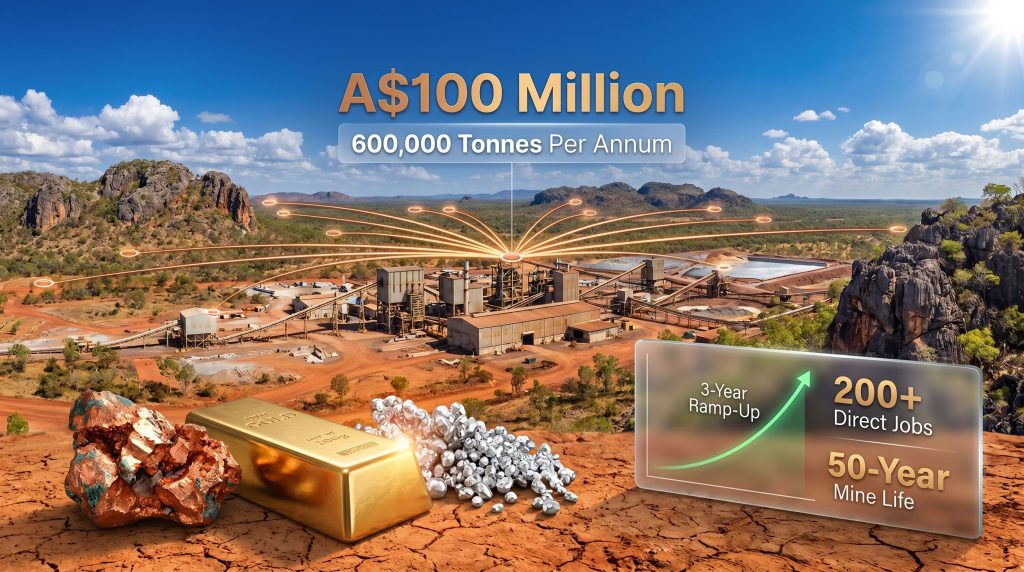
- Refurbishment and full recommissioning of the Mungana processing plant at a 600,000 tonnes per annum nameplate capacity
- Infrastructure upgrades required to support multi-source ore intake from satellite deposits
- Exploration and development activity across the satellite deposit inventory within the 160 km service catchment
- Reconfiguration of the processing circuit to prioritise gold, silver, and copper over the prior lead-zinc production profile
| Investment Component | Detail |
|---|---|
| Total Capital Commitment | A$100 million (~USD $69.27M) |
| Processing Plant Capacity | 600,000 tonnes per annum |
| Prior Capital Embedded in Asset | >A$100 million |
| Satellite Deposit Service Radius | 160 km |
| Target Production Ramp-Up Timeline | Within 3 years |
| Primary Target Commodities | Gold, silver, copper |
The Commodity Pivot: Why Gold, Silver, and Copper Are Replacing Lead and Zinc
Reading the Price Signal Correctly
Commodity mix decisions at restart are among the most consequential choices a mining operator makes, and they are rarely reversed cheaply once circuits are configured. Legacy Mines' decision to pivot away from lead and zinc toward gold, silver, and copper reflects a careful reading of prevailing market signals, but it also carries meaningful technical implications.
The current gold price outlook in 2026 remains exceptionally strong, with spot prices providing a significant buffer against operating cost escalation in remote Queensland. Furthermore, silver's dual role as both a monetary metal and an industrial input, particularly in photovoltaic panel manufacturing and electronics, is generating demand from directions that would not have been anticipated a decade ago. Copper sits at the intersection of energy transition infrastructure demand and constrained new supply growth, making it a commodity that institutional capital is actively seeking exposure to.
What the Circuit Reconfiguration Actually Involves
Switching a processing plant's primary focus from a lead-zinc sulphide regime to gold-copper recovery is not a matter of adjusting a few dials. It typically requires:
- Modification of flotation reagent regimes to selectively recover copper sulphides at the expense of sphalerite and galena
- Installation or upgrade of gravity recovery circuits to capture coarse free gold before it enters the flotation bank
- Revision of tailings management protocols, since gold-copper tailings carry different geochemical risk profiles than lead-zinc residues
- Potential introduction of leaching circuits if the gold deportment in the ore is partly refractory or fine-grained
All of these reconfiguration costs are incorporated within the A$100 million refurbishment budget, which is a critical point for anyone assessing whether the capital commitment is realistic relative to the scope of work.
The Tartana Partnership: Third-Party Validation of the Hub Model
Why a Toll Treatment Agreement Changes the Investment Calculus
Before Legacy Mines' own production ramp-up reaches full velocity, a binding agreement with Tartana Minerals provides a meaningful near-term test of the hub concept in practice. Tartana Minerals has committed to processing ore from its nearby Tartana copper mine through the Mungana plant, with production commencement targeted for the second half of 2025 under a pre-existing arrangement reviewed by the Maxitool Mining Group during their plant assessment process.
The significance of this arrangement extends well beyond its immediate revenue contribution. Third-party toll treatment income serves as a potential cash flow bridge during the ramp-up phase, reducing the period during which the operation is purely a capital consumer. More importantly, it constitutes commercial validation of the hub model from an independent operator who has assessed the facility's capabilities and committed legally to using them.
The existence of a binding third-party toll treatment agreement before the primary operator's own production begins is an unusual form of market validation that analysts rarely see in junior mining project announcements. It suggests the hub's competitive moat, its position as the only processing option within 160 km, is commercially recognised by neighbouring operators.
Economic Footprint: Jobs, Multipliers, and a 50-Year Horizon
Employment Projections and Regional Impact
Legacy Mines has forecast more than 200 direct on-site positions during operations, alongside an estimated 500+ indirect jobs supported across the Far North Queensland supply chain. The indirect figure deserves particular attention. Mining operations in remote regions generate outsized multiplier effects relative to urban industrial facilities, because the supply chain serving a remote mine, from fuel logistics to food catering to equipment maintenance, tends to be highly localised by necessity.
For the Chillagoe region and the broader Cairns hinterland, the economic implications of a 600,000 tonne per annum operation running at sustained capacity would be material. Regional centres that service remote mines benefit from payroll spend, contractor accommodation, equipment procurement, and the gradual development of supporting professional services.
The 50-Year Life Claim: What Sustains It?
A stated minimum 50-year operational life cycle is an extraordinary claim by any measure, and it requires more than optimism to support. Several structural factors underpin this assertion:
- The satellite deposit inventory within the 160 km catchment radius provides a diversified, multi-source feed strategy that no single deposit depletion event can interrupt
- The geological setting of the Chillagoe region is characterised by carbonate-hosted polymetallic mineralisation that has historically demonstrated considerable vertical and lateral continuity
- The hub model's economics improve as additional satellite operators contribute toll treatment volumes, extending the plant's economic life beyond any individual mine's reserve base
- A 50-year horizon fundamentally alters the calculus for regional infrastructure investment, including road upgrades, power infrastructure, and workforce housing
Projected Economic Snapshot
- Direct employment: 200+ on-site positions
- Indirect regional employment: 500+ positions
- Projected mine life: Minimum 50 years
- Processing throughput capacity: 600,000 tonnes per annum
- Capital already embedded in asset: >A$100 million
Risk Architecture: What Could Derail the Restart?
Operational and Technical Exposure
No restart of a care-and-maintenance facility is without technical risk. A plant that has been idle since July 2023 requires systematic assessment of every mechanical and electrical system before recommissioning. In remote Far North Queensland, the supply chain for replacement parts and specialised reagents carries longer lead times than comparable operations in southern Queensland or Western Australia.
Key operational risk factors include:
- Deterioration of rubber linings, pumps, and pipe work during the idle period in a tropical climate
- Water access and treatment requirements in the Chillagoe region, where seasonal rainfall patterns are highly variable
- Power infrastructure adequacy for a 600,000 tonne per annum facility operating continuously
- Environmental authority conditions for recommissioning a legacy site, which may require updated assessments and community consultation processes
Market and Financial Risk Considerations
The same commodity price environment driving the investment decision also introduces timing risk. A three-year ramp-up window is a long period across which gold and copper prices can move substantially in either direction. Capital cost escalation in the Australian construction sector has been a persistent issue since 2021, and remote Far North Queensland carries a structural premium on construction labour and logistics.
Securing offtake agreements for gold, silver, and copper concentrates from a restarted operation with a limited recent production history requires careful commercial positioning. Smelters and refiners will apply pricing adjustments to reflect the uncertainty around consistent grade and volume delivery during the ramp-up period. In addition, the ongoing copper supply crunch adds both opportunity and pricing complexity that operators must navigate carefully.
Regulatory and Community Considerations
Queensland's mining tenure framework requires operators recommissioning legacy sites to satisfy environmental authority conditions that may have evolved significantly since the original operation was active. Heritage surveys and engagement with Traditional Owners in the Chillagoe area represent both a legal obligation and a reputational consideration for a project that aspires to a 50-year operating life.
ESG reporting expectations from potential offtake partners and any future capital partners are also a material consideration. An engineering-driven approach that embeds ESG principles at the operational design level, rather than treating them as a compliance afterthought, is likely to prove commercially advantageous in the current financing environment. Broader mining consolidation trends in 2025 and beyond further reinforce the importance of demonstrating governance credibility to attract institutional capital and strategic partners.
The next major ASX story will hit our subscribers first
Frequently Asked Questions: Legacy Mines Mungana Mine Restart Queensland
What is the Mungana mine and where is it located?
The Mungana mine and associated processing facility are located near Chillagoe in Far North Queensland, Australia. The region has a long history of polymetallic mining activity spanning gold, copper, lead, and zinc. The asset is currently owned and being recommissioned by Legacy Mines.
How much is Legacy Mines investing in the Mungana restart?
Legacy Mines has committed A$100 million (approximately USD $69.27 million) to the restart, as announced on 13 July 2026. This is separate from the more than A$100 million in prior capital already physically embedded in the existing plant infrastructure.
What commodities will the restarted Mungana mine produce?
The primary production focus is gold, silver, and copper, representing a deliberate strategic pivot away from the prior lead-zinc production profile, driven by prevailing commodity price signals and margin analysis.
How many jobs will the Mungana restart create?
Legacy Mines projects more than 200 direct jobs on site and more than 500 indirect jobs across the regional Far North Queensland economy.
What is the expected timeline for production to begin?
Legacy Mines is targeting a production ramp-up within three years of the investment commitment. Tartana Minerals' toll treatment arrangement provides a near-term production commencement point through the plant ahead of Legacy Mines' full operational ramp-up.
What makes the Mungana hub strategically unique?
Its position as the only processing facility within a 160 km radius of multiple satellite deposits gives it a structural competitive advantage that cannot easily be replicated. Any satellite mine operator in the region requiring processing must either haul ore significantly further or engage with the Mungana hub.
What is the projected mine life?
Legacy Mines has stated a minimum 50-year operational life cycle, underpinned by the diversity of satellite deposits within the catchment radius and the geological characteristics of the broader Chillagoe mineral field. A comprehensive definitive feasibility study process will be central to validating these projections for investors and regulators alike.
A Blueprint That Goes Beyond One Project
The Legacy Mines Mungana mine restart Queensland investment represents something larger than a single operational decision. It is a case study in the economics of legacy asset reactivation, a model that starts from the premise that existing infrastructure, even when idle, retains enormous embedded value that new-build economics simply cannot replicate.
The combination of a hub-and-spoke processing architecture, a commodity mix pivoted toward structurally supported metals, third-party toll treatment validation, and a multi-decade satellite deposit pipeline creates a layered investment thesis that is rarely available in a single regional project. Whether the A$100 million commitment delivers on its 50-year promise will depend on execution quality, commodity market conditions, and the regulatory environment over a horizon no analyst can predict with confidence.
What can be said with confidence is that the structural logic is sound: the Mungana plant exists, its prior capital investment is sunk, its catchment territory has no processing competitor, and the commodities it will now prioritise are among the most sought-after in the global mining landscape in 2026. For investors and industry observers tracking Australia's capacity to add downstream processing value to its mineral endowment, the Legacy Mines Mungana mine restart Queensland is a project worth watching closely.
This article contains forward-looking statements and projections based on publicly available information as at the date of publication. Commodity price forecasts, employment projections, and operational timelines are subject to material uncertainty. Readers should conduct their own due diligence and seek independent financial advice before making investment decisions.
Want to Catch the Next Major ASX Mineral Discovery Before the Market Does?
Discovery Alert's proprietary Discovery IQ model delivers real-time alerts on significant ASX mineral discoveries across gold, copper, silver, and beyond — instantly translating complex data into actionable insights for investors at every level. Explore how historic discoveries have generated extraordinary returns and begin your 14-day free trial today to position yourself ahead of the market.