
July 13, 2026
The Engineering Economics of Baseload Power: Why India Keeps Building Big Thermal
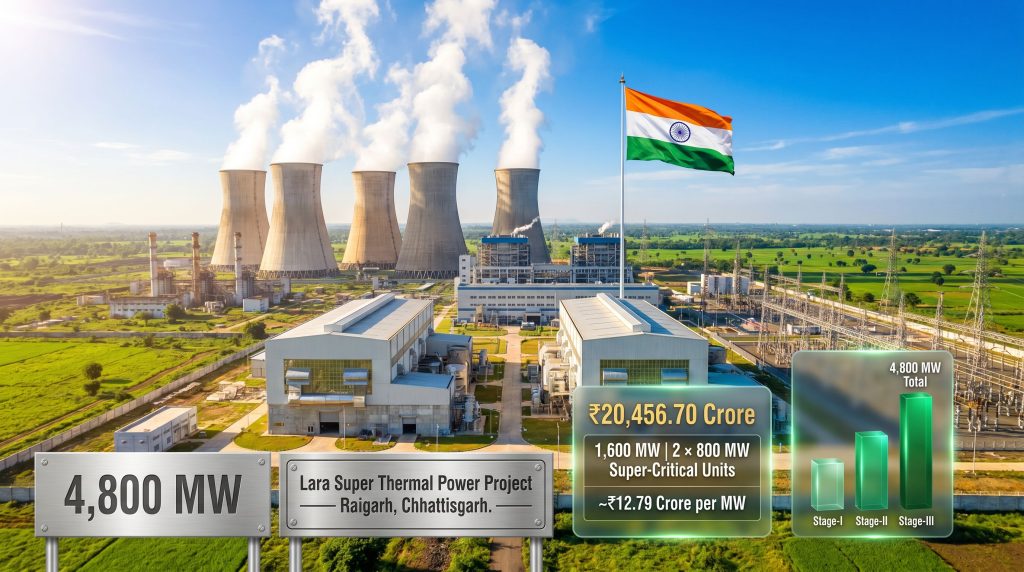
There is a persistent assumption in global energy commentary that the rise of renewables signals the slow death of thermal power investment. The reality playing out across the developing world, and India in particular, is far more nuanced. Baseload electricity, the kind that runs consistently regardless of weather or time of day, cannot yet be reliably replaced by solar panels or wind turbines at the scale India requires. The NTPC Lara Stage-III thermal project investment, approved at ₹20,456.70 crore by NTPC's Board of Directors on July 11, 2026, is one of the clearest expressions of this pragmatic reality.
Understanding what this decision actually means, technically, financially, and strategically, requires moving beyond the headline figure and examining the engineering logic, regulatory architecture, and long-term grid mathematics that drove it.
When big ASX news breaks, our subscribers know first
From Greenfield Site to India's Largest Thermal Power Plant
The Lara Super Thermal Power Project sits in the Raigarh district of Chhattisgarh, a state that occupies a strategically vital position within India's central transmission corridor. Chhattisgarh's geology and coal reserves have historically made it a preferred location for large thermal installations, and Lara has followed a deliberate stage-by-stage capacity build-up since its inception.
With Stage-I and Stage-II already commissioned, the addition of Stage-III through two 800 MW super-critical units brings the site's total approved capacity to 4,800 MW. That figure is not merely a numerical milestone; it repositions Lara as India's largest thermal power plant by installed capacity, surpassing established clusters like Vindhyachal and Talcher that have long defined the upper boundary of single-site thermal scale in India.
The geographic advantage of Raigarh extends beyond coal proximity. The site's connectivity to the central and western regional grids allows bulk power evacuation across some of India's highest-demand zones, reducing transmission losses and improving the commercial viability of each unit of electricity generated.
Why 800 MW Super-Critical Units Are the Engineering Choice of Scale
The selection of 800 MW super-critical units for Stage-III is not incidental; it reflects a deliberate engineering and commercial calculus that has become standard for large Maharatna-class projects.
Super-critical thermal technology operates at steam pressures above 220 bar and temperatures exceeding 550 degrees Celsius, pushing thermal efficiency into the 40 to 42 percent range, compared to 33 to 36 percent for older sub-critical configurations. The practical consequence is a meaningfully lower coal consumption rate per unit of electricity produced.
| Parameter | Sub-Critical Units | Super-Critical Units (800 MW) |
|---|---|---|
| Thermal Efficiency | ~33–36% | ~40–42% |
| Coal Consumption (g/kWh) | ~600–650 | ~520–540 |
| CO₂ Emissions Intensity | Higher | Comparatively Lower |
| Capital Cost per MW | Lower upfront | Higher, but operationally efficient |
For a plant operating at 4,800 MW cumulative capacity, even a modest reduction in coal consumption per kilowatt-hour compounds into enormous savings across the fuel supply chain. At the same time, India's revised emission norms for thermal power plants, which set tighter limits on particulate matter, sulphur dioxide, and nitrogen oxides, create a regulatory imperative to deploy technology that is inherently cleaner at the point of combustion. Super-critical units address both dimensions simultaneously.
It is also worth noting that while ultra-super-critical (USC) technology, which operates at even higher pressures and temperatures, is being evaluated for future Indian projects, the domestic supply chain for USC components remains less mature than for super-critical equipment. The 800 MW super-critical configuration therefore represents the current optimum between efficiency ambition and procurement certainty. Furthermore, decisions like these are inevitably shaped by broader energy economics, including India energy import costs, which create additional incentives to maximise the output efficiency of domestically fuelled generation assets.
Dissecting the ₹20,456.70 Crore Capital Commitment
The approved investment figure for the NTPC Lara Stage-III thermal project warrants careful decomposition. At ₹20,456.70 crore for 1,600 MW, the implied capital cost works out to approximately ₹12.79 crore per MW, a figure that sits at the upper end of recent Indian thermal project benchmarks but is broadly consistent with post-2023 inflationary realities in heavy infrastructure.
| Project Metric | Lara Stage-III |
|---|---|
| Total Approved Investment | ₹20,456.70 crore |
| Capacity Addition | 1,600 MW (2 × 800 MW) |
| Cost per MW | ~₹12.79 crore |
| Location | Raigarh, Chhattisgarh |
| Board Approval Date | July 11, 2026 |
| Cumulative Lara Capacity (Post Stage-III) | 4,800 MW |
Earlier feasibility estimates prepared during 2024 and 2025 placed Stage-III costs at approximately ₹15,500 crore. The gap between that figure and the board-approved ₹20,456.70 crore represents a revision of roughly 32 percent. This is not an anomaly specific to Lara; it reflects a pattern visible across multiple large thermal and infrastructure projects sanctioned in this period.
Key Insight: The principal cost escalation drivers include heavy electrical equipment pricing pressures, civil and structural construction inflation, enhanced environmental compliance infrastructure requirements, and higher logistics costs embedded in long supply chains for large boiler and turbine packages. Together, these forces have structurally reset the baseline cost assumptions for utility-scale thermal construction in India.
The capital structure for the Main Plant Package is intended to follow a blended debt-equity model, consistent with NTPC's approach to other large-scale capacity additions. Long-tenor project debt from institutional lenders and domestic bond markets typically provides the majority of funding, with equity drawn from internal accruals and NTPC's balance sheet. This structure allows the company to manage return-on-equity targets while keeping financing costs aligned with the long operational life of the asset.
The Regulatory Sequencing That Preceded Board Approval
Large thermal projects in India do not move directly from concept to board sanction. The regulatory pathway for Lara Stage-III followed a defined sequence under India's environmental governance framework:
-
August 2025: NTPC secured the Terms of Reference for the Environmental Impact Assessment (EIA), the mandatory first step under the Environment Protection Act for projects of this scale.
-
November 2025: Bids for the Main Plant Package were invited, initiating the procurement and contracting phase.
-
July 11, 2026: The NTPC Board of Directors formally approved the ₹20,456.70 crore investment proposal in New Delhi.
The EIA process for a project in Chhattisgarh carries specific complexities. The state's ecological zones, water resource dependencies, and proximity to forest land create assessment requirements that go beyond the standard thermal project checklist. Water availability for cooling systems at 4,800 MW cumulative scale is a particularly scrutinised factor, given the competing demands on the Mahanadi river system that feeds the region.
The selection of super-critical technology, while more capital-intensive, directly supports compliance with India's revised emission norms, effectively reducing the environmental clearance risk that sub-critical configurations might carry under tightening regulatory standards.
India's Power Demand Gap and the Structural Case for Thermal Baseload
Positioning the NTPC Lara Stage-III thermal project investment purely as an infrastructure decision would miss the broader demand context that makes it strategically necessary. India's electricity consumption is growing at a pace that renewable additions alone cannot absorb without creating grid stability risks.
India's National Electricity Plan projects that the country will need to add hundreds of gigawatts of generation capacity by 2031-32 to meet demand. Critically, the plan acknowledges that thermal capacity additions remain essential for baseload security even as renewables scale rapidly. This is not a contradiction; it reflects the technical reality that solar and wind generation are intermittent, while industrial loads, data centres, railways, and urban commercial demand require consistent power supply regardless of cloud cover or wind speed.
The distinction between peaking power and baseload power is central here. Solar can satisfy afternoon demand peaks in certain geographies, but it cannot provide the sustained, round-the-clock generation that large thermal plants deliver. An 800 MW unit running at a plant load factor above 80 percent generates electricity across approximately 7,000 hours per year, a reliability profile that no current renewable configuration can match without massive battery storage infrastructure. In addition, shifting natural gas price trends globally reinforce the comparative economics of coal-based baseload for countries with domestic fuel access.
The next major ASX story will hit our subscribers first
NTPC's Dual-Track Strategy: Thermal Expansion and Nuclear Pipeline
What makes NTPC's strategic position particularly interesting in 2026 is the simultaneous pursuit of two seemingly divergent energy pathways. On one track, the company is committing tens of thousands of crores to new thermal capacity at sites like Lara. On the other, it has announced ambitions to develop 30 GW of nuclear power capacity over the next two decades.
To support that nuclear pipeline, NTPC has issued a tender to appoint consultants to identify potential overseas uranium mining assets across Canada, Australia, Kazakhstan, and South Africa, according to a Bloomberg report. Securing upstream fuel supply is a prerequisite for any credible long-duration nuclear programme, and NTPC's early movement on this front signals that the nuclear ambition is more than aspirational positioning. Consequently, uranium market trends will become an increasingly relevant consideration as NTPC advances its nuclear fuel procurement strategy.
Strategic Framing: These two tracks are not in conflict. Thermal assets commissioned today will provide baseload security for the 15 to 20 years that nuclear projects typically require from planning to commercial operation. The Lara expansion effectively buys the time needed for nuclear capacity to mature, without leaving grid reliability hostage to an energy transition timeline that remains uncertain.
This sequenced approach also reflects a sophisticated understanding of capital deployment. Thermal projects can be financed, built, and commissioned within five to seven years. Nuclear projects require a decade or more, involve higher regulatory complexity, and demand entirely different fuel logistics. Running both tracks in parallel, rather than sequentially, maximises the probability that India's baseload capacity remains adequate through the transition period.
Operational and Economic Advantages of Concentrated 4,800 MW Scale
One dimension of the Lara project that receives insufficient attention is the operational premium that comes with concentrating so much capacity at a single interconnected site. The advantages operate across multiple dimensions:
- Shared switchyard and transmission infrastructure reduce per-MW evacuation costs significantly compared to dispersed smaller plants.
- Common coal handling and logistics systems across four stages create procurement leverage and reduce fuel cost per unit.
- Auxiliary systems and maintenance economies benefit from shared engineering teams, spare parts inventories, and operational expertise concentrated in one location.
- Plant load factor optimisation is easier to manage across a multi-unit site where units can be rotated for maintenance without supply disruption.
At the economic level, the incremental capital needed for Stage-III benefits from existing site infrastructure, environmental permissions, and workforce already in place from earlier stages. This embedded cost advantage is rarely reflected in headline per-MW comparisons between greenfield and brownfield thermal expansions, but it is a real source of value for NTPC's returns on the Stage-III investment.
The supply chain implications are also considerable. An additional 1,600 MW of capacity requires substantial incremental coal procurement, adding significant annual tonnage requirements to Lara's existing linkage agreements. This creates cascading demand through rail logistics, loading infrastructure, and coal washing facilities, with associated employment and revenue impacts concentrated in Chhattisgarh. However, these dynamics do not exist in isolation; the global steel market outlook also influences the cost of structural components and civil construction materials embedded in projects of this scale.
Frequently Asked Questions: NTPC Lara Stage-III Thermal Project Investment
What is the total approved investment for NTPC Lara Stage-III?
NTPC's Board of Directors approved an investment of ₹20,456.70 crore for Stage-III of the Lara Super Thermal Power Project on July 11, 2026.
How much capacity does Stage-III add, and what technology does it use?
Stage-III adds 1,600 MW through two 800 MW super-critical thermal units, selected for their superior efficiency and compliance characteristics relative to older sub-critical configurations.
What will Lara's total capacity be after Stage-III?
The project's cumulative installed capacity will reach 4,800 MW upon Stage-III completion, establishing it as India's largest thermal power plant.
Why did costs rise from approximately ₹15,500 crore to ₹20,456.70 crore?
The roughly 32 percent revision reflects post-2023 inflationary pressures across heavy electrical equipment, civil construction, and enhanced environmental compliance requirements embedded in the final project scope.
How is NTPC financing the project?
The Main Plant Package is intended to be financed through a blended combination of long-tenor project debt and equity, consistent with NTPC's financing model for comparable Maharatna-class infrastructure investments.
What regulatory milestones preceded the board approval?
Key steps included securing Terms of Reference for the Environmental Impact Assessment in August 2025 and issuing bids for the Main Plant Package in November 2025, before the formal board sanction in July 2026.
What the Lara Stage-III Approval Signals for India's Power Sector
The ₹20,457 crore commitment carries implications that extend well beyond a single project approval. Taken alongside NTPC's parallel nuclear ambitions, it signals several important structural messages about the direction of India's energy investment landscape. Furthermore, critical minerals demand for battery storage and grid technologies will only intensify as India attempts to balance thermal reliability with its longer-term clean energy commitments.
- Thermal baseload investment is not in structural retreat; it is being actively scaled up in response to near-term demand realities.
- Cost escalation in large infrastructure has moved cost-per-MW benchmarks materially upward, and future project budgets will need to reflect this new baseline.
- Super-critical technology is now the de facto standard for large Indian thermal additions, with ultra-super-critical configurations on the medium-term horizon as domestic supply chains mature.
- The concentration of capacity at established sites like Lara, rather than dispersal across multiple greenfield locations, reflects a deliberate strategy to extract operational and financing efficiencies from scale.
- NTPC's simultaneous movement into nuclear fuel procurement signals that the company is thinking in decade-scale investment horizons, not just immediate capacity gaps.
Disclaimer: This article is intended for informational purposes only and does not constitute financial or investment advice. Forecasts, timelines, and cost projections are subject to change based on regulatory, commercial, and macroeconomic conditions. Readers should conduct independent due diligence before making any investment decisions related to the Indian power sector or NTPC.
Want to Stay Ahead of the Commodity and Energy Investment Trends Shaping Major Markets?
Discovery Alert's proprietary Discovery IQ model delivers real-time alerts on significant ASX mineral discoveries — from the uranium assets NTPC is actively pursuing to the critical minerals driving the global energy transition — instantly translating complex data into actionable investment insights. Explore historic discoveries and their exceptional returns, then begin your 14-day free trial to position yourself ahead of the broader market.