July 13, 2026
The Structural Fault Line in US Critical Minerals Finance
The challenge of rebuilding domestic rare earth supply chains has never been purely a geological or technological problem. It is, at its core, a financing problem. Rare earth processing is capital-intensive, technically demanding, and commercially unproven at scale in the United States. The gap between pilot-plant success and full commercial output represents one of the most difficult risk thresholds in industrial finance, and it is precisely this gap that has defined the trajectory of the ReElement Pentagon loan withdrawal.
When governments attempt to bridge that gap using conventional debt instruments, they encounter a structural mismatch: the due diligence frameworks designed to protect public capital are built for mature borrowers, not pre-commercial start-ups operating at the frontier of critical minerals technology. The ReElement situation is a direct expression of that tension, and its implications extend well beyond one company's balance sheet.
When big ASX news breaks, our subscribers know first
What the Pentagon's Office of Strategic Capital Was Actually Trying to Build
Established within the US Department of Defence, the Office of Strategic Capital was created with a specific mandate: to mobilise private and public capital toward supply chains that carry national security significance. Critical minerals, and rare earth elements in particular, sit at the top of that priority list.
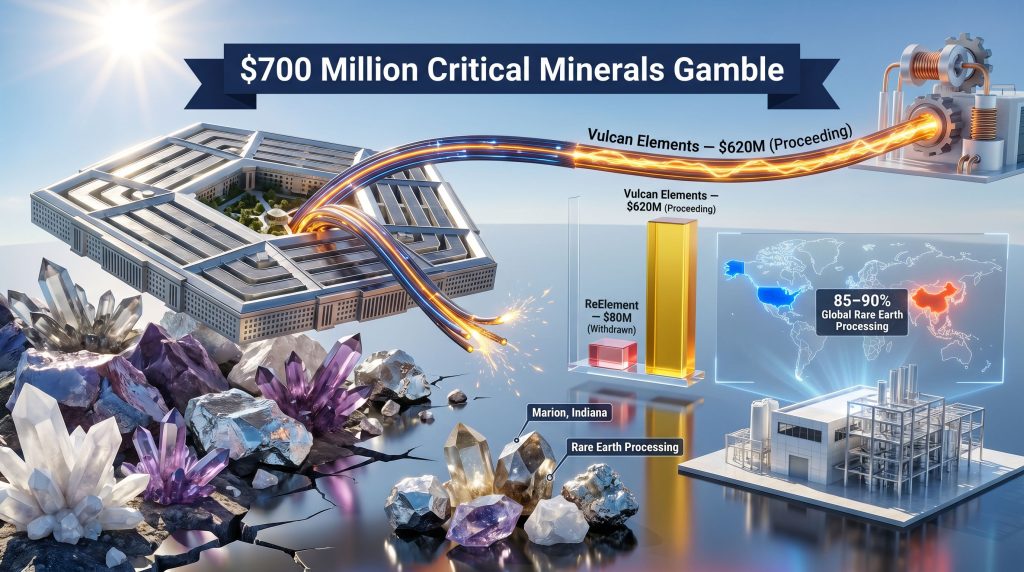
China currently controls an estimated 85 to 90 percent of global rare earth processing capacity, according to widely cited industry data. This concentration creates acute vulnerabilities for US defence systems, clean energy infrastructure, and advanced manufacturing. Neodymium-iron-boron (NdFeB) permanent magnets, which depend on rare earth inputs, are essential components in everything from fighter jet actuators to electric vehicle motors. Without domestic processing capacity, the US defence industrial base remains structurally dependent on a single geopolitical rival.
The OSC's $700 million critical minerals financing package, announced in November 2025, was structured as a conditional loan program. This distinction matters enormously. Unlike grants, which transfer capital upon approval, conditional loans require borrowers to reach a "financial close" milestone, meaning they must satisfy rigorous financial, legal, and technical due diligence standards before a single dollar is disbursed. No funds were transferred to ReElement prior to its withdrawal.
The Vertical Integration Logic Behind the Two-Company Model
The OSC's approach was built around a vertically integrated supply chain model. ReElement Technologies was designated as the upstream processor, tasked with applying its proprietary rare earth separation and recycling technology to produce refined feedstock at a planned commercial facility in Marion, Indiana. Vulcan Elements, a downstream start-up backed by the 1789 private equity fund, would then transform that feedstock into finished NdFeB permanent magnets, targeting production of up to 10,000 tonnes per year for Pentagon procurement.
This upstream-to-downstream architecture appealed to defence planners because it addressed the entire value chain in a single initiative. ReElement's processing technology, which emphasises continuous ion exchange methods rather than traditional solvent extraction, was positioned as a cost-competitive alternative to Chinese refining operations. Vulcan's magnet manufacturing capacity would then convert that processed material into a defence-ready end product, closing the loop on domestic supply.
The interdependency was the model's greatest strength and, as events have demonstrated, also its greatest vulnerability.
Why the ReElement Pentagon Loan Withdrawal Happened: Reading Between the Lines
The official account is straightforward: ReElement did not satisfy the OSC's federal due diligence standards, and the administration officials who confirmed this declined to specify which criteria the company failed to meet. That opacity is itself informative. When government agencies decline to detail the reasons for a failed financing process, it typically signals either ongoing legal sensitivity, internal disagreement about the assessment, or concerns serious enough that public disclosure would be commercially damaging.
The Three-Pillar Due Diligence Framework
The OSC applies a multi-dimensional assessment to critical minerals loan candidates. Based on publicly available information about federal loan programs, the evaluation framework encompasses three primary dimensions:
- Financial viability: Long-term revenue projections, balance sheet resilience, and the ability to service debt under stress scenarios
- Legal compliance: Corporate structure, intellectual property ownership, regulatory standing, and contractual obligations
- Technical scalability: The demonstrated capacity to transition from pilot-scale operations to commercial-volume production
Reported concerns centred on the third dimension. ReElement's proprietary continuous ion exchange technology had demonstrated promising results at smaller scales, but scaling rare earth separation to commercially meaningful volumes is an extraordinarily complex engineering challenge. The process chemistry that works efficiently at a few tonnes per month does not automatically translate to hundreds of tonnes per month without significant capital investment, operational refinement, and time.
For a debt instrument, this creates a fundamental problem. Lenders need confidence that the borrower can generate sufficient revenue to service the loan. If the technology's commercial scalability remains unproven, that revenue confidence evaporates, regardless of how compelling the strategic rationale appears on paper.
Political Dimensions and Congressional Scrutiny
The withdrawal did not occur in a political vacuum. Democratic lawmakers had already raised formal questions about whether political considerations influenced the loan review process, particularly given that Vulcan Elements, the company retaining its $620 million loan, is backed by the 1789 fund, a private equity vehicle associated with high-profile figures in the current political environment. Both the US Department of Defence and the White House declined to comment publicly on the ReElement withdrawal, a posture that has done little to reduce speculation about the integrity of the selection process.
The asymmetry between the two loan outcomes is striking. ReElement's $80 million allocation fell away while Vulcan's allocation, nearly eight times larger, remained intact. Whether this reflects a genuine differential in due diligence outcomes, a strategic prioritisation of downstream manufacturing over upstream processing, or something else entirely remains an open question, and one that Congressional oversight committees appear increasingly interested in pursuing.
Comparing the Two Loan Outcomes Side by Side
| Factor | ReElement Technologies | Vulcan Elements |
|---|---|---|
| Loan Amount | $80 million (withdrawn) | $620 million (retained) |
| Due Diligence Outcome | Failed to meet standards | Proceeding |
| Technology Focus | Rare earth processing and recycling | NdFeB magnet manufacturing |
| Private Backing | Transition Equity Partners ($200M) | 1789 Fund |
| Strategic Role | Upstream feedstock supplier | Downstream magnet producer |
| Japanese Industrial Involvement | Mitsubishi Materials (undisclosed stake) | None reported |
| Government Comment | Declined | Declined |
The OSC's apparent prioritisation of downstream manufacturing capacity over upstream processing raises a longer-term strategic question. Permanent magnet manufacturing is valuable, but it is only viable if a reliable, domestically sourced rare earth feedstock exists. By retaining the downstream loan while losing the upstream processor, the Pentagon may have inadvertently created a gap in the very supply chain it was trying to build.
ReElement's Alternative Path: Industrial Capital Over Government Debt
CEO Mark Jensen's public positioning after the withdrawal centred on a philosophy of cost discipline. His stated view was that carrying government debt on a balance sheet introduces structural cost burdens that undermine competitiveness against Chinese rare earth producers, which benefit from state support, low labour costs, and decades of accumulated processing expertise. In this framing, private capital is not merely a fallback option but a deliberate strategic choice.
Whether this represents genuine conviction or a pragmatic reframing of an adverse outcome is difficult to determine from public statements alone. What is clear is that ReElement's alternative financing position is more substantive than most early-stage critical minerals companies could claim.
The Transition Equity Partners and Mitsubishi Materials Investments
Earlier in 2026, ReElement secured a $200 million investment from Transition Equity Partners, providing a significant capital foundation independent of government loans. More strategically significant, perhaps, is the decision by Japan's Mitsubishi Materials to acquire an undisclosed equity stake in the company.
Japanese industrial capital entering the US rare earth processing space carries meaningful implications. Japan has its own acute vulnerability to Chinese rare earth supply disruptions, a lesson learned painfully during the 2010 Sino-Japanese diplomatic dispute when China temporarily restricted rare earth exports to Japan. Since then, Japanese companies and the Japanese government have pursued aggressive diversification strategies through entities like JOGMEC, which provides government-backed offtake agreements and equity co-investment in critical minerals projects globally.
Mitsubishi Materials' move into ReElement suggests a parallel track to Pentagon financing: allied-nation industrial partnerships that bring both capital and a built-in offtake rationale. For a rare earth processor, having a Japanese industrial anchor investor is arguably more valuable than a US government loan, because it combines financial support with a credible end-use customer relationship.
Could a Restructured Government Loan Still Emerge?
Reports indicate that ReElement is exploring alternative forms of federal assistance with potentially different structural terms. This opens the door to several possibilities beyond the OSC's standard debt instrument model:
- Department of Energy loan programs: The DOE's Loan Programs Office has different risk tolerance parameters and has previously supported first-of-kind clean energy manufacturing projects
- EXIM Bank facilities: Export-Import Bank financing could be structured around ReElement's potential export relationships with allied-nation partners, including Japanese customers
- Revenue-sharing arrangements: A hybrid structure where the government takes a portion of future revenues in lieu of fixed debt service could better match the company's pre-commercial risk profile
- Subordinated debt with equity kickers: Government participation as a junior creditor, with warrants or equity conversion rights, would align public capital more closely with the company's upside
None of these alternatives have been confirmed publicly, and investors should treat any such speculation as unverified until formal announcements are made.
What This Reveals About the US Critical Minerals Financing Architecture
The ReElement Pentagon loan withdrawal is more than a single company's setback. It functions as a diagnostic event, revealing structural limitations in how the United States currently finances critical minerals independence. Furthermore, the critical minerals demand surge globally makes resolving these structural financing challenges all the more urgent.
The Technology Readiness Gap Problem
A recurring challenge across the domestic rare earth sector is the mismatch between where companies are technologically and where debt financing requires them to be. Most US rare earth processing ventures are operating at Technology Readiness Levels (TRLs) of 5 to 7, meaning they have demonstrated proof of concept and pilot-scale viability but have not yet achieved full commercial deployment. Debt financing is most naturally suited to TRL 8 and above, where commercial operations are established and revenue visibility is high.
The conventional loan instrument, with its fixed repayment obligations, is structurally misaligned with the risk profile of pre-commercial critical minerals processors. This is not a reflection of poor technology or weak management; it is a reflection of where these companies necessarily sit in the industrial development cycle.
Comparing Allied-Nation Financing Models
The US model's reliance on debt instruments stands in contrast to the blended finance approaches adopted by key allied nations. In addition, rare earth supply chains have increasingly become a focal point for allied governments seeking to reduce dependence on Chinese processing capacity.
| Country | Policy Mechanism | Key Features |
|---|---|---|
| Australia | Critical Minerals Facility (Export Finance Australia) | Concessional loans for processing and refining projects |
| Canada | Critical Minerals Infrastructure Fund | Combines grants with equity co-investment |
| European Union | Critical Raw Materials Act | Strategic project designation with blended finance access |
| Japan | JOGMEC Programs | Government-backed offtake agreements and equity stakes |
| United States | OSC Conditional Loan Program | Debt-only, high due diligence threshold |
The consistent theme across allied-nation programs is the combination of concessional debt with equity participation, grant components, or offtake guarantees. These blended structures reduce the debt service burden on pre-commercial companies and align government capital more closely with the actual risk profile of early-stage industrial development. The European critical raw materials facility model, for instance, illustrates how a more flexible blended approach can accelerate project development timelines.
The US OSC model, as currently designed, applies a debt-only structure with due diligence standards calibrated for mature industrial borrowers. The result, as the ReElement case demonstrates, may be a systematic exclusion of exactly the kind of early-stage domestic processors that the program was designed to support.
Geopolitical Cost Accounting
Every quarter that domestic rare earth processing capacity remains below critical mass extends US dependence on Chinese supply chains. This is not an abstract policy concern. China rare earth export restrictions, expanded in April 2025 with new licensing requirements for seven categories of rare earth elements, demonstrated that supply chain weaponisation remains an active tool of Chinese economic statecraft.
For the US defence industrial base, the cost of continued dependence is measurable in procurement lead times, price volatility, and the strategic vulnerability of critical weapons systems whose performance depends on rare earth-containing components. The ReElement Pentagon loan withdrawal, even at the relatively modest scale of $80 million, represents a deferred increment of that independence. Consequently, US critical minerals policy will need to evolve significantly if the country is to close this gap with key rivals.
The next major ASX story will hit our subscribers first
Frequently Asked Questions
What was the ReElement Pentagon loan intended to fund?
The $80 million conditional loan was designed to support ReElement's proprietary rare earth separation and recycling operations as part of the Pentagon's broader $700 million critical minerals financing initiative administered by the Office of Strategic Capital. The funds were intended to advance the company's planned commercial processing facility in Marion, Indiana.
Why did the ReElement Pentagon loan withdrawal occur?
ReElement did not satisfy the OSC's federal due diligence requirements. Reported concerns centred on the company's ability to demonstrate commercial-scale technology readiness and long-term revenue visibility. No funds were disbursed prior to the withdrawal. The administration officials who confirmed the decision did not publicly specify which criteria were not met.
Is Vulcan Elements' Pentagon loan still active?
Yes. The $620 million allocation to Vulcan Elements for downstream NdFeB magnet manufacturing remains in place, according to Reuters reporting from July 2026. However, the longer-term viability of this downstream investment without a domestic upstream supplier remains an open strategic question.
What private financing has ReElement secured as an alternative?
ReElement received a $200 million investment from Transition Equity Partners earlier in 2026. Additionally, Japan's Mitsubishi Materials agreed to acquire an undisclosed equity stake in the company, providing both capital support and a strategically significant allied-nation industrial partnership.
Could ReElement still access federal financing in a different form?
Reports indicate the company is actively exploring alternative federal assistance structures, potentially through different loan terms or mechanisms outside the OSC program. No specific program or confirmed terms have been publicly disclosed.
Key Analytical Takeaways
The ReElement Pentagon loan withdrawal crystallises several interconnected challenges that will shape US critical minerals policy for years to come:
- The technology readiness gap between pilot-scale demonstration and commercial-volume rare earth processing is a structural barrier that conventional debt financing is poorly equipped to bridge
- The asymmetric outcome between ReElement and Vulcan Elements, with the downstream magnet manufacturer retaining a loan nearly eight times larger than the upstream processor lost, raises questions about the completeness of the Pentagon's supply chain strategy
- Allied-nation industrial capital, exemplified by Mitsubishi Materials' stake in ReElement, may prove to be a more structurally compatible source of financing for pre-commercial critical minerals ventures than domestic government debt instruments
- The political scrutiny surrounding the OSC loan program, particularly questions about the influence of investor connections on loan review decisions, will intensify Congressional oversight and may slow future disbursements
- A blended finance model incorporating equity co-investment, concessional debt, and offtake guarantees would more accurately match the risk profile of early-stage domestic rare earth processors, and the divergence between the US approach and those of allied nations makes a compelling case for program redesign
This article contains forward-looking analysis and commentary on matters that remain subject to change. Statements regarding company financing, government policy, and market dynamics involve inherent uncertainty and should not be construed as investment advice. Readers are encouraged to consult primary sources and seek independent financial guidance before making investment decisions.
Want to Track the Next Major Critical Minerals Discovery Before the Market Catches On?
Discovery Alert's proprietary Discovery IQ model delivers real-time alerts on significant ASX mineral discoveries — instantly cutting through complex data to surface actionable opportunities in critical minerals, rare earths, and beyond. Explore historic examples of major discoveries and their returns, then begin your 14-day free trial at Discovery Alert to position yourself ahead of the broader market.