June 15, 2026
The Hidden Economics Behind Africa's Aluminium Smelter Crisis
Across sub-Saharan Africa, a quiet but consequential pattern has been unfolding for years. Large-scale industrial assets, many of them built during commodity booms and reliant on infrastructure promises that never fully materialised, are being placed into suspended states as private capital retreats from the economics of high-cost, energy-intensive production. These are not failed projects in any absolute sense. They are facilities caught between the structural realities of developing-market energy systems and the unforgiving arithmetic of global commodity pricing. The Mozal aluminium smelter in Mozambique is the latest and most prominent example of this phenomenon, and the question of who steps in to preserve it reveals something fundamental about the future of African industrial policy.
When big ASX news breaks, our subscribers know first
Understanding the IDC Bid for South32's Mozal Smelter
The IDC bid for South32's Mozal smelter has emerged as one of the more strategically significant corporate developments in southern Africa's industrial landscape in 2026. South Africa's Industrial Development Corporation (IDC) is actively pursuing advisory services to evaluate the feasibility of acquiring a controlling interest in the Mozal aluminium smelter, a facility located west of Maputo, Mozambique, that was placed on care and maintenance in March 2026.
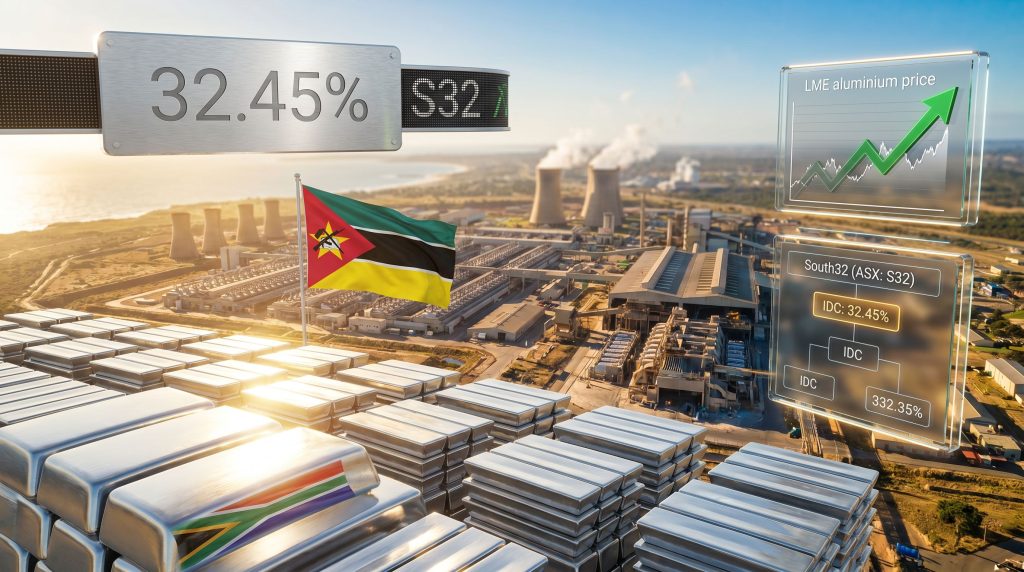
The IDC does not enter this scenario as an outsider. It already holds a 32.45% equity stake in Mozal, a position it built incrementally by exercising pre-emptive rights to acquire an additional 8.445% from a Mitsubishi-affiliated subsidiary, increasing its holding from a previous position of 24%. This deliberate escalation of ownership, executed even as the smelter's operational challenges were becoming apparent, signals a long-term conviction in the asset's underlying industrial value.
Mozal at a Glance
| Attribute | Detail |
|---|---|
| Location | West of Maputo, Mozambique |
| Regional Classification | One of sub-Saharan Africa's largest aluminium smelters |
| Operational Status | Care and maintenance (suspended March 2026) |
| Majority Stakeholder | South32 (ASX: S32) |
| IDC Equity (Current) | 32.45% |
| IDC Equity (Previous) | 24% |
| Additional Stake Acquired | 8.445% from Mitsubishi subsidiary |
| IDC Transaction Stage | Advisory counsel being sought; early evaluation |
What Care and Maintenance Actually Means for an Aluminium Smelter
The term care and maintenance is commonly misunderstood outside the mining and processing industries. It does not mean a facility has been decommissioned or written off. Rather, it describes a carefully managed operational suspension in which the physical asset is preserved in a restartable condition while active production is halted to stop cash outflows.
For an aluminium smelter specifically, this status carries distinct technical implications:
- Potlines, which are the electrochemical reduction cells that convert alumina into aluminium metal, must be managed carefully to prevent damage from cooling and solidification of molten bath material
- Anode production facilities, casting equipment, and fume treatment systems are placed into low-energy holding states
- A core maintenance workforce is retained to conduct regular equipment inspections, prevent corrosion, and ensure critical systems remain functional
- Environmental compliance obligations continue regardless of production status, including fluoride emission management and effluent controls
- Restart timelines from care and maintenance are typically measured in months rather than weeks, often requiring 6 to 12 months of recommissioning activity before full production is achievable
"The longer a smelter remains in care and maintenance, the greater the risk that skilled workers disperse, supply chain relationships weaken, and equipment deteriorates beyond the point where a rapid restart is practical."
This time-sensitivity dimension adds urgency to the IDC's evaluation. Every month the smelter remains idle increases the capital intensity of any eventual restart and reduces the probability that the broader industrial ecosystem surrounding the facility — including logistics, port handling, and local supply chains — remains intact.
Why Aluminium Smelting Is Fundamentally an Energy Business
To understand why Mozal was suspended and why its revival is so challenging, it is essential to understand the core physics of aluminium production. Aluminium smelting via the Hall-Heroult electrolytic process is among the most electricity-intensive industrial operations in existence, requiring approximately 13,000 to 15,000 kilowatt-hours of electricity per metric ton of aluminium produced. This is not a marginal cost consideration; electricity typically represents 30 to 40 percent of total aluminium production costs at most smelters globally.
This fundamental reality means that aluminium smelters are, in essence, industrial-scale electricity consumers that happen to produce a tradeable metal commodity. Their viability is inseparable from:
- The price and reliability of electricity supply at the smelter location
- The spread between electricity costs and the prevailing LME aluminium price, which determines whether production is cash-generative
- The stability of power delivery, since potline interruptions due to power outages can cause catastrophic and expensive damage to the electrochemical reduction process
- Long-term power purchase agreement structures that insulate the smelter from spot price volatility
Mozambique's electricity infrastructure, managed primarily through Electricidade de Moçambique (EDM), has historically struggled to deliver the consistent, large-volume baseload power that aluminium smelters require. Furthermore, renewable energy solutions are increasingly being considered as part of any credible restart plan. Any such plan for Mozal would need to resolve this energy equation before production economics could be rendered viable.
The IDC's Strategic Calculus: Beyond Financial Returns
The Industrial Development Corporation of South Africa is not a conventional investor. Established in 1940 and operating under the South African Department of Trade, Industry and Competition, the IDC is a state-owned development finance institution whose mandate explicitly extends beyond financial return optimisation to encompass industrial capacity building, employment creation, and regional economic development across southern Africa.
This institutional character explains behaviours that would appear irrational for a purely commercial investor. The IDC:
- Exercises pre-emptive rights to increase its stake in a suspended smelter
- Seeks advisory counsel to evaluate acquiring a majority position in an asset that has been generating no revenue
- Maintains a long-term perspective on industrial assets that commercial investors have characterised as uneconomic under current conditions
From the IDC's analytical framework, allowing Mozal to reach permanent closure would represent a far greater cost than the capital required to sustain and potentially revive it. The reasoning draws on several multiplier effects that a functioning smelter delivers:
- Direct employment across the smelter's operational workforce
- Indirect employment across logistics, maintenance contractors, and local service providers along the Maputo corridor
- Export earnings that contribute meaningfully to Mozambique's foreign exchange position
- Infrastructure utilisation across port facilities, road networks, and energy distribution systems in the greater Maputo region
- Skills retention in a specialised industrial workforce that would be extremely difficult to rebuild if dispersed
"For a development finance institution, the cost of losing industrial capacity permanently is almost always higher than the cost of maintaining it through a cyclical downturn. This is the institutional logic that drives the IDC's interest in Mozal."
In addition, the mining decarbonisation benefits of preserving and modernising an existing asset rather than constructing new capacity elsewhere are considerable, reinforcing the IDC's long-term strategic rationale.
Mapping the Possible Transaction Structures
Given the IDC's existing 32.45% stake, any acquisition of South32's majority position would represent a fundamental restructuring of Mozal's ownership architecture. Several credible structural pathways exist.
Scenario 1: Outright Majority Acquisition
The IDC acquires South32's controlling stake directly, becoming the dominant shareholder and gaining full operational authority over the smelter's future. This scenario requires the largest upfront capital commitment and would likely necessitate co-financing from multilateral institutions such as the African Development Bank or the Development Bank of Southern Africa (DBSA). The advantage is that it gives the IDC unconstrained ability to implement its strategic vision for the asset.
Scenario 2: Consortium-Led Bid
The IDC anchors a consortium that may include Mozambican state entities, regional development finance institutions, or strategic industrial partners with downstream aluminium processing interests. This structure distributes financial risk while maintaining South African development finance leadership. African infrastructure transactions have established precedent for DFI-led consortia acquiring distressed industrial assets. Consequently, this model is increasingly viewed as the most viable pathway for complex cross-border industrial negotiations.
Scenario 3: Staged Acquisition with Conditional Restart Triggers
The IDC acquires sufficient incremental equity to gain operational control, with the restart of production contingent on achieving defined prerequisites — primarily long-term power purchase agreements and aluminium offtake commitments. This approach minimises upfront capital exposure while maintaining optionality and allowing time for market conditions to improve.
The IDC's decision to seek external advisory counsel rather than proceeding directly with a bid indicates the transaction is at an early feasibility stage. Significant due diligence remains ahead of any formal offer, particularly around power supply arrangements, smelter condition assessment, and Mozambique's regulatory environment.
The next major ASX story will hit our subscribers first
South32's Portfolio Logic: Why Divesting Mozal Makes Strategic Sense
South32 has been systematically reorienting its asset portfolio toward operations that align with its long-term capital allocation priorities: higher-margin assets, lower carbon intensity, and commodities positioned for energy transition demand growth. Mozal's profile creates several tensions within this strategic framework.
| Strategic Dimension | Mozal's Position | South32's Preference |
|---|---|---|
| Energy intensity | Extremely high | Declining |
| Decarbonisation alignment | Challenging | Core priority |
| Market conditions | Difficult | Resilient |
| Operational location | Developing-market energy risk | Manageable risk environments |
| Capital return profile | Uncertain | Predictable |
Divesting to a development-focused acquirer like the IDC carries an additional reputational dimension for South32: it allows the company to characterise the transition as a responsible handover to an institution better positioned to manage the asset's long-term industrial mission, rather than a straightforward commercial exit from a troubled operation.
The Critical Risk Factors That Could Derail an IDC-Led Mozal Revival
Even if the IDC successfully acquires South32's stake, the pathway to restarting Mozal involves navigating several interlocking risk dimensions that have no simple resolution.
Power Infrastructure Constraints
Mozambique's electricity system has experienced chronic reliability challenges. Securing a long-term power purchase agreement that provides the guaranteed, competitively priced baseload power that aluminium smelting demands would require either a dedicated power generation arrangement or a restructured agreement with EDM that is contractually protected from tariff volatility and supply interruptions.
Global Aluminium Price Dynamics
LME aluminium prices remain subject to significant cyclical pressure, amplified by China's dominant position in global aluminium production. Chinese smelters benefit from subsidised electricity and state policy support, allowing them to sustain output at cost levels that structurally disadvantage higher-cost producers elsewhere. However, the aluminium tariff impact of recent trade policy shifts adds further complexity to global pricing dynamics. A Mozal restart would need to be underpinned by long-term offtake arrangements at commercially viable pricing rather than relying on spot market conditions.
Capital Requirements for Recommissioning
Restarting a care and maintenance smelter is capital-intensive well beyond ordinary operational capex. Equipment refurbishment across potlines and associated processing facilities, workforce reconstitution and retraining, supply chain re-engagement, and environmental compliance recertification all require substantial upfront investment before a single ton of aluminium can be produced.
Mozambique's Political and Regulatory Environment
Mozambique has navigated periods of political instability in recent years, which creates real due diligence considerations for any major industrial investment. Regulatory clarity around industrial licensing, fiscal terms, and the repatriation of investment returns would need to be firmly established before the IDC could justify a majority acquisition to its own stakeholders.
Aluminium as an Energy Transition Material: The Long-Term Investment Thesis
One dimension of the Mozal story that extends beyond immediate operational economics is the role aluminium plays in global energy transition supply chains. Aluminium is a foundational material in:
- Electric vehicle manufacturing, where it is used extensively in lightweight body structures, battery housings, and motor components
- Solar panel framing and racking systems for utility-scale renewable energy installations
- Wind turbine nacelle and structural components
- High-voltage transmission infrastructure for renewable energy grid expansion
- Lightweight construction materials supporting energy-efficient building design
This downstream demand trajectory provides a structural long-term argument for maintaining aluminium production capacity in sub-Saharan Africa. Furthermore, the broader model of the aluminium joint venture approach demonstrates how creative ownership structures can unlock stranded industrial value. If Mozal were to become a casualty of short-term market dynamics, rebuilding equivalent industrial capacity in the region would require far greater investment and far longer timelines than preserving the existing asset through its current challenges.
What the Mozal Situation Reveals About African Industrial Policy
The IDC bid for South32's Mozal smelter crystallises a broader debate about the appropriate role of development finance institutions in Africa's industrial economy. The pattern is becoming familiar: a commodity price cycle turns, private capital withdraws, a strategically important industrial asset enters care and maintenance, and the question of who bears the cost of preservation falls to state-linked institutions.
The critical question is not whether DFIs should step into these situations. Their institutional mandates almost demand it. The harder question is whether ownership transfer alone is sufficient to resolve the structural challenges that caused the suspension in the first place. Without addressing Mozambique's energy infrastructure constraints and establishing commercially viable power procurement arrangements, a change in Mozal's ownership architecture does not change its operational economics.
"Aluminium smelting converts electrical energy into a tradeable metal commodity. Resolving Mozal's future is therefore as much a question about Mozambique's energy policy trajectory as it is about development finance capability or aluminium market conditions."
This insight distinguishes the IDC bid for South32's Mozal smelter from simpler cases of distressed asset acquisition. The IDC's advisory process will need to grapple not just with smelter valuation but with Mozambique's broader energy sector reform agenda, the realistic timeline for power supply stabilisation, and the conditions under which a restart becomes commercially defensible rather than simply institutionally desirable.
Key Takeaways: The IDC Bid for South32's Mozal Smelter
| Theme | Core Insight |
|---|---|
| Transaction Stage | Advisory counsel stage; formal bid not yet lodged |
| IDC Equity Position | 32.45%, built through pre-emptive rights exercise |
| Asset Status | Care and maintenance since March 2026 |
| Energy Dependency | 13,000-15,000 kWh required per ton of aluminium produced |
| Restart Timeline | Typically 6-12 months from decision to production |
| Primary Structural Risk | Power supply reliability and cost competitiveness |
| Long-Term Demand Thesis | Aluminium critical to EV and renewable energy infrastructure |
| Broader Policy Significance | Test case for DFI-led industrial preservation across Africa |
Disclaimer: This article is intended for informational purposes only and does not constitute financial or investment advice. The transaction described is at an early evaluation stage and no formal bid has been publicly confirmed. Forecasts and scenario projections involve inherent uncertainty and should not be relied upon as indicators of future outcomes. Readers should conduct independent research and consult qualified advisers before making investment decisions.
Want to Track the Next Major ASX Mineral Discovery Before the Market Moves?
Discovery Alert's proprietary Discovery IQ model scans ASX announcements in real time, instantly identifying significant mineral discoveries — including those tied to energy transition commodities like aluminium — and converting complex data into actionable insights for investors at every level. Explore historic discoveries and their returns on Discovery Alert's dedicated discoveries page, or begin a 14-day free trial at discoveryalert.com.au to position yourself ahead of the broader market.