June 15, 2026
The Structural Case for Aluminium: Why Vertical Integration Is Rewriting the Metals Playbook
Across the global metals landscape, a quiet but consequential divergence is underway. While steel producers navigate softening demand cycles and margin compression, aluminium — particularly in its downstream, flat-rolled form — is attracting a different kind of institutional attention. The reasons are both structural and cyclical, and they converge at an interesting moment for one of India's most globally integrated industrial conglomerates.
Understanding why Hindalco stock as Novelis restarts New York hot mill operations is generating renewed analyst interest in mid-2026 requires looking beyond a single operational event. The Novelis Oswego hot mill restart is significant, but it is best understood as one piece within a larger investment thesis — one built on vertical integration, sustained commodity pricing, and the growing industrial appetite for aluminium in an energy-transitioning world.
When big ASX news breaks, our subscribers know first
Novelis and Hindalco: Why Subsidiary Performance Shapes Parent Valuation
Novelis is not simply a business unit within Hindalco's portfolio. It is the engine of the company's global downstream ambitions, contributing a substantial portion of consolidated revenue and operating earnings. As a wholly owned subsidiary, Novelis' performance flows directly into Hindalco's financial statements, meaning any operational disruption at a major Novelis facility carries immediate implications for the parent company's earnings per share, margin profile, and investor sentiment.
The Oswego facility, located in New York State, operates as one of Novelis' key North American manufacturing hubs. Its hot mill processes aluminium into flat-rolled sheet products serving the automotive, beverage can, and industrial sectors — product categories that command premium pricing relative to commodity-grade aluminium.
The Oswego Outage: What Happened and What It Cost
The Oswego facility suffered fire-related damage that forced an unplanned shutdown of its hot mill operations. According to Reuters reporting on the incident, Hindalco estimated an impact of up to $1.6 billion from the fire damage at its New York plant. The outage extended across Q1 and into Q2 of 2026, creating a meaningful drag on Novelis' consolidated output figures and triggering exceptional loss recognition at the subsidiary level.
Beyond the direct financial impact, the shutdown elevated investor uncertainty about the pace of operational recovery and the degree of customer disruption.
During the extended downtime, Novelis deployed its global manufacturing network — spanning facilities across North America, Europe, South America, and Asia — to absorb lost Oswego volumes and maintain continuity of supply to key customers. This network redundancy proved to be a critical differentiator. Single-facility producers facing a comparable event would have had no comparable fallback, yet Novelis was able to sustain customer relationships through coordinated logistics and production reallocation across continents.
On June 10, 2026, Novelis confirmed the Oswego hot mill had returned to operation. The company's leadership described the resumption as a meaningful step for both the business and its customer base, acknowledging the collaborative effort of employees, suppliers, and customers throughout the outage period. Production is being increased incrementally, with the explicit goal of rebuilding capacity to meet customer demand.
The restart announcement is not equivalent to a full recovery. A phased ramp-up means consolidated earnings normalisation will unfold over several quarters, not several weeks. Investors pricing in an immediate financial rebound may be significantly ahead of the operational reality.
From Restart to Recovery: Understanding the Ramp-Up Timeline
Hot mill operations in aluminium rolling are not switched back to full capacity instantaneously. After a fire-related shutdown of this duration, the recommissioning process involves equipment integrity verification, process parameter recalibration, and gradual throughput escalation to ensure product quality meets specification. Customer qualification requirements — particularly in the automotive sheet segment, where tolerances are tight — add additional time before full commercial volumes can be reallocated back to the Oswego facility.
This is a critical nuance that separates the operational announcement from its financial consequences. The risk premium embedded in Hindalco's share price during the outage period will not evaporate overnight. It will decompress gradually as production data validates management's ramp-up narrative.
| Metric | During Oswego Outage | Post-Restart Expectation |
|---|---|---|
| Hot Mill Operational Status | Offline | Phased ramp-up underway |
| Customer Supply Continuity | Maintained via global network | Transitioning back to Oswego |
| Novelis Consolidated Output | Reduced | Recovering incrementally |
| Exceptional Loss Exposure | Active | Diminishing over coming quarters |
| Investor Risk Premium | Elevated | Gradually decompressing |
Oswego's Role in North American Flat-Rolled Aluminium Supply
The Oswego facility is not a generic aluminium processing plant. Its hot mill produces flat-rolled sheet for some of the most demanding end-use categories in the downstream aluminium market. Automotive body sheet, which requires consistent gauge, surface quality, and formability characteristics, represents one of the facility's critical output streams. Beverage can stock — a high-volume, specification-driven product — is another core category, alongside broader industrial applications.
The North American flat-rolled aluminium market operates within relatively tight supply parameters. New capacity additions are capital-intensive and take years to commission, meaning that single-facility outages in this segment can create localised supply tightness that competitors are not always positioned to quickly absorb. This dynamic partially explains why Novelis' global network redundancy is such a strategically valuable asset — it allowed the company to protect customer relationships during a period when alternative supply sources were limited.
What Global Network Redundancy Actually Means in Practice
For investors unfamiliar with how integrated aluminium rolling companies manage supply disruptions, the mechanics are worth understanding. When a major facility goes offline unexpectedly, a globally networked producer can redirect orders to other plants operating within available capacity headroom. Logistics costs increase, lead times may extend marginally, and some production grades may need to be adjusted, but the fundamental customer relationship is preserved.
This is structurally different from what a single-market producer can offer. The Oswego disruption effectively stress-tested Novelis' global operating model, and the company's ability to maintain supplies during an extended outage validates the strategic rationale for geographic diversification across manufacturing assets. Furthermore, this resilience reinforces why aluminium sector consolidation among major integrated players continues to attract institutional interest.
UBS Coverage Initiation: The Analyst Conviction Behind Hindalco Stock
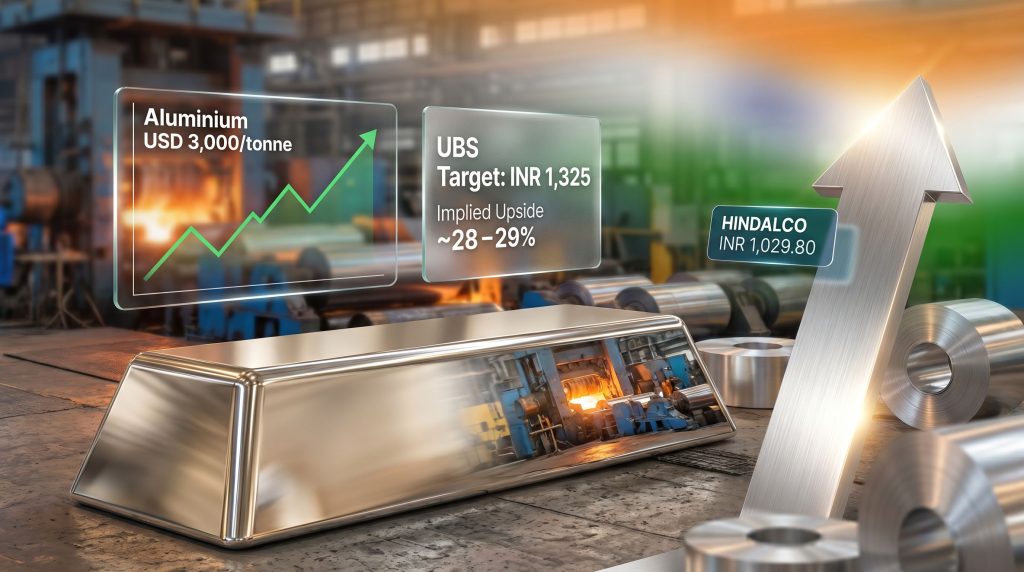
Alongside the operational restart news, Hindalco stock as Novelis restarts New York hot mill operations attracted additional attention following UBS's initiation of coverage across Indian metals and mining companies. The brokerage assigned Hindalco a Buy rating with a 12-month target price of INR 1,325 (approximately USD 145.75), placing it among the brokerage's preferred selections within the sector.
At June 15, 2026 trading levels, this target implies upside of approximately 28 to 29% from where the stock was changing hands. Hindalco opened that session at INR 1,029.80 (approximately USD 113.28), compared to the previous session's close of INR 1,039.30 (approximately USD 114.32), with intraday trading around INR 1,029.30 (approximately USD 113.22).
| Price Reference | INR | USD (Approx.) |
|---|---|---|
| UBS 12-Month Target | 1,325 | 145.75 |
| June 15 Opening Price | 1,029.80 | 113.28 |
| June 15 Intraday Level | 1,029.30 | 113.22 |
| Previous Session Close | 1,039.30 | 114.32 |
| Implied Upside to Target | ~28-29% | — |
The Aluminium-Over-Steel Conviction
UBS's bullish stance on Hindalco is embedded within a broader sectoral view that favours aluminium producers over steel companies in the current commodity cycle. The brokerage adopted a more cautious stance on steel names, including Tata Steel, while constructing a positive thesis around integrated aluminium producers.
The aluminium price outlook forms the foundation of this thesis. UBS expects aluminium to remain above USD 3,000 per tonne across its forecast horizon, underpinned by several converging forces:
-
Supply-side constraints: New smelting capacity additions remain structurally limited. Aluminium smelting is among the most energy-intensive industrial processes in existence, requiring roughly 13 to 14 megawatt-hours of electricity per tonne of primary metal produced. In a world of elevated electricity costs, this creates a formidable barrier to greenfield capacity expansion.
-
Demand from energy transition: Aluminium's lightweight-to-strength ratio makes it the material of choice for electric vehicle body structures, battery enclosures, and charging infrastructure components. The energy transition demand for aluminium is forecast to grow significantly as decarbonisation targets intensify globally.
-
Renewable energy infrastructure: Wind turbines, solar panel frames, and transmission infrastructure all consume aluminium in volume. Infrastructure investment cycles tied to decarbonisation targets are creating durable incremental demand.
-
Packaging sector resilience: Beverage can aluminium demand has proven remarkably stable across economic cycles, supported by the ongoing shift away from single-use plastics in consumer packaging.
UBS also initiated coverage on NALCO with a Buy rating, reinforcing the view that this is a sector-level conviction rather than a stock-specific call. The dual initiation signals that institutional interest in Indian integrated aluminium producers reflects a structural thesis about where margin and earnings growth are most likely to materialise in the metals complex.
UBS's position is not simply that Hindalco is cheap. It is that aluminium's supply-demand dynamics are structurally superior to those of steel, and that integrated producers capturing value across the full production chain are best positioned to monetise that advantage.
Why Integration Is the Critical Variable in Aluminium Economics
The concept of vertical integration in aluminium is frequently referenced but rarely unpacked. For investors, understanding this mechanism is key to appreciating why Hindalco's earnings profile is structurally different from a pure downstream processor or a primary smelter operating in isolation.
A fully integrated aluminium producer controls the value chain from bauxite mining through alumina refining, primary smelting, and ultimately downstream rolling into finished sheet products. At each transition point, a non-integrated buyer must pay a market price that embeds the seller's margin. An integrated producer internalises those margins entirely.
In a high aluminium price environment, this advantage compounds. Consider the mechanics:
- Primary aluminium prices rise above USD 3,000 per tonne.
- Spot premiums for downstream-processed products (automotive sheet, can stock) also expand, as value-added content commands a proportional uplift.
- Integrated producers capture both the primary metal price appreciation and the downstream processing premium simultaneously.
- Non-integrated downstream processors, purchasing primary metal at elevated prices, face margin compression unless they can pass costs to customers.
Hindalco's structure — upstream Indian smelting operations combined with Novelis' global rolling network — positions it to extract value at multiple stages of this chain. The Oswego restart, when it reaches full capacity normalisation, adds incremental downstream rolling capacity back into this integrated earnings engine.
Key Risks That Could Disrupt the Bull Case
Any credible investment analysis must engage with the downside scenarios. For Hindalco stock as Novelis restarts New York hot mill operations specifically, several risk factors warrant careful monitoring.
Operational Risks at Oswego
- The ramp-up from a fire-damaged facility is not linear. Equipment behaviour during recommissioning can reveal secondary damage not apparent during initial assessment.
- Customer reallocation risk is real. Some customers who redirected orders to alternative suppliers during the outage may not immediately return, particularly if alternative supply arrangements proved reliable and competitively priced.
- Management's language around a gradual production increase is deliberately cautious, reflecting genuine uncertainty about the pace of capacity recovery.
Market and Macro Risks
- The entire UBS bull case rests on aluminium prices holding above USD 3,000 per tonne. A demand shock, Chinese capacity surge, or energy cost deflation could pressure this floor.
- Hindalco consolidates Novelis' USD-denominated revenues into INR-reported financials. INR appreciation against the USD would reduce the translated value of Novelis earnings.
- Indian equity markets, including large-cap industrial names like Hindalco, are sensitive to episodes of foreign institutional investor outflows triggered by global risk-off sentiment.
Structural and Competitive Risks
- North American flat-rolled aluminium competitors may have permanently captured a portion of Oswego's former customer relationships during the extended outage.
- Trade policy changes affecting US aluminium import duties could alter the competitive dynamics of Novelis' North American operations.
- Electricity cost volatility in key aluminium-producing regions remains an unresolved risk for smelting economics globally. Consequently, the expanding Indian industrial market is also worth monitoring for upstream energy cost signals that may affect smelting margins.
The next major ASX story will hit our subscribers first
Downstream Aluminium Trends Providing Structural Tailwinds
Beyond the Oswego-specific narrative, the broader downstream aluminium sector is experiencing demand patterns that support the investment thesis for producers like Novelis independently of commodity price movements.
Automotive lightweighting has moved from a design preference to a regulatory necessity in many markets. Electric vehicle growth is driving demand for aluminium-intensive architectures, as EVs carry heavy battery packs requiring chassis and body structures that minimise weight elsewhere to preserve range. Adoption is spreading rapidly from premium into mass-market segments.
Beverage can stock demand continues to grow modestly but consistently, supported by the sustainability narrative around aluminium's high recyclability rate. Aluminium cans have a recycled content rate significantly above most competing packaging materials, giving producers a credible environmental positioning in consumer markets increasingly focused on lifecycle impact.
Industrial and construction applications tied to infrastructure investment cycles provide a third demand pillar. These demand streams are geographically diversified and less correlated with any single economic cycle, which adds earnings stability for downstream producers serving multiple end markets.
Frequently Asked Questions
What caused the Novelis Oswego hot mill shutdown?
A fire at the Oswego facility caused damage to the hot mill, forcing an unplanned cessation of operations that extended through Q1 and into Q2 of 2026.
When did the Novelis Oswego hot mill restart?
Operations resumed on June 10, 2026. Production is being increased incrementally, with full capacity normalisation expected to take additional time beyond the initial restart date.
Why does the Oswego restart matter for Hindalco shareholders?
Novelis is Hindalco's wholly owned subsidiary and a primary contributor to consolidated earnings. The outage generated exceptional losses and weighed on the earnings outlook. The restart begins the process of removing that financial headwind, though recovery will be gradual.
What is UBS's price target for Hindalco?
UBS has assigned a Buy rating with a 12-month price target of INR 1,325 (approximately USD 145.75), representing approximately 28 to 29% upside from mid-June 2026 trading levels around INR 1,029 to 1,030.
Why does UBS favour aluminium over steel in 2026?
UBS's view centres on tighter supply conditions in aluminium, sustained price strength above USD 3,000 per tonne, and structurally growing demand from energy transition and EV sectors. These dynamics disproportionately benefit integrated producers like Hindalco compared to steel companies facing more cyclical demand exposure.
What is the current Hindalco share price?
As of June 15, 2026, Hindalco shares were trading around INR 1,029 to 1,030 on the NSE, with the previous session closing at INR 1,039.30.
Disclaimer: This article is intended for informational purposes only and does not constitute financial advice. Share price targets, analyst ratings, and commodity price forecasts are subject to change and carry no guarantee of outcome. Readers should conduct independent research and consult a qualified financial adviser before making investment decisions. All price references are sourced from publicly available market data and analyst commentary as of June 2026.
Want to Catch the Next Major Mineral Discovery Before the Market Does?
Discovery Alert's proprietary Discovery IQ model delivers real-time alerts on significant ASX mineral discoveries, instantly transforming complex mineral data into actionable investment insights for both short-term traders and long-term investors — explore Discovery Alert's discoveries page to understand how historic finds have generated substantial returns, and begin your 14-day free trial today to position yourself ahead of the broader market.