June 15, 2026
Africa's Most Striking Energy Paradox: A Nation Drowning in Power It Cannot Use
Across Sub-Saharan Africa, the relationship between natural resource wealth and citizen welfare has long been fraught with contradiction. Nowhere is this tension more visible than in the Democratic Republic of the Congo, a country that simultaneously holds one of the planet's most extraordinary concentrations of untapped energy potential and one of its lowest rates of residential electricity access. The DRC energy strategy to expand electricity access represents a direct attempt to resolve this paradox, one that has defined the country's development trajectory for decades. Understanding why this contradiction exists requires looking beyond the resource balance sheet and into the institutional, financial, and infrastructural realities that have shaped the sector.
When big ASX news breaks, our subscribers know first
The Numbers Behind the Contradiction
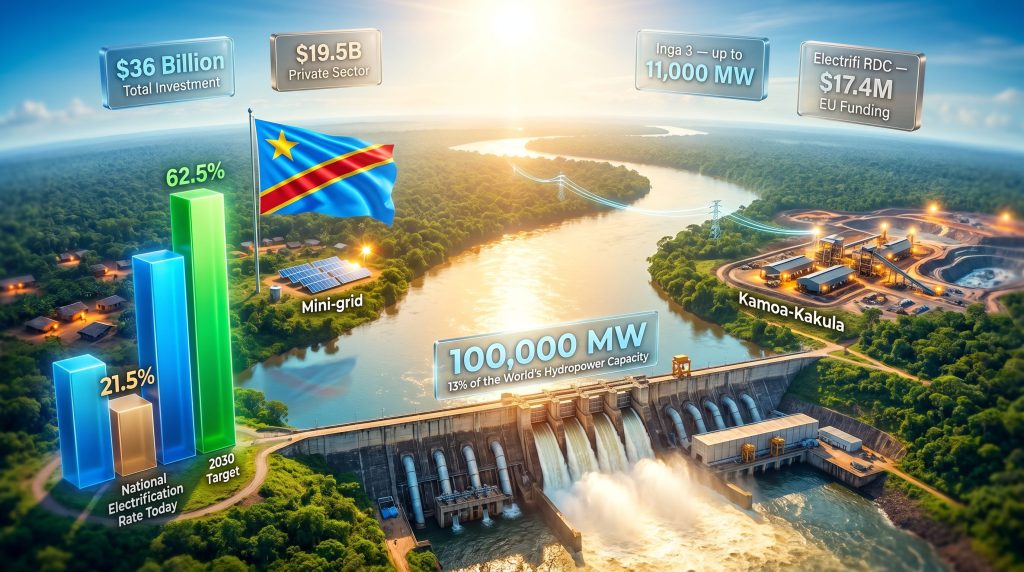
The DRC's hydropower endowment is staggering in global terms. With an estimated 100,000 MW of hydropower potential, the country controls approximately 13% of total global hydropower capacity, according to data cited by the World Bank and the International Hydropower Association. The Congo River itself carries the second-largest volume of freshwater discharge of any river system on Earth, a geological fact that gives the Inga site alone a theoretical generation ceiling of up to 40,000 MW.
Why Does Abundance Coexist With Scarcity?
Yet despite this inheritance, only around 21.5% of the DRC's population currently has access to electricity. In rural areas, that figure collapses to approximately 1%, leaving tens of millions of Congolese entirely outside the formal energy economy. The state utility, SNEL (Société Nationale d'Électricité), currently delivers roughly 2,100 MW against an installed capacity of approximately 2,800 MW, meaning the country's existing infrastructure already operates at a roughly 25% deficit relative to what it theoretically should be producing, before any unmet demand from new consumers is factored in.
"The DRC's electrification deficit is fundamentally an institutional and financial problem, not a resource problem. The energy is there. The systems to deliver it are not."
The consequences extend deep into the industrial economy. Unmet electricity demand from the mining sector alone exceeds 1,500 MW, compelling major operators to import power from neighbouring countries including Zambia, Tanzania, and the Republic of the Congo. Since mining generates the majority of the DRC's export revenues and fiscal receipts, the energy shortfall effectively functions as a self-reinforcing constraint on the government's own capacity to fund infrastructure development. Furthermore, the natural resources in the DRC remain largely underutilised precisely because the energy infrastructure to process and transport them at scale does not yet exist.
What the New National Energy Policy Actually Changes
On June 12, 2026, during its 92nd ministerial session, the DRC's Council of Ministers formally adopted a revised National Energy Policy (PNE). Presented by Minister of Water Resources and Electricity Aimé Sakombi Molendo, the document represents the conclusion of a reform process that began in 2020 and has taken six years to reach formal adoption. The PNE is designed to function as an overarching governance architecture, aligning with sector reforms enacted in 2025 and with the binding commitments embedded in the DRC's National Energy Compact.
The core ambition of the policy is to raise the national electrification rate from its current 21.5% to approximately 62.5% by 2030, a target that requires the annual connection rate to accelerate from roughly 1% per year to over 6% per year. Achieving this would place the DRC among the fastest electrification stories in African development history, but only if execution matches ambition.
| Metric | Current Level | Target (2030) |
|---|---|---|
| National electrification rate | ~21.5% | ~62.5% |
| Rural electrification rate | ~1% | Significant uplift required |
| Annual electrification rate increase | ~1% per year | >6% per year |
| Total investment required | — | ~$36 billion |
| Private sector share | — | ~$19.5 billion |
It is worth noting that different sources report the 2030 target as 62.5%, 63%, or 32%, a discrepancy that likely reflects different assumptions about population growth rates, the treatment of grid versus off-grid connections in access statistics, and the phasing of implementation milestones. The most recent government-aligned reporting supports 62.5% as the operative planning figure.
Three Strategic Pillars Driving the DRC's Electrification Push
Pillar One: Large-Scale Hydropower and the Long-Delayed Inga Question
Hydropower anchors the DRC's long-term generation vision, and the centrepiece of that vision remains Inga 3, a proposed expansion of the existing Inga I and Inga II installations on the Congo River. With an initial estimated capacity of up to 11,000 MW, Inga 3 would represent a transformational addition to the country's generation base. Negotiations with South Africa are ongoing, with Pretoria positioned as a potential anchor offtaker that could provide the revenue certainty needed to mobilise construction financing.
The history of the Grand Inga vision is, however, one of repeated deferral. Governance disputes, financing gaps, and shifting geopolitical priorities have collectively ensured that what could be the world's largest hydropower complex remains largely theoretical after decades of discussion. The new PNE does not resolve these historical obstacles, but it provides a formal framework within which renewed negotiations can operate.
Pillar Two: Decentralised Renewables and the Off-Grid Imperative
Given the physical impossibility of extending a centralised grid to remote communities across a country the size of Western Europe within any near-term timeframe, the DRC's strategy places significant weight on distributed energy solutions. World Bank analysis consistently identifies mid-scale hydro, solar, and hybrid mini-grid configurations as the most cost-effective pathway for communities that large infrastructure cannot reach before 2030.
Key instruments supporting this pillar include:
- Mini-grids powered by solar, small hydro, or hybrid systems serving rural demand clusters
- Off-grid solar home systems for individual household connections in dispersed settlements
- The World Bank's EASE program (Electricity Access Scale-up and Expansion) targeting under-served communities
- The National Mini-Grids Program, providing technical and financial support for distributed generation deployment
- Electrifi RDC, launched in May 2026 with $17.4 million in EU funding, specifically designed to finance small-scale renewable energy projects in underserved areas
A concrete demonstration of the viability of private renewable investment came in February 2026, when the Electricity Sector Regulatory Authority (ARE) approved a 233 MWp solar power plant with battery storage to be developed by CrossBoundary Energy, supplying electricity directly to the Kamoa-Kakula copper mining complex in Lualaba province. This project signals that the DRC's industrial energy market can attract serious private capital when regulatory pathways are clear and offtake arrangements are bankable. In addition, the broader energy transition in mining across Africa is increasingly shaping how major operators approach long-term power procurement strategies.
Pillar Three: Regional Power Integration as a Bridge Supply Strategy
The DRC's long-term ambition is to become a net electricity exporter to the African continent. In the near term, however, regional integration serves a more pressing function: filling domestic supply gaps through cross-border imports while domestic generation capacity is being built.
| Partnership | Nature | Scale |
|---|---|---|
| DRC–South Africa | Inga 3 development negotiations | Up to 11,000 MW (Phase 1) |
| DRC–Angola | Power interconnection project | Angola surplus ~4,000 MW available |
| DRC–Zambia, Tanzania, Republic of Congo | Existing electricity imports | Addresses ~1,500 MW+ mining shortfall |
The DRC-Angola transmission corridor deserves particular attention. Angola holds an estimated 4,000 MW power surplus, and the proposed interconnection is described as potentially one of the longest electricity transmission links on the African continent. If completed, it would provide meaningful bridge supply while the DRC develops its own generation base, reversing the current import dependency over time.
The $36 Billion Question: Financing the Transition
Total investment requirements for the DRC's energy transformation are estimated at approximately $36 billion, of which roughly $19.5 billion is expected to originate from the private sector. This is not a financing gap that multilateral development banks or bilateral donors can bridge alone. It requires a fundamental shift in the perceived risk profile of the DRC as an investment destination for independent power producers and institutional infrastructure investors.
Financing mechanisms currently in play include:
- National Energy Compact commitments linking electrification targets to concessional multilateral financing
- EU-backed Electrifi RDC program with $17.4 million in seed funding for community-scale renewables
- World Bank instruments spanning the EASE program, National Mini-Grids Program, and governance support initiatives
- Power Africa partnerships focused on reducing generation costs and improving the investment climate
- Private sector concessions structured around clearer tariff-setting and renewable energy licensing frameworks
Critical risk: The $19.5 billion private sector component is not guaranteed capital. It is a financing target that can only be achieved if regulatory reform delivers credible, enforceable, and transparent investment frameworks. Without these, institutional capital will not deploy at this scale regardless of the policy ambition on paper.
Furthermore, the Congo minerals partnership with the United States may create additional leverage for unlocking infrastructure financing, given the strategic importance of Congolese resources to global supply chains. DRC's new energy strategy reflects the government's recognition that private capital mobilisation at this scale demands a transformed regulatory environment, not merely aspirational targets.
Regulatory Reform as the True Enabling Condition
The PNE's practical success hinges less on its target figures and more on whether the institutional environment can be transformed sufficiently to attract and retain private investment. Historically, the DRC's energy sector has been characterised by regulatory opacity, weak enforcement, and an absence of the predictable tariff structures that infrastructure investors require to underwrite long-term capital commitments.
Key governance changes embedded in the strategy include:
- Clearer concession frameworks for independent power producers across generation, transmission, and distribution segments
- Transparent, cost-reflective tariff mechanisms with protection provisions for low-income consumers
- A strengthened ARE (Electricity Sector Regulatory Authority) with genuine licensing and enforcement independence
- Sector unbundling, separating generation, transmission, and distribution to improve accountability
- Climate resilience integration into infrastructure planning, supported by World Bank technical programs
The CrossBoundary Energy approval at Kamoa-Kakula demonstrates that ARE is capable of processing and approving complex private renewable projects. The question is whether this capacity can be scaled and systematised across the broader sector.
The next major ASX story will hit our subscribers first
How the DRC Compares to Regional Electrification Models
The DRC's strategic framework draws conceptually from successful precedents elsewhere in Sub-Saharan Africa, though its scale challenges are categorically different from those faced by smaller regional peers.
- Kenya has surpassed 75% electrification through a combination of grid extension and targeted off-grid programs including the Last Mile Connectivity initiative
- Ethiopia has used the Grand Ethiopian Renaissance Dam as an anchor for both domestic access expansion and regional export revenue generation
- Rwanda has demonstrated that strong regulatory governance combined with focused off-grid deployment can rapidly accelerate rural electrification from a very low base
- The DRC, as the second-largest country in Africa by land area with a population exceeding 100 million, faces infrastructure deployment challenges that simply do not have direct precedent in the region
The lesson from these comparisons is not that the DRC should replicate any single model, but that the combination of regulatory credibility, parallel grid and off-grid deployment, and consistent political commitment has proven decisive wherever rapid electrification gains have been achieved. Consequently, the DRC energy strategy to expand electricity access must be evaluated not against regional averages but against the unique structural conditions the country faces.
Execution Risks That Could Derail the 2030 Targets
| Risk Category | Specific Challenge | Mitigation Pathway |
|---|---|---|
| Financing risk | $19.5B private capital may not materialise | Regulatory reform, de-risking instruments |
| Execution risk | Annual rate must increase 6x | Parallel grid and off-grid deployment |
| Institutional risk | Weak regulatory enforcement history | ARE capacity building, World Bank support |
| Political risk | Inga 3 delays, regional negotiation complexity | Bilateral agreements, phased project design |
| Technical risk | Aging SNEL infrastructure, transmission losses | Infrastructure rehabilitation investment |
| Climate risk | Congo River hydrology variability | Energy mix diversification (solar and hydro) |
A less-discussed but significant technical risk is the Congo River's hydrological variability. While the river system carries enormous average discharge volumes, seasonal flow variation affects generation reliability from run-of-river installations. This makes the case for energy mix diversification, particularly the integration of solar capacity alongside hydropower, stronger than a purely resource-based analysis might suggest. The growing global critical minerals demand also means the DRC cannot afford energy instability that undermines mining productivity and export revenues. Furthermore, the DRC cobalt export suspension demonstrated how quickly supply chain disruptions can reverberate globally when the DRC's industrial sector is compromised.
FAQ: DRC Energy Strategy and Electricity Access
What is the DRC's current electricity access rate?
Approximately 21.5% of the total population has access to electricity. In rural areas, this figure is approximately 1%, making the DRC one of the least electrified nations relative to its energy resource base.
What is the DRC's 2030 electrification target?
The National Energy Compact targets an electrification rate of approximately 62.5% by 2030, requiring the annual connection rate to rise from roughly 1% to over 6% per year.
How much investment does the DRC need?
Total investment requirements are estimated at approximately $36 billion, with roughly $19.5 billion expected from private sector sources and the remainder from public budgets, multilateral institutions, and bilateral partnerships.
What is Inga 3?
Inga 3 is a proposed large-scale hydropower development on the Congo River with an initial estimated capacity of up to 11,000 MW. It is part of the broader Grand Inga vision, which envisions eventual total capacity of up to 40,000 MW from the Inga site. Negotiations between the DRC and South Africa regarding its development are ongoing.
What is the Electrifi RDC program?
Launched in May 2026 with $17.4 million in EU funding, Electrifi RDC finances small-scale renewable energy projects in underserved communities across the DRC, complementing the government's broader off-grid electrification agenda.
Can the DRC Convert Its Energy Paradox Into a Development Catalyst?
The adoption of the revised National Energy Policy marks a genuine inflection point in the DRC's energy governance history, but it represents a beginning rather than an achievement. The policy framework is architecturally coherent: it combines large-scale hydropower ambition with pragmatic off-grid deployment, embeds regional integration as a bridge supply mechanism, and places regulatory reform at the centre of the investment mobilisation strategy.
Three conditions will ultimately determine whether the 2030 targets are achievable in any meaningful sense:
- Regulatory credibility: whether the ARE and associated institutions can enforce the new framework consistently enough to shift investor perception of the DRC from high-risk to manageable-risk
- Financing architecture: whether the combination of multilateral instruments, EU programs, and private concessions can actually mobilise capital at the pace and scale required
- Political continuity: whether the governance reforms and international partnerships embedded in the PNE survive the political cycles that have historically disrupted long-term infrastructure planning in the DRC
If these conditions converge, the DRC energy strategy to expand electricity access could represent one of the most consequential electrification stories in African development history, transforming a nation that holds 13% of global hydropower potential into a regional energy hub capable of powering both its own citizens and neighbouring economies. However, if they do not, the PNE risks becoming another well-designed framework that the institutional environment was not yet capable of executing.
The resource endowment has never been in question. What the DRC now requires is the institutional maturity to match it.
This article contains forward-looking statements and projections relating to the DRC's energy sector targets, investment requirements, and regional partnerships. These are based on publicly available policy documents, multilateral institution analysis, and sector reporting. Actual outcomes may differ materially from projections depending on political, financial, regulatory, and macroeconomic developments. Nothing in this article constitutes financial or investment advice.
Want to Capitalise on the Resource Discoveries Powering Africa's Energy Transformation?
The mineral wealth underpinning the DRC's electrification ambitions — from copper to cobalt — is reshaping global commodity markets, and Discovery Alert's proprietary Discovery IQ model delivers real-time ASX alerts the moment significant mineral discoveries are announced, turning complex data across 30+ commodities into actionable insights for investors at every level. Explore how historic discoveries have generated extraordinary returns on Discovery Alert's dedicated discoveries page, and begin your 14-day free trial today to position yourself ahead of the market.