
August 23, 2026
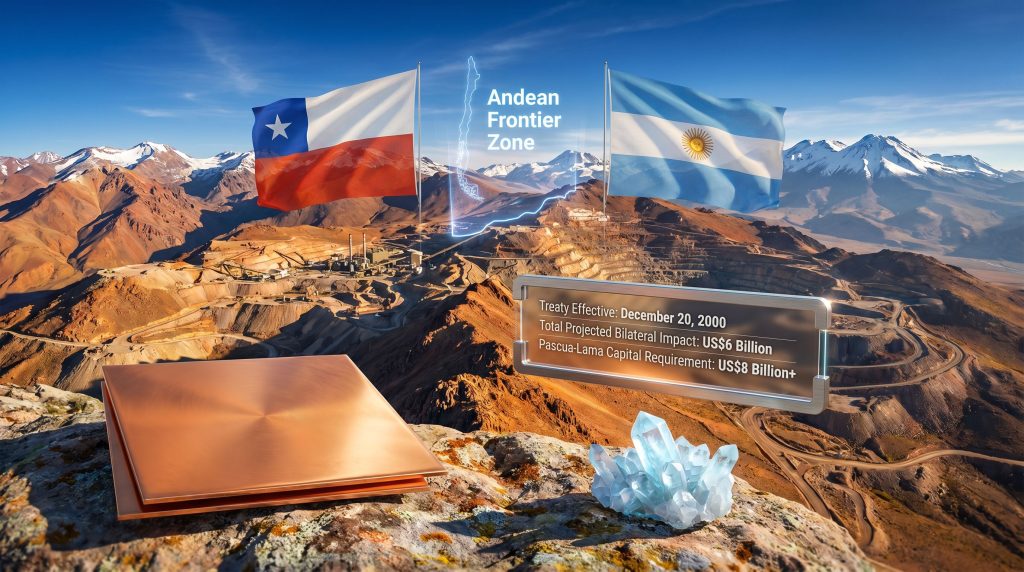
The Andean Frontier as a Global Mineral Chessboard
Few geographic corridors on Earth concentrate as much unrealised mineral wealth as the high-altitude borderlands where Chile and Argentina meet. The Andes do not recognise sovereign boundaries, and neither do the copper porphyries and lithium-bearing salars that sit beneath them. Yet for decades, the legal architecture governing this terrain has struggled to match the geological reality. A single ore body straddling two jurisdictions creates a compounded regulatory burden that can, and historically has, rendered otherwise world-class deposits commercially unviable.
The reactivation of the Chile and Argentina mining treaty in 2026 represents a deliberate effort to close that gap. Understanding what this treaty actually does, why it was necessary, and what obstacles remain is essential context for anyone tracking critical mineral investment flows in South America.
When big ASX news breaks, our subscribers know first
The Legal Architecture of the Chile and Argentina Mining Treaty
The treaty between Chile and Argentina governing cross-border mining activity was formally signed on 29 December 1997, with simultaneous signing ceremonies held in San Juan on the Argentine side and Antofagasta on the Chilean side. This dual-location signing was itself symbolic, reinforcing the bilateral and co-equal nature of the arrangement. Following ratification by both national legislatures and the formal exchange of instruments at San Pedro de Atacama, the treaty entered legal force on 20 December 2000.
A Complementary Protocol, appended on 20 August 1999, addressed practical ambiguities that emerged during the ratification process. This protocol clarified mining rights demarcation procedures, established frontier zone boundary protocols, and created a mechanism for resolving definitional disputes without requiring full treaty renegotiation. That last feature is more significant than it might appear: it means the treaty can adapt to new commodity categories, such as lithium, without either government needing to restart the full legislative ratification cycle.
Core Legal Principles: Beyond Equal Division
The treaty's philosophical foundation rests on the doctrine of rational shared-resource development. Its profit distribution provisions are not built around equal division but around proportional benefit relative to each country's contribution of resources, infrastructure, and regulatory input. This distinction matters in practice because frontier zone deposits are rarely distributed symmetrically across the border. A deposit where 70% of the ore body lies within Chilean territory and 30% within Argentina should, under treaty logic, generate fiscal outcomes that reflect that asymmetry rather than imposing an artificial 50/50 split.
What the Treaty Framework Permits: A Regulatory Breakdown
| Treaty Provision | Operational Meaning |
|---|---|
| Joint exploration rights | Investors from either country may conduct exploration across the frontier zone under a coordinated permit structure |
| Unified frontier zone designation | A defined Andean corridor is treated as a single operational space for regulatory purposes |
| Cross-border customs facilitation | Equipment, materials, and personnel may move across the border with streamlined customs treatment |
| Shared taxation coordination | Provisions to reduce double-taxation risk and clarify fiscal jurisdiction for binational operations |
| Labor mobility protocols | Workers may be deployed across the border under coordinated labor law arrangements |
| Infrastructure co-development | Both states may co-invest in shared access infrastructure serving frontier zone projects |
The frontier zone concept is arguably the treaty's most legally innovative feature. Rather than eliminating sovereignty, it creates a bounded legal space where both regulatory systems operate in parallel with defined precedence rules. Investors can treat a cross-border deposit as a unified asset, dramatically reducing the risk premium that would otherwise make cross-border project financing extremely difficult to structure.
Economic Projections: What the Treaty Zone Is Worth
Before the 2026 reactivation, Chile's executive branch estimated that treaty-enabled projects would generate a minimum of US$1.25 billion in domestic demand for goods and services during the construction phase alone. The total projected bilateral economic impact across both nations was estimated at US$6 billion. These figures were derived from a conservative pipeline assessment and predate the current commodity price environment, which has materially increased the economic potential of lithium and copper frontier zone assets.
To calibrate scale, consider the Pascua-Lama precedent. This gold and silver project straddling the high-altitude Chile-Argentina border required projected capital investment exceeding US$8 billion, making it one of the most capital-intensive cross-border mining proposals in South American history. Its prolonged difficulties, spanning environmental permitting disputes, unresolved tax jurisdiction conflicts, and community opposition, provide an instructive counterpoint to the treaty's theoretical promise.
The Pascua-Lama lesson is not that binational mining is impossible. It is that treaty rights and project execution are separated by a substantial gap that only coordinated institutional effort can close.
What Pascua-Lama demonstrated most clearly was that fiscal dispute resolution is often the critical path item. A project can achieve technical feasibility, secure environmental approval on one side of the border, and still stall for years while governments negotiate which jurisdiction has primary taxing authority over which revenue stream.
The 2026 Reactivation: What Changed and Why Now
The decision to reactivate the Chile and Argentina mining treaty in 2026 was not arbitrary. Four converging pressures made the timing logical:
-
Battery-grade lithium demand acceleration driven by global electric vehicle adoption and grid-scale energy storage deployment has fundamentally repositioned the Andean lithium triangle as a tier-one strategic resource zone.
-
Copper supply constraints from aging deposits in established jurisdictions have elevated the strategic importance of underdeveloped frontier zone copper porphyry systems. Furthermore, the growing copper supply crunch at a global level has added considerable urgency to developing these untapped cross-border assets.
-
Geopolitical pressure from Western-aligned economies to secure critical mineral supply chains outside of jurisdictions perceived as strategically unreliable has created external demand for South American production scale-up.
-
Protectionist trade architecture emerging in competing mineral jurisdictions has incentivised Chile and Argentina to present a coordinated investment environment rather than competing independently for capital.
What the Original Framework Missed: The Lithium Gap
When the treaty was conceived in 1997, lithium was a niche industrial commodity. Battery-grade lithium carbonate and lithium hydroxide were not significant considerations in the original drafting. The 2026 reactivation explicitly addresses this gap by expanding the commodity scope and committing both governments to renewed coordination across four operational pillars.
In addition, understanding how lithium brine mining works is increasingly important context for investors assessing frontier zone assets, given that the majority of the region's lithium is hosted in high-altitude salar brines rather than hard rock deposits.
| Dimension | 2000 Treaty Framework | 2026 Reactivation Focus |
|---|---|---|
| Commodity priority | Primarily gold, silver, copper | Expanded to include lithium, lithium hydroxide, lithium carbonate |
| Infrastructure coordination | Conceptual framework only | Active co-investment in access roads, energy, and water systems |
| Customs facilitation | Broad provisions | Streamlined digital customs protocols |
| Tax coordination | Principle-based | Specific bilateral fiscal arrangements under active negotiation |
| Environmental standards | Separate national regimes | Movement toward harmonized baseline environmental thresholds |
Regulatory Barriers That Still Threaten Treaty-Zone Investment
The reactivation resolves some problems while leaving others structurally intact.
The Dual Mining Code Problem
Chile and Argentina operate under fundamentally different mining codes, royalty structures, and permitting timelines. Chilean mining law is generally considered more investor-friendly and administratively streamlined, while Argentine mining governance is complicated by its federal structure, where provincial governments retain significant authority over resource development. A project spanning the border therefore faces asymmetric risk exposure: it must satisfy two different legal standards simultaneously, and a rejection on either side can halt the entire project.
Indigenous Rights: The Unresolved Consultation Layer
Both countries carry independent obligations under ILO Convention 169 regarding free, prior, and informed consent from indigenous communities. The treaty creates no unified consultation mechanism. Each country must run its own process under its own legal standards. This creates a scenario where a project could receive positive consultation outcomes in Chile while facing a fundamentally different process result in Argentina, or vice versa, effectively paralysing development even when all treaty-level rights are intact.
This is a lesser-known but operationally critical risk that many investors underweight when assessing frontier zone project exposure.
Environmental Permitting Asymmetry
Chile's Environmental Impact Assessment system operates at the national level with relatively defined timelines. Argentina's environmental governance is administered at the provincial level, creating significant variation between, for example, San Juan Province and Salta Province. A project might secure Chilean EIA approval and still face a multi-year provincial review process on the Argentine side. The 2026 reactivation signals intent to move toward harmonized baseline environmental thresholds, but this remains aspirational rather than operational.
How the Chile-Argentina Model Compares Globally
| Framework | Countries | Commodity Focus | Legal Mechanism | Operational Status |
|---|---|---|---|---|
| Chile-Argentina Mining Treaty (1997/2000) | Chile, Argentina | Copper, lithium, gold | Bilateral treaty with frontier zone designation | Reactivated 2026 |
| Timor Sea Treaty | Australia, Timor-Leste | Oil and gas | Joint petroleum development area | Active |
| Zambia-DRC Copper Belt Cooperation | Zambia, DRC | Copper, cobalt | MOU-level coordination | Limited operationalisation |
| Nordic Mining Cooperation | Norway, Sweden, Finland | Iron ore, base metals | EU regulatory harmonisation | Mature |
The frontier zone concept distinguishes the Chile and Argentina mining treaty from most comparable bilateral frameworks. Most cross-border resource agreements address revenue sharing after extraction. This treaty addresses the pre-extraction regulatory environment, allowing investors to structure a project as a single unified asset from the exploration phase onward. That upstream legal clarity is what makes the framework potentially transformative for project finance.
The next major ASX story will hit our subscribers first
Investment Strategy Considerations for Frontier Zone Projects
Investors and project developers considering treaty-zone exposure should weigh several structural considerations:
-
Legal entity structuring matters significantly. Holding assets through entities incorporated in both jurisdictions simultaneously can maximise treaty protections while preserving access to domestic dispute resolution mechanisms in each country.
-
Project finance lenders will assess binational regulatory risk through a dual-jurisdiction credit lens. Treaty provisions that clarify fiscal jurisdiction reduce the sovereign risk premium that lenders embed into pricing, which directly affects feasibility economics.
-
Infrastructure co-investment frameworks such as public-private partnerships can de-risk capital-intensive access requirements, particularly for high-altitude projects where road and energy infrastructure costs can represent a disproportionate share of total development expenditure.
-
Downstream value capture within the frontier zone is an emerging strategic consideration. Co-locating lithium processing and refining facilities within the treaty area would allow both governments to capture value-added economic activity rather than exporting raw material.
Strategic Scenarios for the Decade Ahead
Scenario A: Full Activation. Both governments harmonise customs, tax, and environmental frameworks within three to five years. A new generation of copper and lithium projects enters the construction phase, collectively generating economic activity that exceeds the original US$6 billion bilateral projection, potentially by a substantial margin given current commodity valuations.
Scenario B: Selective Progress. Customs and labor protocols are streamlined, but tax and environmental harmonisation stalls. Investment gravitates toward lower-complexity copper projects while lithium frontier zone development remains constrained by unresolved fiscal architecture.
Scenario C: Stagnation. Political transitions in either country deprioritise binational coordination. The reactivation generates no binding regulatory changes, and the treaty remains a framework without operational projects attached to it.
The probability weighting across these scenarios is not uniform. The structural demand for lithium and copper creates a durable economic incentive for both governments to progress toward Scenario A, but the institutional capacity requirements should not be underestimated.
The Geopolitical Dimension: Latin America's Lithium Triangle as a Strategic Asset
Chile and Argentina together account for an extraordinarily large share of the world's identified lithium triangle reserves, concentrated in the high-altitude salars of the Puna plateau. This geographic concentration creates both an opportunity and a vulnerability. The opportunity is the ability to supply a significant portion of global battery-grade lithium demand from a single, relatively compact geological zone.
The vulnerability, however, is that the zone straddles two separate sovereign jurisdictions with histories of policy divergence. Consequently, the broader conversation around critical minerals and energy security has made coordinated Andean production frameworks considerably more attractive to Western-aligned governments seeking stable supply chains.
Chile's lithium strategy has evolved substantially in recent years, and the reactivation of the bilateral treaty can be read as an extension of that strategic repositioning. Similarly, the Argentina lithium brines of the Puna plateau represent a complementary asset base that gains considerably more commercial relevance when assessed within a coordinated binational framework rather than in isolation.
The Chile and Argentina mining treaty reactivation can be understood partly as a response to this vulnerability. By presenting a coordinated investment environment, both governments strengthen their collective negotiating position in global critical mineral supply chain discussions. Whether that coordination translates into operational project outcomes will depend on the institutional follow-through that historically has distinguished successful bilateral frameworks from those that remain perpetually aspirational. For further context on how this framework is evolving, the fund.ar shared mountain range analysis provides a detailed examination of the integration opportunities specific to the energy transition.
Key Treaty Reference Data
| Metric | Detail |
|---|---|
| Treaty signed | 29 December 1997 |
| Treaty entered into force | 20 December 2000 |
| Complementary Protocol signed | 20 August 1999 |
| Minimum construction-phase economic impact (Chile) | US$1.25 billion |
| Total projected bilateral economic impact | US$6 billion |
| Pascua-Lama estimated capital requirement | US$8 billion+ |
| 2026 reactivation focus areas | Customs, taxation, labour, infrastructure |
| Primary commodities | Copper, lithium, gold, silver |
This article is intended for informational purposes only and does not constitute financial or investment advice. Forward-looking projections and scenario analyses involve significant uncertainty and should not be relied upon as predictions of future outcomes. Readers should conduct independent due diligence before making investment decisions.
Want To Stay Ahead of the Next Major Mineral Discovery in the Andes and Beyond?
Discovery Alert's proprietary Discovery IQ model delivers real-time alerts on significant ASX mineral discoveries across copper, lithium, and other critical minerals, instantly transforming complex data into actionable investment insights — explore historic discoveries and their returns to understand what's possible, then begin your 14-day free trial at Discovery Alert to position yourself ahead of the broader market.