July 9, 2026
A Half-Century of State Control and Its Consequences
The global oil industry has always operated at the intersection of geology, geopolitics, and governance. Few countries illustrate this tension more vividly than Venezuela, a nation sitting atop the world's largest proven crude reserves yet unable to meaningfully monetise them for decades. Understanding why Venezuela's energy sector arrived at this inflection point requires stepping back from the immediate news cycle and examining the structural mechanics that made Venezuela new oil regulations not just desirable, but unavoidable.
Venezuela nationalised its oil industry in 1976, creating Petróleos de Venezuela S.A., universally known as PDVSA, as the instrument of absolute state control over the country's hydrocarbon wealth. For a generation, the model appeared to work. Production climbed, revenues flowed, and the country exercised enormous influence within OPEC.
However, centralised resource control carries compounding costs. Over decades, political interference in PDVSA's management decisions eroded operational efficiency, suppressed capital allocation discipline, and hollowed out the technical expertise that modern upstream operations demand. By the 2010s, production had fallen sharply from its peak. When the United States imposed sweeping sanctions beginning in 2019, Venezuela's capacity to convert its 300-plus billion barrels of proven reserves into actual export revenue collapsed further.
The resulting paradox became defining: Venezuela held more certified crude reserves than any other nation on earth, yet was producing at a fraction of its potential and struggling to finance basic state functions. The existing regulatory architecture, built on the assumption of permanent PDVSA dominance, had become structurally incompatible with attracting the scale of private capital needed to reverse this trajectory.
When big ASX news breaks, our subscribers know first
The Geopolitical Catalyst: January 2025 and the Architecture of Reform
The legislative reform that Venezuela's acting government enacted in mid-2026 did not materialise in a vacuum. Its origins trace to January 3rd of the previous year, when the effective transfer of control over Venezuela's oil sector took place under U.S.-led pressure following the removal of Nicolas Maduro. Consequently, that event placed the sector under emergency operating conditions and forced the incoming administration under Delcy Rodríguez to confront a fundamental choice: preserve the existing state monopoly framework or fundamentally redesign it to attract the foreign capital that sanctions had long blocked. Furthermore, the US policy shift towards Venezuela played a pivotal role in accelerating this decision.
The decision to pursue reform was further accelerated by the devastating dual earthquakes that struck Venezuela on June 24th. The acting government explicitly cited reconstruction financing as a driver for urgently monetising the country's oil endowment, adding domestic political urgency to what had already been a geopolitically compelled process.
By late May 2026, Venezuela's oil minister Paula Henao had signalled that regulatory approval was imminent. The formal enactment followed in early July, with acting president Rodríguez and Henao presiding over the legislative process that reviewed and consolidated approximately 1,400 regulations accumulated across 83 years of oil sector operations into a coherent new framework.
This consolidation exercise is itself significant. It signals an intent to create a regulatory environment that international investors can actually read, interpret, and rely upon. Opacity in petroleum law has historically been as much a barrier to investment as headline fiscal terms.
What the Venezuela New Oil Regulations Actually Change
Breaking the PDVSA Monopoly: Private Upstream Access for the First Time Since 1976
The most structurally transformative element of the new framework is straightforward in concept but profound in implication: private companies are now legally permitted to conduct exploration and production activities in Venezuela independently of PDVSA's operational control. This reverses the foundational principle of Venezuelan resource nationalism that has governed the sector for nearly five decades. For further context on the legal environment surrounding these changes, Venezuela's oil and gas laws provide useful background on the regulatory terrain operators must navigate.
The required entry mechanism is a joint venture with PDVSA. Private operators do not simply acquire standalone licences; they must partner with the state company. However, the critical shift is that within these joint ventures, private operators can assume full management control rather than deferring to PDVSA's operational decisions. This distinction between legal partnership and operational authority is commercially decisive for international oil companies evaluating re-entry into the country.
Productive Participation Contracts: How the New Model Works
The new legal instrument underpinning private sector access is the Productive Participation Contract. Understanding how these contracts differ from what preceded them is essential for assessing the investment case:
| Contract Feature | Previous Model | New Regulatory Model |
|---|---|---|
| Operational Control | PDVSA-led | Private operator assumes full management |
| Cost and Risk Allocation | Shared with state | Entirely borne by private operator |
| State Debt Exposure | Potential liability | Explicitly excluded |
| Asset Ownership | State-retained | Leased to private firms; returned at expiry |
| Dispute Resolution | Venezuelan courts | Independent international arbitration |
Several features deserve particular attention. The explicit exclusion of state debt obligations from private operator liability removes a risk that previously deterred foreign capital. When investors entered Venezuelan joint ventures under prior frameworks, ambiguity around PDVSA's accumulated liabilities created legal exposure that was difficult to quantify and impossible to hedge.
The asset leasing mechanism is equally important. PDVSA infrastructure can be leased to private firms for the operational life of a contract, with reversion at expiry. This reduces the upfront capital requirement for new entrants while preserving Venezuelan state ownership of the underlying physical assets.
The mandatory use of independent international arbitration for dispute resolution directly addresses one of the most persistent and well-documented deterrents to foreign investment in Venezuela. The historically justified concern that domestic courts would prioritise state interests in commercial disputes is a key consideration here. The exits of ExxonMobil and other majors following expropriation actions in the mid-2000s are the benchmark against which any new legal protections will be measured by potential investors.
Direct Marketing Rights: Removing a Critical Commercial Bottleneck
Under the reformed framework, private joint venture partners gain the right to market their proportional share of crude production directly to international buyers, subject to one qualifying condition: the private operator must demonstrate that their achieved sale price exceeds what state-controlled entities would have obtained.
This provision has significant commercial consequences. Previously, pricing and export decisions filtered through PDVSA's commercial apparatus, which created bottlenecks, suppressed realised prices, and gave private partners limited visibility over their actual revenue outcomes. Direct marketing rights restore the price discovery function to the operator level, which is standard practice in virtually every other major producing jurisdiction.
For Venezuelan heavy crude, which sells at a discount to lighter benchmarks due to its high viscosity and sulphur content, achieving even marginal improvements in realised prices through more competitive marketing can materially alter project economics.
The New Fiscal Architecture: Royalties, Taxes, and What Changed
A Tiered Royalty Structure Designed for Marginal Fields
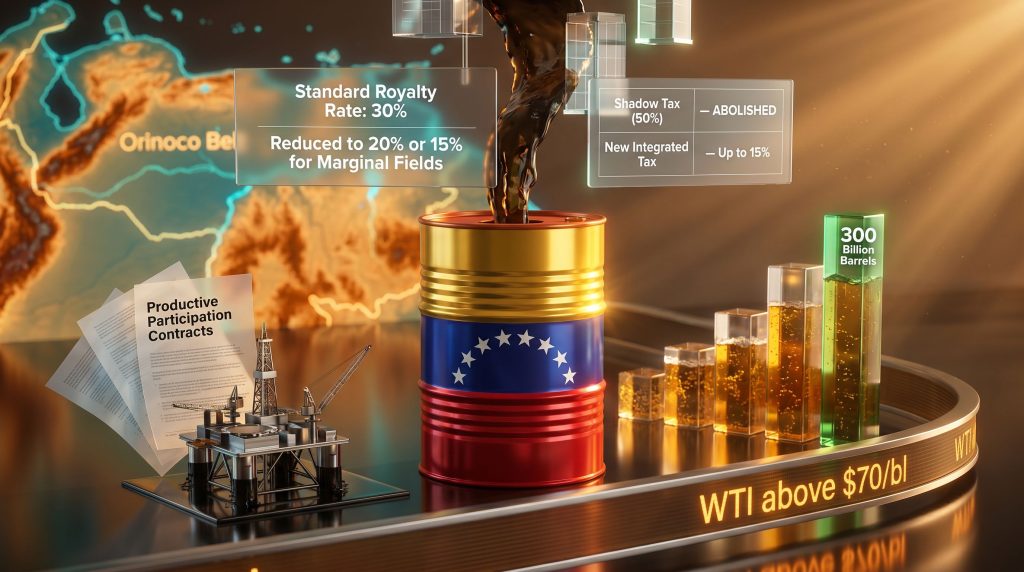
The standard royalty rate under Venezuela's reformed hydrocarbon law is set at 30% of extracted volumes. Critically, this rate can be reduced to 20%, or further to 15%, if an independent economic assessment concludes that a project cannot achieve commercial viability at the higher rate.
This tiered structure is not incidental. Venezuela's Orinoco Belt, which contains the bulk of its reserve base, produces extra-heavy crude with API gravities typically below 10 degrees. Upgrading this material to exportable quality is capital-intensive. Without fiscal relief mechanisms for challenging reservoirs, the economics of Orinoco Belt development frequently fail to meet international investment thresholds.
Abolished Taxes and the New Integrated Levy
The reform eliminates two taxes that had made Venezuelan upstream projects difficult to underwrite:
| Tax Instrument | Status Under New Law | Rate |
|---|---|---|
| Production-based Shadow Tax (previously 50%) | Abolished | N/A |
| Extraordinary Prices Tax | Abolished | N/A |
| New Integrated Tax on gross income | Introduced | Up to 15% |
The removal of the so-called shadow tax is particularly significant. At 50% of production volumes, it represented a compounding fiscal burden on top of royalties that compressed operator margins to levels incompatible with capital-intensive Orinoco Belt development. Replacing both abolished instruments with a single integrated tax capped at 15% of gross income represents a meaningful structural improvement in project economics, though whether Venezuela collects more or less revenue per barrel over a full price cycle remains an open analytical question dependent on production volumes and crude prices.
The U.S. General License No. 46 Dimension
What the License Authorises and What It Does Not
Venezuela's regulatory reform intersects with a separate and equally consequential legal instrument: U.S. General License No. 46. This authorisation permits U.S. companies to engage in the lifting, exportation, sale, and transportation of Venezuelan crude under defined conditions. In addition, the sanctions impact on Russian oil trading offers a useful comparative lens for understanding how such conditional licences function in practice.
A critical distinction must be understood clearly:
- General License No. 46 is not a blanket sanctions removal. Comprehensive U.S. sanctions on Venezuela remain in place.
- Individual production licences are separate from the General License. Operators seeking to produce, as distinct from merely lifting and transporting, still require specific individual authorisation.
- The General License creates a narrow operational window, not a comprehensive sanctions relief architecture.
The Unprecedented Payment Mechanism
Perhaps the most geopolitically striking feature of the current framework is the payment arrangement for authorised operations. Funds owed to the Venezuelan government for transactions conducted under approved authorisations must be deposited into U.S. Government-controlled bank accounts.
This arrangement effectively places a meaningful portion of Venezuela's oil revenue under U.S. financial oversight. For investors, this creates an unusual dynamic: the legal certainty of a U.S.-administered payment mechanism coexists with the sovereignty questions this arrangement raises for any Venezuelan government over the medium term. Whether future administrations, particularly any elected government, would sustain this arrangement is a non-trivial political risk.
The parallel with Iran is instructive. As of early July 2026, Hormuz transit volumes were running at approximately 30% of pre-conflict levels, WTI had risen above $70 per barrel, and the IMF was projecting global growth at just 3% for 2026. This context makes Venezuela's supply-side opening more strategically valuable to Western markets, but it also means the geopolitical stakes of the payment architecture are higher than they might appear in a stable supply environment. The crude oil price analysis for 2025 provides further context on how trade and geopolitics are shaping these dynamics.
Key Risks and Barriers to Translating Reform into Barrels
The Gap Between Legal Authorisation and Physical Capability
Regulatory reform does not automatically produce incremental crude volumes. Venezuela's production infrastructure has suffered years of deferred maintenance, workforce attrition, and underinvestment. PDVSA's operational capacity is severely degraded relative to its peak, and no legislative change reverses the physical realities of ageing separators, pipelines, and upgraders overnight.
The multi-year timeline from contract signature to first incremental production is a structural feature of all upstream development, but it is particularly pronounced for Venezuelan heavy oil, where:
- Extra-heavy crude from the Orinoco Belt requires upgrading facilities to produce exportable synthetic crude.
- Upgrader capacity has been partially mothballed due to PDVSA's financial constraints.
- Diluent supply chains needed to move viscous crude through pipelines require their own infrastructure.
Investor Risk Assessment Matrix
| Risk Category | Assessment | Mitigation Under New Framework |
|---|---|---|
| Legal and Contractual Risk | High | International arbitration mandate |
| Fiscal Stability Risk | Medium-High | Codified royalty caps and tax structure |
| Operational Risk | High | Asset leasing model reduces upfront capital exposure |
| Sanctions Risk | Medium | U.S. General License No. 46 provides partial clarity |
| Political Continuity Risk | High | Reform enacted by acting government, not elected administration |
The political continuity risk deserves particular emphasis. The reform was enacted by an acting government operating under extraordinary conditions following Maduro's removal. Any future elected Venezuelan administration could choose to revise, selectively enforce, or repudiate elements of the new framework. Mexico's partial reversal of its landmark 2013–2014 energy reform under subsequent leadership provides a sobering regional precedent for exactly this scenario.
The Official Gazette Gap: A Legal Grey Zone for Early Movers
At the time the regulations were enacted, the full regulatory text had not yet been published in Venezuela's official gazette. This creates a legally ambiguous period for any company seeking to move quickly. Contracts entered before gazette publication may face enforceability questions, and the specific operational parameters governing leasing arrangements, arbitration procedures, and marketing rights documentation will only become fully actionable once the complete text is publicly available.
The next major ASX story will hit our subscribers first
Comparative Context: How Venezuela's Reform Stacks Up Against Peer Liberalisations
| Country | Reform Year | Key Mechanism | Outcome |
|---|---|---|---|
| Mexico | 2013–2014 | Energy Reform, private upstream entry | Partially reversed under López Obrador |
| Brazil | 1997–2000 | End of Petrobras monopoly | Successful IOC entry, pre-salt boom followed |
| Iraq | 2009 | Technical Service Contracts | Production increases but complex fiscal terms |
| Venezuela | 2025–2026 | Productive Participation Contracts | Reform enacted; execution phase pending |
Brazil's pre-salt development trajectory is arguably the most relevant aspirational benchmark. Following the end of Petrobras's monopoly, international capital entered on sufficient scale to unlock deepwater resources that the state company alone could not have developed. Venezuela's Orinoco Belt is not deepwater, but it shares the characteristic of requiring sustained, large-scale investment beyond what any single state operator can mobilise.
Iraq's experience with Technical Service Contracts after 2009 is also instructive, if cautionary. Production did increase materially in the years following reform, but the fiscal terms proved complex to administer and some operators found the realised economics disappointing relative to initial projections. Venezuela's reformers appear aware of this risk, which may explain the decision to simplify the fiscal structure around the integrated tax rather than layering multiple instruments. The influence of OPEC on global oil markets also remains a key variable in determining how Venezuela's incremental volumes will be absorbed.
ESG Considerations and the Carbon Intensity Challenge
One dimension of Venezuela new oil regulations that receives insufficient attention is the environmental governance dimension. Venezuela's Orinoco Belt produces extra-heavy crude with high carbon intensity across its extraction, upgrading, and transportation lifecycle. For European institutional investors and companies with net-zero commitments, this profile creates a structural barrier that fiscal and legal reform alone cannot address.
The initial reform announcements contained limited explicit environmental standards or community consultation frameworks. The absence of robust ESG provisions does not eliminate investment interest from all capital sources, particularly Asian and Latin American players less constrained by ESG mandates, but it does substantially narrow the universe of potential international partners from Western financial institutions.
Indigenous and community rights frameworks also remain an unresolved dimension. Venezuela's Orinoco Belt development areas intersect with territories where prior consultation obligations under international conventions may apply. How the Productive Participation Contract architecture addresses these obligations will be a due diligence requirement for any responsible investor. Furthermore, geopolitical tensions reshaping global trade add another layer of complexity to how ESG-conscious capital will ultimately evaluate Venezuelan assets.
Frequently Asked Questions: Venezuela New Oil Regulations
Which companies can now operate in Venezuela's oil sector?
Private companies, including foreign international oil companies, can enter Venezuela's upstream sector through joint ventures with PDVSA or by leasing PDVSA operational assets under the new Productive Participation Contract structure.
Does the reform mean U.S. sanctions have been lifted?
No. U.S. General License No. 46 provides specific conditional authorisations for defined activities such as lifting, export, and transportation of Venezuelan crude. Comprehensive U.S. sanctions remain operative; the licence creates a defined operational corridor, not a full sanctions removal.
How does the royalty reduction mechanism work in practice?
The standard 30% royalty applies to all production. If an independent economic assessment concludes that a specific project cannot reach commercial viability at the 30% rate, the royalty can be reduced to 20%, and further to 15% for projects where even the reduced rate renders economics unworkable. This mechanism was specifically designed to enable development of marginal and ultra-heavy oil fields.
What is the significance of mandatory international arbitration?
For foreign investors, domestic court resolution of commercial disputes with the Venezuelan state has historically been regarded as providing inadequate protection. The mandatory use of independent international arbitration outside Venezuelan courts directly removes this barrier, addressing one of the most cited deterrents to re-entry by major international oil companies. Bloomberg's coverage of the draft oil law provides additional detail on how this provision was received by the international investment community.
Strategic Implications for Global Energy Markets
Venezuela's regulatory opening arrives at a moment when the global supply landscape is under considerable stress. With Hormuz transit running well below normal levels due to ongoing U.S.-Iran hostilities, and the IMF projecting only modest global growth through 2026–2027, markets are acutely sensitive to any credible signal of long-term supply additions.
Venezuela's extra-heavy Orinoco Belt crude occupies a specific and commercially valuable niche: Asian refineries configured for heavy sour feedstocks, particularly in China and India, have limited alternative supply options when Middle Eastern heavy grades face transit disruption. A credible Venezuelan production recovery trajectory would therefore carry disproportionate strategic value relative to its absolute volume contribution.
However, whether the country can convert a fundamentally redesigned legal framework into actual incremental barrels is the central execution question. The reform's success depends not on the legal text itself, but on the institutional capacity to administer it, the political durability to preserve it through any future transition to an elected government, and the global pricing environment that will ultimately determine whether the investment case is compelling enough to attract the sustained capital Venezuela urgently requires. S&P Global's analysis of the new oil law outlines how private marketing rights are expected to reshape export flows in the years ahead.
This article is intended for informational purposes only and does not constitute financial or investment advice. Forecasts, scenario analysis, and references to market projections involve inherent uncertainty and should not be relied upon as predictions of future outcomes. Readers should conduct independent due diligence before making any investment decisions related to Venezuelan energy assets or related securities.
Want to Stay Ahead of the Next Major Resource Discovery?
Discovery Alert's proprietary Discovery IQ model scans ASX announcements in real time, instantly identifying significant mineral discoveries and translating complex data into actionable investment insights — explore the historic returns major discoveries have generated to understand what early positioning can mean for a portfolio, then begin your 14-day free trial at Discovery Alert to secure a market-leading edge.