June 27, 2026
The Hidden Cost of Environmental Approval in Chile's Copper Sector
When capital allocation decisions are made for large-scale copper projects, most financial models account for construction risk, commodity price volatility, and operational efficiency. What they have historically underweighted is a more insidious category: the risk that a Chile copper project environmental permit, once secured, does not stay secured. In Chile, this is no longer a theoretical concern. It is an active, measurable, and growing financial exposure that is reshaping how major operators and their lenders think about project development in the world's most copper-rich jurisdiction.
Chile produces roughly 27% of global copper supply, making it the single most important copper-producing nation on earth. Yet the very regulatory architecture that was designed to manage the environmental footprint of that production is increasingly functioning as a multi-stage obstacle course, one that does not end at permit issuance. Understanding why requires looking past individual project headlines and into the structural mechanics of how Chile evaluates, approves, and revisits major mining developments. Furthermore, the copper price forecast for 2025 and beyond makes this regulatory complexity even more consequential for investors.
When big ASX news breaks, our subscribers know first
Chile Copper Project Environmental Permits: From Milestone to Ongoing Legal Exposure
For most of the past two decades, securing an environmental resolution, known in Chile as a Resolución de Calificación Ambiental or RCA, was treated as the defining regulatory milestone for a mining project. Once obtained, the RCA was broadly understood to provide a durable legal foundation for capital deployment and construction.
That assumption is being systematically dismantled.
Chile's Environmental Tribunal system now provides a formal legal pathway for challenging approved RCAs through annulment proceedings. Legal standing extends beyond formal government bodies to include workers' unions, indigenous communities, and civil society organisations — a broad coalition of potential plaintiffs that few project developers adequately factor into their permitting risk models.
The practical consequence is a conceptual split between two distinct categories of regulatory exposure:
- First-order risk: The possibility that an environmental assessment is rejected outright before approval is granted.
- Second-order risk: The possibility that an approved RCA is subsequently overturned after capital has been committed, infrastructure partially constructed, and financing drawn down.
As of mid-2026, second-order risk has become the dominant concern for financiers active in Chilean mining. The Collahuasi copper mine expansion case, where Chile's Second Environmental Tribunal overturned a 2021 RCA in May 2026, illustrates precisely why. A desalination plant that was nearly complete at the time of the ruling became regulatory infrastructure in legal limbo overnight. The US$3.2 billion expansion project now requires a full new environmental assessment, despite the fact that an indigenous consultation process had been completed prior to the original approval.
The Collahuasi reversal signals that conducting an indigenous consultation is no longer sufficient protection against post-approval legal challenge. Courts are now scrutinising whether the underlying impact analysis was substantively adequate, not merely whether the procedural box was ticked.
Mapping the US$10 Billion Permitting Bottleneck Across Three Major Operators
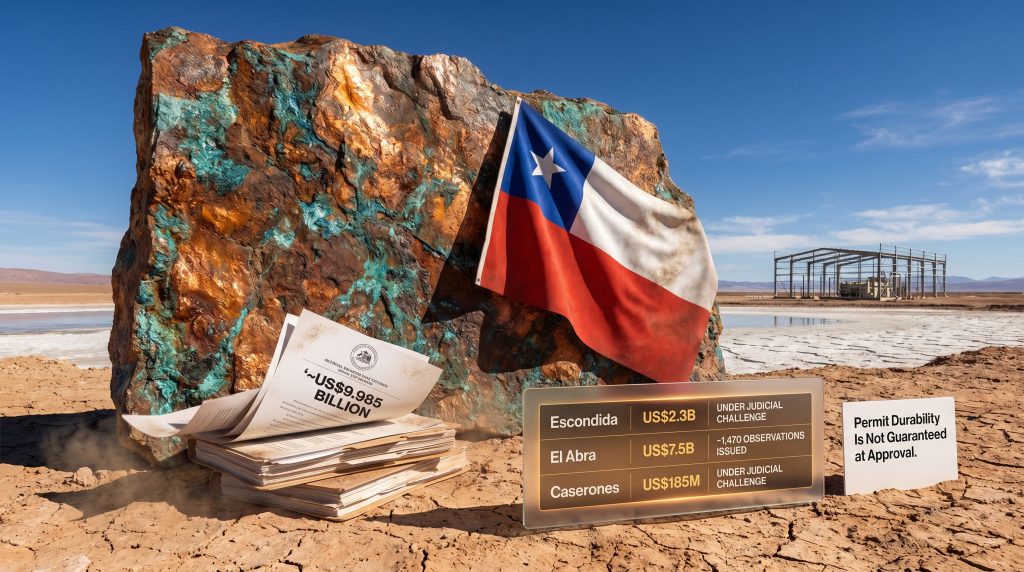
Beyond Collahuasi, three additional copper expansion projects are currently at critical junctures in their respective environmental permitting processes. Together, they represent approximately US$9.985 billion in exposed capital across operators BHP, Freeport-McMoRan, and Capstone Copper. These figures reflect the broader copper market trends that are placing increasing pressure on new supply development.
| Project | Operator | Investment Value | Current Status |
|---|---|---|---|
| Escondida Concentrator and Power Line Expansion | BHP (Minera Escondida) | US$2.3 billion | Approved — annulment claim filed at First Environmental Court |
| El Abra Operational Continuity and Expansion | Freeport-McMoRan | US$7.5 billion | EIA under review — approximately 1,470 ICSARA observations issued |
| Caserones Operational Adjustments | Capstone Copper | US$185 million | Approved — indigenous consultation challenge before First Environmental Court |
| Aggregate Exposed Capital | ~US$9.985 billion |
It is worth noting that the magnitude of investment does not determine the intensity of regulatory scrutiny. The US$185 million Caserones modification faces litigation that is legally and procedurally as complex as the multi-billion dollar El Abra EIA review. Regulatory complexity in Chile is driven by the character of ecological and community impact, not by capital quantum. A relatively modest operational modification that touches indigenous territories or high Andean water systems can attract the same depth of legal challenge as a flagship expansion project.
How Chile's SEA System Actually Works: Understanding the ICSARA Mechanism
To appreciate why the El Abra situation is particularly significant, it is necessary to understand how Chile's Environmental Assessment Service (SEA) processes major mining EIAs under Law 19.300.
When a project proponent submits an EIA, the SEA coordinates input from multiple sectoral agencies covering water resources, biodiversity, air quality, marine environments, cultural heritage, landscape values, and infrastructure. Each agency submits its technical observations, and the SEA consolidates these into a single formal instrument called an ICSARA (Informe Consolidado de Solicitud de Aclaraciones, Rectificaciones o Ampliaciones), or Consolidated Report on Requests for Clarifications, Corrections, or Extensions.
The proponent must then respond to every observation within the ICSARA. The standard response window is 15 days from the date of issuance, with an extension of up to 90 additional days available upon formal request.
For the El Abra expansion, the SEA issued an ICSARA containing approximately 1,470 observations across a wide range of technical domains. The key response deadline was set at July 14, 2026, with an extension available if formally requested. The sheer volume of observations across so many technical domains simultaneously suggests that the EIA's baseline methodology was assessed as deficient in multiple areas, not just one or two.
The specific domains covered by El Abra's ICSARA observations include:
- Marine discharge parameters associated with the proposed desalination plant
- Operational details including reagent consumption thresholds
- Groundwater extraction impacts and updated hydrogeological modelling
- Potential effects on the Salar de Ascotán ecosystem
- Expanded area-of-influence assessments for flora, vegetation, fauna, and terrestrial invertebrates
- Fishing activity impacts, benthic resource management areas, and cumulative marine discharge from co-located projects
- Greenhouse gas emissions baselines and air quality methodology
- Cultural heritage assessment completeness
The Salar de Ascotán reference is particularly noteworthy. High Andean salt flats are among the most ecologically and hydrologically sensitive environments in northern Chile, and regulatory scrutiny of groundwater impacts near these systems has intensified considerably as Chile grapples with a structural water crisis that shows no near-term resolution.
Three Legal Theories Driving Current Environmental Court Challenges
Air Quality and Human Health: The Escondida Annulment Claim
Workers' unions at Minera Escondida — specifically Union No. 1 and the Intercompany Services Workers Union — filed annulment claims before the First Environmental Court targeting the SEA's approval of the US$2.3 billion concentrator and power line expansion. The legal argument centres on air quality standards for the mining camp population, with the unions contending that the environmental assessment failed to apply appropriate health impact thresholds and that the underlying data was insufficient to rule out adverse effects on human health. The First Environmental Court has requested a formal explanatory report from the SEA.
Indigenous Consultation Procedural Deficiency: The Caserones Challenge
The Colla Tata Inti Indigenous Community of the People of Los Loros has mounted a legal challenge to the approval of Capstone Copper's US$185 million operational adjustments at the Caserones mine. The community argues that works affecting territories integral to their cultural practices and customs proceeded without the indigenous consultation required under Chilean law and ILO Convention 169, which Chile ratified in 2008.
The specific grievances outlined by the community include:
- Impacts on high Andean wetland systems and water resource availability
- Increased heavy vehicle traffic on route C-35 through culturally significant territory
- Disruption caused by the regularisation of 14 pumping wells for the infiltration control and water recovery system around the La Brea tailings deposit
- Pre-existing sanctions from both the Environmental Superintendency and the General Water Directorate, which the community argues undermines the operator's regulatory credibility
The First Environmental Court has directed the Committee of Ministers, represented by the SEA, to submit a report explaining the basis on which a previous indigenous claim was rejected. The existence of prior sanctions from two separate regulatory bodies adds material weight to the community's legal position.
Permit Reversal Despite Prior Consultation: The Collahuasi Precedent
The most structurally significant development in Chilean mining permitting in recent years is the Second Environmental Tribunal's decision to overturn Collahuasi's 2021 RCA in May 2026. The ruling was initiated by reclamations filed by indigenous and fishing associations, who argued that the EIA had not adequately assessed impacts on the local indigenous community and the marine environment.
The critical detail is that indigenous consultation had been conducted before the original approval was granted. The tribunal's ruling establishes that consultation completion is not a sufficient legal shield if the quality and depth of the environmental impact analysis itself is found wanting. Current production at Collahuasi continues using alternative water sources, and the mine's Anglo American and Glencore ownership group is seeking regulatory clarification on next steps from both the Tribunal and the SEA.
The Collahuasi ruling represents a structural shift in Chilean environmental jurisprudence: it moves the legal standard from consultation occurrence to consultation and assessment quality. This distinction will redefine how EIAs are prepared for every major copper project that follows.
The Cumulative Impact Problem: A Structural Shift in Chilean EIA Practice
One of the least-discussed but most consequential trends in Chile's environmental assessment landscape is the increasing expectation that project EIAs account for cumulative impacts, not just the footprint of the individual project under review. In addition, the metals and mining geopolitics of the region are amplifying scrutiny on how these assessments are conducted.
For copper projects in northern Chile, the most acute cumulative impact issues arise from:
- Marine discharge: Multiple projects proposing desalination plants and marine effluent discharge into shared coastal waters are now expected to model their combined ecological effect.
- Groundwater extraction: Projects drawing from shared aquifer systems in arid regions, particularly near salares, face scrutiny of aggregate extraction volumes across all users of that system.
- Salar ecosystem integrity: As more projects seek water from high Andean sources, the cumulative pressure on individual salar ecosystems becomes a central regulatory question.
Older approved projects did not face these cumulative methodology requirements at the time of their original EIA submission. When those projects seek operational modifications or expansions, they re-enter an assessment framework that now carries expectations that did not exist during their original permitting process. This creates a structural disadvantage for operators seeking to modify projects based on older environmental baselines.
The next major ASX story will hit our subscribers first
What This Means for Capital Allocation: A Framework for Investors
For investors and project financiers assessing exposure to Chilean copper assets, the emerging permitting landscape demands a materially more sophisticated risk framework than simple permit status tracking. Consequently, copper investment strategies must now incorporate permit durability as a core variable alongside traditional commodity risk factors.
| Risk Category | Typical Trigger | Elevated Exposure Projects |
|---|---|---|
| Indigenous Consultation Deficiency | Works near ancestral territories without substantive consultation | Caserones, Collahuasi |
| Marine and Coastal Impact Methodology | Inadequate desalination discharge and cumulative marine effect analysis | El Abra, Collahuasi |
| Hydrogeological Modelling Gaps | Failure to model groundwater extraction and salar impacts | El Abra, salar-adjacent projects broadly |
| Air Quality and Human Health Standards | Insufficient camp or community health impact thresholds | Escondida |
| Biodiversity Area-of-Influence Underestimation | Spatial scope of flora, fauna, and ecosystem assessments too narrow | El Abra |
| Post-Approval Compliance Violations | Existing sanctions undermining operator credibility in legal proceedings | Caserones |
The timeline implications compound the financial exposure significantly. A realistic modelling of the permitting lifecycle for a major Chilean copper expansion that encounters legal challenge now looks like this:
- EIA submission to ICSARA response: Several months at minimum, longer for complex multi-domain observations
- SEA review and approval decision following ICSARA response: Typically 12 to 24 months
- Post-approval legal challenge period: Court proceedings commonly extend 12 to 36 months
- Permit reversal and full re-assessment: If overturned, the entire EIA cycle recommences; the Collahuasi case demonstrates that near-complete physical infrastructure offers no protection against this outcome
A project receiving EIA approval in 2026 that then faces a legal challenge could realistically not achieve a legally durable approval until 2029 or later. If the RCA is overturned, a final stable approval might not materialise until the early 2030s, potentially more than a decade after initial capital planning was undertaken.
Construction financing structures are beginning to reflect this reality. Post-approval legal challenge windows are being incorporated into drawdown conditions, and capital already deployed in pre-construction infrastructure — as the Collahuasi desalination plant case illustrates — represents genuine stranded asset risk if an RCA is subsequently reversed. The commodity price impact of these delays is increasingly material, as prolonged permitting timelines directly affect project economics and operator valuations.
Strategic Recommendations for Operators Navigating Chilean Permitting in 2026
For operators and developers seeking to reduce exposure to the regulatory risks described above, a proactive and methodologically rigorous approach to EIA preparation is no longer optional. The following strategic priorities reflect the current regulatory and judicial environment:
- Commission independent hydrogeological and marine impact studies before EIA submission, specifically addressing cumulative impacts across co-located projects and shared water systems, to pre-empt the volume and scope of ICSARA observations.
- Structure indigenous consultation as a genuine participatory process, with comprehensive documentation of community engagement, concerns raised, and how those concerns were addressed in the impact analysis. Courts are examining substance, not just procedure.
- Adopt cumulative impact assessment methodology proactively, even where current regulatory guidelines do not yet mandate it, particularly for desalination, marine discharge, and groundwater-intensive components.
- Maintain a clean compliance record throughout all operational activities. Pre-existing sanctions from the Environmental Superintendency or other regulatory bodies materially strengthen the credibility of any legal challenge mounted against an RCA.
- Structure project financing with permit durability contingencies, including drawdown conditions tied to the expiry of established legal challenge windows after RCA issuance.
- Monitor Environmental Tribunal precedent developments as a leading indicator of how EIA standards are evolving, particularly regarding the quality thresholds being applied to indigenous impact analysis and cumulative environmental assessments.
FAQ: Chile Copper Project Environmental Permits
What is the current status of the El Abra copper mine expansion permit?
The El Abra EIA, filed by Freeport-McMoRan for a US$7.5 billion expansion project targeting operational continuity through to 2070, received approximately 1,470 observations from sectoral agencies via an ICSARA. The proponent's response deadline was July 14, 2026, with a possible 90-day extension upon formal request. The project has not yet received an RCA.
Can an approved environmental permit in Chile be overturned after construction begins?
Yes. Chile's Environmental Tribunal system allows approved RCAs to be challenged through annulment proceedings even after capital has been deployed and construction has commenced. The Second Environmental Tribunal's reversal of the Collahuasi 2021 RCA in May 2026, while a desalination plant was in advanced construction, confirms this risk is not theoretical.
What is the ICSARA process and why does it matter for mining investors?
An ICSARA is the SEA's formal consolidated instrument for communicating all sectoral agency observations on an EIA. Proponents must respond within 15 days or request an extension of up to 90 days. The volume, breadth, and technical depth of observations in an ICSARA are a strong indicator of how close the EIA's baseline methodology is to meeting current regulatory standards, and therefore how long the approval process is likely to take.
Why is indigenous consultation no longer a reliable legal shield for Chilean copper projects?
Chilean courts are examining whether indigenous consultation was substantively meaningful and whether the accompanying impact analysis adequately addressed community concerns — not merely whether a consultation process occurred. The Collahuasi reversal established that a completed consultation does not protect an RCA if the environmental assessment itself was found to be analytically insufficient.
What is the aggregate value of copper projects facing environmental permitting challenges in Chile as of mid-2026?
Across the three projects covered in detail here, approximately US$9.985 billion in investment is at various stages of environmental review or legal challenge. Adding the Collahuasi expansion brings the sector-wide figure to over US$13 billion, underscoring the systemic rather than isolated nature of Chile's permitting stress.
Disclaimer: This article is intended for informational purposes only and does not constitute financial or investment advice. Forecasts, timelines, and scenario projections discussed herein involve inherent uncertainty and should not be relied upon as predictions of future outcomes. Investors should conduct their own independent due diligence before making any capital allocation decisions related to the projects or jurisdictions discussed.
Want to Track the Next Major Copper Discovery Before the Market Does?
While billions in Chilean copper capital navigates complex permitting challenges, Discovery Alert's proprietary Discovery IQ model scans ASX announcements in real time, instantly alerting subscribers to significant mineral discoveries across copper and 30+ other commodities — explore historic discovery returns on the Discovery Alert discoveries page and begin your 14-day free trial to position yourself ahead of the broader market.