May 14, 2026
The Supply Chain War That Started Before Anyone Was Watching
Commodity markets have always reflected geopolitical ambition, but the competition unfolding across Africa's mineral belt operates on a fundamentally different logic to anything the world has seen before. Unlike oil, whose extraction and transport infrastructure took decades to become politically weaponised, China's grip on Africa's rare earths has been constructed through a patient, layered, and deliberately invisible architecture. By the time Western governments began treating critical minerals demand as a strategic priority, Beijing had already spent two decades building positions that would take an equivalent amount of time to meaningfully challenge.
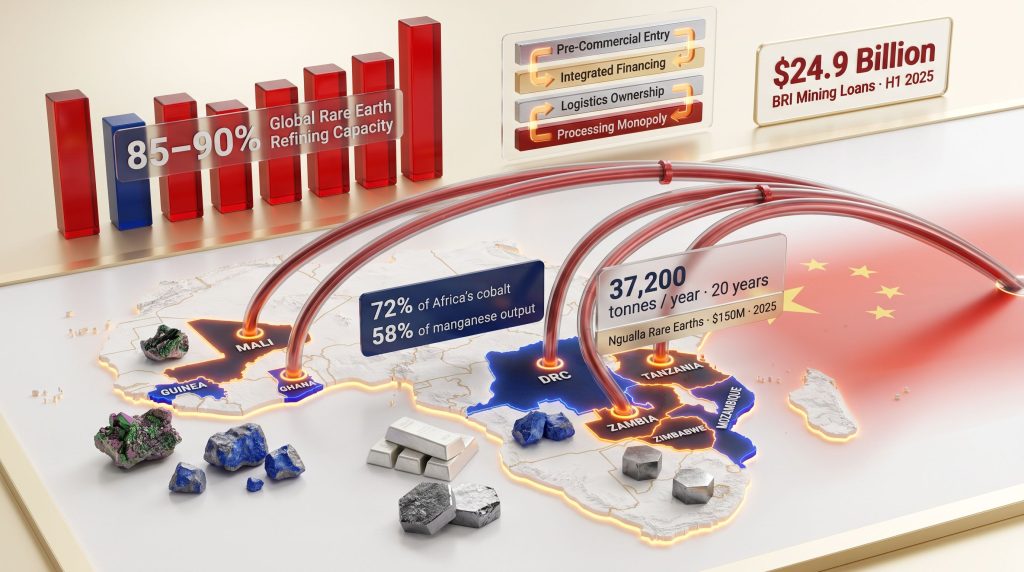
Understanding this dynamic requires moving beyond the surface narrative of who owns which mine. The real story is structural, and it plays out across four interlocking dimensions: who enters first, who finances the risk, who controls the export route, and who holds the refinery. China has built dominance across all four simultaneously. The West, by contrast, has struggled to establish reliable footholds in even one.
When big ASX news breaks, our subscribers know first
Why Africa Has Become the Central Theatre of Industrial Competition
The continent's mineral endowment has always been known in broad terms, but the full weight of its strategic importance only became apparent as electrification, decarbonisation, and advanced defence systems began converging on the same set of raw inputs. Africa holds an estimated 30% of the world's critical mineral reserves, encompassing some of the largest identified deposits of cobalt, lithium, graphite, manganese, and rare earth elements on the planet.
The demand picture adds further urgency. As electric vehicle adoption scales, renewable energy infrastructure expands globally, and next-generation defence platforms require increasingly specialised components, analysts broadly project that global critical mineral requirements could grow by a factor of three to six by 2040. That figure is not uniform across minerals. Lithium and cobalt face the sharpest near-term demand curves driven by battery chemistry requirements, while rare earth supply chains face sustained pressure from both EV motors and defence magnets.
Africa's transition from peripheral resource supplier to central battleground did not happen because Western governments woke up to the opportunity. It happened because China recognised the structural reality of critical mineral supply chains in the 1990s and built a comprehensive response. The West is only now beginning to construct one.
How China Built an Unbreakable Structural Position Across Four Layers
Layer One: Entering Before Competitors Understand the Prize
The most underappreciated dimension of China's strategy in Africa is temporal. Chinese firms have developed a consistent and deliberate pattern of establishing positions in mineral projects at the exploration or early feasibility stage, acquiring stakes in junior miners and securing joint ventures before commercial viability is formally confirmed.
This pre-production entry model carries significant risk. Junior mining projects frequently fail to progress to production, and exploration-stage capital is exposed to geological disappointment, permitting delays, and infrastructure constraints. Chinese state-coordinated entities are structured to absorb these losses in ways that listed Western companies accountable to quarterly earnings cycles fundamentally cannot replicate.
The payoff for accepting early-stage risk is structural control. By entering at inception, Chinese partners effectively shape project design, partner selection, processing arrangements, and export routing from the ground up. When Western capital eventually arrives, it typically finds that the most strategically valuable positions have already been locked in through long-term offtake agreements with durations frequently spanning fifteen to twenty-five years.
The dynamic is observable across multiple jurisdictions. As reported by Business Insider Africa, this early-entry model has played out across lithium, cobalt, graphite, and rare earth projects spanning Mali, Zimbabwe, the Democratic Republic of the Congo, and South Africa (Okebiorun, Business Insider Africa, May 2026). By the time valuations reflect genuine strategic interest and geopolitical competition intensifies, the most advantageous commercial terms have already been assigned.
A concrete illustration of execution speed as competitive advantage emerged in Ghana's Ewoyaa lithium project, where Chinese firm Zhejiang Huayou Cobalt moved quickly to assume development obligations following the withdrawal of U.S.-linked Elevra Lithium. The episode demonstrates a broader pattern: when Western capital retreats from frontier African projects due to risk thresholds or shareholder pressure, Chinese entities treat the vacancy as an entry opportunity rather than a warning signal.
Layer Two: Financing That Combines Capital With Political Relationships
Western development finance institutions and private capital markets operate under frameworks that systematically exclude the highest-risk African jurisdictions from meaningful financing. Environmental and social safeguards, governance conditionality, debt sustainability thresholds, and political risk assessments collectively eliminate the Sahel region, parts of Central Africa, and several other mineral-rich territories from the investable universe for most Western lenders.
Chinese policy banks, including the Export-Import Bank of China and China Development Bank, face no equivalent constraints. They can extend financing into regions that Western institutions formally decline, and they do so with a speed and flexibility that reflects institutional mandates oriented around strategic objectives rather than commercial return optimisation. Furthermore, the scale of African mining finance available through Chinese channels continues to dwarf Western alternatives.
The financing model extends well beyond mine development capital. As confirmed by Business Insider Africa, once Chinese agreements are secured in a host country, accompanying packages frequently bundle roads, hospitals, railways, power infrastructure, and security cooperation into a single arrangement (Okebiorun, Business Insider Africa, May 2026). The result is a multi-dimensional relationship that creates political goodwill extending far beyond the mineral project itself, reducing host governments' incentive to renegotiate terms or pivot toward competing Western offers.
This infrastructure-for-minerals architecture has been deployed systematically across:
- The Sahel region, including Mali, Burkina Faso, and Niger, where security cooperation accompanies resource agreements
- The DRC-Zambia copper belt, where transport network investments complement equity positions in mining operations
- Mozambique's graphite export corridors, where logistics infrastructure has been paired with mining development capital
- Guinea's bauxite and Simandou iron ore corridors, where Chinese involvement spans both extraction and export infrastructure
| Financing Mechanism | Primary Chinese Institution | Strategic Function |
|---|---|---|
| Long-term project loans | Export-Import Bank of China | Fund mine and infrastructure development in high-risk regions |
| State-backed equity | China Development Bank, SOEs | Acquire stakes across exploration to production stage |
| Infrastructure bundling | JCHX, Sinohydro, CRCC | Build logistics networks tied to mineral export flows |
| Corporate offtake agreements | BYD, Ganfeng, Zhejiang Huayou Cobalt | Lock in long-term mineral supply for domestic processing |
Layer Three: Controlling the Route Between Mine and Market
A mineral deposit with no viable export pathway has no commercial leverage. This is not merely a logistical observation. It is a structural fact that Chinese firms have systematically converted into strategic advantage.
By pairing mining investments with port development, railway construction, and road networks, Chinese entities ensure that extracted minerals flow into trade networks where they retain influence over routing, pricing, and commercial terms. The key insight, noted by industry analysts, is that even where African governments hold formal legal sovereignty over subsurface mineral rights, the physical infrastructure required to monetise those rights is frequently Chinese-built and Chinese-operated.
This logistics integration is visible across multiple African corridors, including Guinea's bauxite transport network, the DRC-Zambia copper belt, Zimbabwe's lithium export routes, and Mozambique's graphite shipping infrastructure. In each case, the infrastructure investment serves a dual function: it accelerates project timelines and generates political goodwill, while simultaneously orienting mineral flows toward Chinese-controlled downstream networks rather than open global markets.
Layer Four: The Processing Monopoly That Determines Where Value Is Created
If the first three layers explain how China enters, finances, and routes African minerals, the fourth layer explains why this architecture is so difficult to displace. China controls an estimated 85 to 90 percent of global rare earth separation, refining, and magnet manufacturing capacity, a structural position built through three decades of deliberate industrial policy, subsidised investment, and accumulated technical expertise.
The critical implication is that securing a mining licence in Africa does not, in isolation, break China's supply chain dominance. Raw ore extracted from an African deposit must in many cases pass through Chinese-controlled refining and processing infrastructure before it can be converted into the purified elements and engineered components required for EV motors, defence magnets, semiconductor manufacturing, or AI hardware.
As Business Insider Africa reported, even in situations where African governments have pursued local beneficiation requirements, the practical outcome has frequently been the establishment of limited in-country processing operations while higher-value refining and advanced manufacturing remain concentrated inside China (Okebiorun, Business Insider Africa, May 2026). The distinction matters enormously because processing and refining stages are where pricing power and industrial margin actually reside.
Securing mining rights in Africa without matching processing capacity leaves Western nations as downstream consumers of Chinese industrial infrastructure, regardless of where the raw ore originates.
China's African Portfolio: A Continent-Wide Web of Strategic Positions
The breadth of China's exposure across African critical mineral assets reflects the systematic application of the four-layer strategy described above. The portfolio spans multiple minerals, multiple jurisdictions, and multiple stages of the value chain.
| Project or Asset | Country | Strategic Mineral | Nature of Chinese Involvement |
|---|---|---|---|
| Goulamina Lithium | Mali | Lithium | Major equity stake; EV battery supply chain integration |
| Ewoyaa Lithium | Ghana | Lithium | Zhejiang Huayou Cobalt entry following Western exit |
| Lubambe Copper Mine | Zambia | Copper | JCHX acquisition; Africa's second-largest copper producer |
| Khoemacau Copper | Botswana | Copper | Equity stake secured; EV wiring and components |
| DRC Copper Operations | DR Congo | Cobalt, copper | Multiple SOE positions; global EV battery supply chain |
| Nigerian Lithium Processing | Nigeria | Lithium | Downstream processing infrastructure investment |
| Simandou Iron Ore | Guinea | Iron ore, bauxite | Corridor infrastructure and logistics integration |
BYD's approach to African lithium supply illustrates how corporate vertical integration amplifies state-level strategic positioning. The Chinese EV manufacturer has secured binding supply agreements across multiple African lithium operations through 2032, a move that insulates its battery supply chain from geopolitical disruption while simultaneously deepening China's structural footprint across African lithium output.
The flow of African mineral exports toward Chinese processing networks reflects the cumulative effect of this positioning. China imports the substantial majority of Africa's cobalt production, a significant share of manganese output, and a meaningful portion of graphite supply. These raw material flows are processed inside Chinese industrial facilities before re-entering global supply chains as refined products, battery components, or finished goods, a cycle that reinforces both economic dependency and structural leverage simultaneously.
Why Western Efforts to Compete Have Consistently Fallen Short
The asymmetry between Chinese and Western approaches to African mineral competition is not primarily a function of intent or awareness. It reflects deep structural differences in how capital is deployed, risk is assessed, and strategic objectives are weighted against financial return requirements.
Western listed mining companies operate under shareholder return expectations, ESG compliance frameworks, and political risk thresholds that collectively make rapid deployment into frontier African jurisdictions structurally difficult. Institutional investors seeking quarterly earnings performance have limited appetite for exploration-stage exposure in the Sahel or Central Africa, regardless of long-term strategic rationale.
Chinese state-coordinated entities face no equivalent constraint. They can absorb project delays, political instability, and below-market financial returns across individual investments provided the aggregate strategic objective, securing future mineral flows, is being advanced. This risk asymmetry produces the pattern repeatedly observed across African mineral competition: Western firms conduct extended due diligence while Chinese entities sign agreements.
The refining gap compounds the problem. Building rare earth separation and processing capacity requires not just capital but decades of accumulated technical expertise, trained workforce development, supply chain ecosystem construction, and sustained industrial policy support. Even with growing Western investment in domestic processing infrastructure, analysts broadly agree that meaningful operational scale remains ten to fifteen years away at minimum.
Consequently, any African mining rights secured by Western companies remain exposed to the same Chinese processing infrastructure that Western supply chain diversification strategies are attempting to bypass. The energy security risks embedded in this dependency are substantial and growing more acute as electrification accelerates globally.
Geopolitical fragmentation within the Western bloc adds a further constraint. Competing industrial priorities between Washington and Brussels, including disagreements over trade policy, critical minerals tariffs, and investment screening frameworks, have impeded the formation of a unified counter-strategy. The elevation of critical minerals to a central agenda item in U.S.-China bilateral trade discussions reflects just how consequential this competition has become, but it also reveals how far the West remains from coordinated action.
Western maritime dominance over global shipping routes and influence over international financial architecture do not translate into processing independence. Rare earth supply chains are won or lost at the refinery, not the shipping lane.
How African Nations Are Navigating Their Structural Position
A meaningful shift in African policy discourse since 2020 has centred on beneficiation mandates, formal requirements that raw minerals undergo at least partial processing before export. Countries including Zimbabwe, the DRC, and Tanzania have introduced or signalled export restrictions on unprocessed ores, reflecting a genuine aspiration to capture more industrial value domestically rather than export raw material at low margins.
The effectiveness of these policies is constrained by practical realities. Domestic refining infrastructure is limited, capital requirements for meaningful processing capacity are substantial, and Chinese firms remain the dominant buyers and processors of African mineral output. Even where beneficiation mandates exist in legislation, enforcement depends on having credible alternative buyers, a condition that has been difficult to establish given China's entrenched position.
The emergence of Western counter-offers, including U.S. Development Finance Corporation commitments and EU Global Gateway corridor investments, has nonetheless given some African governments greater negotiating leverage than at any previous point. However, China's decades-long relationship infrastructure, established contractor networks, and financing flexibility mean it retains a significant first-mover advantage in the majority of negotiations. As detailed in analysis of U.S. and Chinese investment strategies, the gap in deployment speed and risk tolerance between the two blocs remains structurally significant.
African nations face a structural paradox that limits their leverage in both directions. Pushing back too aggressively against Chinese terms risks losing access to the only capital source both willing and able to finance projects in high-risk jurisdictions at the required scale. China, in turn, needs African mineral supply to sustain its EV, battery, and clean technology industrial base, creating a mutual dependency that in the near term continues to reinforce Chinese supply chain control rather than dissolving it.
The next major ASX story will hit our subscribers first
What Breaking China's Grip Would Actually Require
Genuine supply chain diversification for the West is a multi-decade undertaking that requires action across several dimensions simultaneously. Capital deployment alone is insufficient. The strategic gap spans processing infrastructure, financing architecture, logistics ownership, and early-stage entry models, each of which requires a different institutional response. A coherent critical minerals strategy must therefore address all four layers concurrently rather than sequentially.
| Strategic Requirement | Current Western Status | Estimated Timeline to Close Gap |
|---|---|---|
| Domestic rare earth processing capacity | Early-stage investment; minimal operational scale | 10 to 15 years |
| Competitive development finance in frontier markets | Growing but structurally slower than Chinese SOEs | 5 to 10 years |
| Infrastructure-bundled mineral agreements | Limited; mostly standalone mining transactions | Requires fundamental policy architecture change |
| Early-stage offtake agreements at exploration stage | Rare; Western firms typically enter at later stages | Requires institutional culture change |
| Unified U.S.-EU critical minerals strategy | Fragmented; competing industrial priorities | Politically uncertain timeline |
The refinery-first imperative is the most frequently cited priority among analysts examining the structural dimensions of this competition. Without sovereign or allied refining infrastructure, Western nations will remain downstream consumers of Chinese industrial networks regardless of how many African mining licences they secure. Investment in processing capacity, whether in Africa, Australia, Canada, or domestically within the U.S. and EU, must precede or accompany any meaningful supply chain diversification strategy rather than following it.
The scenario pathways if this gap is not closed carry serious long-term consequences:
- Near-term (2025 to 2030): Western EV manufacturers, defence contractors, and semiconductor producers remain exposed to Chinese supply chain leverage, particularly across rare earth magnets and battery-grade lithium inputs
- Medium-term (2030 to 2040): As African mineral production scales, Chinese-controlled processing networks capture the majority of incremental industrial value, deepening structural dependency across critical technology sectors
- Long-term (2040 onward): If no alternative processing ecosystem is constructed, China's position shifts from dominant to effectively irreplaceable across multiple critical technology supply chains, with profound implications for Western industrial and defence independence
Rare Earths, Defence Vulnerabilities, and the National Security Dimension
The strategic stakes extend well beyond commercial competition. Rare earth elements including neodymium, dysprosium, and terbium are essential inputs for precision-guided munitions, fighter jet propulsion systems, submarine sonar arrays, and advanced radar platforms. Western defence supply chains currently have limited alternatives to Chinese-processed rare earth components for these applications.
Historical precedent confirms that Beijing is willing to treat critical mineral supply chains as active geopolitical instruments. China has previously restricted rare earth exports during diplomatic disputes, including restrictions targeting Japan during territorial tensions over the East China Sea. This precedent establishes that supply chain leverage is not merely theoretical but has been deployed in practice.
China's grip on Africa's rare earths therefore represents something beyond an economic competition over commodity markets. It is a structural determinant of where industrial and military capability accumulates over the next several decades. The 20th century's defining resource competition centred on petroleum; the 21st century equivalent is the set of critical minerals that underpin electric mobility, renewable energy, advanced computing, and next-generation defence systems.
The window for the West to construct credible alternatives is narrowing. China's early-entry capital model, infrastructure integration strategy, processing monopoly, and long-term offtake architecture form a self-reinforcing system that becomes progressively more difficult to displace as African production scales and Chinese supply chain architecture deepens. The longer that window remains open without decisive action, the closer the outcome slides toward a world in which Western industrial policy operates inside constraints that Beijing set decades earlier.
Disclaimer: This article is intended for informational purposes only and does not constitute financial or investment advice. Projections, timelines, and strategic assessments contained herein reflect publicly available analysis and are subject to change based on evolving geopolitical, regulatory, and market conditions. Readers should conduct independent research and seek professional advice before making investment decisions.
Want to Know Which ASX Companies Are Positioned in the Critical Minerals Race?
Discovery Alert's proprietary Discovery IQ model scans ASX announcements in real time, delivering instant alerts on significant mineral discoveries — including the critical minerals reshaping global supply chains — so subscribers can identify actionable opportunities ahead of the broader market. Explore historic discoveries and their returns to understand the scale of what early positioning can achieve, and begin your 14-day free trial at Discovery Alert to gain your market-leading edge.