
July 17, 2026
The Hidden Crisis Inside the World's Largest Battery Fleet
Energy infrastructure history is littered with examples of capacity that was built faster than it could be absorbed. The story of coal plant overbuilding in the 2000s, the solar curtailment crises in California and Germany, and the stranded pipeline assets of the North American shale boom all share a common thread: deployment velocity, when disconnected from market design, creates assets that underperform relative to their physical potential. Battery energy storage in China is now navigating precisely this tension, and the outcome will define not just China's power system, but the global template for large-scale grid storage.
The China battery storage market shift from scale to utilization is not merely a policy adjustment. It represents a fundamental rethinking of what energy storage is actually for, and how the economic framework surrounding it must evolve to deliver real grid value.
When big ASX news breaks, our subscribers know first
From Quota to Market: The Policy Architecture Behind China's Storage Boom
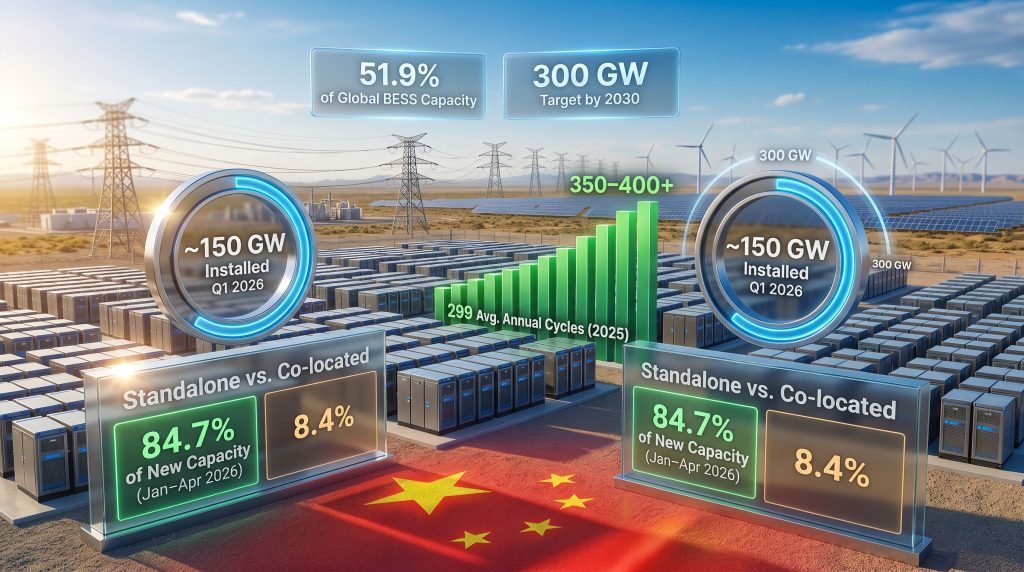
For much of the early 2020s, China's battery storage expansion was driven by a blunt but effective instrument: mandatory co-location requirements. New wind and solar project approvals were conditionally tied to the installation of paired battery systems, typically sized at 10 to 20 percent of the renewable asset's capacity. This policy achieved its primary goal spectacularly. China's total installed lithium-ion battery storage capacity reached approximately 150 GW by Q1 2026, and by end of 2025 China held more than 51.9% of global BESS capacity, up from just over 20% in 2021, according to analysis published by Ember.
However, the mandate created a structural problem that became increasingly difficult to ignore. Co-located batteries were operationally shackled to their paired renewable assets. Their dispatch schedules were rigid, their access to wholesale electricity markets was restricted, and their revenue pathways were narrow. The result was a fleet of batteries that cycled far less than their standalone counterparts, generating weaker economics and delivering limited grid services. Furthermore, this tension is central to understanding the broader challenges of critical minerals in energy transition planning globally.
Document 136: Dismantling the Mandate
In February 2025, China's National Development and Reform Commission and National Energy Administration jointly issued Document 136, a directive that formally ended the co-location requirement for new energy storage projects. The policy shift was significant not because it stopped battery deployment, but because it redirected the incentive architecture entirely. Instead of building batteries to satisfy a regulatory checkbox, developers were now expected to build storage that could compete in markets and earn revenue based on performance.
The contrast between the two eras is stark:
| Policy Era | Deployment Model | Primary Revenue Mechanism | Avg. Annual Cycles |
|---|---|---|---|
| Pre-2025 (Mandate Phase) | Co-located with wind/solar | Fixed dispatch, limited market access | ~90–100 cycles (est.) |
| Post-Feb 2025 (Market Phase) | Standalone independent storage | Spot trading, ancillary services, capacity payments | 299 cycles (2025) |
Standalone Systems Are Winning, and the Numbers Prove It
The market has responded to the policy shift with remarkable speed. Between January and April 2026, standalone battery storage systems accounted for 84.7% of new installed capacity in China, while renewable co-located systems fell to just 8.4% of new installations over the same period. Independent storage now represents approximately 60% of China's cumulative installed base.
The performance differential between the two models explains the preference shift. In 2025, standalone systems averaged 299 annual charge-discharge cycles, more than double the rate recorded in 2022. Even co-located systems showed improvement, reaching approximately 199 annual cycles in 2025, representing a more than twofold increase from prior years. Consequently, the evolving battery metals investment landscape is increasingly shaped by these utilisation dynamics.
Why Standalone Systems Outperform: A Technical Perspective
The superior utilisation of standalone systems is not accidental. It flows from structural advantages built into their market positioning:
- Standalone assets can participate directly in provincial spot power markets, capturing price differentials between off-peak and peak periods
- They can simultaneously access ancillary service markets, earning payments for frequency regulation, voltage support, and spinning reserve
- Dispatch timing is fully optimised around real-time market signals rather than constrained by a co-located renewable asset's generation profile
- Capacity remuneration mechanisms, clarified through 2026 policy updates, compensate operators for maintaining standby availability regardless of actual dispatch volume
The layered revenue model available to standalone storage operators, combining spot arbitrage, ancillary services, and capacity payments simultaneously, is what makes the economics fundamentally different from the co-location era. A battery cycling 299 times per year under multiple revenue streams generates a categorically different return profile than one cycling 100 times under fixed dispatch.
How a Market-Competitive Storage Asset Actually Earns Revenue
For readers unfamiliar with how grid-scale battery economics work under China's evolving market framework, the revenue generation process follows a structured sequence:
- Asset registration in provincial spot market and ancillary service market platforms, establishing eligibility for multiple revenue streams
- Daily bidding into peak-period dispatch windows based on forecast price spreads between charging and discharging periods
- Charging during low-price overnight periods or midday solar-surplus windows when generation exceeds demand
- Discharging during high-demand evening peak windows, capturing the price differential between purchase and sale
- Ancillary service participation during grid frequency deviation or voltage instability events, earning premium payments for rapid-response services
- Capacity payment collection for maintaining available standby capacity, providing baseline revenue independent of market conditions
- Performance reporting to regulators to maintain compliance and capacity remuneration eligibility
This multi-layered approach transforms the economics of storage from a single-use instrument into a diversified revenue platform, which is precisely what the post-Document 136 framework was designed to enable.
The 300 GW Target and the Utilization Paradox
In June 2026, the NDRC and NEA jointly released China's 15th Five-Year Plan energy storage targets, setting a national goal to deploy 300 GW of new energy storage by 2030. Given that China's installed base was approximately 150 GW in early 2026, this target implies a doubling of capacity within four years, requiring sustained annual installation rates that would dwarf any previous deployment period.
This is where the China battery storage market shift from scale to utilization becomes existential rather than theoretical. If market infrastructure, dispatch optimisation, and grid integration do not keep pace with physical capacity growth, the same underutilisation problem that characterised the mandate era will simply recur at twice the scale. Ember's analysis found that utilisation rates were estimated in the 55 to 65% range in early 2026 projections, a compression caused by capacity growing faster than market mechanisms could absorb it.
The policy pivot toward market-based mechanisms is structurally designed to reverse this compression. However, the timeline matters enormously. Assets built today under the new framework will be cycling for a decade or more, and the revenue assumptions embedded in their financing models depend on utilisation rates recovering as market depth improves.
The Stranded Asset Risk No One Is Talking About
A less-discussed dimension of China's storage transition involves the legacy co-located fleet. Developers who built under the mandate face a strategic choice that is not straightforward:
- Retrofit for market participation: Technically complex and potentially costly, requiring regulatory reclassification and new metering infrastructure in many cases
- Accept lower returns: Operating at 199 cycles annually versus a standalone system's 299 cycles means meaningfully lower revenue over an asset's operational life
- Wait for grid market deepening: Hoping that improved provincial market access eventually extends to co-located assets as well
The risk of stranded asset formation is real, particularly for early-vintage co-located systems built during the 2021 to 2023 period when the mandate was most aggressively enforced. In addition, innovations such as the Chinese battery recycling breakthrough may offer partial solutions for managing the end-of-life economics of these legacy assets.
What Global Markets Can Learn from China's Experience
The China battery storage market shift from scale to utilization carries lessons that extend well beyond China's borders. Several parallels with earlier energy transition phases deserve attention:
- Solar feed-in tariff markets followed a similar arc: generous fixed-rate policies drove rapid deployment but created economic distortions that required market liberalisation to resolve. China's storage sector is now executing a comparable transition.
- Emerging storage markets in Southeast Asia are still in the mandate-equivalent phase, using storage co-location requirements to build capacity quickly. China's experience suggests they should plan for the utilisation problem before it becomes entrenched.
- European capacity markets have already grappled with the challenge of ensuring storage assets are dispatched efficiently rather than simply held in reserve. Their solutions, including market auction reforms and multi-service eligibility rules, echo what China is now implementing at far greater scale.
Globally, annual BESS installations surpassed 100 GW for the first time according to Wood Mackenzie analysis published in July 2026, with China as the dominant contributor to that milestone. Furthermore, the battery raw materials market will be profoundly shaped by whether China's utilisation-focused model succeeds in the years ahead. The market design questions China is resolving today will likely inform regulatory frameworks in markets where storage is still in its infancy.
The next major ASX story will hit our subscribers first
Three Structural Priorities for China's Market-Integration Phase
Looking toward 2030, the transition from scale-focused to utilisation-focused storage development hinges on three interconnected priorities:
1. Intelligent dispatch optimisation
AI-driven energy management systems are increasingly critical for maximising cycle efficiency across the diverse and sometimes volatile conditions of provincial spot markets. The gap between operators with sophisticated dispatch software and those relying on manual bidding strategies will widen significantly as market complexity increases.
2. Safety and lifecycle management
As the earliest large-scale BESS assets approach the end of their initial design life, full-lifecycle operational frameworks become critical. Thermal management, state-of-health monitoring, and second-life pathways for battery cells are emerging as competitive differentiators rather than compliance exercises.
3. System-level grid integration
Individual storage assets earning revenue through spot arbitrage and ancillary services is valuable, but maximum system benefit comes from coordinated dispatch across provincial and national grid levels. This challenge closely mirrors China's renewable backup strategy for balancing intermittent generation at scale. The transition from asset-level optimisation to fleet-level optimisation represents the next frontier in Chinese storage market sophistication.
Key Metrics to Watch Through 2030
| Indicator | Current Benchmark (2025–2026) | Target Trajectory |
|---|---|---|
| Average annual cycles (standalone) | 299 | 350–400+ |
| China's share of global BESS capacity | ~51.9% | Likely to remain dominant |
| Standalone share of new installations | 84.7% (Jan–Apr 2026) | Expected to remain majority |
| Total installed capacity target | ~150 GW (Q1 2026) | 300 GW new by 2030 |
| Utilisation rate | 55–65% (early 2026 est.) | Recovery expected as market matures |
Gigawatts Were Just the Beginning
China's achievement in building the world's largest battery storage fleet in less than a decade is genuinely remarkable. The speed, scale, and cost trajectory of that build-out have reshaped global BESS supply chains and accelerated cost reductions that benefit storage markets worldwide.
However, as Ember's analysis makes clear, possessing the batteries is a categorically different achievement from deploying them effectively. The next chapter of the China battery storage market shift from scale to utilization will be measured not in gigawatts commissioned, but in gigawatt-hours actually delivered, cycles completed, and revenue earned through competitive market participation rather than policy-mandated dispatch.
For investors, developers, and policymakers watching from outside China, the message is equally clear: market design is not a secondary consideration to be addressed after deployment targets are met. It is the foundation on which those deployment targets either create lasting value or become expensive lessons in the limits of mandate-driven infrastructure policy.
Disclaimer: This article contains forward-looking projections, scenario analysis, and market estimates drawn from third-party research including Ember and Wood Mackenzie reports. These projections are subject to change and should not be interpreted as financial advice. Readers should conduct independent analysis before making investment or operational decisions based on any figures cited herein.
Want to Invest in the Commodities Powering the Global Energy Storage Revolution?
Discovery Alert's proprietary Discovery IQ model delivers real-time alerts on significant ASX mineral discoveries tied to the battery metals and critical minerals driving China's grid-scale storage expansion — instantly translating complex market data into actionable investment insights. Explore how historic discoveries have generated substantial returns on Discovery Alert's dedicated discoveries page, and begin your 14-day free trial today to position yourself ahead of the market.