July 19, 2026
The Fragile Architecture of Global Supply Chains: Why Mineral Processing Concentration Changes Everything
Most conversations about resource security focus on where minerals are mined. Far fewer examine where they are transformed into usable materials, and that distinction sits at the heart of one of the most consequential geopolitical shifts of the current decade. A country can hold significant ore deposits yet remain entirely dependent on another nation's processing infrastructure. This structural reality underpins China critical minerals export controls as instruments of strategic leverage, and it explains why the G7's June 2026 response signals something more than a diplomatic disagreement over trade rules.
Understanding this dynamic requires looking beyond headline announcements. The regulatory architecture Beijing has constructed since early 2025 operates across three distinct layers: raw material export licensing, technology and know-how transfer restrictions, and a novel extraterritorial mechanism that extends Chinese regulatory jurisdiction into foreign manufacturing supply chains. Each layer compounds the others, creating a system where diversifying mining alone offers only partial relief.
When big ASX news breaks, our subscribers know first
The Strategic Logic Behind China's Export Licensing Framework
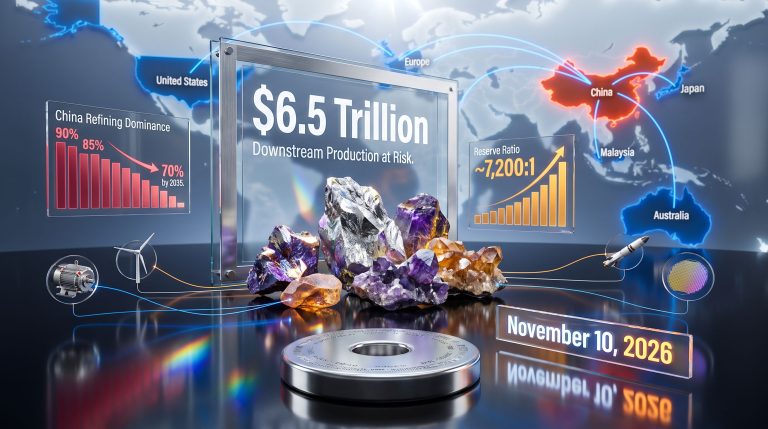
China's dominance in critical mineral processing did not emerge overnight. Decades of deliberate industrial policy, subsidised refining capacity, and tolerance for environmental costs that Western jurisdictions rejected created a position of extraordinary market concentration. Today, China accounts for roughly 85 to 90 percent of global rare earth processing capacity, with comparable dominance in the refining of tungsten, bismuth, indium, and several other technology-critical metals.
This processing monopoly functions as a force multiplier. Even when mineral deposits exist in Australia, Canada, Africa, or Brazil, the extracted ore has historically moved through Chinese processing facilities before reaching manufacturers in Europe, Japan, South Korea, or the United States. Furthermore, the rare earth supply chain importance becomes evident when considering that export controls on refined materials, processing chemicals, and technical know-how create bottlenecks that no amount of new mine development can immediately resolve.
Strategic Insight: The dependency gap is not at the mine gate. It sits in the solvent extraction circuits, separation facilities, and metallurgical know-how that convert raw ore into specification-grade oxides, metals, and alloys. China controls this stage decisively, and its export control regime is engineered precisely at this chokepoint.
This architecture reflects a calculated awareness that resource leverage is most durable when embedded in processing complexity rather than raw reserves. Rare earth separation, for instance, is not a straightforward industrial operation. It involves dozens of sequential solvent extraction stages, proprietary chemical formulations, and process expertise accumulated over generations of industrial practice. Replicating this outside China requires years of investment, skilled workforce development, and significant capital expenditure.
A Chronological Map of Escalation: 2025 to 2026
The progression of China's export control measures follows a discernible pattern of staged escalation, with each new wave expanding both the scope of controlled materials and the geographic reach of the regulations.
February 2025: The Opening Salvo
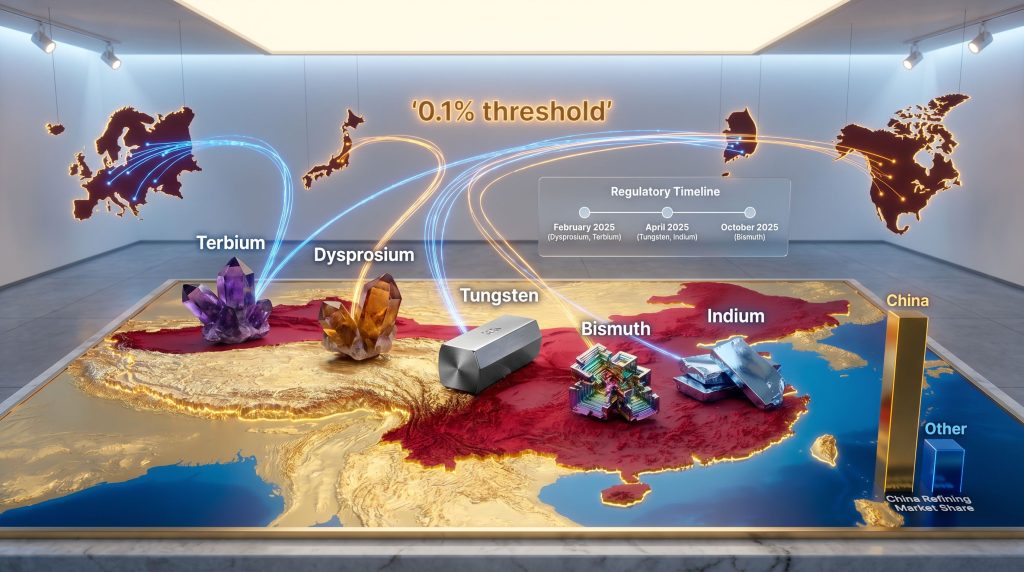
The first wave targeted a cluster of industrial metals and technology materials: tungsten, tellurium, bismuth, indium, and molybdenum. Alongside export licensing requirements, Beijing introduced technology transfer restrictions that prohibited the export of processing know-how for these materials. This combination was significant because it addressed not just physical flows of refined product but also the intellectual infrastructure needed to build alternative processing capacity elsewhere.
- Tungsten is essential for cutting tools, armour-piercing munitions, and high-performance electronics
- Indium underpins flat panel displays, solar cells, and thin-film semiconductor applications
- Bismuth serves pharmaceutical, metallurgical, and cosmetic industries as a safer substitute for lead. China's bismuth export controls have consequently attracted particular attention from industries reliant on this material
- Tellurium is critical to cadmium telluride solar panels, a major thin-film photovoltaic technology
- Molybdenum strengthens high-temperature steel alloys used in aerospace and energy infrastructure
April 2025: Heavy Rare Earths Enter the Controlled List
The second regulatory wave was arguably more consequential for the clean energy and defence sectors. Seven heavy rare earth elements were placed under export licensing requirements: samarium, gadolinium, terbium, dysprosium, lutetium, scandium, and yttrium.
Terbium and dysprosium occupy a particularly strategic position. Both are essential additives in neodymium-iron-boron (NdFeB) permanent magnets, the high-performance magnets used in electric vehicle traction motors and direct-drive wind turbine generators. Without these additives, NdFeB magnets lose thermal stability and cannot operate reliably at the elevated temperatures found inside EV drivetrains.
October 2025: Extraterritorial Reach and Five Additional Elements
The October 2025 expansion added erbium, europium, holmium, thulium, and ytterbium to the controlled list, covering applications in fibre optic amplifiers, medical imaging equipment, solid-state lasers, and advanced display technologies. Equipment and process know-how restrictions were extended to this new group as well.
More structurally significant was the introduction of a 0.1% threshold rule with extraterritorial application. Under this mechanism, products manufactured outside China that incorporate components containing Chinese-origin rare earths above a 0.1% concentration level may require Chinese government export approval before being shipped to third-party markets. The IEA's analysis of supply concentration risks highlights precisely why this mechanism represents such a departure from conventional trade controls.
Compliance Warning: Manufacturers in Europe, Japan, South Korea, and the United States whose products incorporate Chinese-origin rare earths, even in trace quantities exceeding the 0.1% threshold, face potential exposure to Chinese export licensing requirements for their own finished goods. Legal, procurement, and supply chain functions should conduct full bill-of-materials reviews to assess this exposure.
This mechanism draws direct comparisons to the United States Foreign Direct Product Rule (FDPR), which the US has used to restrict foreign-manufactured semiconductor products that incorporate American-origin technology above defined thresholds. Beijing's adoption of an analogous instrument reflects a deliberate mirroring of US extraterritorial trade controls, applied to the minerals and materials domain where China holds the corresponding leverage.
Complete Reference: Controlled Materials by Wave
| Mineral / Group | Control Date | Category | Key Applications |
|---|---|---|---|
| Tungsten, Tellurium, Bismuth, Indium, Molybdenum | February 2025 | Industrial metals + tech transfer ban | Electronics, semiconductors, steel alloys, solar cells |
| Samarium, Gadolinium, Terbium, Dysprosium, Lutetium, Scandium, Yttrium | April 2025 | Heavy rare earths | EV motors, wind turbines, defence systems, MRI contrast agents |
| Erbium, Europium, Holmium, Thulium, Ytterbium | October 2025 | Rare earths + equipment / know-how | Fibre optics, medical lasers, display phosphors, imaging |
The November 2025 Suspension: Calibrated Pressure, Not Retreat
In November 2025, China's Ministry of Commerce announced a partial suspension of the October 2025 controls, pausing certain rare earth equipment and know-how restrictions until November 2026. This move is widely misread as a softening of position.
The suspension was narrowly scoped. It applied only to portions of the October 2025 expansion, leaving the February and April 2025 licensing regimes fully active. Military end-use restrictions remained entirely in force. The move is better understood as a pressure calibration: signalling flexibility while preserving the core architecture of the control system.
| Control Category | Post-November 2025 Status | Review / Expiry |
|---|---|---|
| October 2025 rare earth + equipment controls | Suspended / paused | November 2026 |
| April 2025 heavy rare earth licensing | Active | Ongoing |
| February 2025 industrial metals controls | Active | Ongoing |
| Military end-use restrictions | Active | Ongoing |
Analytical Note: The selective suspension demonstrates that Beijing views its export control regime as a graduated instrument. Controls can be tightened, relaxed, or held in suspension depending on diplomatic conditions, a dynamic that introduces significant uncertainty for manufacturers attempting long-range supply planning.
China's Official Position and the G7 Response
In June 2026, G7 leaders reached agreement on a coordinated strategy to reduce dependence on Chinese critical mineral supply chains. The package included commitments to align national stockpiling reserves, deepen cooperation on supply chain diversification, and expand the International Energy Agency's mandate to encompass critical minerals supply security.
China's foreign ministry responded by characterising its export control measures as consistent with market economy principles and internationally accepted trade law frameworks, while criticising what it described as the formation of exclusionary groupings among Western nations. Beijing's framing positions the export controls not as coercive instruments but as legitimate regulatory tools no different in kind from export controls maintained by other major economies.
This framing deserves scrutiny. The extraterritorial dimension of the October 2025 controls represents a qualitative expansion beyond conventional export licensing. Extending Chinese regulatory jurisdiction to cover foreign-manufactured goods based on the origin of trace material inputs is a structural innovation in trade control architecture, not a routine application of existing frameworks.
The next major ASX story will hit our subscribers first
Why Western Manufacturers Face Asymmetric Vulnerability
The compliance implications of China's export control regime vary significantly across industries and geographies.
Industries with the greatest exposure under the current framework include:
- Electric vehicle manufacturers relying on NdFeB permanent magnets for traction motors, particularly those sourcing magnet assemblies through supply chains with Chinese rare earth content
- Wind turbine producers using direct-drive generator architectures dependent on large-format permanent magnets incorporating dysprosium and terbium
- Defence contractors manufacturing precision-guided munitions, radar systems, and electronic warfare equipment that rely on heavy rare earths for thermal stability and magnetic performance
- Medical equipment manufacturers using gadolinium-based MRI contrast agents, europium phosphors, and holmium surgical lasers
- Telecommunications and fibre optic network operators dependent on erbium-doped fibre amplifiers for long-distance signal transmission
The common thread across these industries is that rare earth content is embedded deeply in the performance characteristics of end products. Substitution is either technically infeasible in the near term or requires redesign cycles measured in years rather than months.
The Western Response: Stockpiling, Friend-Shoring, and Processing Investment
The G7 coordination framework represents the most structured collective response to China's critical minerals leverage yet attempted. Beyond stockpiling alignment and the expanded IEA mandate, individual member nations have accelerated domestic processing investment with varying degrees of progress.
Australia has emerged as a key node in allied supply chain development, with rare earth separation projects moving toward commercial scale. Canada's geological endowment includes significant rare earth, tungsten, and indium resources, with policy frameworks evolving to support domestic processing. The United States has targeted rare earth magnet manufacturing capacity through industrial policy instruments, seeking to close the gap between ore availability and finished magnet production.
However, a fundamental challenge persists: building processing capacity is not simply a matter of capital investment. The chemical engineering knowledge embedded in rare earth separation processes, the environmental management requirements for processing facilities, and the workforce skills needed to operate them at specification represent barriers that cannot be overcome through funding commitments alone.
Realistic timelines for meaningful Western processing capacity suggest that the supply chain vulnerability window extends at least through the early 2030s, even under optimistic investment scenarios.
Clean Energy Transition at Risk: The Rare Earth Dependency Equation
The intersection of China critical minerals export controls and the global clean energy transition creates a compounding strategic problem. The technologies most central to decarbonisation targets, electric vehicles and wind generation, depend most heavily on precisely the materials subject to the most consequential export controls. Consequently, the broader question of critical minerals and energy security has moved to the top of policy agendas across allied nations.
EV production growth projections assume continued access to high-performance NdFeB permanent magnets at competitive prices. Disruption to rare earth supply chains, or significant licensing delays, could affect production scheduling, raise input costs, and potentially slow adoption trajectories in markets where EV price parity with internal combustion vehicles remains marginal.
Battery metals such as lithium, cobalt, and nickel present a different vulnerability profile. While China also dominates processing in these categories, the geographic distribution of mining activity and the emergence of alternative processing capacity in Indonesia, Australia, and elsewhere creates somewhat greater supply resilience than exists for rare earths.
The case for accelerating rare earth recycling programmes and substitution research has therefore never been stronger. The urban mining potential of end-of-life EV motors, wind turbine generators, and hard disk drives represents an emerging source of rare earth feedstock that operates entirely outside Chinese supply chains. While current recycling volumes remain modest relative to primary demand, the long-term potential is significant, particularly as the installed base of rare-earth-intensive clean energy equipment accumulates.
Frequently Asked Questions: China Critical Minerals Export Controls
What is the purpose of China's critical minerals export controls?
China's export control framework serves multiple overlapping objectives: managing domestic resource conservation, generating diplomatic leverage in trade negotiations, and restricting the transfer of processing technology that could enable competitive industries in rival economies.
Which rare earths are currently subject to Chinese export licensing requirements?
As of mid-2026, active licensing requirements cover samarium, gadolinium, terbium, dysprosium, lutetium, scandium, and yttrium from the April 2025 wave, with erbium, europium, holmium, thulium, and ytterbium subject to partially suspended controls from October 2025.
How does the extraterritorial 0.1% rule affect non-Chinese manufacturers?
Products manufactured outside China whose components contain Chinese-origin rare earths above a 0.1% concentration threshold may require Chinese export licences before being shipped to third countries. This creates compliance obligations for foreign manufacturers that have no direct commercial relationship with China.
What did the G7 agree to in response to China's export controls?
G7 leaders in June 2026 committed to coordinating national stockpiling strategies, advancing supply chain diversification initiatives, and expanding the IEA's role in monitoring and addressing critical minerals supply security.
Were any of China's 2025 export controls suspended or reversed?
Certain October 2025 controls on rare earth equipment and know-how were suspended by China's Ministry of Commerce in November 2025, with the suspension running to November 2026. Earlier controls from February and April 2025 remained fully active.
How long has China been using export controls as a trade policy instrument?
China has applied export quotas and licensing requirements to rare earth materials since at least 2010, when a significant reduction in export quotas triggered a World Trade Organization dispute. The current framework represents a substantial escalation of both scope and sophistication compared to earlier iterations.
What role does the IEA play in the Western response to China's minerals strategy?
The International Energy Agency has been assigned an expanded mandate within the G7 framework to assess critical minerals supply security, monitor market conditions, and support coordination among member nations on strategic reserve policies and diversification strategies.
Key Takeaways: The Strategic Stakes of a Fragmented Minerals Order
The architecture China has built across three regulatory waves reflects a deliberate, layered strategy rather than reactive trade policy. Mining concentration creates the foundation; processing dominance provides the operational leverage; technology transfer restrictions prevent rivals from escaping the dependency; and extraterritorial mechanisms extend Chinese regulatory reach into foreign supply chains.
The G7's June 2026 coordination commitment marks a structural shift in how allied nations conceptualise supply chain security. The transition from ad-hoc bilateral responses to coordinated multilateral frameworks, with an institutional anchor in the IEA, represents meaningful progress in governance architecture even as physical supply chain diversification remains years away from practical impact.
In addition, the broader effort to advance critical raw materials transition strategies will be essential if Western economies are to reduce their structural exposure to China critical minerals export controls before the clean energy transition reaches its most materials-intensive phase. The critical question for the remainder of this decade is whether Western investment in processing capacity, recycling infrastructure, and substitution research can compress the vulnerability window fast enough. Chatham House's assessment that China's rare earth restrictions send a stark warning to Western policymakers reinforces the urgency of this challenge.
This article is intended for informational purposes only and does not constitute financial, legal, or investment advice. Forecasts and timeline assessments are based on currently available information and are subject to change as market and regulatory conditions evolve. Readers are encouraged to seek independent professional advice before making supply chain or investment decisions based on the information presented here.
For ongoing coverage of critical minerals policy and supply chain developments, Mining Weekly at miningweekly.com provides detailed reporting across the minerals sector.
Want to Stay Ahead of Critical Mineral Discoveries as Supply Chain Dynamics Shift?
As China's export control architecture reshapes global critical minerals markets, identifying significant ASX mineral discoveries early has never been more strategically important — Discovery Alert's proprietary Discovery IQ model delivers real-time alerts the moment major discoveries hit the ASX, turning complex mineral data into actionable investment insights. Explore historic discoveries and their returns to understand the opportunity, then begin your 14-day free trial at Discovery Alert to position yourself ahead of the market.