July 19, 2026
The Ocean as Industrial Feedstock: How Seawater Could Reshape Critical Mineral Supply Chains
The history of materials science is punctuated by moments when an abundant, overlooked resource becomes the foundation of an entirely new industrial system. Hydrometallurgy transformed oxide ores once considered worthless into the backbone of modern copper supply. Electrolysis made aluminium, once more precious than gold, a commodity cheap enough to wrap sandwiches. Today, researchers are asking whether seawater rare earth extraction could shift the ocean from a geological frontier into a functioning industrial feedstock for the minerals powering the clean energy transition.
The question is not merely academic. The structural fragility embedded in today's critical minerals demand supply chains is one of the most consequential and underappreciated risks facing the global economy, and the answer to that fragility may lie beneath the surface of the sea.
When big ASX news breaks, our subscribers know first
The Supply Chain Vulnerability Hiding in Plain Sight
The clean energy transition depends on a narrow group of materials that are simultaneously essential, difficult to substitute, and overwhelmingly controlled by a single nation. China's rare earth export restrictions are just one dimension of a far broader dominance: the country controls approximately 85 to 95 percent of global rare earth refining capacity, 85 to 90 percent of mine-to-metal processing, 68 percent of global cobalt output, 65 percent of nickel refining, and 60 percent of EV-battery-grade lithium production, according to data cited by Goldman Sachs.
This is not simply market concentration in the conventional sense. It represents a structural chokepoint through which virtually every electric vehicle motor, wind turbine generator, and grid-scale battery storage system must pass. Any supply restriction, politically motivated export control, or domestic demand surge within China could cascade across clean energy manufacturing globally with immediate effect.
The International Energy Agency projects that global demand for critical minerals from the clean energy sector will at minimum double and could potentially quadruple by 2040, depending on the pace of clean energy adoption. Lithium faces the steepest demand trajectory, driven by electric vehicles and grid-scale battery storage. Furthermore, geopolitical disruptions, including the closure of the Strait of Hormuz, have already accelerated clean energy adoption timelines, compressing the window within which alternative supply chains must be built.
As UN Secretary-General António Guterres stated at the 2024 Panel on Critical Energy Transition Minerals, a world powered by renewables is a world hungry for critical minerals, and for developing nations, those minerals represent a genuine economic opportunity, but only if managed properly.
What Rare Earth Elements Actually Are, and Why Concentration Matters
The 17 metallic elements classified as rare earth elements (REEs) include lanthanum, cerium, neodymium, praseodymium, and dysprosium, among others. They are foundational to permanent magnets used in EV motors and wind turbines, to phosphors in displays, to defence systems, and to a broad range of consumer electronics. Despite the name, REEs are not geologically rare in an absolute sense, as their average crustal abundance is comparable to common industrial metals.
The challenge is concentration: REEs rarely accumulate in deposits dense enough to make conventional mining economically viable, and their chemical similarity makes separation at the refining stage extraordinarily complex and energy-intensive. This refining complexity is precisely why China's dominance is so difficult to replicate quickly, requiring not just capital, but decades of accumulated process chemistry expertise.
What the Ocean Actually Holds
Seawater contains measurable concentrations of virtually every element on the periodic table. However, the concentrations vary enormously across different minerals, and this distinction is critical for understanding which ocean-derived extraction pathways are realistic near-term opportunities versus long-term research targets.
| Mineral | Approximate Seawater Concentration | Commercial Recovery Status |
|---|---|---|
| Magnesium | ~1,290 mg/L | Most accessible; active pilot development |
| Lithium | ~0.17 mg/L | Low concentration; longer-term target |
| Nickel | Trace levels | Under early research investigation |
| Uranium | ~3.3 µg/L | Subject of ongoing research |
| REEs (e.g., neodymium) | 1-10 ng/kg (sub-nanogram range) | Not commercially viable from open ocean |
The core insight here is that seawater rare earth extraction, when applied to open ocean water, faces a fundamental constraint: REEs exist at concentrations measured in nanograms per kilogram. Consequently, recovering meaningful quantities would require processing volumes of seawater so enormous that the energy costs would vastly exceed the market value of the recovered metals. This is a thermodynamic and economic reality that no currently known technology can overcome at commercial scale.
The more productive framing is not open-ocean REE extraction, but rather the recovery of more concentrated marine-derived mineral streams. Desalination brine, deep-sea polymetallic nodules, and biological concentration mechanisms each offer higher-grade pathways.
The Four Extraction Methodologies: A Technical Overview
Understanding how seawater mineral extraction actually works requires distinguishing between four fundamentally different scientific approaches, each with distinct applications, limitations, and commercial readiness levels.
1. Solid-Phase Extraction
Solid-phase extraction (SPE) uses chelating resins, such as TAR-immobilised materials or acrylic polymer substrates, to selectively bind REEs from seawater at controlled pH levels, typically between pH 5.0 and 5.5. The process achieves high enrichment factors with minimal contamination risk, making it the method of choice for coupling with ICP-MS analysis in geochemical and oceanographic research. It is currently a laboratory and analytical tool, not a commercial production technology.
2. Co-Precipitation with Magnesium Hydroxide
Aqueous ammonia introduced to acidified seawater triggers REEs to co-precipitate alongside magnesium hydroxide (Mg(OH)₂). This process removes over 99.8 percent of competing matrix salts, including barium ions, enabling clean multi-element trace analysis. The same chemical reaction underpins the Pacific Northwest National Laboratory's co-flow reactor design, applied at an engineered scale. Research into rare earth supply chains increasingly highlights this approach as a promising intermediate step.
3. Electrochemical Extraction
An emerging methodology exploiting reduction-oxidation (redox) cycling to selectively draw dissolved metals from aqueous solutions. PNNL researchers are exploring this approach for magnesium and, in future iterations, nickel recovery. It offers theoretical energy efficiency advantages over thermal or evaporative concentration methods, however commercial scalability has not yet been demonstrated.
4. Liquid-Liquid Extraction
Modified solvent-based approaches using compounds such as bis(2-ethylhexyl) phosphate in heptane can recover REEs from hypersaline or industrial brine solutions. Performance degrades significantly in natural seawater due to interference from competing ions including calcium and magnesium. This method is more applicable to controlled industrial waste streams than open-ocean environments. For a broader overview of solvent-based approaches, extraction of rare earths provides useful technical context.
The PNNL Co-Flow Reactor: What Makes It Different
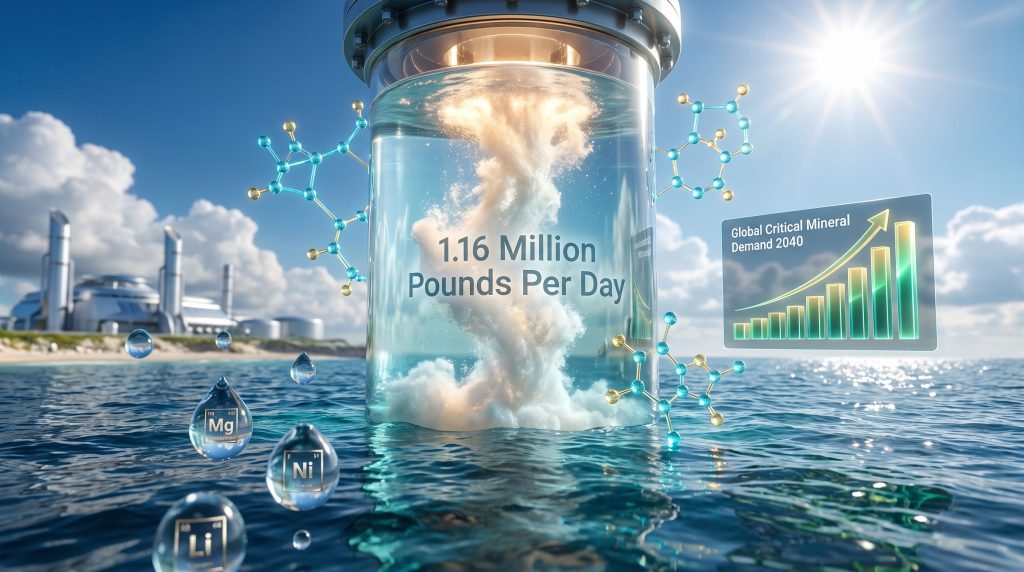
The most commercially advanced development in marine mineral extraction is the co-flow reactor developed at Pacific Northwest National Laboratory. The device simultaneously cycles seawater and sodium hydroxide through a controlled mixing chamber. When the two streams converge, a chemical precipitation reaction produces high-purity magnesium hydroxide, a widely used industrial compound currently imported by the United States in substantial volumes.
What distinguishes this system from prior experimental approaches is its integration strategy. Rather than attempting open-ocean extraction, the co-flow reactor is designed for co-location with existing coastal desalination infrastructure, processing seawater volumes that desalination plants already handle as part of their standard operations.
PNNL analysis of California's Carlsbad desalination facility illustrates the potential scale:
| Metric | Value |
|---|---|
| Target facility | Carlsbad Desalination Plant, California |
| Projected daily magnesium hydroxide output | 1.16 million pounds (524,000 kg) |
| Relative to U.S. daily consumption | More than 3x the national daily requirement from a single site |
| Next extraction target | Nickel (under active research development) |
Chinmayee Subban, a chemist at PNNL, has noted that seawater's relatively consistent chemical composition across global ocean regions means that a technology validated at one location can be replicated rapidly across multiple geographies worldwide. This geographic universality is a critical differentiator from conventional mining, which is constrained by the geological accident of where mineral deposits happen to occur.
Jessica Cross, a chemical oceanographer at PNNL, has pointed out that just 0.1 percent of the world's seawater, if fully processed, contains sufficient concentrations of magnesium and lithium to satisfy human needs for tens of thousands of years. The operative qualifier is fully extracted, a technical threshold that remains far beyond current capability for most minerals, but magnesium hydroxide represents a meaningful first step. Researchers at PNNL have published findings on sequestering rare earth elements and precious metals from seawater using highly efficient reactor systems.
Why Start with Magnesium Hydroxide?
Magnesium hydroxide is not chosen arbitrarily as the initial target mineral. Several factors make it the logical proof-of-concept:
- It is present in seawater at ~1,290 mg/L, orders of magnitude higher than REEs or lithium
- It has established industrial demand across pharmaceutical, environmental treatment, and flame retardant applications
- The co-precipitation chemistry that produces it also creates conditions theoretically capable of trapping co-occurring trace elements, opening a multi-mineral recovery pathway
- Commercial verifiability is straightforward: magnesium hydroxide has transparent market pricing and well-understood quality specifications
Three Higher-Concentration Pathways Beyond Open Ocean Extraction
The most technically credible near-term alternatives to open-ocean seawater rare earth extraction focus on feedstocks with meaningfully higher mineral concentrations.
Desalination Brine
Desalination plants globally generate approximately 37 billion gallons of hypersaline brine per day as a processing byproduct. This brine is a concentrated waste stream containing elevated mineral levels compared to raw seawater, making it a significantly more energy-efficient extraction feedstock. Oregon's Brine Miner initiative is one of several research programs attempting to recover lithium and REEs from this otherwise discarded material. In addition, the PNNL co-flow reactor is explicitly designed for desalination co-location, making brine processing the most commercially credible near-term pathway.
Deep-Sea Ferromanganese Nodules
Deep-sea mining concerns notwithstanding, polymetallic nodules scattered across the deep ocean floor contain REE concentrations far exceeding those in dissolved seawater. Solvent-based extraction techniques using compounds such as desferrioxamine-B have demonstrated approximately 80 percent recovery rates for key REEs from ferromanganese material under laboratory conditions. Deep-sea mining remains environmentally contentious and faces substantial regulatory complexity, but represents a longer-term strategic option for nations with Pacific Ocean territorial access.
Seaweed Bio-Adsorption
Green seaweed species, particularly Ulva sp., have demonstrated the capacity to remove REEs from saline industrial wastewater with efficiencies exceeding 90 percent. Bio-adsorption leverages natural biological concentration mechanisms, potentially reducing energy requirements compared to chemical extraction. Furthermore, desalination brine mining research increasingly intersects with bio-adsorption models, suggesting that hybrid approaches may offer new avenues for scalable, low-energy mineral recovery from marine sources.
The next major ASX story will hit our subscribers first
Key Barriers to Commercial Scale: An Honest Assessment
Enthusiasm for marine mineral extraction must be balanced against a rigorous assessment of the obstacles that remain. The following table summarises the principal challenges:
| Challenge | Technical Detail | Commercial Impact |
|---|---|---|
| Extreme Dilution | REEs at ng/kg to sub-ng/kg in open ocean | Billions of litres required per meaningful yield |
| Matrix Interference | Mg²⁺, Ca²⁺, Ba²⁺ compete with REE binding sites | Reduces selectivity and final purity |
| Energy Intensity | Ultra-dilute concentration demands enormous throughput | Processing costs frequently exceed metal market value |
| Infrastructure Scale | No existing open-ocean commercial harvesting model | Prohibitive capital expenditure without co-location |
| Regulatory Complexity | Marine extraction triggers jurisdictional and treaty questions | Extended permitting and potential international conflict |
One factor rarely discussed in mainstream coverage is the selectivity problem in electrochemical extraction. The challenge is not simply removing a target metal from seawater, but doing so without simultaneously removing competing ions that would contaminate the product or force expensive downstream purification. Achieving selective electrochemical extraction from a matrix as chemically complex as seawater at commercial throughput volumes remains an unsolved engineering problem.
Conventional Mining vs. Marine Extraction: A Strategic Comparison
| Dimension | Conventional REE Mining | Marine / Brine Extraction |
|---|---|---|
| Geographic distribution | Highly concentrated (China, Australia, USA) | Globally available to any coastal nation |
| Environmental footprint | Significant land disturbance, acid drainage, tailings | Lower for brine co-processing; deep-sea mining raises separate concerns |
| Supply chain resilience | Vulnerable to geopolitical disruption | Inherently decentralised |
| Technology readiness | Commercially mature | Early-stage to pilot scale |
| Feedstock concentration | High (thousands of ppm in ore) | Low in seawater; moderate in brine |
| Time to commercial scale | Established | 5 to 15+ years for most ocean-derived methods |
Frequently Asked Questions: Seawater Rare Earth Extraction
Is seawater rare earth extraction commercially viable today?
No. REEs in open ocean seawater exist at nanogram-per-kilogram concentrations, far too dilute for economically viable recovery with current technology. Research priority has consequently shifted toward higher-concentration alternatives such as desalination brine and seafloor nodules.
What minerals can realistically be extracted from seawater in the near term?
Magnesium is the most accessible dissolved mineral in seawater at approximately 1,290 mg/L. The PNNL co-flow reactor targets magnesium hydroxide production first, with nickel identified as a medium-term development goal.
Why is desalination brine better than raw seawater as a feedstock?
Desalination brine is a concentrated byproduct already removed from the ocean, containing higher mineral levels per unit volume. Processing brine requires far smaller throughput to recover equivalent quantities of minerals, dramatically improving energy efficiency and economic viability.
How does China's refining dominance affect clean energy manufacturing?
China controls the overwhelming majority of global rare earth, cobalt, nickel, and lithium refining infrastructure. Any supply disruption originating from Chinese domestic policy, export controls, or geopolitical tension would propagate directly through EV manufacturing, battery storage deployment, and wind energy production worldwide.
The Longer Arc: From Laboratory Reactor to Distributed Supply Chain
If the PNNL co-flow reactor technology is successfully validated at pilot scale and subsequently deployed across coastal desalination infrastructure globally, it would represent something structurally new in critical mineral supply chains: a distributed, ocean-integrated production model that is geographically universal, co-located with existing water infrastructure, and not dependent on the geological lottery of terrestrial deposit formation.
Nations currently absent from the critical minerals economy due to a lack of terrestrial deposits, but possessing extensive coastlines and operational desalination capacity, could become meaningful contributors to global mineral supply. This is a supply chain model with no direct historical precedent, and its realisation, even partially, would constitute one of the most consequential developments in materials science since the industrialisation of hydrometallurgy.
The near-term milestones that will determine whether this vision progresses from aspiration to industrial reality include:
- Pilot-scale deployment of the PNNL co-flow reactor at a functioning desalination facility
- Demonstration of nickel extraction capability alongside magnesium hydroxide production
- Independent economic modelling of full-scale commercial deployment costs versus import parity pricing benchmarks
- Development of regulatory frameworks governing mineral extraction rights from desalination brine streams across different national jurisdictions
Disclaimer: This article contains forward-looking statements and projections regarding technology development timelines and commercial outcomes. These involve inherent uncertainty and should not be interpreted as investment advice. Readers should conduct independent research before making any investment or commercial decisions related to critical mineral supply chains or marine extraction technologies.
Want to Stay Ahead of the Next Major Mineral Discovery?
Discovery Alert's proprietary Discovery IQ model delivers real-time alerts the moment significant ASX mineral discoveries are announced, transforming complex commodity data into clear, actionable investment insights for both short-term traders and long-term investors. Explore how historic discoveries have generated substantial returns and begin your 14-day free trial today to position yourself ahead of the broader market.