July 19, 2026
The Geology Is Not the Bottleneck: Why Africa's Rare Earths Future Is a Political and Industrial Problem
The periodic table does not distribute its most strategically valuable elements evenly, and the global economy is now paying the price for ignoring that reality for decades. Rare earth elements, the 17 metallic compounds that underpin everything from electric vehicle drivetrains to precision-guided munitions, were treated as commodity footnotes for most of the twentieth century. Today, the Africa rare earths supply chain sits at the centre of a geopolitical contest that is reshaping trade policy, investment flows, and national security calculations simultaneously.
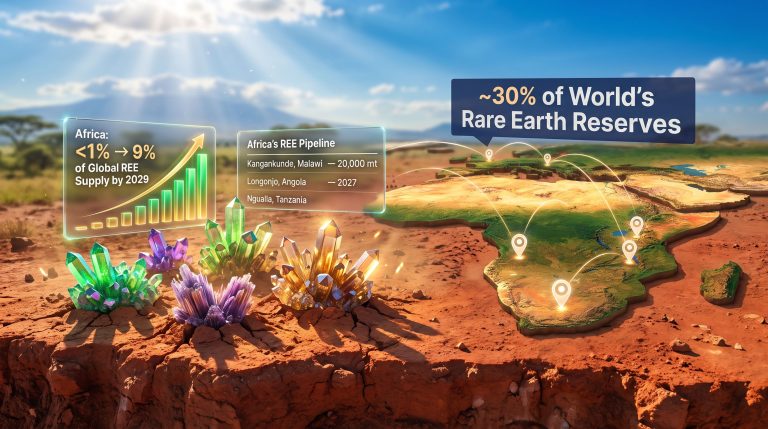
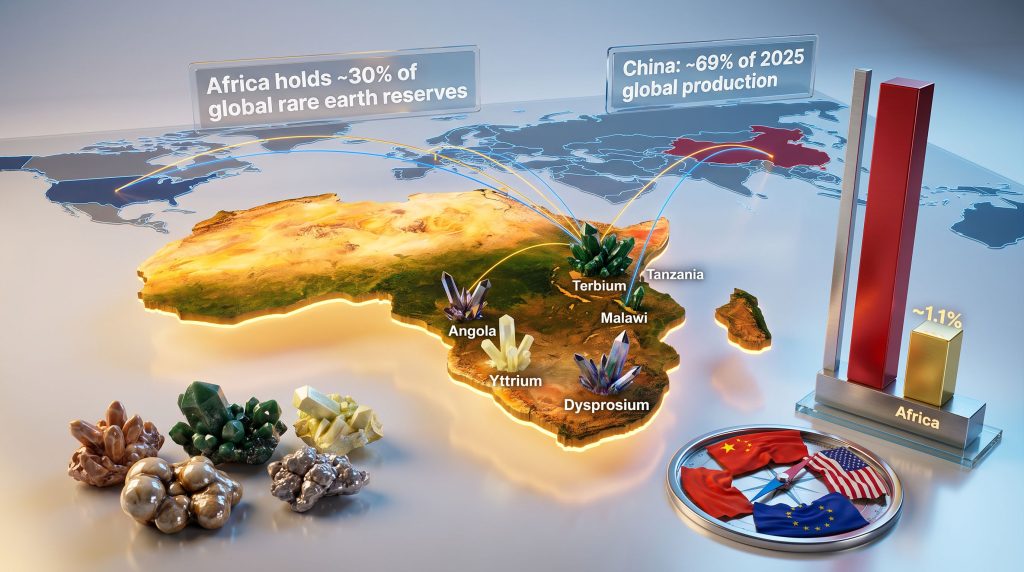
What makes the current moment particularly significant is that the supply chain architecture being built right now, across project boardrooms in Malawi, Tanzania, Angola, and South Africa, will likely determine who captures the economic premium from the energy transition for the next thirty years. Africa holds roughly 30% of global rare earth reserves by geological estimate, yet contributes less than 2% of current global production. That gap is not a geological mystery. It is the cumulative result of infrastructure deficits, capital access constraints, and a processing industry that has been deliberately concentrated elsewhere.
When big ASX news breaks, our subscribers know first
Global Rare Earth Supply in 2025: Understanding the Starting Point
Before assessing where Africa fits into the future supply picture, it is worth being precise about where the world actually stands. According to U.S. Geological Survey estimates for 2025, global rare earth oxide production reached approximately 390,000 metric tons, with the following distribution across major producing nations:
| Country | 2025 Estimated Production (metric tons REO) | Global Share |
|---|---|---|
| China | 270,000 | ~69% |
| United States | 51,000 | ~13% |
| Australia | 29,000 | ~7.4% |
| Myanmar | 22,000 | ~5.6% |
| Thailand | 4,800 | ~1.2% |
| India | 2,900 | ~0.7% |
| Africa (combined) | ~4,200 | ~1.1% |
Source: U.S. Geological Survey (USGS), 2025 estimates
China's dominance extends well beyond its mining share. The country controls approximately 90% of global rare earth separation and refining capacity, meaning that even ore extracted in Australia or Myanmar typically enters Chinese processing facilities before re-entering global supply chains as usable inputs. This structural reality is what makes supply chain diversification so technically difficult: redirecting mining output does not solve the problem if all roads to finished rare earth materials still run through the same refining chokepoint.
Why Rare Earth Elements Are Not a Niche Concern
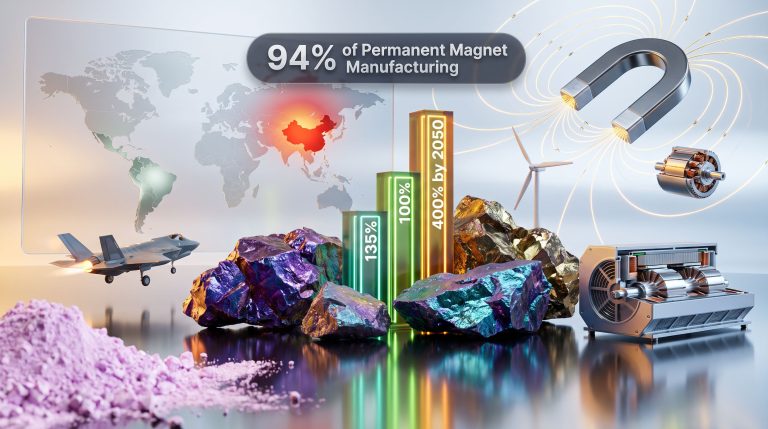
The 17 elements classified as rare earths include terbium, dysprosium, neodymium, praseodymium, scandium, and yttrium, among others. Furthermore, their applications span virtually every high-technology sector of the modern economy:
- Permanent magnets for electric vehicle motors and wind turbine generators, where neodymium-iron-boron alloys are irreplaceable at current technology levels
- Defense systems including radar, sonar, precision guidance components, and jet engine alloys
- Consumer electronics across display technologies, speakers, and miniaturised motors
- Clean energy infrastructure including grid-scale storage systems and hydrogen electrolysers
The critical point for investors and policymakers is that no commercially viable substitutes currently exist for rare earth permanent magnets in high-performance EV motors. As EV adoption scales globally, rare earth demand trajectories are effectively locked in for at least the next decade regardless of efficiency improvements elsewhere.
Africa's Rare Earth Reserves: The Strategic Asset the World Has Underpriced
Africa's geological endowment for rare earth elements is concentrated in a corridor spanning Southern and Eastern Africa, with secondary potential distributed more broadly across the continent. The deposit landscape includes both primary hard-rock deposits and secondary sources such as tailings from historic mining operations.
Key Insight: The highest-value African rare earth deposits are concentrated across Malawi, Tanzania, South Africa, Angola, and Namibia, with secondary potential in Madagascar, Nigeria, Kenya, Mozambique, Zambia, Burundi, and the Democratic Republic of Congo. Reserve size, however, does not equate to production readiness.
A country-by-country overview of current project status illustrates the uneven pace of development:
| Country | Key Deposit / Project | Current Status |
|---|---|---|
| Malawi | Kangankunde (Lindian Resources), Songwe Hill | Mining commenced 2026; targeting industrial-scale output by end-2026 |
| South Africa | Steenkampskraal, Phalaborwa (Rainbow Rare Earths) | Advancing toward full production; tailings processing underway |
| Tanzania | Ngualla (Peak Rare Earths) | One of the largest high-grade deposits globally; Chinese investment secured via 2025 deal |
| Angola | Longonjo (Pensana Plc) | Development pipeline; attracting Western interest |
| Namibia | Various exploration-stage deposits | Early feasibility stage |
| Madagascar | Undisclosed sources | ~2,700 metric tons recorded in USGS data |
| Nigeria | Undisclosed sources | ~1,500 metric tons recorded in USGS data |
| Burundi | Gakara (closed 2021) | Previously the continent's only commercial producer; currently inactive |
One of the least appreciated facts in this landscape is that Africa had zero industrial-scale rare earth production between 2021 and 2026. The closure of Burundi's Gakara mine in 2021 created a five-year void on the continent. The USGS statistics recording marginal output from Madagascar and Nigeria do not correspond to confirmed industrial operations, making Lindian Resources' Kangankunde project in Malawi not merely a single mining milestone but a structural reset for the entire Africa rare earths supply chain narrative.
What Distinguishes a Reserve From a Production-Ready Asset
This distinction matters enormously for investors evaluating African rare earth exposure. A geological reserve estimate confirms the presence and approximate quantity of mineralisation. It says nothing about:
- Metallurgical complexity – whether the ore can be processed cost-effectively given its mineralogy
- Infrastructure connectivity – whether power, water, and logistics networks exist to support a mine and processing facility
- Capital availability – whether project sponsors can raise the capital required for both mining and midstream processing
- Offtake security – whether binding commercial agreements exist with buyers who are not simply routing product back through Chinese refining networks
Many African rare earth deposits fail on at least two of these four criteria even where geological quality is strong. Consequently, understanding the geopolitical dimensions of these supply chains is equally as important as understanding the geology.
Three Scenarios for Africa's Share of Global Rare Earth Supply
Scenario 1: Base Case Reaching 9% by 2029
Benchmark Mineral Intelligence estimated in 2024 that eight new mines across Tanzania, Angola, Malawi, and South Africa could collectively position Africa to supply approximately 9% of global rare earth output by 2029. Kangankunde is the most advanced of these, with Lindian Resources targeting up to 20,000 metric tons of rare earth concentrate annually at industrial-scale production. Pipeline contributors include Longonjo in Angola, Ngualla in Tanzania, and Phalaborwa in South Africa.
At current global production volumes of roughly 390,000 metric tons annually, a 9% share would represent approximately 35,000 metric tons from Africa, compared to a near-zero baseline in 2025. That is a significant ramp, but it requires all eight projects to advance on schedule, which introduces meaningful execution risk.
Scenario 2: Conservative Trajectory at 7% by 2034
Fitch Solutions projects a more measured outcome, forecasting Africa reaching 7% of global rare earth supply by 2034. The variables that could suppress the base case include:
- Persistent infrastructure bottlenecks, particularly rail and port access in landlocked producing countries like Malawi
- Capital market conditions that constrain junior miner fundraising across development-stage African projects
- Geopolitical competition that allows Chinese capital to lock in offtake ahead of Western financiers
- Permitting and regulatory timelines that consistently extend project schedules beyond initial forecasts
Scenario 3: AfCFTA-Enabled Continental Value Chain
The most transformative scenario involves African nations coordinating rare earth processing under the African Continental Free Trade Area framework. A continental processing hub serving concentrate from Malawian, Tanzanian, and South African operations simultaneously would achieve economies of scale that no single-country solution can replicate.
Strategic Callout: The gap between a base case and an accelerated continental scenario is not geological. Africa has the reserves. What remains undetermined is whether the institutional architecture for regional value chain integration can be built before the current window of Western interest closes.
The economics of midstream rare earth processing are unforgiving at small scale. A standalone separation facility capable of processing concentrate into individual rare earth oxides typically requires capital expenditure exceeding $500 million. That figure is prohibitive for most African nations acting independently, but may become viable under a shared regional infrastructure model.
The Geopolitical Contest: China's Integrated Playbook Against Western Catch-Up
China has not secured its position in African rare earths through geological luck. It has deployed a systematic strategy pairing mining investment with infrastructure development, creating dependency relationships that make it structurally difficult for African producers to redirect output to alternative buyers even when they wish to.
Chinese entities have secured approximately 37% of Africa's projected future rare earth supply through a combination of direct investment and offtake agreements. The 2025 deal for Tanzania's Ngualla project exemplifies this approach. A reported $150 million investment from Chinese capital outpaced Western rival offers, securing control of a deposit that Western supply chain strategists had flagged as a priority asset. Indeed, China's approach to weaponising its rare earth dominance has made this contest increasingly urgent for Western nations.
Western nations are attempting to respond. The G7 set a target in June 2026 of reducing Chinese rare earth supply dependency to below 60% by 2030, but the arithmetic of reaching that target without African contributions is essentially impossible. The United States has focused strategic interest on Longonjo in Angola and Phalaborwa in South Africa as anchor projects for an alternative supply corridor. The European Union and Japan are developing financing instruments for African mineral processing capacity.
The structural disadvantage Western engagement faces is not financial capacity but operational speed. Chinese deal-making combines project financing, infrastructure bundling, and long-term offtake in a single integrated offer. Western equivalents typically require separate financing instruments from different institutions, moving at different timelines, creating windows that Chinese capital consistently exploits.
The Value Chain Gap: Africa's Most Expensive Problem
The rare earth value chain has three distinct stages:
- Upstream – Exploration, mining, and beneficiation to produce concentrate
- Midstream – Chemical separation and refining into individual rare earth oxides
- Downstream – Manufacturing of magnets, alloys, electronics, and advanced components
Africa currently operates almost exclusively at Stage 1. Most output leaves the continent as concentrate or mixed carbonate, enters Chinese refining facilities, and re-enters global supply chains as processed inputs that African nations then purchase at a significant markup for their own manufacturing ambitions.
Historical Pattern Warning: The trajectory Africa is currently on risks replicating the extractive commodity model that characterised the colonial era. Raw material outflows with minimal domestic value retention generate revenue but not industrialisation. Rare earths offer a genuine opportunity to break that pattern, but only if processing investment follows mining investment on the same timeline.
The three structural barriers that perpetuate this dynamic are:
- Infrastructure deficit: Rare earth separation is energy-intensive, water-intensive, and chemically complex. Sub-Saharan Africa's energy infrastructure, while improving, remains inadequate for large-scale midstream operations in most producing regions
- Capital concentration: The $500 million+ cost of a standalone separation plant makes single-country solutions economically unviable for most African sovereigns and junior operators
- Technical expertise gap: Building domestic rare earth chemistry capability requires sustained investment in scientific education, laboratory infrastructure, and industrial training that cannot be compressed into a single project development cycle
Furthermore, processing challenges facing the broader rare earth sector make the African context even more complex to navigate for prospective investors and policymakers alike.
The next major ASX story will hit our subscribers first
Project Readiness: Comparing Africa's Most Advanced Assets
| Project | Country | Operator | Stage | Annual Capacity Target | Key Risk Factor |
|---|---|---|---|---|---|
| Kangankunde | Malawi | Lindian Resources | Mining commenced 2026 | Up to 20,000 t concentrate/yr | Offtake concentration risk |
| Phalaborwa | South Africa | Rainbow Rare Earths | Advancing to production | TBC | Tailings processing complexity |
| Steenkampskraal | South Africa | Various | Pre-production | TBC | Capital raising environment |
| Longonjo | Angola | Pensana Plc | Development | TBC | Infrastructure access |
| Ngualla | Tanzania | Chinese-controlled post-2025 | Development | TBC | Western market access constraints |
For investors assessing exposure to the Africa rare earths supply chain, the distinction between exploration-stage and development-stage risk profiles is fundamental. Kangankunde's first blast completion in early July 2026 marks a transition from development-stage to operational-stage risk, a significant de-risking event that repositions Lindian Resources' risk profile relative to peers still awaiting first ore.
The offtake dimension deserves particular scrutiny. An African rare earth project that ships concentrate exclusively to Chinese buyers does not contribute to Western supply chain diversification regardless of its geographic location. In addition, the Longonjo project in Angola represents one of the more closely watched examples of a project actively seeking to route output toward genuinely alternative supply chains. Investors and policymakers evaluating African rare earth assets should examine not just whether a project can mine, but whether its commercial agreements achieve that same objective.
Frequently Asked Questions: Africa Rare Earths Supply Chain
Does Africa Have Significant Rare Earth Deposits?
Africa holds approximately 30% of global rare earth reserves by geological estimate, with the most significant concentrations in Malawi, Tanzania, South Africa, Angola, and Namibia. Reserve scale is not the continent's constraint. Processing capacity and infrastructure connectivity are.
Which African Country Produces the Most Rare Earths Currently?
As of 2025-2026, Madagascar and Nigeria are the only African nations recording any production in USGS statistics, at approximately 2,700 and 1,500 metric tons respectively, though neither has confirmed industrial-scale operations. Malawi's Kangankunde project is positioned to become the continent's largest operational rare earth mine by end-2026 following the commencement of mining operations in July 2026.
How Much of Global Supply Could Africa Realistically Provide?
Forecasts range from 7% (Fitch Solutions, by 2034) to 9% (Benchmark Mineral Intelligence, by 2029), contingent on eight planned mines across four countries reaching production. Both projections represent a substantial increase from the near-zero baseline of 2025.
Why Doesn't Africa Process Its Own Rare Earths?
Midstream rare earth separation requires capital investment exceeding $500 million for a standalone facility, specialist chemical engineering expertise, and energy infrastructure that most African producing nations currently lack. The African Development Bank's analysis of rare earth value chains highlights precisely these bottlenecks as the primary obstacles to mineral-based industrialisation across the continent.
Is Chinese Investment Active in African Rare Earth Projects?
Chinese entities have secured approximately 37% of Africa's projected future rare earth supply through offtake agreements and direct investment, including a reported $150 million transaction securing control of Tanzania's Ngualla deposit in 2025.
The Three Variables That Will Define Africa's Rare Earths Outcome
First, whether processing investment follows mining investment. Every tonne of concentrate that leaves Africa without value-adding processing represents a permanent transfer of economic value to whoever operates the separation facility. If African governments and their commercial partners do not build midstream capacity in parallel with upstream development, the continent will remain a raw material exporter at the bottom of the value chain.
Second, whether regional cooperation through AfCFTA can unlock continental processing scale. No single African nation can justify a $500 million rare earth separation facility on the basis of its own domestic mine output alone. The economic logic points unambiguously toward shared regional infrastructure. The political and institutional challenge is building the trust and coordination mechanisms to make that work.
Third, whether Western capital can move fast enough to compete with Chinese deal-making velocity. The window during which African projects can be oriented toward genuinely diversified supply chains is narrowing with each offtake agreement signed. Chinese investment does not wait for Western institutions to complete multi-stakeholder due diligence processes. The Ngualla example demonstrates what the cost of that timing gap looks like.
Africa's rare earth reserves are real, substantial, and strategically positioned to serve the energy transition at scale. The continent's geology is not the bottleneck. The question that will be answered over the next five years is whether Africa emerges as a full supply chain participant, capturing value from extraction through to processed output, or whether it exports strategic wealth in raw form while the industrial premium accumulates elsewhere. That outcome depends entirely on decisions being made right now.
This article contains forward-looking statements, scenario projections, and third-party forecast data. All production estimates, supply share projections, and investment figures should be independently verified before being relied upon for investment decisions. Mineral resource projects involve substantial risks and uncertainties that may cause actual outcomes to differ materially from any projections discussed.
Want to Track the Next Major Mineral Discovery Before the Broader Market Does?
Discovery Alert's proprietary Discovery IQ model delivers real-time alerts on significant ASX mineral discoveries — cutting through complex mineral data to surface actionable opportunities the moment they are announced, whether in rare earths or across 30+ other commodities. Explore historic discoveries and their returns to understand the scale of what early positioning can mean, then begin your 14-day free trial at Discovery Alert to secure your market-leading edge.