July 17, 2026
The Supply Chain That Two Mega-Trends Are Quietly Breaking
Commodity markets have experienced demand shocks before. The rise of consumer electronics drove a rare earth frenzy in the 1990s. The hybrid vehicle boom reshaped magnet markets in the 2000s. Each of those cycles was powered by a single dominant sector, and markets eventually adapted. What is unfolding now is categorically different, and the distinction carries enormous consequences for investors, policymakers, and industrial planners alike.
For the first time in modern industrial history, two of the largest capital expenditure categories on the planet are competing simultaneously for the same constrained pool of minerals. Artificial intelligence infrastructure and military modernisation are not taking turns at the commodity counter. They are both arriving at once, with non-negotiable procurement timelines, no viable material substitutes, and collectively insatiable appetites. Understanding how AI and defense spending rare earth demand is reshaping global supply chains requires looking well beyond the headlines.
When big ASX news breaks, our subscribers know first
What Makes Rare Earth Elements So Difficult to Replace
Before examining the demand side, it helps to understand why the rare earth supply chain occupies such an irreplaceable position in modern technology. The 17 metallic elements that make up the rare earth group are not particularly rare in the earth's crust, but they occur in economically viable concentrations in very few locations, and separating them from host rock into usable form is extraordinarily complex.
The elements driving the current critical minerals demand surge are a specific subset:
- Neodymium (Nd) and praseodymium (Pr): Combined into NdPr alloys, these elements form the basis of the most powerful permanent magnets available. NdPr magnets deliver 30 to 40% greater energy efficiency than conventional magnet alternatives.
- Dysprosium (Dy) and terbium (Tb): These so-called heavy rare earths are added in small quantities to NdPr magnets to maintain performance at elevated temperatures, a critical requirement for military propulsion systems and electric vehicle motors operating under load.
The functional performance gap between NdPr-based magnets and any available substitute is wide enough that neither military procurement agencies nor hyperscale data centre operators are in a position to engineer around it. This is not a preference — it is a physics constraint.
How AI Infrastructure Generates Rare Earth Demand at Industrial Scale
The Infrastructure Layer Most Analysts Overlook
A widespread misconception frames AI's relationship with critical minerals for semiconductors as being primarily about the chips inside graphics processing units. In reality, the rare earth intensity of artificial intelligence is driven largely by the physical infrastructure required to operate hyperscale data centres, not the chips themselves.
Hyperscale facilities require enormous quantities of high-efficiency motors, generators, and cooling systems. Every component in the thermal management chain, from compressor motors to variable-speed drives, relies on NdPr permanent magnets to achieve the efficiency levels that make large-scale AI workloads economically viable. Cooling infrastructure alone currently accounts for more than 20% of total data centre power costs, and NdPr magnets reduce energy consumption across these systems by 30 to 40% compared to conventional alternatives.
The capital commitment behind this buildout is staggering. Hyperscale operators collectively committed approximately US$400 billion in capital expenditure during 2025 alone, according to data published by Sprott Asset Management. The International Energy Agency projects that AI-driven data centres will account for 3% of global magnet rare earth element consumption by 2030, a figure that may appear modest in isolation but represents a structurally new demand category added on top of existing industrial volumes.
The Broader Critical Mineral Basket Feeding AI
Rare earths are not the only critical minerals being absorbed by AI infrastructure expansion. Furthermore, a recent industry report highlights the breadth of materials under pressure:
- Copper is consumed in enormous volumes across data centre electrical wiring and power distribution networks
- Gallium is essential to high-performance GPU fabrication
- Germanium underpins fibre optic communications infrastructure connecting data centres globally
- Tantalum is used in capacitor components throughout server hardware
Each of these materials carries its own supply concentration risk, but NdPr remains the most strategically exposed given China's processing dominance and the absence of mature Western refining alternatives.
Defense Spending as a Structural, Non-Cyclical Demand Driver
The Mineral Weight of Modern Military Hardware
Military hardware is extraordinarily rare earth intensive in ways that civilian applications rarely approach. Consider the scale:
| Military Platform | Rare Earth Content |
|---|---|
| F-35 Fighter Jet | Over 400 kg (approximately 882 lbs) |
| Arleigh Burke-Class Destroyer | Over 2.2 metric tons |
| Patriot Missile Defense System | NdPr and dysprosium-based magnets throughout |
| Precision-guided munitions | Rare earth-dependent guidance and propulsion |
These figures are not abstract. Each new platform commissioned, each munition produced, each missile defence battery deployed represents a discrete and quantifiable draw on the global rare earth supply chain. Unlike consumer demand, which can shift with economic cycles, defence procurement operates on legislatively mandated multi-year contracts. Once a defence budget is appropriated and a manufacturing contract signed, the downstream mineral demand is effectively locked in regardless of commodity pricing.
The NATO Rearmament Multiplier
Global military expenditure has reached approximately US$2.6 trillion annually, and the trajectory is accelerating. NATO member nations have collectively committed to raising defence spending targets to 5% of gross domestic product by 2035, a threshold that would represent an historic expansion of the alliance's collective military industrial base.
The United States has been evaluating expanded missile and missile-defence manufacturing under the Defense Production Act, programmes that rely heavily on high-performance rare earth permanent magnets. The US Department of Defense has already allocated US$439 million since 2020 specifically toward domestic rare earth supply chain resilience, a figure that signals institutional awareness of the strategic exposure.
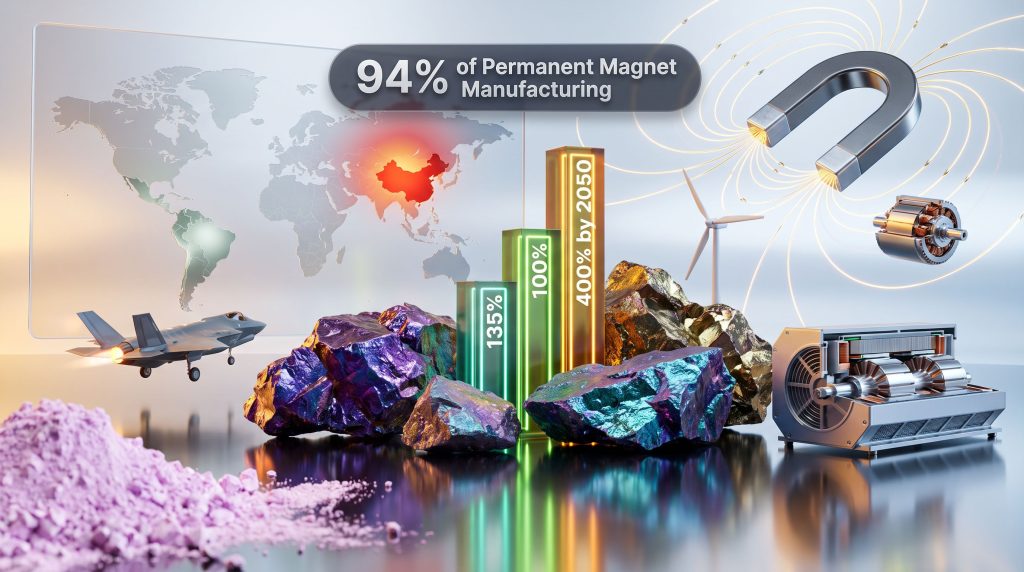
Defence-related critical mineral demand is projected to surge between 80 and 250% by 2035, with a central estimate of approximately 135% growth over the coming decade. Active conflicts in Europe and the Middle East are compounding this trajectory by requiring continuous hardware replenishment rather than one-time procurement cycles.
"Defence procurement cannot defer mineral demand the way consumer markets can. When governments classify rare earth access as a national security imperative, they are prepared to pay above-market prices, guarantee long-term contracts, and subsidise domestic production — all of which structurally elevate price floors regardless of broader commodity cycles."
China's Control of the Entire Value Chain: A Statistical Reality
The Concentration Problem in Numbers
The demand surge from AI and defense spending rare earth demand is colliding with a supply chain where operational control is concentrated to a degree rarely seen in strategic commodity markets:
| Supply Chain Stage | China's Approximate Market Share |
|---|---|
| Global rare earth mining production | ~70% |
| Global rare earth processing and refining | ~87% |
| Global permanent magnet manufacturing | ~94% |
| US domestic rare earth mining (global share) | ~13% |
| US reliance on imports for AI magnet rare earths | ~80% |
The distinction between mining share and processing share is critical and frequently misunderstood. Western nations can identify ore bodies containing rare earth elements. What they cannot do efficiently is separate, refine, and convert those ores into the high-purity oxides and alloys that magnet manufacturers require. China's 87% control of processing capacity is a more strategically decisive chokepoint than its mining dominance.
The Export Control Escalation
China's rare earth export restrictions on products destined for external military applications have been compounded by prohibitions on exporting technical expertise related to element separation. This second restriction is particularly consequential. Even if a Western nation located domestic ore deposits and secured project financing, it would face severe difficulty replicating the separation chemistry expertise that China has accumulated over decades of industrial practice. The knowledge gap is as significant as the infrastructure gap.
The 16-Year Timeline Problem
Perhaps the most structurally constraining fact in the entire rare earth debate is this: the average timeline from initial mineral discovery to active commercial production for a rare earth project is 16 years. This encompasses exploration, resource definition, feasibility studies, environmental assessment, permitting, construction, and commissioning. Processing and refining capacity requires its own separate development timeline layered on top.
This means that supply responses initiated today will not reach market before the early 2040s. Every year of underinvestment in rare earth project development during the 2010s is now presenting itself as a structural supply deficit in the 2030s demand environment.
Western Policy Responses: From Market Dependence to Strategic Industrial Policy
United States: Direct Intervention Across the Supply Chain
America's rare earth supply chain has become a central focus of federal industrial policy, with direct financial intervention now well underway:
- Secured an equity stake in MP Materials, the country's sole operating rare earth producer
- Introduced long-term price guarantees for neodymium-praseodymium production to de-risk private sector investment
- Extended direct federal loans for the construction of new rare earth processing facilities
- Allocated US$439 million since 2020 specifically toward domestic supply chain resilience programmes
- Set a target of achieving defence-grade rare earth self-sufficiency by 2027
Allied Nation Coordination
The policy response is not unilateral. Australia and Japan both have active supply chain diversification programmes underway, supported by combinations of government capital and private institutional investment. Japan's urgency is informed by direct historical experience: China's 2010 rare earth embargo during a territorial dispute with Japan demonstrated in concrete terms what supply cut-off looks like in practice.
At the multilateral level, 55 nations participated in the US-convened Inaugural Critical Minerals Ministerial on February 4, 2026, establishing a framework for a preferential trade zone covering strategic materials. The breadth of participation signals that rare earth supply security has graduated from a bilateral US-China trade issue to a genuinely global strategic concern.
The next major ASX story will hit our subscribers first
Mexico's Position in the Global Rare Earth Rebalancing
A Strategic Mineral Endowment at a Critical Moment
Mexico occupies an analytically interesting position in the evolving critical minerals landscape. The country ranks among the top global producers of eight minerals classified as critical by the US Geological Survey, including antimony, copper, fluorite, graphite, silver, and zinc. Mexico's domestic rare earth minerals market was valued at US$7.9 billion in 2025 and is projected to reach US$12.8 billion by 2031, driven by automotive, aerospace, and defence sector demand growth.
Economy Minister Marcelo Ebrard has identified 13 strategic minerals, including rare earths, as priority inputs for domestic industrial development, reflecting a policy-level recognition that Mexico's mineral endowment can be leveraged for industrial value creation rather than raw commodity export alone.
The Pacific Alliance as a Collective Minerals Platform
During its 2026 pro tempore Pacific Alliance presidency, Mexico has positioned critical mineral industrialisation as a central policy pillar. The Pacific Alliance, comprising Chile, Colombia, Mexico, Peru, and Costa Rica, represents 40% of Latin America's GDP and is actively aligning its mining and processing sectors to support semiconductor and battery manufacturing supply chains.
The bloc's collective mineral endowment, combined with geographic proximity to North American manufacturing corridors, positions Latin America as a potential third-party supplier node operating outside the direct US-China bilateral tension. However, under USMCA preferential trade terms, processed rare earth materials originating in Mexico could potentially supply US defence and AI manufacturers with supply chain traceability and allied-nation provenance. The constraint remains the absence of operational rare earth separation infrastructure and the technical workforce required to run it.
The Long-Term Demand Trajectory: Clean Energy Compounds the Pressure
AI and defense spending rare earth demand is not operating in isolation. Permanent magnet demand across transportation, defence, robotics, and clean energy applications is expected to grow 2.5 to 3 times over the next decade. The volume of NdPr-based magnets required for electric vehicle motors and wind turbines alone could double by 2050, according to industry projections analysed by VanEck.
This creates a compounding dynamic where three structurally independent demand categories — AI infrastructure, military modernisation, and clean energy transition — are all drawing from the same constrained mineral pool simultaneously. Unlike previous commodity cycles where demand from one sector could ease as another grew, all three of these categories are expanding in parallel and none can readily substitute away from rare earth permanent magnets at current performance requirements.
"Critical mineral demand is projected to increase 135% over the next decade, with some scenarios modelling growth approaching 400% by 2050 as clean energy deployment accelerates alongside AI and defence expansion."
Frequently Asked Questions
What rare earth elements are most critical for AI data centres?
Neodymium and praseodymium, combined as NdPr, are the primary elements driving AI-related rare earth demand. They power the high-efficiency permanent magnets used in cooling systems, generators, and electrical motors within hyperscale data centre facilities.
Why can't Western nations simply increase rare earth mining to meet growing demand?
Ore availability is not the primary constraint. China controls approximately 87% of global rare earth refining infrastructure, and its restrictions on exporting separation expertise prevent Western nations from rapidly replicating processing capability. The average project timeline from discovery to production is 16 years, meaning no new supply response initiated today meaningfully addresses demand pressures before the early 2040s.
What does NATO's 5% GDP defence spending target mean for rare earth markets?
If achieved by 2035, the resulting expansion of advanced weapons systems, missile defence platforms, and military electronics would drive an estimated 80 to 250% increase in defence-related critical mineral demand over the next decade — a volume that current non-Chinese supply chains cannot satisfy without significant new investment.
What is the significance of China restricting rare earth separation technology exports?
Rare earth separation is the most technically complex and capital-intensive stage of the supply chain. By prohibiting the export of the expertise required to operate separation facilities, China has effectively created a barrier that prevents Western nations from achieving refining independence even when domestic ore is available. This is a more durable form of supply chain leverage than controlling mining output alone.
Disclaimer: This article contains forward-looking projections and demand forecasts sourced from industry research and institutional analysis. These projections involve assumptions and uncertainties and should not be construed as financial advice. Readers are encouraged to conduct independent research before making investment decisions related to critical minerals or resource sector equities.
Want to Stay Ahead of the Next Major Critical Minerals Discovery?
Discovery Alert's proprietary Discovery IQ model scans ASX announcements in real time, instantly identifying significant mineral discoveries across rare earths and other critical commodities — turning complex data into actionable investment insights before the broader market catches on. Explore historic discoveries and their remarkable returns, then start your 14-day free trial at Discovery Alert to position yourself at the forefront of the critical minerals supply chain revolution.