July 17, 2026
The Rare Earth Supply Chain Rethink: Why Dual-Commodity Economics Are Reshaping Project Valuations
The global rare earth industry has spent two decades grappling with a structural paradox. Demand for magnet-grade rare earth elements is accelerating at a pace driven by electric vehicle adoption and renewable energy deployment, yet the economics of standalone rare earth mining remain stubbornly difficult. Processing complexity, price volatility, and the near-impossibility of securing offtake agreements before production is demonstrated have made project financing a persistent bottleneck for non-Chinese developers.
Against this backdrop, a dual-commodity development model is attracting serious attention from institutional capital. When a rare earth deposit can generate revenue from a second commodity — one with deeper, more liquid markets and less processing risk — the financial architecture of the project changes fundamentally. This is precisely the strategic logic underpinning the Resouro rare earths project in Brazil, known as the Tiros Project, which is now positioned as one of the most technically and economically compelling development-stage critical mineral assets in the western hemisphere.
When big ASX news breaks, our subscribers know first
Brazil's Underappreciated Position in the Global Rare Earth Race
Most critical mineral supply chain discussions centre on Australia, Canada, and the United States as the primary alternatives to Chinese dominance. Brazil rarely appears in that conversation with the prominence its geology deserves. China currently accounts for an estimated 60% or more of global rare earth mining output and an even larger share of separation and processing capacity, according to data from the U.S. Geological Survey. The urgency to diversify away from this concentration has become a defining theme for EV manufacturers, defence procurement agencies, and allied-nation governments.
Furthermore, understanding rare earth supply chains is increasingly critical for investors and policymakers alike. Brazil's mineral endowment is substantial, and its position on Atlantic shipping routes offers genuine logistical advantages for supplying European and North American refinery infrastructure. The country hosts a range of rare earth deposit styles, including regolith-hosted, ionic clay-type, and mineral sand-type mineralisation.
These deposit styles differ meaningfully from the hard-rock carbonatite deposits more commonly discussed in Canadian and Australian contexts. Softer host material often translates to lower mining costs, reduced energy consumption per tonne of ore, and simpler ore preparation circuits.
The Tiros Project sits within Tiros Municipality in northern Minas Gerais, a state that has served as the backbone of Brazilian mining for generations. Located approximately 350 kilometres from Belo Horizonte, the project benefits from proximity to established mining logistics corridors, regional processing infrastructure, and a skilled mining workforce.
A Resource of Generational Scale: Breaking Down the 1.9 Billion Tonne Endowment
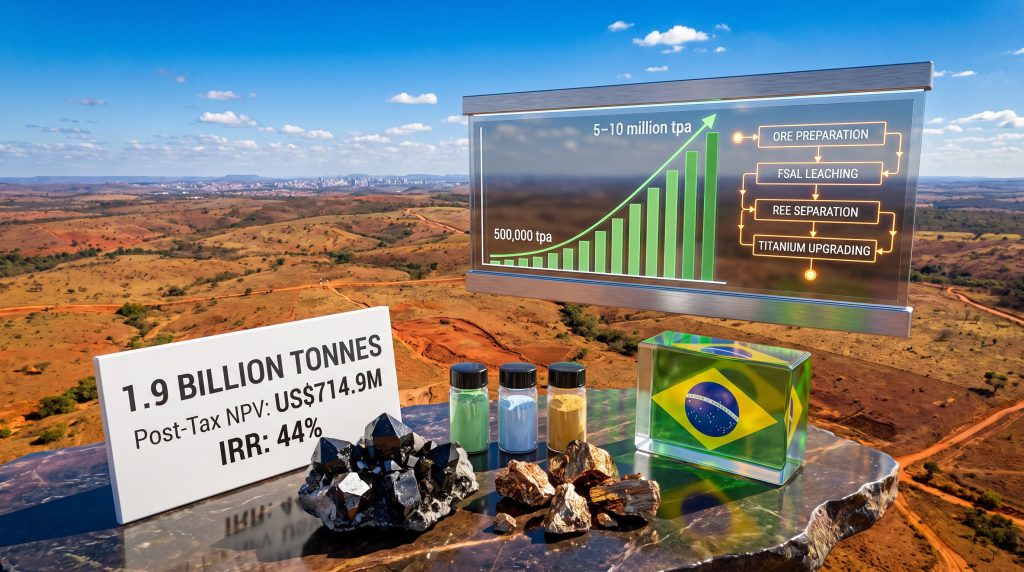
Scale alone does not determine project quality, but when combined with competitive grades and a credible reporting standard, it becomes a powerful differentiator. The Tiros Project carries a total JORC-compliant resource of 1.9 billion tonnes, subdivided as follows:
| Resource Category | Tonnage | Key Grades |
|---|---|---|
| Measured + Indicated | 1.4 billion tonnes | 12% TiO₂; 4,000 ppm TREO |
| Inferred | ~500 million tonnes | Consistent with M&I grades |
| Total Resource | 1.9 billion tonnes | JORC-compliant |
| High-Grade Zone | 120–130 million tonnes | 9,000 ppm TREO; 23–24% TiO₂ |
The JORC Code (Joint Ore Reserves Committee) is an internationally recognised reporting standard that imposes rigorous requirements around data quality, geological continuity, and estimation methodology. Its use signals a level of geological confidence that fundamentally distinguishes Tiros from exploration-stage plays with non-compliant historical estimates.
Geological Note: A grade of 9,000 ppm TREO in the high-grade zone is not simply a headline number. In rare earth resource economics, the proportion of the total rare earth oxide basket attributable to magnet-critical elements (specifically Neodymium, Praseodymium, and Dysprosium) determines the effective revenue yield per tonne. Deposits where NdPr and Dy account for a high fraction of TREO command materially better economics than those dominated by lanthanum and cerium, which have limited commercial markets.
The 120–130 million tonne high-grade zone at 9,000 ppm TREO and 23–24% TiO₂ is particularly significant. Taken in isolation, this sub-section of the deposit would qualify as a globally competitive standalone resource. Its existence within a larger 1.9 billion tonne system means that a staged development strategy can prioritise the highest-value material first, maximising early cash flows while the full deposit remains available for long-term expansion.
The FSAL Process: Proprietary Metallurgy as Competitive Advantage
Metallurgy is where rare earth projects most frequently fail to commercialise. The chemistry of separating rare earth elements from their host minerals is notoriously complex, and rare earth processing challenges can erode project economics even when grades appear compelling on paper. Resouro's response to this challenge is the Fusion Sulphuric Acid Leach (FSAL) process, a proprietary extraction methodology designed to simultaneously recover REEs and upgrade the titanium mineralogy of the ore.
The processing pathway follows a logical sequence:
- Ore preparation — the regolith-hosted material does not require hard-rock blasting, which reduces both capital requirements for mining equipment and per-tonne operating costs compared with conventional hard-rock REE operations.
- FSAL leaching circuit — sulphuric acid fusion liberates rare earth elements from the mineral matrix while simultaneously converting anatase TiO₂ into a chloride-grade rutile precursor.
- REE separation — downstream solvent extraction or ion exchange circuits produce individual rare earth oxides, including NdPr oxide and Dysprosium oxide, targeted at the permanent magnet supply chain.
- Titanium upgrading — the chloride-grade rutile product is directed toward aerospace-grade and pigment-grade titanium markets, where it commands a significant premium over standard ilmenite or unupgraded anatase concentrates.
Laboratory and pilot-scale testing has demonstrated REE extraction efficiency of 90–94% via the sulphuric acid leaching component of the FSAL process. This recovery rate is competitive with leading global REE operations and provides the technical foundation for the project's economic model.
Key Insight: The titanium-to-REE upgrading pathway is not widely understood outside specialist metallurgical circles. Anatase is the naturally occurring TiO₂ mineral in the Tiros orebody, but it is considered an inferior feedstock for chloride-process pigment and aerospace titanium manufacturing compared with rutile. The FSAL process effectively converts a lower-value titanium mineral into a higher-value product in the same processing circuit that extracts the rare earths — a metallurgical outcome that would otherwise require separate, costly upgrading steps.
In July 2024, Resouro signed a Memorandum of Understanding with Rare Earth Technologies Inc. (RETI) for REE extraction and separation collaboration. This partnership signals an intent to develop downstream processing capability rather than simply selling mixed rare earth concentrates, which carry significantly lower margins than separated oxide products.
The Titanium Revenue Hedge: A Structural Advantage Most Peer Projects Lack
The financial architecture of the Tiros Project is built around a principle that deserves careful examination: when titanium revenues are sufficient to cover the project's operating costs, rare earth production carries effectively zero incremental cost burden. This is the economic logic of the dual-commodity model, and it creates a structural margin advantage that very few development-stage rare earth projects globally can replicate.
Chloride-grade rutile commands a meaningful premium in global titanium feedstock markets over ilmenite and standard anatase concentrates. Sierra Leone and South Africa dominate current chloride-grade rutile supply. A new Brazilian source would represent genuine geographic diversification for a market where supply concentration carries its own strategic risks for downstream manufacturers.
The aerospace sector provides a structurally inelastic demand base for titanium. Titanium's irreplaceable role in airframe and engine components — driven by its exceptional strength-to-weight ratio and corrosion resistance — means rutile demand is substantially insulated from the cyclical downturns that periodically afflict commodity markets more broadly.
Comparison Note: Unlike most single-commodity REE projects that are entirely exposed to rare earth pricing cycles, the Tiros dual-commodity architecture provides a natural hedge. If NdPr oxide prices soften, titanium revenues maintain project cash flow. If titanium markets weaken, REE revenues provide the offset. This asymmetric resilience is a characteristic shared by very few development-stage critical mineral projects anywhere in the world.
PEA Economics: What the Numbers Actually Mean for Capital Allocators
The Preliminary Economic Assessment released in June 2026 for the starter operation at 500,000 tonnes per year of throughput produced the following headline metrics:
| Economic Metric | Value |
|---|---|
| Post-Tax NPV (8% discount rate) | US$714.9M (C$1 billion) |
| Post-Tax IRR | 44% |
| Initial Capital Expenditure | US$191.1M |
| Annual TREO Production | ~3,636 tonnes |
| Annual TiO₂ Concentrate Production | ~90,000 tonnes |
| Mine Life (starter phase) | 20 years |
For readers unfamiliar with mining project economics, context is essential. A post-tax IRR of 44% sits dramatically above the 15–20% threshold that project finance lenders typically use as the minimum threshold for debt serviceability in the mining sector. The additional margin above this threshold provides meaningful buffer against construction cost overruns, commodity price softness, or schedule delays — all of which are routine features of mining project development.
The capital efficiency ratio of approximately 3.7x (NPV of US$714.9M against initial CapEx of US$191.1M) is a figure that will attract attention from both project finance lenders and strategic investors. In practical terms, it means that every dollar of initial capital investment is associated with approximately $3.70 of net present value. This metric is particularly relevant for junior mining companies seeking to attract institutional capital, where capital efficiency is a primary screening criterion.
The staged expansion strategy from the 500,000 tonne per year starter operation to a potential 5–10 million tonne per year full-scale operation reflects sound development logic. Rather than committing to the full capital requirement upfront, the staged approach allows the company to validate the FSAL process at commercial scale, generate early cash flows that can partially fund subsequent expansion phases, and reduce the binary risk that characterises many junior mining projects.
The next major ASX story will hit our subscribers first
Development Milestones: Mapping the Path from Exploration to Production
| Milestone | Date / Target |
|---|---|
| Field work commencement | March 2023 |
| Maiden JORC resource published | July 17, 2025 |
| Resource upgrade to 1.9 billion tonnes | 2026 |
| PEA release | June 2026 |
| 200 kg pilot plant scoping study | Summer 2026 |
| Trial mining licence application | Mid-2026 |
| 30-tonne pilot plant and PFS | Year-end 2026 (target) |
| Full-scale starter production | Subject to permitting and financing |
The publication of the maiden JORC resource in July 2025 was a transformational moment for the project. Before that date, Tiros was an exploration concept. Afterward, it became a globally reportable mineral asset with the geological confidence required to engage institutional investors, offtake partners, and project finance providers.
The 30-tonne pilot plant represents the single most important near-term de-risking milestone. Pilot-scale operations generate the bulk metallurgical data that lenders require to satisfy technical due diligence processes. Without this data, even a compelling PEA cannot unlock the construction financing required to advance the project. The pilot plant is therefore not merely a technical exercise but a capital markets enabler.
Competitive Benchmarking: How Tiros Stacks Up Against Global Peers
| Project | Location | Resource Size | Primary REE Grade | Development Stage |
|---|---|---|---|---|
| Tiros (Resouro) | Brazil | 1.9B tonnes | 4,000 ppm TREO (9,000 ppm high-grade) | PEA complete |
| Pensana Longonjo | Angola | ~200M tonnes | ~3,800 ppm TREO | Development |
| Vital Metals Nechalacho | Canada | ~94M tonnes | ~1,500 ppm TREO | Early production |
| NioCorp Elk Creek | USA | Smaller scale | Niobium-primary | Feasibility |
Tiros's resource scale is in a different category from most peer projects. Its combination of size, grade in the high-grade zone, dual-commodity revenue architecture, proprietary processing technology, and location in an established mining jurisdiction creates a convergence of favourable characteristics that is genuinely rare among development-stage critical mineral projects.
However, the key risks relative to peers are worth acknowledging clearly. The FSAL process, while demonstrating strong laboratory and pilot-scale results, has not yet been proven at commercial scale. Brazil's environmental permitting framework, administered through IBAMA at the federal level and SUPRAM-MG at the state level in Minas Gerais, carries execution timeline risk that is present in all major Brazilian mineral development projects. For comparison, the Longonjo rare earth project in Angola illustrates how permitting and infrastructure challenges can affect even well-resourced development-stage assets.
Capital Formation: The US$160 Million Challenge and the Available Pathways
Resouro is seeking approximately US$160 million to advance the Tiros Project through pilot plant commissioning, pre-feasibility study completion, and toward construction financing. This requirement sits within a broader context of structural difficulty in rare earth project financing that persists despite elevated demand narratives.
The financing challenge for rare earth projects stems from several compounding factors:
- Long lead times from exploration to production create extended periods of capital deployment without revenue generation.
- Processing complexity introduces technical risk that conventional resource lenders are not always equipped to evaluate.
- Offtake agreements are difficult to secure before production at scale is demonstrated, yet lenders typically require offtake visibility before committing construction debt.
Potential capital formation pathways for Tiros include:
- Strategic partnerships with downstream manufacturers in EV, defence, or wind energy sectors seeking to secure magnet-grade REE supply.
- Export finance and development finance institutions from Canada, the United States (through the Development Finance Corporation), or the European Union (through CRMA-aligned mechanisms) that have mandates to support critical mineral supply chain diversification. In addition, the European critical raw materials facility represents a further avenue for securing non-dilutive capital support.
- Royalty streaming arrangements that provide non-dilutive capital in exchange for a revenue royalty on future production.
- Equity capital markets through the TSX Venture Exchange listing, which provides access to Canadian retail and institutional investor capital familiar with junior mining development stories.
The 44% post-tax IRR provides a compelling argument for debt serviceability, and the modest initial CapEx of US$191.1M relative to the NPV significantly improves the probability of assembling a viable capital stack.
Frequently Asked Questions About the Resouro Rare Earths Project in Brazil
What is the Resouro rare earths project in Brazil?
The Resouro rare earths project in Brazil is the Tiros Project, a large-scale titanium and rare earth element deposit in Tiros Municipality, northern Minas Gerais. It is recognised as Brazil's largest JORC-compliant REE and titanium resource, with a total resource of 1.9 billion tonnes grading 4,000 ppm TREO and 12% TiO₂.
What rare earth elements does the Tiros Project contain?
The deposit contains magnet-critical rare earths including Neodymium (Nd), Praseodymium (Pr), and Dysprosium (Dy), the three most strategically important REEs for permanent magnet manufacturing in EV motors and wind turbine generators.
What are the key economic metrics from the Tiros PEA?
The June 2026 PEA returned a post-tax NPV of US$714.9M at an 8% discount rate and a post-tax IRR of 44%, with initial CapEx of US$191.1M for the 500,000 tpa starter operation. Resouro recently reached this PEA milestone following a period of intensive metallurgical and resource definition work.
What is the FSAL process?
The Fusion Sulphuric Acid Leach (FSAL) is Resouro's proprietary extraction process that simultaneously recovers rare earth elements at 90–94% efficiency while upgrading anatase titanium mineralogy to chloride-grade rutile.
Where exactly is the Tiros Project located?
The project is in Tiros Municipality, northern Minas Gerais, approximately 350 km from Belo Horizonte, across a licence area of approximately 450–500 km² spanning 25–28 mineral concessions.
The Bigger Picture: Latin America's Critical Mineral Potential Is Being Repriced
The Tiros Project represents something broader than a single asset story. It illustrates how the combination of resource scale, metallurgical innovation, dual-commodity architecture, and geographic positioning can create a project profile that is genuinely differentiated in a crowded development-stage critical mineral landscape.
Consequently, the China rare earth strategy of maintaining dominance over processing and separation is increasingly prompting western governments and private capital alike to actively seek alternatives. Every EV motor requires approximately 1–2 kilograms of NdPr-based permanent magnets. Every large offshore wind turbine requires between 200 and 300 kilograms.
The arithmetic of the energy transition creates a demand trajectory for magnet-grade rare earths that will require substantial new supply from sources outside China. The question for capital allocators is not whether new supply will be needed, but which projects have the economics, the technology, and the geological foundation to actually deliver it. On those three criteria, the Resouro rare earths project in Brazil has constructed a credible and increasingly well-documented case.
Disclaimer: This article contains forward-looking statements and references to preliminary economic assessments that involve assumptions and estimates which may differ materially from actual outcomes. PEA-level economics are preliminary in nature and are subject to change as the project advances through feasibility study stages. Nothing in this article constitutes financial advice. Investors should conduct their own due diligence and consult a licensed financial adviser before making investment decisions related to any mining company or project discussed herein.
Want to Stay Ahead of the Next Major Critical Mineral Discovery?
Discovery Alert's proprietary Discovery IQ model scans ASX announcements in real time, instantly identifying significant mineral discoveries across rare earths, titanium, and more than 30 other commodities — turning complex data into actionable investment insights. Explore how historic discoveries have delivered exceptional returns on Discovery Alert's dedicated discoveries page, and begin your 14-day free trial today to position yourself ahead of the broader market.