July 17, 2026
The Geopolitical Calculus Behind Rare Earth Supply Chains
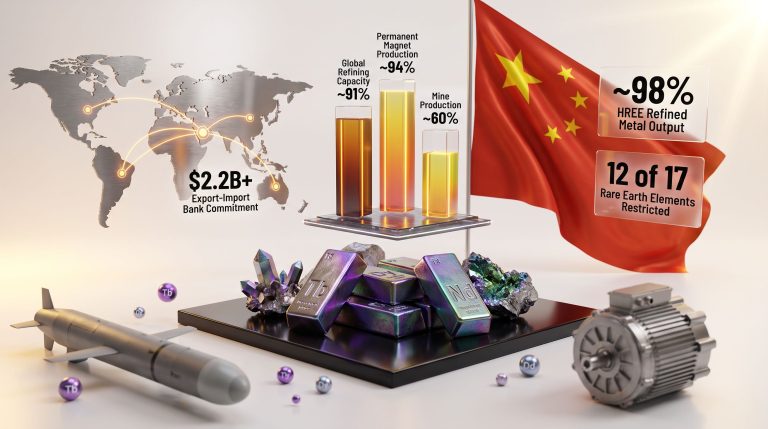
Every major industrial economy is quietly wrestling with the same structural problem: the materials that power electric vehicles, wind turbines, and precision defence systems flow overwhelmingly from a single country. China controls an estimated 85-90% of global rare earth processing capacity, and within that dominance, it holds an even tighter grip on the separation and refining of neodymium-praseodymium oxide, the compound at the heart of high-performance permanent magnets. For Western governments and manufacturers, this is not an abstract policy concern. It is an operational vulnerability baked into every EV drivetrain rolling off an assembly line.
Understanding rare earth supply chains is, consequently, essential for any nation seeking to reduce its exposure to single-source dependency in advanced manufacturing.
Against this backdrop, projects capable of delivering separated, finished NdPr oxide from outside China carry a strategic weight that transcends their commercial economics. The Arafura Rare Earths Nolans project construction now underway in Australia's Northern Territory represents one of the most advanced attempts by any Western-aligned nation to close this gap, not by exporting raw material for overseas processing, but by completing the entire value chain domestically.
When big ASX news breaks, our subscribers know first
What Mine-to-Oxide Integration Actually Means in Practice
Understanding the Full Processing Chain
The phrase mine-to-oxide gets used loosely in industry discussions, but its technical meaning is precise and its commercial implications are significant. At Nolans, the production model encompasses four sequential processing stages:
- Mining and crushing of ore from the open pit resource
- Beneficiation to produce a rare earth mineral concentrate by separating gangue material
- Hydrometallurgical extraction using acid leaching to dissolve rare earth elements from the concentrate into solution
- Solvent extraction and separation to isolate and purify individual rare earth oxides, including NdPr oxide at commercial specification
Each stage requires fundamentally different engineering disciplines, chemical inputs, and regulatory management. Most rare earth projects globally stop at stage two or three, shipping concentrate or mixed rare earth carbonate offshore for the expensive and technically demanding separation work. China's dominance exists precisely because it has built the industrial infrastructure to execute stages three and four at scale, and at low cost, for decades.
The rare earth processing challenges associated with retaining separation capability domestically are considerable, however the strategic value of doing so cannot be overstated.
A project that retains separation capability domestically is not simply a mining operation. It is a sovereign industrial asset with a fundamentally different risk and value profile than a mine that exports partially processed material.
The distinction between separated oxide and upstream concentrate is not academic. On global markets, separated NdPr oxide commands a substantial price premium over mixed rare earth carbonate, and crucially, it is the form required directly by magnet manufacturers. Selling concentrate means remaining a commodity supplier. Selling separated oxide means participating in the value chain at the point where industrial buyers actually need the product.
Core Construction Parameters for the Arafura Rare Earths Nolans Project
Key Project Metrics at a Glance
| Parameter | Detail |
|---|---|
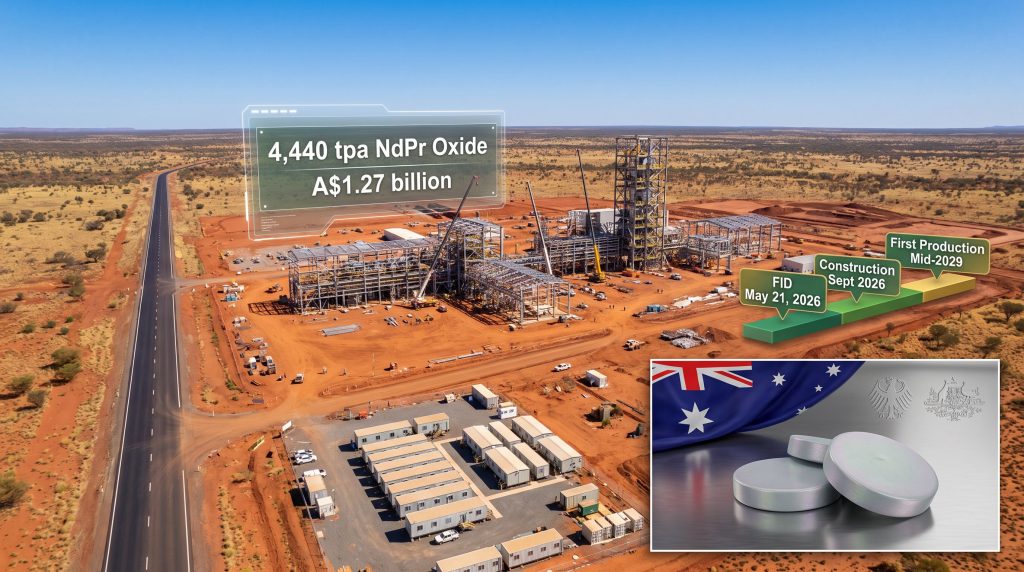
| Final Investment Decision (FID) | 21 May 2026 |
| Formal Construction Commencement | September 2026 |
| Estimated Construction Duration | ~30 months |
| Targeted First Production | Mid-2029 |
| Commercial Ramp-Up Target | Late 2029 |
| Pre-Production Capital Cost | ~A$1.27 billion (incl. contingency) |
| EPCM Contractor | Hatch |
| Project Location | 135 km north of Alice Springs, NT |
| Annual NdPr Oxide Output (Target) | 4,440 tonnes per annum |
What Enabling Works Were Completed Before FID
The period between a project's final feasibility study and its FID is often used strategically to compress the post-FID construction schedule. At Nolans, Arafura Rare Earths deployed this window effectively by completing a series of early enabling works packages that would otherwise sit on the critical path after financial close.
Key pre-FID enabling works included:
- Rehabilitation of 25 kilometres of site access road, a non-trivial undertaking in the remote NT environment where wet season conditions can render unsealed roads impassable
- Earthworks and site levelling for the construction camp footprint
- Installation of water supply infrastructure to service both construction and early operational needs
- Acquisition of a 200-room accommodation camp facility at a cost of A$6.75 million, enabling contractor mobilisation to begin without waiting for purpose-built accommodation to be constructed
The camp acquisition in particular reflects a nuanced understanding of remote project logistics. Workforce accommodation sits on the critical path of any remote mine construction. By securing a pre-built camp asset and having it partially operational before main construction commenced, the project team shaved meaningful time off what is already an ambitious 30-month build programme.
The Role of Hatch as EPCM Contractor
Hatch's appointment as Engineering, Procurement and Construction Management contractor is a meaningful signal about how project risk is being managed. EPCM contracting differs fundamentally from traditional EPC (Engineering, Procurement and Construction) models in one critical respect: under EPCM, the owner retains the contract risk with individual trade contractors, while the EPCM firm manages coordination, procurement, and construction oversight on their behalf.
This structure is increasingly preferred for complex, remote hydrometallurgical facilities for several reasons:
- It allows the owner to benefit from the EPCM firm's procurement networks and technical expertise without ceding direct financial control to a single head contractor
- It provides greater transparency over cost build-up, since the owner sees individual trade contract pricing rather than a single lump-sum figure
- It is better suited to facilities with high technical complexity, where scope evolution during construction is likely
Hatch has established credentials in hydrometallurgical processing and rare earth facility design, making the appointment a credible technical choice rather than simply a cost-driven one. Furthermore, more detailed information on the Nolans project's scope is available directly from Arafura Rare Earths.
How the A$1.27 Billion Capital Stack Came Together
A Multi-Layered Financing Structure
Funding a first-of-kind, integrated rare earth separation facility in a remote location, without an established track record of comparable domestic operations, is not a task that conventional project finance addresses comfortably. The Nolans financing structure reflects a deliberate strategy of layering concessional, sovereign-backed, and commercially motivated capital to achieve bankability.
| Funding Source | Commitment | Instrument Type |
|---|---|---|
| Australia's National Reconstruction Fund | A$200 million | Concessional Debt |
| KfW (Germany) + Export Finance Australia | A$230 million (combined) | Binding Equity Commitment |
Why KfW's Involvement Matters Beyond the Balance Sheet
Germany's participation through KfW is arguably the most strategically revealing element of the Nolans financing structure. KfW is not a passive financier. It is an instrument of German industrial policy, and its equity commitment to Nolans reflects the acute urgency felt by European manufacturers, particularly in the automotive sector, about securing non-Chinese NdPr supply.
Germany's automotive industry is the largest consumer of NdPr-dependent permanent magnets in Europe, driven by aggressive EV transition programmes across manufacturers including Volkswagen, BMW, and Mercedes-Benz. KfW's participation in Nolans effectively means the German state is co-investing in upstream supply chain security for its own industrial base, a model that blurs the conventional boundary between commercial mining finance and allied-nation industrial strategy.
The National Reconstruction Fund's Strategic Logic
Australia's National Reconstruction Fund was designed with a mandate to support domestic industrial capability development, with a particular emphasis on value-adding manufacturing and supply chain resilience. Nolans fits this mandate precisely: it is not a raw material export project, but a downstream processing investment that would establish Australia as a producer of refined, market-ready rare earth oxide.
In addition, the broader Australia critical minerals strategy underscores the government's commitment to retaining processing capability onshore rather than simply exporting unrefined material.
The NRF's A$200 million concessional debt commitment signals a policy judgement that the domestic economic benefits of retaining rare earth separation onshore justify concessional pricing of the associated risk, not that the project has received any form of government guarantee or sovereign backing beyond the terms of the financing instrument itself.
The Demand Fundamentals: Why NdPr Oxide Commands Strategic Priority
Permanent Magnets and the Clean Energy Hardware Stack
Neodymium-praseodymium oxide is the direct precursor to sintered NdFeB (neodymium-iron-boron) permanent magnets, the most powerful permanent magnets commercially available. These magnets are embedded in:
- Electric vehicle traction motors, where they enable the high torque density and efficiency that define modern EV performance
- Direct-drive wind turbine generators, particularly offshore installations where maintenance access is expensive and reliability is paramount
- Defence systems including precision-guided munitions, radar arrays, and autonomous vehicle platforms
- Industrial automation and robotics, where high-performance motors require compact, powerful magnetic circuits
The volume of NdPr oxide required per application unit is modest, but aggregate demand across millions of EVs and hundreds of gigawatts of wind capacity creates a supply requirement that existing non-Chinese production cannot satisfy. Indeed, critical minerals demand is forecast to intensify considerably, with industry projections consistently showing NdPr demand doubling or more by the mid-2030s relative to 2024 levels, driven primarily by EV adoption curves in Europe, North America, and Southeast Asia.
Where Nolans Sits in the Global Supply Picture
At its targeted output of 4,440 tonnes per annum of NdPr oxide, the Arafura Rare Earths Nolans project construction is designed to deliver a meaningful increment to the non-Chinese separated oxide supply base, which currently operates well below demand levels at separated oxide specification. The significance of this figure is best understood in context:
- Global NdPr oxide production is estimated at approximately 50,000-60,000 tonnes per annum, with the vast majority originating from Chinese-controlled supply chains
- Non-Chinese separated NdPr oxide production at commercial scale is currently limited to a small number of operations, with MP Materials in the United States and Lynas Rare Earths in Australia representing the most significant contributors
- Nolans at full capacity would add roughly 7-9% to the current non-Chinese NdPr oxide supply base, a meaningful contribution given the structural undersupply relative to forecast demand growth
The Grade and Deposit Characteristics Worth Understanding
One aspect of Nolans that receives less attention than its processing model is the nature of the underlying ore deposit. The Nolans Bore deposit is an apatite-hosted rare earth deposit, a mineralogy that presents specific processing considerations distinct from the more commonly discussed ionic clay deposits of southern China or the carbonatite-hosted deposits of projects like Mountain Pass in the United States.
Apatite-hosted rare earth mineralisation typically requires acid leaching to liberate rare earth elements from the apatite mineral lattice, which is the basis for the hydrometallurgical processing approach at Nolans. The deposit also contains phosphate as a co-product, which introduces both complexity and potential revenue diversification, since phosphate has independent fertiliser market value.
The NdPr content as a proportion of total rare earth oxide (TREO) at Nolans is estimated to be relatively high within the magnet rare earth fractions, which enhances the economics of the separation circuit relative to deposits weighted toward lighter, lower-value rare earth oxides like lanthanum and cerium.
Operational and Execution Risk: What Could Disrupt the Timeline
Hydrometallurgical Complexity and Cost Overrun Risk
Integrated rare earth processing facilities are among the most technically complex assets in the mining industry. The combination of crushing, flotation, acid leaching, solvent extraction, and precipitation circuits requires precise chemical control across multiple interdependent unit operations. Cost overruns and schedule delays in comparable facilities have historically been driven by:
- Unexpected variability in ore feed characteristics affecting leach kinetics
- Reagent sourcing challenges, particularly for specialist acids and organic extractants used in solvent extraction
- Commissioning failures at the circuit integration stage, where individual unit operations that tested well in isolation interact unpredictably
- Workforce availability constraints in remote locations, particularly for specialist hydrometallurgical process operators
The 30-month construction window is achievable but leaves limited buffer against material scope changes or commissioning setbacks. Industry experience with comparable first-generation processing facilities suggests that 12-18 month schedule overruns are not uncommon, which would push first production toward late 2030 rather than mid-2029 in a downside scenario.
NdPr Price Sensitivity Through the Construction Period
The project's economics are exposed to NdPr oxide price movements throughout the construction and ramp-up period, with no production revenue to offset operating costs until commissioning commences. NdPr oxide prices have demonstrated significant cyclicality, ranging from below US$40 per kilogram to above US$120 per kilogram over the past decade.
Binding offtake agreements, which are a standard feature of project finance for commodity processing facilities, provide partial protection against price risk by locking in volume commitments at defined pricing mechanisms. The Arafura rare earth offtake deal with Traxys is a notable example of how the project team has sought to underpin bankability through committed volume contracts. Consequently, the terms of these agreements will significantly influence the project's debt service capacity under stressed price scenarios.
Environmental and Regulatory Compliance in the NT
Operating in an arid, ecologically sensitive environment north of Alice Springs imposes specific environmental management obligations. Water is the most critical constraint: the processing circuit requires substantial volumes of water, and the Northern Territory's groundwater resources in the region require careful management to avoid ecological impact.
Dust management, acid containment, and tailings storage facility design are additional environmental management obligations that will require ongoing regulatory reporting throughout the construction and operational phases. The Northern Territory Environment Protection Authority's approval conditions govern these obligations, and any material non-compliance would carry both regulatory and reputational consequences. For further detail on how community and stakeholder engagement has been managed, Arafura's community engagement approach provides useful context.
The next major ASX story will hit our subscribers first
Step-by-Step: From FID to First Production at Nolans
- FID Approval (May 2026) – Board resolution and financing conditions satisfied; EPCM contractor and major procurement packages activated
- Early Enabling Works (Pre-September 2026) – Access road rehabilitation completed; camp facility operational; water supply infrastructure commissioned
- Main Civil Works Mobilisation (September 2026) – Formal construction commencement; earthworks, foundations, and structural steelwork begin across processing facility footprint
- Mechanical and Electrical Installation (2027-2028) – Processing equipment installed progressively across beneficiation, leaching, and solvent extraction circuits
- Individual Circuit Commissioning (Late 2028) – Systematic testing and commissioning of individual process units using water and reagents prior to ore introduction
- Hot Commissioning (Early 2029) – Ore feed introduced; initial production runs generate first NdPr-bearing solutions through the processing circuit
- First Oxide Production (Mid-2029) – Separated NdPr oxide produced to specification; quality verification and initial product dispatch
- Commercial Ramp-Up (Late 2029) – Progressive optimisation toward nameplate capacity of 4,440 tpa NdPr oxide
Frequently Asked Questions: Arafura Rare Earths Nolans Project Construction
When will construction of the Nolans project officially begin?
Formal construction commencement is targeted for September 2026, following the FID approved on 21 May 2026. Early enabling works, including access road rehabilitation and camp facility establishment, were completed prior to this date.
How long will it take to build the Nolans project?
The construction programme spans approximately 30 months from formal commencement, targeting first NdPr oxide production in mid-2029 and commercial ramp-up toward late 2029.
How much will the Nolans project cost to build?
The pre-production capital cost is approximately A$1.27 billion, inclusive of contingency allowances. This figure covers all construction, equipment procurement, commissioning, and pre-production operating costs.
Who is the construction contractor for the Nolans project?
Hatch has been appointed as the EPCM contractor, responsible for engineering design management, procurement coordination, and construction management across all processing facility components.
What will the Nolans project produce?
The facility is designed to produce 4,440 tonnes per annum of separated neodymium-praseodymium oxide from an integrated mine-to-oxide processing operation. Phosphate may also be recovered as a co-product given the apatite-hosted nature of the mineralisation.
Where is the Nolans project located?
The project is situated approximately 135 kilometres north of Alice Springs in Australia's Northern Territory, within a region accessible by road but subject to the significant logistical constraints of remote inland Australia.
How is the Nolans project being funded?
The capital structure includes A$200 million in concessional debt from Australia's National Reconstruction Fund and a combined A$230 million in binding equity commitments from Germany's KfW development bank and Export Finance Australia, subject to shareholder approval.
What Successful Execution Would Mean for Australia's Rare Earth Position
The Arafura Rare Earths Nolans project construction represents more than a single mining development reaching financial maturity. If the project delivers first production on schedule in mid-2029 and successfully ramps to nameplate capacity, it would establish a proof-of-concept with significant implications for Australian industrial capability.
Australia has historically been an exporter of raw and partially processed minerals, with value-adding processing occurring offshore. A fully operational, vertically integrated rare earth separation facility would demonstrate that the domestic regulatory, workforce, and infrastructure environment can support complex hydrometallurgical operations at commercial scale, potentially catalysing further investment in Australian rare earth separation capacity from other project developers.
The combination of KfW's participation and the National Reconstruction Fund's concessional debt also establishes a financing template that other critical mineral projects with allied-nation demand linkages may seek to replicate. Germany's industrial interest in NdPr supply security extends beyond Nolans, and a successful project outcome would reinforce the case for deeper capital market integration between Australian critical mineral producers and European industrial end-users.
For investors and analysts monitoring the global rare earth supply pipeline, the critical milestone to watch is not the FID itself, which has already passed, but the commissioning performance in 2029. That is when the distance between a well-funded construction project and a commercially operating rare earth producer will be measured in tonnes of separated oxide rather than capital commitments and permitting approvals.
This article contains references to forward-looking statements, project timelines, and financial structures that are subject to material uncertainty. Construction schedules, capital costs, and production targets represent management estimates and may differ from actual outcomes. This content does not constitute financial advice. Readers should conduct independent research and consult qualified advisers before making investment decisions.
For ongoing technical and operational coverage of the Nolans project and other significant developments across the global mining industry, Mining Magazine provides detailed reporting at miningmagazine.com.
Want to Catch the Next Major Mineral Discovery Before the Market Does?
While the Nolans project illustrates the transformative potential of critical mineral discoveries, opportunities like this rarely wait — Discovery Alert's proprietary Discovery IQ model scans ASX announcements in real time, delivering instant alerts on significant mineral discoveries directly to subscribers, just as it did for historic finds by De Grey Mining and WA1 Resources. Explore Discovery Alert's dedicated discoveries page to understand the returns major discoveries have historically generated, and begin your 14-day free trial today to position yourself ahead of the broader market.