August 5, 2026
The Processing Bottleneck That Defines Modern Geopolitical Risk
Most discussions about resource scarcity focus on where minerals are found in the ground. The more consequential question, particularly for manufacturers in defence, clean energy, and advanced electronics, is where those minerals are transformed into usable industrial inputs. Refining, separating, and processing raw ore into specification-grade materials requires decades of accumulated technical expertise, purpose-built infrastructure, and chemical process knowledge that cannot be replicated quickly regardless of capital availability. This asymmetry sits at the heart of why China critical minerals export controls have become one of the most consequential instruments in contemporary economic statecraft.
When big ASX news breaks, our subscribers know first
Understanding the Mechanics of China's Export Control System
Export Controls vs. Tariffs: A Critical Distinction
The common tendency to conflate export controls with trade tariffs obscures how fundamentally different these instruments are. Tariffs raise the cost of trade universally and mechanically. Export controls, by contrast, determine who receives materials and for what purpose, creating a discretionary licensing system where approval can be granted, delayed, conditioned, or denied based on geopolitical calculation rather than price signals alone.
China's foundational legal architecture for this system is the Export Control Law, which establishes four interlocking mechanisms:
- List-based controls covering designated materials, technologies, and related equipment
- Temporary control designations allowing rapid addition of new items without legislative process
- Catch-all provisions extending jurisdiction beyond listed items where national security concerns arise
- End-use and end-user review mechanisms requiring applicants to demonstrate that controlled materials will not be redirected to prohibited applications
The Ministry of Commerce (MOFCOM) serves as the primary regulatory authority, with application timelines and approval grounds that remain deliberately opaque, creating compliance uncertainty for foreign buyers even when licences are technically available.
Why Critical Minerals Are Uniquely Suited to This Policy Tool
Three structural features make critical minerals particularly effective targets for export control leverage. First, China's dominance is concentrated not in mining but in processing and refining, the steps that convert raw ore into specification-grade materials usable by manufacturers. Second, demand for these materials is highly inelastic in the short term because there are no drop-in substitutes for heavy rare earth elements in high-performance permanent magnets. Third, substitution timelines are measured in years to decades, not months, meaning downstream manufacturers cannot quickly pivot regardless of how motivated they are to do so.
Furthermore, China's bismuth export controls illustrate precisely this dynamic — a material with deeply concentrated refining capacity and highly inelastic downstream demand across electronics manufacturing.
China's leverage over critical mineral supply chains is fundamentally a processing story, not a geology story. The ore exists on multiple continents; the capacity to refine it to commercial specifications does not.
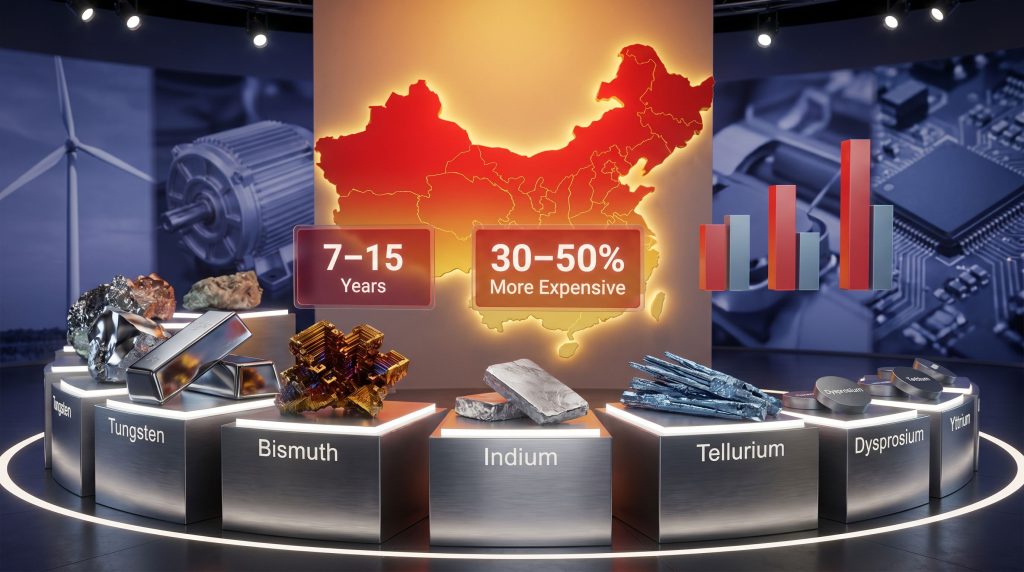
China controls an estimated 85–90% of global rare earth processing capacity and holds dominant positions across a range of adjacent materials. Key materials where structural market control is most pronounced include:
- Heavy rare earth elements: dysprosium, terbium, and yttrium, which are essential for high-temperature-resistant permanent magnets used in EV motors and military systems
- Tungsten and molybdenum: critical for tooling, defence coatings, and superalloy applications
- Indium and tellurium: foundational inputs for display panel manufacturing and thin-film photovoltaic cells
- Bismuth: used in lead-free soldering across electronics manufacturing
- Rare earth permanent magnets (NdFeB): the finished component that sits inside EV traction motors, wind turbine generators, and precision-guided munitions
A Chronological Map of China's Escalating Export Control Regime
The controls introduced across 2025 were not isolated policy decisions. They represent a deliberate, phased escalation that expanded in both material scope and legal reach over successive waves. The IEA has noted that these measures have transformed theoretical supply concentration risks into immediate operational realities for manufacturers globally.
February 2025: The First Wave
The initial tranche of 2025 controls imposed licensing requirements on five industrial metals: tungsten, tellurium, bismuth, indium, and molybdenum, along with associated processed products and refining technologies. The industries immediately affected were diverse:
- Semiconductor fabrication (indium in indium tin oxide for display panels)
- Solar panel production (tellurium in cadmium telluride photovoltaic cells)
- Defence coating and tooling applications (tungsten)
- Electronics manufacturing (bismuth in lead-free solder)
April 2025: The Second Wave
The April escalation moved into territory with far more direct implications for both clean energy and national defence. Seven heavy rare earth elements, along with their compounds, refined metals, and finished magnets, were placed under export control. China's official communications cited national security justifications for this expansion. The practical consequence was to introduce licensing risk into permanent magnet supply chains that Western defence contractors and automotive OEMs had previously treated as reliably accessible commodity markets.
October 2025: Extraterritorial Reach
The third wave represented a qualitative shift in the legal architecture. Beyond expanding the list of covered materials to additional rare earth categories and associated processing equipment, the October 2025 measures introduced licensing requirements for foreign-manufactured products that incorporate even trace quantities of Chinese-origin rare earth inputs. This extraterritorial provision means a motor manufacturer in Germany or Japan assembling a product using Chinese-origin rare earth magnets could, in principle, face Chinese licensing obligations.
MOFCOM subsequently announced that certain provisions of the October 2025 expansion would be suspended until November 2026, though controls from the February and April waves remain fully active.
| Control Wave | Date | Key Materials Targeted | Status (as of mid-2026) |
|---|---|---|---|
| Wave 1 | February 2025 | Tungsten, tellurium, bismuth, indium, molybdenum | Active |
| Wave 2 | April 2025 | Seven heavy rare earth elements and magnets | Active |
| Wave 3 | October 2025 | Additional rare earths, equipment, technology, extraterritorial rules | Partially suspended until Nov 2026 |
It is worth noting that the 2025 controls build on a precedent set in 2023, when China imposed export restrictions on gallium and germanium. Those earlier measures targeted primarily semiconductor inputs; the 2025 escalation is broader in both industrial scope and legal sophistication.
The Extraterritorial Dimension and Its Compliance Implications
The extraterritorial provisions of the October 2025 measures draw a direct conceptual parallel with the United States Foreign Direct Product Rule, which extends U.S. export control jurisdiction to foreign-manufactured goods that incorporate U.S.-origin technology or equipment. China's adoption of a structurally similar mechanism signals that Beijing is not merely responding to Western trade policy but actively developing a parallel framework of economic jurisdiction.
For compliance officers and supply chain managers, the practical implications are substantial:
- Traceability requirements now extend to verifying the geographic origin of rare earth inputs embedded in purchased components, not just direct procurement
- Contractual obligations between foreign manufacturers and their Chinese-origin material suppliers may need to be restructured to accommodate licensing conditions
- Legal grey zones remain unresolved, particularly regarding how Chinese authorities would enforce extraterritorial claims against non-Chinese entities not operating within Chinese jurisdiction
- Re-export restrictions may affect how manufacturers in Japan, South Korea, Germany, and the United States can supply finished goods incorporating controlled inputs to third-country customers
Companies that source even trace quantities of Chinese-origin rare earth inputs into their manufacturing processes may face licensing obligations under Chinese law, regardless of where final product assembly occurs.
Industries Facing the Greatest Supply Chain Disruption
Defence and Aerospace: The Most Acute Vulnerability
Heavy rare earth elements, particularly dysprosium and terbium, are non-negotiable inputs for the high-coercivity permanent magnets used in precision-guided munitions, radar systems, electric actuators for flight control surfaces, and jet engine components. There is currently no Western supplier capable of producing these magnets at defence-grade specifications in commercially meaningful volumes. The CSIS has highlighted that these restrictions pose a direct and immediate threat to U.S. and allied defence supply chains.
A less widely understood vulnerability concerns the magnet-to-motor ratio in modern defence platforms. Next-generation naval vessels, unmanned aerial systems, and electrified ground vehicles all consume substantially more rare earth magnet material per platform than their predecessors, meaning that even modest supply constraints produce outsized effects on procurement schedules.
Semiconductor and Electronics Manufacturing
The cumulative pressure on semiconductor supply chains from successive China critical minerals export controls is compounding. Gallium and germanium controls imposed in 2023, combined with the 2025 measures covering indium, create overlapping vulnerabilities across chip fabrication, compound semiconductor production, and optoelectronics manufacturing. Indium tin oxide remains the dominant transparent conductor for display panels, and no commercially scaled alternative has yet displaced it.
Electric Vehicles and Renewable Energy Infrastructure
Automotive OEMs face a dual exposure challenge: battery material sourcing on one vector and motor magnet sourcing on another. Most high-performance EV traction motors use neodymium-iron-boron (NdFeB) magnets that incorporate dysprosium and terbium to maintain coercivity at operating temperatures. Magnet-free motor architectures, such as switched reluctance and wound-rotor induction designs, do exist but currently trail NdFeB motors on power density and efficiency metrics that matter to vehicle range and performance.
The renewable energy sector faces parallel constraints. Offshore wind turbines using direct-drive generators are among the most rare-earth-intensive applications in the energy transition, with a single large turbine consuming hundreds of kilograms of NdFeB magnet material. Consequently, the intersection of critical minerals and energy security has never been more strategically significant, with expansion targets across the EU and UK presupposing magnet supply availability that the current control environment has made structurally uncertain.
The G7 Response and Its Structural Limitations
G7 leaders agreed to coordinate strategic stockpiling policies across member nations and to expand the role of the International Energy Agency in monitoring critical mineral supply security. These are directionally meaningful commitments, however, the gap between China's implementation speed and the West's response capacity remains wide.
| Policy Action | China | G7 Nations |
|---|---|---|
| Export control implementation | Months (executive regulatory process) | Years (legislative and procurement cycles) |
| Strategic stockpile depth | Classified and opaque | Limited and fragmented |
| Processing infrastructure | Decades of accumulated investment | Early-stage development |
| Diplomatic coordination | Centralised decision-making | Multilateral, slower consensus |
China's foreign ministry characterised G7 coordination efforts as an attempt to form exclusive groupings that undermine multilateral market principles, framing its own controls as legitimate national security measures consistent with WTO exceptions. This diplomatic positioning places Western nations in the procedurally awkward position of challenging Chinese measures at the WTO while simultaneously deploying analogous national security justifications for their own trade restrictions.
The next major ASX story will hit our subscribers first
Long-Term Strategic Scenarios for Western Supply Chains
Scenario 1: Accelerated Western Supply Chain Buildout
Sustained government investment in rare earth mining projects across Australia, Canada, and the United States, combined with deliberate development of processing and refining capacity, could meaningfully reduce dependency over a 10 to 15 year horizon. The critical bottleneck is not ore availability but processing infrastructure. Building a separation and refining facility from greenfield takes 7 to 12 years when accounting for permitting, engineering, construction, and commissioning timelines.
Scenario 2: Managed Interdependence
China selectively grants export licences as a diplomatic instrument, maintaining leverage without triggering the full decoupling that would accelerate Western investment in alternative supply chains. Western manufacturers adapt through strategic inventory accumulation, product redesign, and partial substitution. This scenario preserves the status quo dependency while reducing its political visibility, which is arguably the outcome most convenient for China.
Scenario 3: Geopolitical Bifurcation
Full separation of critical mineral supply chains along geopolitical lines would impose substantial cost penalties on Western manufacturers. Independent analysis suggests Western supply chains built outside the Chinese-integrated system could carry cost premiums of 30 to 50 percent in the near term relative to Chinese-processed alternatives, with that premium narrowing as Western processing capacity scales.
The most probable near-term trajectory is managed interdependence, with the long-run outcome determined by whether Western governments sustain the capital commitment and policy consistency needed to develop independent processing capacity over the coming decade.
How Governments and Corporations Are Responding
National Critical Mineral Strategies: A Comparative Overview
| Country or Bloc | Key Policy Instrument | Focus Minerals | Maturity Level |
|---|---|---|---|
| United States | Defense Production Act, IRA incentives | Rare earths, lithium, cobalt | Mid-stage |
| European Union | Critical Raw Materials Act | 34 designated critical materials | Early-stage |
| Australia | Critical Minerals Strategy 2030 | Rare earths, lithium, cobalt, nickel | Advanced |
| Japan | Economic Security Promotion Act | Rare earths, semiconductors | Advanced |
| Canada | Critical Minerals Strategy | Lithium, cobalt, graphite, rare earths | Mid-stage |
In addition, European critical raw materials supply frameworks are evolving rapidly in response to these pressures, with the Critical Raw Materials Act representing the most ambitious attempt yet to reduce structural dependence on single-source suppliers.
Corporate Adaptation Strategies
At the company level, supply chain adaptation is unfolding across four primary strategies:
- Dual sourcing: qualifying non-Chinese suppliers even at a cost premium to build optionality into procurement
- Design-for-substitution: investing in engineering programmes to reduce or eliminate reliance on controlled materials, including development of ferrite-based and magnet-free motor architectures
- Strategic inventory building: accumulating buffer stocks ahead of potential licensing disruptions, accepting carrying costs as a form of supply chain insurance
- Vertical integration: downstream manufacturers taking direct ownership stakes in upstream mining and processing assets to secure supply outside the spot market
A less commonly discussed corporate response involves specification renegotiation: working with end-customers to relax performance requirements that currently mandate rare-earth-intensive components, creating design headroom for lower-intensity alternatives. This approach is particularly relevant in commercial rather than defence applications, where regulatory performance thresholds are less rigidly defined.
Frequently Asked Questions: China Critical Minerals Export Controls
What minerals are currently under active Chinese export controls?
As of mid-2026, active controls cover tungsten, tellurium, bismuth, indium, molybdenum, seven heavy rare earth elements and their compounds, finished magnets, and associated processing technologies. Gallium and germanium have been subject to separate controls since 2023. Certain provisions from the October 2025 expansion remain suspended until November 2026.
Are China's export controls consistent with international trade law?
China frames its measures under the national security exceptions available under WTO agreements. The extraterritorial provisions targeting foreign-manufactured goods containing Chinese-origin inputs represent a significant legal grey zone that trading partners are actively contesting through bilateral diplomatic channels and, in some cases, formal WTO dispute mechanisms.
How long will it realistically take to build Western processing independence?
Even with sustained government investment and policy consistency, independent analysis points to a minimum of 7 to 15 years to establish meaningful rare earth processing capacity outside China. Mining project development from initial discovery to commercial production typically spans 10 to 20 years. Processing infrastructure carries its own separate timeline for engineering, permitting, and commissioning.
What is the key difference between the 2023 and 2025 Chinese export control measures?
The 2023 controls on gallium and germanium were primarily targeted at semiconductor manufacturing inputs. The 2025 measures are broader in industrial scope, covering materials central to defence, clean energy, and electronics simultaneously, and more sophisticated legally, introducing extraterritorial jurisdiction over foreign-manufactured goods in a manner with no direct precedent in Chinese trade law before 2025.
Key Takeaways for Industry Stakeholders
The cumulative picture that emerges from analysing China critical minerals export controls is one of deliberate, phased escalation rather than reactive trade retaliation. Several structural observations deserve particular emphasis:
- China's leverage is a processing and refining story, not simply a mining story, and building processing capacity outside China is the actual challenge Western nations face
- The extraterritorial provisions of the October 2025 measures represent a qualitative legal escalation that mirrors U.S. Foreign Direct Product Rule architecture, signalling long-term intent rather than tactical positioning
- Compounding exposure across multiple controlled materials within the same industrial sectors, particularly defence and clean energy, amplifies risk beyond what any single material control would imply in isolation
- Western governments face a structural asymmetry: China can implement new controls within months through executive regulatory processes, while Western industrial policy responses require years of legislative process, procurement cycles, and capital deployment
- The G7 coordination framework, while meaningful in direction, is operating at a speed and scale that remains substantially below what the depth of China's processing dominance would require to address
Furthermore, the broader implications for rare earth supply chains and critical minerals demand underscore that this is not a temporary disruption but a structural realignment of global industrial supply that will define manufacturing competitiveness for decades to come.
Want to Track ASX Discoveries in the Critical Minerals Reshaping Global Supply Chains?
As Western nations race to build independent processing capacity across rare earths, tungsten, bismuth, and other strategically vital materials, Discovery Alert's proprietary Discovery IQ model delivers real-time alerts the moment significant mineral discoveries hit the ASX — explore historic discoveries and their returns to understand the opportunity, then begin your 14-day free trial at Discovery Alert to position yourself ahead of the market.