
August 1, 2026
Understanding China's Economic Framework for Carbon Reduction
The transformation of global energy markets increasingly depends on how major economies balance growth ambitions with environmental commitments. China's 2030 climate playbook and the EV market represents a strategic framework that prioritises economic efficiency over absolute emission caps, creating ripple effects across international markets from electric vehicles to renewable energy technologies.
Carbon Intensity Versus Traditional Emission Controls
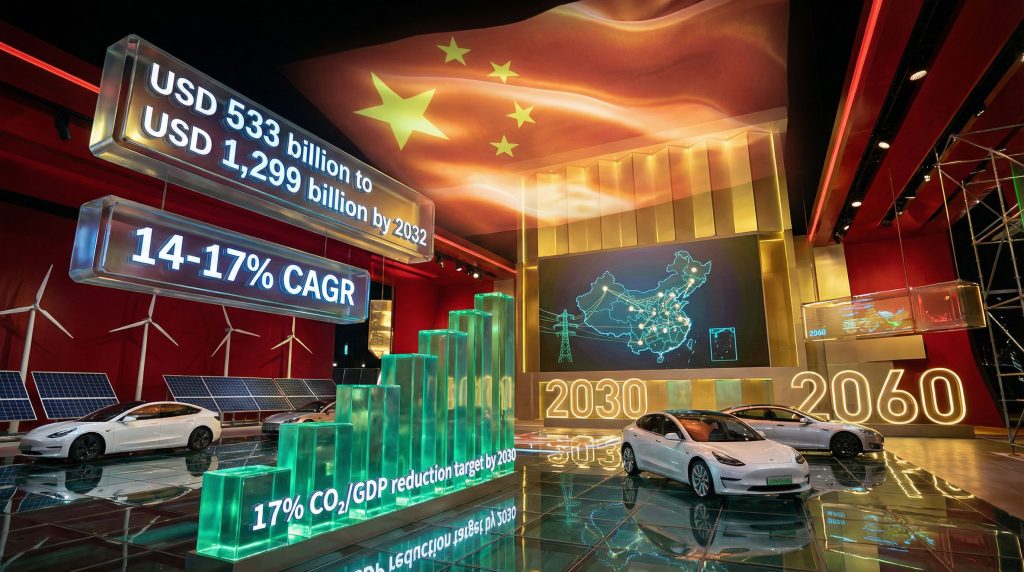
Carbon intensity targets fundamentally differ from the absolute emission caps used by many developed nations. This metric measures CO₂ emissions per unit of gross domestic product, typically expressed as tonnes of carbon dioxide per million yuan of economic output. China's commitment to reduce this ratio by 17% between 2026 and 2030 allows for continued economic expansion while improving environmental efficiency.
The mathematics reveal the strategic trade-offs inherent in this approach. With GDP growth targets of 4.5-5% annually, China could potentially experience net emission increases of approximately 0.5% per year even while achieving its intensity reduction goals. This contrasts sharply with the European Union's emissions trading system, which imposes direct production limits on regulated sectors.
Economic Growth and Environmental Efficiency Balance
China's dual-carbon framework establishes peak emissions before 2030 and carbon neutrality by 2060, creating a 30-year transition period that differs markedly from more aggressive international timelines. Current projections suggest emissions will peak between 11.6-13.2 gigatonnes of CO₂ equivalent during the 2027-2030 window under existing policy trajectories.
The immediate 2026 target of 3.8% carbon intensity reduction establishes a baseline for monitoring progress while maintaining economic stability. This measured approach reflects China's position as the world's largest emitter, accounting for approximately 30% of global CO₂ emissions, where rapid structural changes could destabilise international supply chains.
When big ASX news breaks, our subscribers know first
China's Five-Year Plan and Clean Energy Investment Strategy
Renewable Energy Infrastructure as Economic Driver
China's 15th Five-Year Plan prioritises massive infrastructure development that simultaneously supports economic growth and emission reduction objectives. The strategy includes replacing approximately 30 million tonnes of annual coal consumption with renewable energy sources, representing a quantifiable transition target that emphasises substitution rather than demand destruction.
Table: China's Clean Energy Investment Focus Areas 2026-2030
| Investment Sector | Strategic Priority | Economic Impact | Global Implications |
|---|---|---|---|
| Solar/Wind Deployment | Desert megaprojects | Manufacturing economies of scale | Technology cost reduction |
| Nuclear Baseload | Grid stability enhancement | Energy security improvement | Export technology potential |
| Transmission Networks | West-to-East corridors | Regional integration | Supply chain optimisation |
| Energy Storage | Grid stabilisation | Battery technology advancement | International competitive advantage |
The geographic concentration of renewable projects in western arid regions maximises solar irradiance benefits exceeding 1,700 kWh/m²/year while minimising land-use conflicts. Wind resources in Inner Mongolia and Xinjiang provide complementary generation capacity, enabling economies of scale in manufacturing and installation services.
Carbon Trading System Evolution
China's emissions trading system expansion represents a market-based approach to efficiency improvement, currently covering approximately 40-50% of national emissions through power generation, cement, and steel sector participation. The system's evolution toward broader sectoral coverage creates price discovery mechanisms that incentivise technology investment across the economy.
Recent policy developments suggest expansion to airlines and heavy industry sectors, broadening the market's scope while maintaining price stability. This approach provides flexibility for companies to choose between direct emission reductions and purchasing allowances, creating liquidity that supports clean technology investment.
China's Electric Vehicle Market Transformation
Market Valuation and Growth Trajectories
The critical minerals energy transition represents the world's largest concentration of clean transportation adoption, with current valuations estimated between USD 418-533 billion in 2026. Projections indicate growth to USD 909-1,299 billion by 2031-2032, representing a compound annual growth rate of 14-17% over the projection period.
The market structure reveals significant consumer preference patterns, with 47.9% of total auto sales represented by new energy vehicles in 2024. Battery Electric Vehicles (BEVs) capture 60% of the 12.87 million new energy vehicle sales, translating to approximately 7.72 million BEV units annually – a volume exceeding total vehicle sales in most individual countries historically.
Key Market Dynamics:
- BEV market share: 57-60% of total EV sales
- PHEV growth rate: 20.88% CAGR
- Tier-1 city penetration: 70%+
- Vehicle exports: 1.28 million units to 160 international markets
Technology Adoption Patterns and Consumer Preferences
The dominance of Battery Electric Vehicles over Plug-in Hybrid Electric Vehicles reflects China's strategic priority on complete electrification rather than transitional hybrid technologies. This contrasts with European markets where PHEVs represented approximately 15-20% of EV sales in 2024-2025, suggesting different consumer preferences and infrastructure capabilities.
Geographic penetration patterns reveal substantial rural-urban disparities, with Tier-1 cities achieving over 70% EV market penetration while rural areas lag significantly. This concentration indicates potential manufacturing capacity utilisation challenges and supply chain planning complexities as market saturation approaches in urban centres.
China's EV market transformation demonstrates how climate policy can create economic opportunities while addressing environmental challenges. The scale of domestic adoption provides manufacturers with cost advantages that enable international expansion and technology transfer.
Economic Competitiveness Factors in China's EV Market
Cost Structure and Pricing Dynamics
The USD 10,000-20,000 price segment captures 46% of market volume, establishing this range as the critical competitive zone for mass market adoption. This pricing represents approximately 4-8 years of median Chinese urban household income, making affordability a primary constraint for market expansion.
Battery cost reductions from approximately USD 160/kWh in 2015 to USD 80-100/kWh in 2025-2026 enable competitive pricing while maintaining manufacturer profitability. Government tax exemptions of USD 1,390-4,175 per vehicle provide meaningful purchase price reductions, particularly impactful for budget-conscious consumers where a USD 1,390 incentive reduces vehicle cost by 10-15%.
Manufacturing Scale and Export Economics
China's position as the global leader in solar panel production, maintaining over 50% global market share, demonstrates how domestic policy drives manufacturing concentration with international competitive implications. The 1.28 million vehicle export volume in 2024 represents substantial market penetration across diverse international markets, supported by coastal manufacturing hub advantages.
Manufacturing Competitive Advantages:
- Integrated supply chain proximity
- Container port access for efficient shipping
- Established logistics networks
- Battery manufacturing capacity exceeding 500 GWh annually
- Technology transfer capabilities
Clean Energy Policy Integration with Transportation Electrification
Grid Decarbonisation Impact on EV Lifecycle Emissions
The correlation between renewable electricity generation growth and EV environmental benefits creates a reinforcing policy cycle. In 2025, renewable sources met approximately 84% of electricity demand growth while fossil fuel use declined an estimated 2%, improving the carbon profile of electric vehicle operation.
This trend strengthens the climate case for EV adoption by reducing lifecycle emissions associated with electricity consumption. As renewable penetration increases, the environmental advantage of electric vehicle innovations over internal combustion engines expands, supporting continued consumer adoption and policy support.
Technology Innovation and Cost Reduction
Advanced charging infrastructure deployment, including 800V fast-charging technology implementations, reduces consumer range anxiety while improving utilisation efficiency. Autonomous driving system integration from manufacturers represents additional value propositions beyond environmental benefits.
Technology Development Areas:
- Battery efficiency improvements from 22-24% to target 26-28%
- Charging time reduction through high-voltage systems
- Autonomous driving capability integration
- Vehicle-to-grid energy storage applications
- Manufacturing process optimisation
Economic Risks and Market Sustainability Considerations
Potential for Continued Emission Growth
Despite intensity-based targets, China's approach creates the mathematical possibility for 3-6% absolute emission increases by 2030 if economic growth accelerates faster than efficiency improvements. This scenario presents risks for investors betting on rapid fossil fuel phase-outs while creating opportunities for those focused on clean technology scaling.
The absence of absolute emission caps distinguishes China's strategy from approaches used in developed markets, creating different incentive structures and investment implications. Companies operating across multiple jurisdictions must navigate varying regulatory frameworks and market expectations.
Market Volatility and Growth Sustainability
Recent market data indicating 20% monthly sales declines in certain periods suggests potential market maturation effects. Projected 2026 "hangover" effects post-boom periods create timing considerations for investors and manufacturers planning capacity expansion.
Risk Assessment Framework:
- Economic pressure impacts on consumer demand
- Market saturation in urban centres
- Infrastructure development pace
- Raw material supply chain security
- International trade relationship stability
The next major ASX story will hit our subscribers first
International Comparison and Global Market Implications
Policy Framework Differences
China's 2030 climate playbook and the EV market contrasts with 145 countries that have announced net-zero targets covering approximately 77% of global emissions. The unique framework prioritises economic stability while gradually shifting energy systems, creating both opportunities and risks depending on investor expectations and time horizons.
International carbon border adjustment mechanisms under development in various jurisdictions may impact Chinese exports, particularly in carbon-intensive sectors. Trade implications extend beyond climate policy into broader economic relationships and technology transfer agreements. Furthermore, US‑China trade dynamics play a crucial role in shaping global market access.
Supply Chain and Manufacturing Dominance
China's control of over 70% of global EV production and critical mineral processing creates supply chain dependencies for international manufacturers. This concentration enables cost advantages through scale economies while potentially creating vulnerabilities for importing countries seeking supply diversification.
Table: China's Global Market Position
| Sector | Market Share | Strategic Advantage | International Dependency |
|---|---|---|---|
| EV Manufacturing | 70%+ | Scale and cost efficiency | Technology transfer |
| Battery Production | 500+ GWh capacity | Raw material processing | Critical mineral access |
| Solar Panels | 50%+ | Manufacturing expertise | Installation markets |
| Wind Turbines | Significant share | Technology development | Grid integration |
Investment Opportunities and Market Themes
Clean Technology Manufacturing and Scaling
China's climate strategy creates substantial opportunities in clean technology manufacturing, particularly for companies positioned to benefit from domestic market growth and international expansion. Battery technology advancement, energy storage deployment, and renewable energy integration represent high-growth segments supported by policy frameworks.
The 25% renewable energy mix target drives infrastructure investment needs while creating export opportunities for companies with technological capabilities. Additionally, energy transition in mining sectors provides a pathway for smart grid development and charging infrastructure expansion, offering additional investment themes beyond direct manufacturing.
Infrastructure Development and Financing
Low-carbon transition fund establishment indicates government commitment to providing capital for clean energy projects. Energy storage deployment requirements create market opportunities for companies developing grid stabilisation technologies and services.
Investment Theme Analysis:
| Theme | Market Size Projection | Primary Growth Driver | Key Risk Factor |
|---|---|---|---|
| EV Manufacturing | USD 533B+ (2026 baseline) | Policy support and cost reduction | Market saturation risk |
| Battery Technology | Integrated across sectors | Raw material cost decline | Supply chain disruption |
| Renewable Energy | Infrastructure scaling | Grid integration needs | Technology transition |
| Carbon Trading | Expanding sector coverage | Regulatory mandate | Price volatility |
Long-term Economic Implications for Global Markets
Technology Transfer and Innovation Spillovers
Chinese clean technology exports drive global cost reductions through manufacturing scale economies and innovation development. Intellectual property creation in renewable energy, battery technology, and electric vehicles generates licensing opportunities and competitive dynamics in international markets.
Innovation spillovers extend beyond direct technology transfer into manufacturing process improvements, materials science advancement, and system integration capabilities. These developments benefit global decarbonisation efforts while creating competitive pressures for established manufacturers. Moreover, green transition strategies demonstrate how technological advancement accelerates across multiple sectors.
Geopolitical Economic Considerations
Energy security implications of reduced fossil fuel dependence affect international trade relationships and strategic planning. Regional economic integration through clean energy infrastructure creates new patterns of interdependence while potentially reducing traditional energy trade flows.
The balance between economic growth and climate action reflected in China's approach influences international policy discussions and competitive dynamics. Whether China accelerates ambition before 2030 remains critical for global decarbonisation timelines and market development.
Market Psychology Considerations:
- Investor confidence in long-term policy stability
- Technology adoption cycle timing
- Consumer behaviour shifts toward electrification
- Manufacturing capacity utilisation optimisation
- International collaboration versus competition dynamics
According to the Asia Policy Institute's comprehensive analysis, China's strategic climate initiatives focus on balancing economic growth with environmental goals, creating opportunities across multiple sectors while maintaining competitive advantages.
Investment decisions should consider the complex interplay between policy frameworks, technological development, and market forces. While China's 2030 climate playbook and the EV market creates substantial opportunities in clean technology and electric vehicle markets, investors must carefully evaluate timing, scale, and execution capabilities when assessing specific opportunities.
Furthermore, the World Economic Forum's analysis suggests that global trade patterns will continue evolving as China implements its five-year plan, potentially reshaping international supply chains and technology transfer mechanisms across the clean energy sector.
Looking to Capitalise on China's Clean Energy Transition?
Discovery Alert's proprietary Discovery IQ model identifies emerging opportunities in critical minerals and clean technology sectors that power China's massive EV and renewable energy expansion. With China driving global demand for lithium, cobalt, and rare earth elements, our real-time ASX alerts help investors position ahead of market movements in the companies supplying these essential materials. Begin your 14-day free trial today and gain the market edge needed to capitalise on the world's largest clean energy transformation.