August 14, 2026
The Tectonic Shift in Global Energy Infrastructure
The world stands at the precipice of a fundamental transformation in how nations generate, distribute, and leverage electrical power. While geopolitical tensions dominate headlines, a quieter revolution unfolds through massive infrastructure investments that will reshape economic competitiveness for decades. The scale of change occurring in energy systems today mirrors the industrial transformations that defined previous centuries, yet the speed of deployment and technological sophistication far exceeds historical precedents.
This infrastructure revolution extends beyond simple capacity additions. Modern power systems integrate artificial intelligence, advanced materials science, and sophisticated grid management technologies that create entirely new paradigms for energy security and economic development. The nations positioning themselves at the forefront of this transformation are fundamentally altering the global balance of industrial capability and strategic advantage.
When big ASX news breaks, our subscribers know first
Understanding the Scale of China's Energy Revolution
China's energy capacity expansion represents the most significant peacetime infrastructure development in human history. The magnitude of construction and technological deployment occurring across Chinese provinces creates a new baseline for what constitutes national-scale energy planning. Furthermore, this rapid development raises significant energy transition challenges that other nations must carefully consider when planning their own renewable energy strategies.
Breaking Down 3.9 Terawatts of Total Installed Capacity
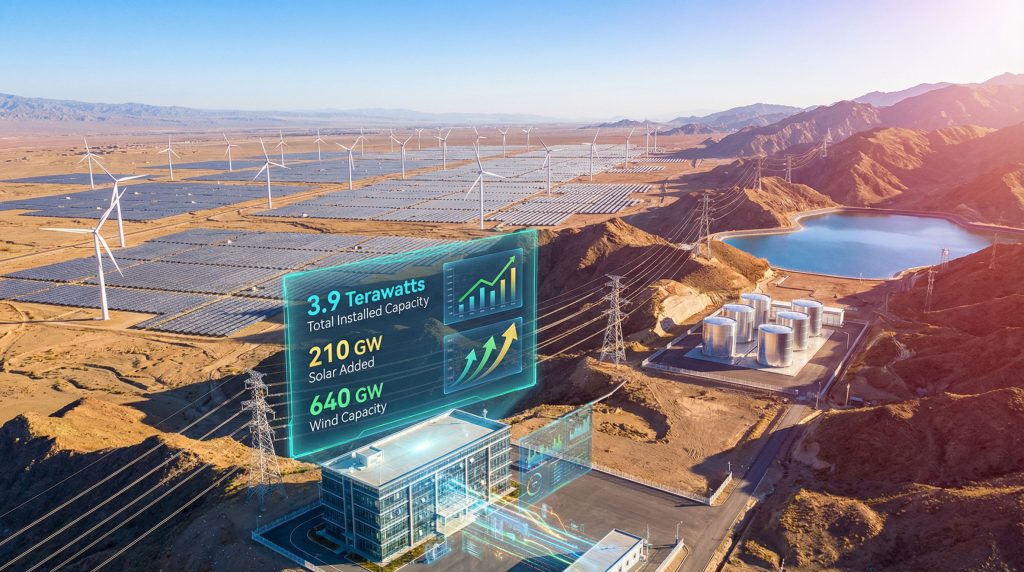
The numbers associated with China's energy capacity expansion challenge conventional understanding of infrastructure development timelines. With total installed capacity reaching 3.9 terawatts by the end of 2025, China operates more generating capacity than the combined total of the United States, European Union, and India.
To contextualise this achievement, consider that most developed nations required decades to build their current energy infrastructure. China has effectively constructed the equivalent of multiple national grids within a compressed timeframe, fundamentally altering global energy economics through sheer scale.
The composition of this capacity reveals strategic priorities extending beyond immediate energy needs. Renewable sources now comprise approximately 52% of total capacity, representing a structural shift that positions clean energy as the dominant foundation for future economic growth.
How China's 2025 Energy Additions Compare to Entire National Grids
The scale of annual additions provides perhaps the most striking illustration of China's energy transformation pace. In 2025 alone, China installed 543 gigawatts of new capacity, exceeding the total generating capacity of most G20 nations.
This single-year addition surpasses:
- Germany's entire national grid capacity by 400%
- Japan's total installed base by 300%
- The United Kingdom's complete power system by 500%
The implications extend beyond raw numbers. This construction pace demonstrates industrial capacity, supply chain coordination, and project execution capabilities that reshape competitive dynamics across multiple sectors. The engineering workforce, manufacturing capacity, and financial resources required for such deployment create self-reinforcing advantages in related industries.
The Strategic Significance of Surpassing Coal with Renewables
The transition point where renewable capacity exceeds fossil fuel capacity marks a fundamental strategic milestone. China achieved this threshold whilst simultaneously maintaining energy security and supporting unprecedented economic growth rates.
This achievement demonstrates technological maturity in renewable energy deployment that reduces dependency on commodity imports whilst creating domestic industrial advantages. The shift positions China's manufacturing sectors to benefit from increasingly abundant clean electricity, potentially offering competitive advantages in energy-intensive industries.
Why China's Energy Capacity Growth Outpaces Historical Precedents
Understanding the drivers behind accelerated capacity deployment reveals the intersection of technological advancement, policy coordination, and economic strategy that enables such unprecedented growth rates. Moreover, the scale of this expansion creates significant demand for critical minerals & energy security considerations that ripple throughout global supply chains.
Analysing the 16.5% Annual Growth Rate in Context
The 16.5% annual growth rate in energy capacity additions represents an exponential expansion curve that defies traditional infrastructure development patterns. Historical analysis of power system growth in developed nations typically shows single-digit percentage increases even during peak industrialisation periods.
Several factors enable this extraordinary growth trajectory:
- Manufacturing scale economies in renewable technologies
- Standardised deployment processes reducing project timelines
- Coordinated supply chain integration minimising bottlenecks
- Financial systems optimised for infrastructure investment
- Regulatory frameworks designed for rapid permitting
The sustainability of such growth rates depends on continued technological advancement and market absorption capacity. However, the current trajectory suggests China will reach 5+ terawatts of total capacity well before most projections anticipated.
Solar Dominance: 210 GW Added in Six Months
Solar photovoltaic deployment demonstrates the most dramatic example of accelerated capacity addition. The 210 gigawatts installed in just six months of 2025 exceeds the cumulative solar capacity of most continents.
This deployment rate reflects several converging trends:
- Manufacturing costs falling below $0.10 per watt for utility-scale systems
- Installation processes increasingly automated and standardised
- Grid integration technologies capable of handling variable generation
- Energy storage costs declining sufficiently to support intermittent sources
The speed of solar deployment creates cascading effects throughout the energy ecosystem. Wholesale electricity prices in regions with high solar penetration now regularly approach zero during peak generation hours, fundamentally altering economic calculations for energy-intensive industries.
Wind Power Expansion: 640 GW Total Capacity Reached
Wind power capacity reaching 640 gigawatts represents another milestone in China's renewable energy transformation. This capacity equals approximately 60% of total U.S. electricity generating capacity across all sources, concentrated exclusively in wind technology.
The geographic distribution of wind capacity reveals strategic planning considerations:
- Offshore wind farms increasingly dominate coastal installations
- High-altitude mountain ranges utilised for consistent wind resources
- Transmission corridors connecting remote generation to population centres
- Grid stability systems managing variable wind output across vast distances
What Economic Forces Drive China's $80 Billion Grid Investment Strategy?
The massive financial commitment to grid infrastructure reflects recognition that generation capacity requires equally sophisticated transmission and distribution systems to realise economic benefits. Consequently, China has made historic breakthroughs in integrating renewable energy sources into its national grid system.
Ultra-High Voltage Lines Connecting Remote Generation to Urban Demand
Ultra-high voltage transmission lines represent perhaps the most technically sophisticated component of China's energy infrastructure expansion. These systems operate at voltages exceeding 800 kilovolts, enabling power transmission across distances that span multiple time zones with minimal losses.
The engineering challenges associated with ultra-high voltage systems include:
- Corona discharge management at extreme voltages
- Environmental impact mitigation across diverse ecosystems
- Grid stability maintenance during fault conditions
- Construction logistics in remote mountainous terrain
Current ultra-high voltage projects connect:
| Route | Distance (km) | Capacity (GW) | Primary Sources |
|---|---|---|---|
| Western-Eastern Corridor | 2,400 | 12.0 | Wind, Solar, Hydro |
| Northern-Southern Line | 1,800 | 10.5 | Wind, Coal, Nuclear |
| Coastal Integration | 1,200 | 8.0 | Offshore Wind, Nuclear |
National Power Market Unification and Cross-Provincial Trading
The development of unified national power markets requires sophisticated coordination mechanisms that balance supply and demand across enormous geographic scales. China's approach integrates multiple regional grids into a cohesive system capable of optimising resource allocation in real-time.
Key components of market unification include:
- Standardised trading platforms enabling automatic dispatching
- Price discovery mechanisms reflecting real-time supply conditions
- Cross-provincial settlement systems handling complex financial flows
- Emergency coordination protocols maintaining grid stability
The economic benefits of market integration become apparent during peak demand periods when surplus capacity in one region can serve shortfalls in distant provinces. This flexibility reduces the need for redundant generating capacity whilst improving overall system reliability.
AI-Powered Dispatch Systems and Grid Optimisation Technology
Artificial intelligence applications in grid management represent a frontier technology deployment that China is implementing at unprecedented scale. These systems process vast amounts of real-time data to optimise generation dispatch, predict maintenance requirements, and prevent cascading failures.
AI systems manage multiple complex variables:
- Weather pattern analysis for renewable generation forecasting
- Load prediction algorithms incorporating economic activity data
- Equipment health monitoring using sensor networks and predictive analytics
- Cyber security protocols protecting critical infrastructure systems
How Does Energy Storage Infrastructure Support Renewable Integration?
The challenge of integrating variable renewable generation with consistent electricity demand requires sophisticated energy storage solutions deployed at scales never before attempted. However, innovations in battery recycling innovations are helping to address sustainability concerns whilst supporting this massive storage deployment.
Grid-Scale Storage Exceeding 213 GW Capacity
China's grid-scale storage capacity of 213 gigawatts represents more storage than most nations possess in total generating capacity. This infrastructure enables the integration of renewable sources that would otherwise create grid instability.
Storage technologies deployed include:
- Pumped hydro storage utilising natural and artificial reservoirs
- Lithium-ion battery systems providing fast-response capability
- Compressed air energy storage in underground caverns
- Thermal storage systems integrated with concentrated solar plants
The geographic distribution of storage systems reflects optimisation for maximum grid benefit:
| Region | Storage Type | Capacity (GW) | Primary Function |
|---|---|---|---|
| Western Mountains | Pumped Hydro | 85.0 | Long-duration storage |
| Coastal Provinces | Battery Systems | 78.0 | Fast response |
| Northern Plains | Compressed Air | 32.0 | Seasonal storage |
| Southern Regions | Thermal Storage | 18.0 | Solar integration |
Pumped Storage and Battery Systems Managing Intermittency
The combination of pumped storage and battery systems creates a comprehensive approach to managing renewable energy intermittency. Pumped storage provides long-duration capacity for seasonal variations, whilst battery systems handle minute-to-minute fluctuations.
Pumped storage facilities increasingly incorporate advanced features:
- Variable-speed turbines improving efficiency across operating ranges
- Seawater systems reducing freshwater requirements
- Underground installations minimising environmental impact
- Hybrid systems combining pumped storage with solar generation
Battery storage systems benefit from rapidly declining costs and improving performance characteristics. Utility-scale installations now achieve:
- Round-trip efficiency exceeding 90%
- Cycle life extending beyond 10,000 charge-discharge cycles
- Response times measured in milliseconds
- Modular expansion allowing capacity increases without system replacement
The Role of 74 GW New Storage in Grid Stability
The 74 gigawatts of new storage capacity added in 2025 demonstrates the accelerating pace of storage deployment. This addition alone exceeds the total storage capacity of all other nations combined, highlighting the strategic priority placed on renewable integration.
New storage installations focus on:
Grid stability services that maintain frequency and voltage within acceptable parameters despite variable renewable generation patterns.
The economic value of storage systems extends beyond simple energy shifting. These systems provide ancillary services that improve overall grid efficiency and reduce the need for conventional backup generation capacity.
What Are the Macroeconomic Implications of Clean Energy's GDP Contribution?
The clean energy sector's economic impact extends far beyond electricity generation, creating industrial clusters and employment opportunities that reshape regional development patterns. In addition, this transformation has attracted significant battery metals investment from both domestic and international sources.
Renewable Sector Driving Over 90% of Investment Growth
The renewable energy sector's dominance in driving investment growth reflects a fundamental shift in capital allocation patterns. Over 90% of energy investment increases flow into renewable technologies, storage systems, and grid infrastructure rather than conventional power sources.
This investment concentration creates several macroeconomic effects:
- Industrial cluster development around manufacturing centres
- Technology spillover effects benefiting adjacent industries
- Export capacity expansion in renewable energy equipment
- Research and development acceleration in emerging technologies
The multiplier effects of renewable investment often exceed those of conventional energy projects due to higher domestic content and more distributed economic benefits.
Clean Energy's One-Third Share of 2025 GDP Expansion
Clean energy technologies contributed over one-third of GDP growth in 2025, representing a remarkable concentration of economic activity in emerging industrial sectors. This contribution equals approximately $2.1 trillion in economic value, comparable to the entire GDP of major developed nations.
The sectoral breakdown reveals diversified economic impact:
- Manufacturing activities including solar panels, wind turbines, and batteries
- Construction services for generation and transmission infrastructure
- Technology services providing grid management and optimisation
- Financial services supporting project development and operation
Employment and Industrial Value Chain Development
The employment implications of China's energy capacity expansion extend across multiple skill levels and geographic regions. Clean energy employment now exceeds 13 million jobs, representing significant economic opportunity in both traditional industrial regions and emerging development areas.
Employment categories include:
- Manufacturing positions in equipment production facilities
- Construction jobs for installation and infrastructure development
- Technical roles in system operation and maintenance
- Research positions advancing next-generation technologies
The geographic distribution of clean energy employment helps address regional development imbalances by creating high-value jobs in previously underutilised areas with superior renewable resources.
The next major ASX story will hit our subscribers first
How Will China's 2026-2030 Energy Trajectory Reshape Global Markets?
Projections for continued capacity expansion suggest that China's energy transformation will accelerate rather than moderate, creating implications that extend far beyond national boundaries. Meanwhile, other nations are developing strategies for securing lithium supply to support their own renewable energy ambitions.
Projecting 200-300 GW Annual Renewable Additions
Current trajectory analysis suggests China will maintain annual renewable capacity additions of 200-300 gigawatts through 2030, representing sustained exponential growth in clean energy deployment. This pace exceeds the total renewable capacity of most developed nations added annually.
Several factors support continued high growth rates:
- Technology cost curves continuing to decline
- Manufacturing capacity expanding to meet domestic and export demand
- Grid infrastructure increasingly capable of absorbing variable generation
- Policy frameworks maintaining supportive regulatory environment
The sustainability of such growth rates depends on continued technological advancement and market mechanisms that can efficiently allocate enormous quantities of variable renewable generation.
Solar Capacity Targeting 2.5 TW by 2030
The target of 2.5 terawatts of solar capacity by 2030 represents an installation rate that would require deploying approximately 300 gigawatts annually through the remainder of the decade. This pace would establish solar as the dominant electricity source across most of China's grid.
Achieving this target requires:
- Manufacturing scale reaching unprecedented levels of production
- Installation capabilities maintaining current deployment rates
- Grid integration managing enormous quantities of variable generation
- Storage deployment supporting intermittent solar generation patterns
The economic implications include wholesale electricity prices approaching zero during peak solar generation hours across vast geographic regions, fundamentally altering industrial competitiveness calculations.
Coal's Paradoxical Role: High Additions, Declining Utilisation
The apparent contradiction between continued coal capacity additions and declining utilisation rates reflects the complex role of conventional generation in supporting renewable integration. New coal plants increasingly function as backup capacity rather than baseload generation.
Modern coal installations incorporate:
- Flexible operation capabilities enabling rapid startup and shutdown
- Advanced emission controls reducing environmental impact per megawatt-hour
- Grid stability services supporting renewable integration requirements
- Strategic reserve functions maintaining energy security during extended weather events
The economic rationale for new coal capacity despite declining utilisation reflects the value of maintaining dispatchable generation capability in a grid dominated by variable renewable sources.
What Challenges Could Limit China's Energy Expansion Momentum?
Despite impressive achievements, several potential constraints could moderate the pace of continued energy capacity expansion or create operational challenges in managing massive renewable deployment. For instance, reports suggest that wind and solar now generate over a quarter of China's electricity in some regions, creating new grid management challenges.
Grid Absorption Limits and Regional Transmission Constraints
The physical and economic limits to grid absorption of variable renewable generation represent a growing constraint on capacity utilisation. Even with massive transmission investments, regional grid congestion increasingly limits the economic value of additional renewable capacity in certain areas.
Transmission constraints manifest in several ways:
- Thermal limits on existing transmission lines during peak generation
- Voltage stability challenges during rapid generation fluctuations
- Frequency regulation requirements exceeding system capabilities
- Protection system coordination complexity increasing with system scale
Addressing these constraints requires continued investment in grid infrastructure that may outpace even current ambitious spending levels.
Overcapacity Risks in Manufacturing and Generation
The rapid scale-up in manufacturing capacity for renewable energy equipment creates potential overcapacity risks that could destabilise economics across the supply chain. Current manufacturing capacity significantly exceeds domestic installation rates, creating dependency on export markets.
Overcapacity indicators include:
- Manufacturing utilisation rates declining despite continued expansion
- Price pressure on equipment manufacturers reducing profitability
- Export dependency increasing vulnerability to trade restrictions
- Financial stress among smaller manufacturers unable to achieve scale
Balancing Renewable Intermittency with Industrial Demand
The challenge of matching intermittent renewable generation with consistent industrial electricity demand becomes more complex as renewable penetration increases. Traditional demand response mechanisms may prove inadequate for managing the scale of variation inherent in renewable-dominant grids.
Industrial adaptation strategies include:
- Flexible manufacturing processes capable of adjusting to generation patterns
- On-site storage systems providing demand stability
- Load scheduling optimisation aligning production with renewable availability
- Power purchase agreements providing predictable revenue streams for generators
How Does China's Energy Strategy Compare to Global Competitors?
International comparison reveals the extent to which China's energy development pace exceeds that of other major economies, creating potential competitive advantages and strategic vulnerabilities.
Renewable Capacity Growth Versus US and European Markets
The scale differential between China's renewable deployment and that of other major economies continues expanding. China's annual renewable additions exceed the total installed capacity of most developed nations, creating cumulative advantages that compound over time.
Comparative annual additions (2025):
| Country/Region | Renewable Additions (GW) | Total Capacity (GW) | Per Capita (kW) |
|---|---|---|---|
| China | 293.0 | 1,419.0 | 1.01 |
| United States | 32.0 | 294.0 | 0.89 |
| European Union | 42.0 | 357.0 | 0.80 |
| India | 18.0 | 87.0 | 0.06 |
The per capita comparison reveals that China has achieved renewable capacity deployment exceeding developed economies whilst maintaining significantly higher absolute growth rates.
Technology Leadership in Solar Manufacturing and Wind Turbines
China's dominance in renewable energy equipment manufacturing creates strategic advantages that extend beyond domestic deployment. Chinese companies control over 80% of global solar manufacturing capacity and increasingly dominate wind turbine production.
Manufacturing leadership provides multiple benefits:
- Cost advantages through scale economies and supply chain integration
- Technology development leadership driving next-generation innovations
- Export revenue from equipment sales to global markets
- Strategic influence over global renewable energy deployment pace
Export Implications for Global Clean Energy Supply Chains
The concentration of renewable energy manufacturing in China creates dependencies that affect global clean energy deployment strategies. Most nations rely heavily on Chinese-manufactured components for their renewable energy programmes.
Supply chain dependencies include:
- Solar panels with over 90% global production in China
- Battery systems dominated by Chinese manufacturers
- Critical minerals processing concentrated in Chinese facilities
- Grid infrastructure components increasingly sourced from China
These dependencies create both opportunities and vulnerabilities for nations pursuing aggressive clean energy deployment strategies whilst seeking supply chain diversification.
What Investment Opportunities Emerge from China's Energy Transformation?
The scale and pace of China's energy capacity expansion create investment opportunities across multiple sectors, whilst also highlighting potential risks and strategic considerations for global investors.
Critical Mineral Demand for Battery and Grid Infrastructure
The massive deployment of energy storage and grid infrastructure creates unprecedented demand for critical minerals essential to clean energy technologies. Lithium demand alone could increase 400% by 2030 based on current capacity expansion plans.
Critical mineral requirements include:
- Lithium for battery storage systems and electric vehicles
- Cobalt for high-performance battery chemistries
- Rare earth elements for wind turbine generators and motors
- Copper for transmission infrastructure and electrical systems
- Nickel for advanced battery technologies and grid equipment
Investment opportunities exist across the mineral supply chain, from exploration and extraction through processing and recycling technologies.
Technology Transfer and International Project Development
China's technological leadership in renewable energy creates opportunities for international collaboration and technology transfer arrangements. Chinese companies increasingly participate in overseas renewable energy projects, bringing advanced technologies and competitive pricing.
International opportunities include:
- Engineering services for complex grid integration projects
- Equipment financing arrangements supporting overseas deployment
- Joint venture partnerships combining Chinese technology with local expertise
- Training programmes developing local technical capabilities
Supply Chain Dependencies and Diversification Strategies
The concentration of renewable energy manufacturing in China motivates diversification efforts that create investment opportunities in alternative supply chain development. Governments and companies seek to reduce dependency whilst maintaining cost competitiveness.
Diversification strategies include:
- Regional manufacturing facilities reducing transportation costs and supply risks
- Vertical integration securing critical component supplies
- Alternative technology development reducing dependency on dominant suppliers
- Strategic stockpiling maintaining inventory buffers for critical components
Disclaimer: Investment in energy infrastructure and related commodities involves significant risks including technological, regulatory, and market volatility. Past performance does not guarantee future results. Investors should conduct thorough due diligence and consider professional advice before making investment decisions.
Key Takeaways: China's Energy Expansion as a Geopolitical Game-Changer
The transformation of China's energy capacity expansion represents more than an impressive engineering achievement; it constitutes a strategic repositioning that will influence global economic and political dynamics for decades.
Energy Security as National Security Strategy
China's approach to energy development treats abundant, reliable electricity as fundamental to national security and economic competitiveness. The massive infrastructure investments reflect recognition that energy independence provides strategic flexibility in an increasingly uncertain geopolitical environment.
Energy security benefits include:
- Reduced import dependency for fossil fuels and associated foreign exchange requirements
- Industrial competitiveness through abundant, low-cost electricity
- Strategic autonomy in energy-intensive manufacturing sectors
- Export capacity in energy technologies and equipment
Industrial Competitiveness Through Abundant Clean Power
The availability of abundant, low-cost clean electricity creates competitive advantages for energy-intensive industries that extend far beyond direct energy costs. Industries ranging from aluminium production to data centres benefit from reliable, affordable power that increasingly distinguishes Chinese manufacturing capabilities.
Competitive advantages include:
- Lower production costs for energy-intensive manufacturing
- Environmental compliance advantages in global markets
- Technology leadership in clean energy applications
- Investment attraction for industries requiring reliable power supplies
Long-Term Implications for Global Energy Trade Flows
China's energy transformation will fundamentally alter global energy trade patterns as the world's largest energy consumer reduces import requirements whilst expanding equipment exports. These changes create both opportunities and challenges for traditional energy-exporting nations.
Trade flow implications include:
- Reduced fossil fuel imports affecting global commodity markets
- Increased equipment exports supporting Chinese manufacturing sectors
- Technology transfer arrangements with developing nations
- Strategic relationships based on energy technology rather than resource extraction
The long-term strategic implications suggest that nations capable of rapidly deploying clean energy infrastructure will possess significant advantages in the emerging global economy. China's current trajectory positions it to benefit from this transition whilst other nations struggle to achieve comparable deployment rates.
This analysis is based on publicly available information and industry reports. Energy infrastructure development involves complex technical, economic, and regulatory factors that may affect outcomes. Readers should consult multiple sources and professional expertise when making decisions based on this information.
Ready to Capitalise on the Next Major Mineral Discovery?
China's unprecedented energy expansion requires massive quantities of lithium, cobalt, rare earth elements, and other critical minerals essential to clean energy technologies, creating extraordinary opportunities for investors positioned ahead of major mineral discoveries. Discovery Alert's proprietary Discovery IQ model delivers real-time alerts on significant ASX mineral discoveries, instantly empowering subscribers to identify actionable opportunities before the broader market recognises their potential. Begin your 14-day free trial today to secure your market-leading advantage in this rapidly expanding sector.