
August 1, 2026
The Dual-Engine Powering Global Aluminium Extrusion Growth
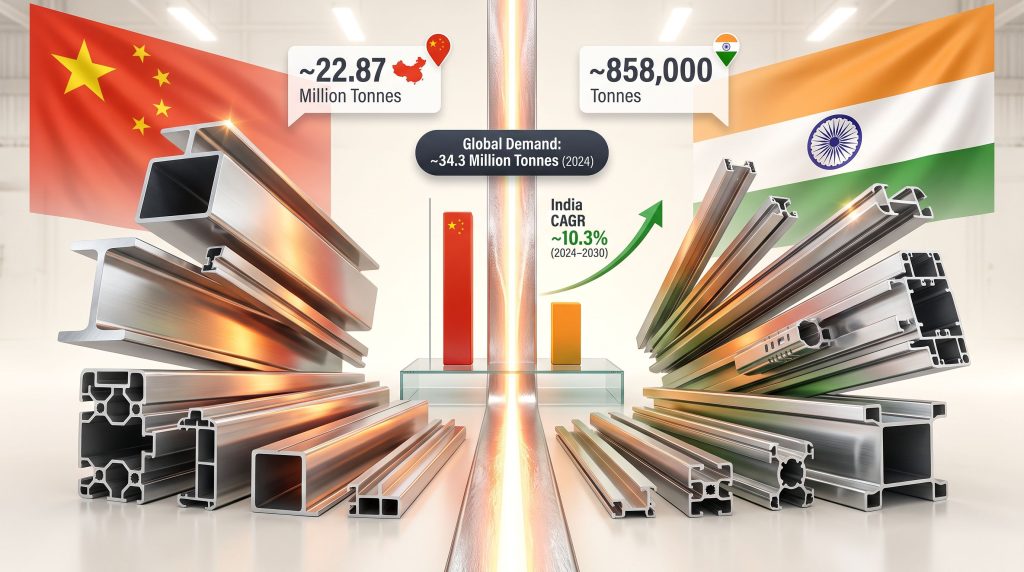
The global aluminium extrusion industry is not simply growing — it is being fundamentally restructured by two economies operating on entirely different trajectories. Understanding where extrusion demand flows in the coming decade requires examining a paradox: one market is so large it defines global benchmarks, while the other is growing fast enough to reshape regional supply chains. Neither tells the full story alone. Together, the China and India aluminium extrusion market dynamic presents one of the most consequential structural shifts in global metals manufacturing.
To grasp the scale of this shift, consider that global extrusion demand reached approximately 34.3 million tonnes in 2024, against an installed worldwide capacity of roughly 49.9 million tonnes. That structural overcapacity is not evenly distributed. It is overwhelmingly concentrated in Asia Pacific, and within that region, in two countries at opposite ends of the industrial maturity spectrum.
When big ASX news breaks, our subscribers know first
China's Commanding Scale: Numbers That Redefine Global Benchmarks
China's position in aluminium extrusion is without precedent in any global manufacturing sector. The figures are difficult to contextualise without a reference point, so consider this: roughly two in every three tonnes of aluminium extrusions consumed worldwide are used within China's borders.
The following table summarises China's trajectory:
| Metric | Data Point |
|---|---|
| Extrusion consumption (2023) | ~20.94 million tonnes |
| Extrusion consumption (2024) | ~21.47 million tonnes |
| Projected consumption (2030) | ~27.52 million tonnes |
| CAGR (2023–2030) | ~3.98% |
| Share of global consumption | ~66% |
| Share of global installed capacity | ~64% |
| Estimated production output (2025) | ~23.5 million tonnes |
| Domestic consumption (2025 estimate) | ~22.87 million tonnes |
China's installed extrusion capacity exceeds 30 million tonnes per annum, creating a structural net-export position that influences aluminium pricing, trade flows, and downstream competition across every major market globally. Worldwide extrusion capacity stood at approximately 49 million tonnes in 2023, with China accounting for nearly 31 million tonnes of that figure.
What End-Use Sectors Drive This Volume?
China's extrusion consumption is not monolithic. It is spread across several end-use categories, though building and construction has historically dominated. China industrial demand trends are reshaping how analysts interpret these underlying sector splits:
-
Building and construction: Historically representing 57–60% of Chinese extrusion consumption, supported by an estimated 8,000+ companies in aluminium door and window manufacturing and approximately 1,500 curtain-wall fabricators. Aluminium holds roughly 55% of China's doors and windows market.
-
Transportation: Approximately 15–16% of consumption. China represents an estimated 56% of global aluminium extrusion usage in transportation, anchored by its dominance in electric vehicle manufacturing.
-
Electrical and electronics: Approximately 1.46 million tonnes consumed in 2023 alone.
-
Industrial applications: Approximately 2.09 million tonnes consumed in 2023.
-
Solar PV manufacturing: A structurally growing layer, given China's estimated 71% share of global solar PV manufacturing capacity.
China's extrusion consumption mix is undergoing a fundamental rotation. Construction remains the largest single end-use by volume, but growth momentum has decisively shifted toward industrial, energy transition, and transport applications. This rotation is not cyclical — it reflects a durable structural change in how China's economy consumes aluminium.
How China's Demand Mix Is Evolving Through 2025 and 2026
The headline tonnage figures, while impressive, obscure a more nuanced story unfolding at the sector level. Traditional architectural extrusion demand remained subdued through the first half of 2026, reflecting the ongoing correction in China's residential property market — historically the single largest demand pillar for the industry.
Industrial extrusions linked to new energy infrastructure, power transmission equipment, energy storage systems, and thermal management components emerged as the primary demand support during this period. SMM data indicated that operating rates among tracked Chinese extrusion producers stood at approximately 57.6% in early June 2026, reflecting an uneven demand environment rather than broad-based weakness.
The table below illustrates the divergence across application segments in H1 2026:
| Application Segment | H1 2026 Demand Trajectory |
|---|---|
| Architectural and construction profiles | Weak — property market drag |
| Power transmission and transformation equipment | Resilient |
| Energy storage structural components | Resilient |
| Industrial heat sinks and thermal management | Resilient |
| Rail transit profiles | Relatively stable |
| EV lightweighting profiles | Firm |
| Solar PV frames and mounting systems | Elevated in Q1, normalising post-April |
One notable short-term dynamic was the pull-forward of photovoltaic frame and mounting profile orders in Q1 2026. Overseas buyers accelerated procurement ahead of China's cancellation of export tax rebates for PV-related products, which took effect on 1 April 2026. This policy change temporarily distorted demand patterns before normalising in subsequent months.
China's Extrusion Export Strategy: Redirecting Volume East and South
China's extrusion export volumes experienced significant month-to-month volatility during the first half of 2026, reflecting both seasonal factors and broader geopolitical trade uncertainty. The data reveals a pronounced V-shaped recovery:
| Month | Export Volume (approx.) | Notable Movement |
|---|---|---|
| January 2026 | ~81,000 tonnes | Baseline |
| February 2026 | ~64,000 tonnes | Seasonal softness |
| March 2026 | ~48,000 tonnes | H1 trough; -32.8% year-on-year |
| April 2026 | ~76,000 tonnes | +56.8% month-on-month |
| May 2026 | ~87,000 tonnes | +20.1% year-on-year |
The March trough coincided with a convergence of seasonal factors and trade uncertainty in Western markets. The subsequent April to May recovery was driven predominantly by demand from emerging-market buyers. SMM identified Southeast Asia, Australia, South America, and Central Asia as four core growth corridors for Chinese extrusion exporters.
At the broader aluminium semis level, China exported 535,700 tonnes in April 2026, rising 20.9% month-on-month and 9.8% year-on-year. Cumulative semis exports for January through April 2026 reached approximately 1.1555 million tonnes, up 6.2% year-on-year.
Chinese producers are deploying increasingly sophisticated logistics strategies — including overseas warehousing, cross-border stocking arrangements, and overseas processing facilities — to navigate rising trade barriers in European and US markets. Furthermore, US aluminium tariffs have accelerated this pivot, as producers systematically redirect volume toward emerging-market corridors — a long-term structural realignment with lasting implications for global aluminium supply chains.
India's Aluminium Extrusion Market: Smaller Scale, Faster Trajectory
India operates at a fundamentally different order of magnitude to China, but the growth dynamics are arguably more compelling for forward-looking analysis. The country's aluminium extrusion demand is estimated at approximately 795,000 tonnes in 2025, rising to roughly 858,000 tonnes in 2026 — a year-on-year expansion of approximately 7.9%.
The value-based market picture is equally striking. According to market research on the aluminium extrusion sector, India's trajectory stands out even within a strong regional growth story:
| Metric | Data Point |
|---|---|
| Market value (2024) | USD 2,076.2 million |
| Projected market value (2030) | USD 3,718.7 million |
| Value CAGR (2024–2030) | ~10.3% |
| Installed capacity | ~3 million tonnes per year |
| Estimated actual output | ~1.2–1.3 million tonnes |
| Capacity utilisation rate | ~40–43% |
The 10.3% value CAGR through 2030 reflects not only volume growth but an increasing shift toward higher-value product categories — a dynamic that carries significant implications for both domestic producers and international suppliers eyeing the market.
The Sectors Building India's Demand Base
India's extrusion demand growth is sector-driven rather than monolithic, with multiple industries contributing to the acceleration:
-
Building and construction: The largest demand segment, with an estimated 280,000–300,000 tonnes of aluminium consumed in 2023. India's construction industry is projected to expand at 8–10% annually over the medium term.
-
Renewable energy: Solar mounting systems and structural profiles represent an accelerating demand source as India expands its solar generation capacity.
-
Automotive and transportation: India's automotive sector consumes approximately 60% of domestically produced secondary aluminium, with lightweighting trends gradually driving extrusion demand growth.
-
Defence, aerospace, and strategic manufacturing: An emerging high-value demand segment, discussed in detail below.
-
Electrical and industrial applications: Growing in line with broad-based infrastructure investment.
The Structural Constraints Holding India Back
Understanding India's aluminium extrusion opportunity requires confronting a paradox that sits at the heart of the market's current condition. India has installed extrusion capacity of approximately 3 million tonnes per year, yet actual output is only 1.2–1.3 million tonnes — implying a capacity utilisation rate of just 40–43%. Simultaneously, approximately 1.5 million tonnes of downstream aluminium products are imported annually.
This is not a demand problem. It is a competitiveness problem rooted in structural policy and supply-chain conditions.
The Tariff Asymmetry Challenge
Finished value-added aluminium products entering India under certain Free Trade Agreements can attract zero or near-zero import duties in specific categories, while primary aluminium imported by Indian processors for domestic manufacturing attracts higher duty rates. This creates a structural cost disadvantage for domestic downstream producers, suppressing capacity utilisation despite strong underlying demand.
Consequently, as cheap Chinese imports continue to hurt India's aluminium extrusion industry, industry associations have advocated for tariff rationalisation, lower energy and financing costs, greater domestic billet availability, and policies that actively incentivise domestic value-added aluminium consumption.
The 2026 Supply Chain Disruption: A Warning Signal
Early 2026 delivered a stark reminder that installed capacity does not guarantee reliable production. Geopolitical disruption in West Asia triggered severe fuel shortages affecting Indian extrusion operations, exposing the sector's structural dependence on LPG and piped natural gas for heating and processing.
The consequences were severe:
-
By March 2026, at least 25 Indian extrusion units had fully suspended operations
-
Approximately 200 facilities were running at significantly reduced capacity
-
Monthly industry output fell from approximately 70,000 tonnes to 45,000 tonnes — a decline of roughly 36%
The raw material dimension compounded the disruption. India generates approximately half of its 4.2 million tonnes of annual aluminium production through the secondary sector, and roughly 30% of aluminium scrap imports originate from the Middle East. Following the supply shock, some secondary aluminium plants reduced output by 20–40%, while scrap prices increased by approximately 30%. Given that India's automotive sector consumes around 60% of domestically produced secondary aluminium, the downstream consequences rippled across multiple industries.
The 2026 disruption episode illustrates a critical vulnerability: India may possess the physical extrusion infrastructure and the demand trajectory, but billet supply security, scrap import concentration, fuel reliability, and energy cost competitiveness collectively determine how much of that theoretical capacity translates into dependable supply.
The next major ASX story will hit our subscribers first
India's Move Up the Value Chain: Defence and Aerospace Extrusions
Perhaps the most strategically significant development in India's aluminium extrusion sector during 2026 was the commissioning of the foundation stone for a 10,000-tonne aluminium extrusion press at Yantra India Limited's Ordnance Factory Ambajhari in Nagpur, laid in June 2026.
The facility is designed to manufacture large-section, high-strength, complex aluminium alloy profiles for applications including:
-
Defence platforms and weapons systems
-
Aerospace and aviation structural components
-
Missile manufacturing programs
-
Railway and rail transit applications
-
Other strategic industrial uses
This represents a material departure from India's traditional extrusion profile, which has been dominated by architectural, general engineering, and renewable energy applications. Furthermore, India's strategic supply push into critical materials more broadly provides important context for this domestic push into precision, high-value extrusion — a segment currently satisfied largely through imports — with implications that extend beyond commercial manufacturing into national industrial self-sufficiency.
China vs. India: A Side-by-Side Market Comparison
| Dimension | China | India |
|---|---|---|
| 2025 Consumption Volume | ~22.87 million tonnes | ~795,000 tonnes |
| Installed Capacity | ~31+ million tonnes/year | ~3 million tonnes/year |
| Capacity Utilisation (H1 2026) | ~57.6% operating rate | ~40–43% |
| Dominant End-Use Sector | Construction (rotating to industrial) | Construction and infrastructure |
| Volume Growth Rate | ~3.98% CAGR (2023–2030) | ~7.9% year-on-year (2025–2026) |
| Value Growth Rate | Embedded in volume scale | ~10.3% CAGR (2024–2030) |
| Trade Position | Net exporter | Net importer of downstream products |
| Key Growth Segments | EV, solar, energy storage, power systems | Infrastructure, defence, renewables, automotive |
| Primary Structural Challenge | Property sector drag | Tariff asymmetry, supply chain vulnerability |
These are not competing markets. They are structurally distinct economies at different phases of the China and India aluminium extrusion market development cycle, each shaped by unique demand drivers, policy environments, and trade exposures. China built its position through manufacturing scale and construction-led consumption. India's emerging model is more diversified — combining infrastructure-driven volume growth with an increasingly deliberate push into strategic, high-value manufacturing segments.
The Asia Pacific Context: Regional Forces Beyond the Two Giants
Asia Pacific is the largest and fastest-growing regional extrusion market globally, with projected CAGRs ranging from approximately 7.0% to 9.6% depending on the analytical framework applied. In addition, aluminium industry leaders across the region are positioning themselves to capture this growth, particularly as the end-use breakdown in 2023 included:
-
Building and construction: ~1.54 million tonnes
-
Transportation: ~431,000 tonnes
-
Industrial applications: ~269,000 tonnes
-
Electrical and electronics: ~189,000 tonnes
Transportation was forecast to be the fastest-growing category among these segments, at a CAGR of approximately 5.18% through 2030, with India, South Korea, and Southeast Asian economies among the principal growth contributors. Moreover, aluminium decarbonisation investment across the region is adding further momentum to the transition away from carbon-intensive production methods.
Frequently Asked Questions: China and India Aluminium Extrusion Market
What percentage of global aluminium extrusions does China produce?
China accounts for approximately 64–66% of global aluminium extrusion capacity and consumption, making it the dominant force in the worldwide market by a substantial margin. No other single country approaches this concentration.
How fast is India's aluminium extrusion market growing?
India's extrusion demand is growing at approximately 7.9% year-on-year in volume terms during 2025–2026, with market value projected to expand at a 10.3% CAGR between 2024 and 2030, reaching an estimated USD 3,718.7 million by 2030.
Why does India have low capacity utilisation despite strong demand growth?
India's installed extrusion capacity is utilised at only 40–43% due to tariff structures that favour finished product imports, higher input costs for energy and financing, raw material supply vulnerabilities, and periodic supply-chain disruptions linked to geopolitical events.
Which sectors are driving aluminium extrusion demand growth in both markets?
China: Electric vehicles, solar PV, energy storage systems, power transmission infrastructure, and rail transit.
India: Building and construction, renewable energy, automotive lightweighting, infrastructure investment, and defence and aerospace manufacturing.
What is the outlook for global aluminium extrusion demand through 2030?
Global extrusion demand is expected to grow steadily through 2030, driven by transportation electrification, renewable energy infrastructure, and industrial applications. China's consumption alone is projected to reach approximately 27.52 million tonnes by 2030, while India's market value is expected to nearly double over the same period. The China and India aluminium extrusion market will consequently remain the central axis around which global supply chains and investment decisions are organised.
Disclaimer: All forecasts, projections, and market estimates referenced in this article are drawn from third-party industry research and publicly available data. They represent analytical estimates subject to revision and should not be construed as investment advice. Readers should conduct independent due diligence before making any financial or commercial decisions based on this content.
Want to Track ASX Mineral Discoveries Linked to the Metals Powering This Structural Shift?
As aluminium and the broader metals complex undergo a fundamental demand transformation driven by electrification, renewable energy, and defence manufacturing, Discovery Alert's proprietary Discovery IQ model delivers real-time alerts on significant ASX mineral discoveries — instantly translating complex data across 30+ commodities into actionable insights for investors at every level. Explore how historic mineral discoveries have generated substantial market returns and begin your 14-day free trial today to position yourself ahead of the market.