August 1, 2026
Why the Minerals Beneath Our Feet Are Now Central to the Energy Future
The global economy has undergone a quiet but profound transformation over the past decade. Increasingly, the success or failure of the energy transition is not being determined by the availability of wind or sunlight, but by the availability of the physical materials required to capture, store, and transmit that energy. Lithium, copper, graphite, cobalt, nickel, and rare earth elements have moved from the periphery of commodity markets to the centre of geopolitical strategy, corporate planning, and investment capital allocation.
Understanding the scale and trajectory of critical mineral demand through 2040 is no longer a niche analytical exercise. It is a prerequisite for informed decision-making across government, industry, and financial markets alike. Furthermore, critical minerals demand is reshaping how nations think about resource sovereignty and industrial policy.
When big ASX news breaks, our subscribers know first
The Four Technology Pillars Driving Structural Mineral Consumption Growth
The demand transformation currently underway is being powered by four interlocking technological systems, each of which is itself accelerating.
Electric vehicles and battery storage represent the largest single driver of new mineral demand. Every lithium-ion battery cell requires lithium, graphite, nickel, cobalt, and manganese in varying proportions depending on chemistry. As global EV penetration moves from single digits to double digits, and eventually toward the majority of new vehicle sales, the compounding effect on mineral offtake is substantial.
Renewable energy infrastructure adds a further layer of demand. Wind turbines rely on permanent magnets containing neodymium and dysprosium, both rare earth elements. Solar photovoltaic panels consume silicon, silver, and indium. Grid-scale battery storage, now being deployed at utility scale across Europe, North America, and Asia, draws on the same battery mineral supply chains as the EV sector.
Electricity network modernisation is perhaps the most underappreciated demand driver. Upgrading aging transmission and distribution infrastructure to handle bidirectional power flows from distributed generation sources requires enormous volumes of copper conductors, aluminium wiring, and specialty steel for towers and substations.
Industrial electrification, encompassing the shift of heating, motors, and industrial processes from fossil fuel combustion to electric power, adds a compounding multiplier to base metal consumption that is only beginning to be fully priced into long-term demand models.
What Do the IEA's 2040 Demand Scenarios Actually Project?
Understanding the Difference Between STEPS, SDS, and NZE Pathways
The International Energy Agency structures its mineral demand analysis around a family of scenarios that reflect different assumptions about how aggressively governments will pursue decarbonisation policy. According to the IEA's critical minerals analysis, these scenario distinctions are fundamental to any credible supply chain planning exercise.
-
The Stated Policies Scenario (STEPS) represents a floor-level projection anchored to existing policy commitments as they actually stand, without assuming additional ambition. It is the most conservative of the IEA's main pathways.
-
The Sustainable Development Scenario (SDS) models an accelerated but not maximal decarbonisation trajectory aligned with Paris Agreement temperature goals.
-
The Net Zero Emissions (NZE) pathway models the conditions required for the global energy system to reach net zero emissions by 2050, representing the most demanding case for mineral supply chains.
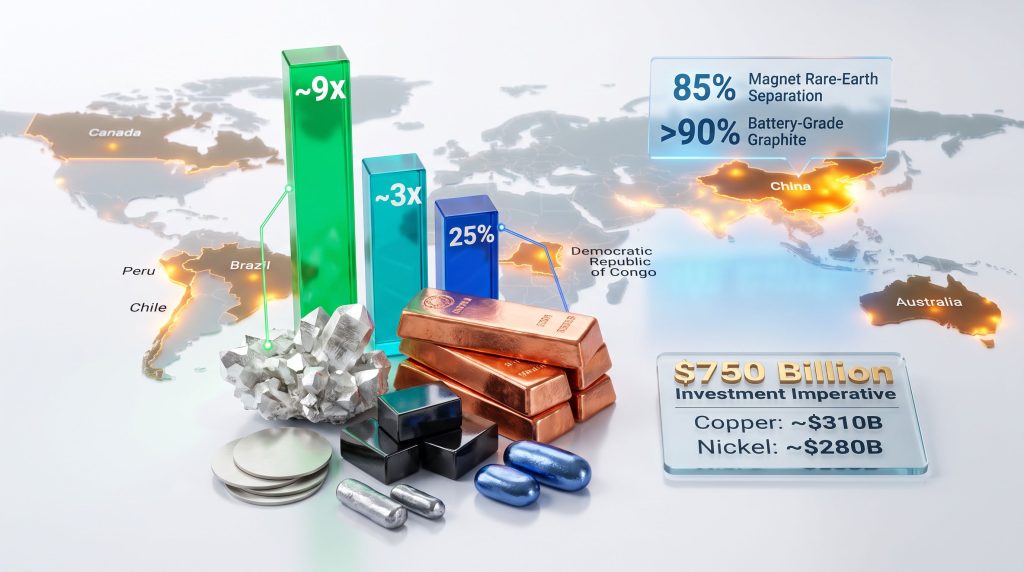
The gap between these scenarios is not marginal. For individual minerals, particularly lithium and graphite, the difference between STEPS and NZE demand projections by 2040 spans a factor of three to four. This makes scenario selection one of the most consequential variables in any supply planning or capital allocation exercise.
Scenario assumptions are not merely academic. For a mine developer planning a project with a 15-year lead time, the difference between STEPS and NZE demand projections can mean the difference between a commercially viable operation and a stranded asset, or the reverse.
Critical Mineral Demand Growth Summary: STEPS vs. NZE by 2040
| Mineral | STEPS Demand Growth (by 2040) | NZE Demand Growth (by 2040) |
|---|---|---|
| Lithium | More than triple | Approximately ninefold |
| Graphite | Approximately double | Nearly quadruple |
| Nickel | ~65% | Approximately double |
| Cobalt | Moderate growth | Approximately double |
| Rare Earth Elements | ~50% | Significant uplift |
| Copper | +7 million tonnes (~25%+) | Grid demand approaching 10 Mt |
Even under STEPS, the most conservative pathway, total clean energy mineral demand doubles by 2040. Under full decarbonisation trajectories, it roughly quadruples. No single supply response can fully absorb this shift without coordinated global investment at a scale the industry has not previously experienced.
Which Minerals Face the Most Severe Supply-Demand Imbalances Through 2040?
Lithium: The Fastest-Growing Critical Mineral on the Planet
Lithium occupies a singular position in the critical mineral hierarchy. According to IEA projections, demand is set to more than triple by 2040 under STEPS, with the NZE scenario pushing that multiple to approximately ninefold. The primary engine of this demand is EV battery adoption, which accounts for the overwhelming majority of incremental lithium consumption.
What makes the lithium outlook particularly complex is the divergence between upstream mining progress and downstream refining capacity. Announced lithium mining projects outside dominant producing jurisdictions have grown substantially, but the conversion of spodumene concentrate and brine into battery-grade lithium carbonate or lithium hydroxide remains heavily concentrated. China controls approximately 70% of global lithium refining capacity, meaning that even diversified mining supply must pass through a narrow processing bottleneck before reaching battery manufacturers.
Direct lithium extraction technologies are emerging as a potential partial solution to this processing challenge, offering faster ramp-up times and lower environmental footprints than conventional evaporation pond methods. However, a persistent supply gap for lithium is expected to remain through at least 2035, even accounting for projects currently in development.
Copper: A Slow-Burning Structural Deficit With Enormous Capital Implications
Copper's demand trajectory is less dramatic in percentage terms but staggering in absolute volume. IEA analysis projects demand growth of more than 25%, adding approximately 7 million tonnes by 2040 under STEPS. Under SDS, grid-related copper demand alone approaches 10 million tonnes annually.
Electricity grid modernisation is the single largest incremental demand source, representing a structural shift that is often overlooked in commodity market commentary focused on EV battery minerals. Every kilometre of transmission line, every substation transformer, every household connection to a smart grid requires copper at densities that have not changed despite decades of material science innovation.
Closing the copper supply gap is estimated to require approximately $310 billion in investment through 2040, making it the single largest capital requirement of any critical mineral. Supply gaps for copper are expected to persist through 2035 under current investment trajectories.
Graphite: The Overlooked Battery Mineral With a Refining Chokepoint
Graphite rarely receives the same investor attention as lithium or copper, yet it is present in every lithium-ion battery anode and has no commercially scalable substitute currently in widespread deployment. Demand is projected to double under STEPS and nearly quadruple under NZE by 2040.
The structural vulnerability in graphite markets is arguably more acute than for any other battery mineral. China accounts for more than 90% of global battery-grade graphite production, encompassing both natural graphite processing and synthetic graphite manufacturing. Announced mining projects in Africa, Australia, and North America have expanded the potential upstream supply base, but downstream spherical graphite purification capacity outside China remains a fraction of what projected demand will require.
A lesser-known dimension of this challenge is the technical difficulty of graphite purification itself. Achieving the 99.95%+ carbon purity required for battery-grade material typically requires either hydrofluoric acid processing, which carries significant environmental and regulatory challenges in Western jurisdictions, or emerging thermal purification methods that are still being scaled commercially.
Nickel and Cobalt: Tightening Outlooks With Geopolitical Dimensions
Nickel demand is projected to grow by approximately 65% under STEPS by 2040. The supply outlook has tightened compared to prior year assessments, partly reflecting underinvestment in Class 1 nickel production, which is the high-purity form required for battery cathode materials.
An important nuance often missed in mainstream coverage is the distinction between nickel classes. Class 1 nickel, including refined metal and nickel sulphate, is what battery manufacturers require. Class 2 nickel, predominantly nickel pig iron produced in Indonesia and the Philippines for stainless steel, requires additional processing steps to reach battery grade. The expansion of Indonesian nickel output has suppressed nickel prices but has not fully resolved the battery-grade supply picture.
Cobalt faces a different risk profile. The Democratic Republic of the Congo produces roughly 70% of the world's mined cobalt, and the introduction of export quotas by Congolese authorities has created a supply disruption dynamic that adds a policy risk premium. Battery chemistry evolution, particularly the adoption of lithium iron phosphate (LFP) chemistry, which contains no cobalt, provides a partial offset. However, higher-energy-density applications continue to rely on cobalt-containing cathode chemistries, meaning demand growth persists across all IEA scenarios.
Rare Earth Elements: Magnetic Materials at the Heart of EV Motors and Wind Turbines
Rare earth demand is projected to rise by approximately 50% under STEPS by 2040, driven primarily by permanent magnet demand for EV traction motors and direct-drive wind turbines. Rare earth supply chains remain critically exposed to geographic concentration, with China controlling approximately 85% of global magnet rare-earth separation capacity.
Emerging rare earth processing projects in Australia, the United States, and Europe have made progress, but the timeline to meaningful scale outside China remains measured in years to decades rather than months.
Where Is the Real Vulnerability: Mining or Refining?
The Upstream vs. Downstream Imbalance
The critical mineral supply chain risk has evolved. New mine approvals are accelerating in multiple jurisdictions, and the upstream mining picture, while still inadequate, is improving. The more acute vulnerability now lies in the midstream: the refining, processing, and chemical conversion steps that transform raw ore into battery-grade or technology-grade material.
The distinction matters enormously for policy and investment. A new lithium mine in Australia or Chile adds to raw material supply, but if the spodumene or brine it produces must still be shipped to China for refining, the geographic concentration risk in the supply chain is not materially reduced.
China's Refining Dominance: A Statistical Overview
| Mineral | China's Share of Global Refining/Processing |
|---|---|
| Copper refining | ~50% |
| Lithium refining | ~70% |
| Cobalt refining | ~75% |
| Magnet rare-earth separation | ~85% |
| Battery-grade graphite | >90% |
This concentration did not emerge by accident. It reflects decades of deliberate industrial policy, subsidised energy costs for energy-intensive processing operations, integrated supply chain development, and the accumulation of technical expertise that is difficult to replicate quickly.
Why New Mining Capacity Alone Cannot Solve the Supply Gap
Several interconnected factors mean that upstream diversification, while necessary, is insufficient on its own:
- Announced lithium and graphite mining projects outside dominant suppliers represent substantial capacity additions, but refining and cathode material capacity outside China remains considerably smaller than required to match projected demand.
- The bottleneck scenario is real: new mines could come online on schedule while processed material supply remains constrained because the refining step has not kept pace.
- Policy levers being deployed in the United States, European Union, and Australia are beginning to direct capital toward midstream processing, but the timelines for new facilities to reach commercial operation typically run to five to ten years.
- Technical knowledge transfer is a genuine constraint, as battery-grade processing requires highly specialised expertise in hydrometallurgy, electrochemistry, and quality control.
How Much Investment Is Required to Close the Critical Mineral Gap by 2040?
The $750 Billion Investment Imperative
Meeting projected critical mineral demand through 2040 under STEPS alone requires more than $750 billion in combined mining and refining investment. This figure, drawn from IEA analysis, breaks down as follows:
| Mineral | Estimated Investment Required Through 2040 |
|---|---|
| Copper | ~$310 billion |
| Nickel | ~$280 billion |
| Lithium, graphite, cobalt, rare earths | Remaining allocation |
These are not theoretical numbers. They represent the capital that must be committed, permitted, constructed, and brought into operation over roughly fifteen years, against a backdrop of commodity price volatility, geopolitical risk, permitting complexity, and competition for engineering talent and infrastructure.
Where Is This Capital Expected to Come From?
- Sovereign wealth funds and state-backed mining enterprises in resource-rich nations are emerging as significant capital providers, particularly in Australia, Canada, and parts of Latin America.
- Private equity and institutional capital has increased its exposure to critical minerals over the past three years, attracted by the structural demand narrative but increasingly cautious about project execution risk.
- Multilateral development bank financing, including from the World Bank, Asian Development Bank, and regional development institutions, is being directed toward critical mineral projects in developing nations where commercial financing is constrained.
- Offtake agreements from large battery manufacturers, automotive OEMs, and technology companies are becoming essential de-risking tools for greenfield project financing.
Consequently, battery metals investment is increasingly characterised by complex financing structures that blend public and private capital across multiple jurisdictions.
Investment Risk Factors That Could Delay Supply Response
- Permitting timelines in Western jurisdictions have historically averaged between 10 and 20 years for new mine development from discovery to production, creating a structural lag between demand signals and supply response.
- Community consent processes, environmental impact assessments, and indigenous land rights considerations are becoming more complex and time-consuming in many jurisdictions.
- Commodity price volatility remains a critical financing risk. Lithium's price collapsed by more than 80% between its 2022 peak and late 2024, creating severe capital market conditions for lithium project developers regardless of the structural long-term demand outlook.
- Geopolitical risk in high-concentration supply regions, including the DRC, Indonesia, and China, adds a systemic risk premium that is difficult to hedge through conventional financial instruments.
The next major ASX story will hit our subscribers first
Can Recycling Meaningfully Reduce Primary Mineral Demand by 2040?
The Secondary Supply Trajectory
Recycling is expected to become an increasingly important contributor to critical mineral supply, but its scale through 2040 should not be overstated. Under STEPS, secondary supply from recycling could roughly double its share of total supply, rising from approximately 10% currently to nearly 20% by 2040.
The minerals most amenable to closed-loop recovery at commercial scale are lithium, cobalt, and nickel, all of which can be extracted from end-of-life battery materials through hydrometallurgical processes with reasonable efficiency. Graphite and rare earth elements, however, present more significant technical and economic recycling challenges.
What Needs to Happen for Recycling to Reach Its Projected Contribution
- End-of-life EV battery volumes need to reach critical mass, which is primarily a post-2030 phenomenon given the typical 8–15 year battery lifespan and the relative youth of the EV fleet.
- Investment in battery collection infrastructure, disassembly facilities, and hydrometallurgical processing plants must accelerate considerably beyond current levels.
- Regulatory frameworks mandating minimum recycled content in new battery production, similar to requirements emerging in the EU's Battery Regulation, need to be implemented and enforced consistently.
- Extended producer responsibility schemes that assign end-of-life management obligations to battery manufacturers and EV producers need to become the norm rather than the exception across major markets.
Even at 20% recycling penetration by 2040, primary demand growth will still require enormous new mine and refinery development. Secondary supply is a complement to primary supply expansion, not a substitute for it.
What Policy Architecture Is Needed to Build Resilient Critical Mineral Supply Chains?
Reducing Investment Risk: The Policy Toolkit
Governments seeking to accelerate critical mineral supply development have a range of tools available:
- Production tax credits and accelerated depreciation allowances for qualifying mining and refining projects, as exemplified by provisions within the US Inflation Reduction Act.
- Strategic stockpiling programs that provide floor price certainty and demand signals for domestic producers.
- International supply chain partnerships, including the Minerals Security Partnership, which involves the United States, European Union, Japan, South Korea, Australia, Canada, and the United Kingdom.
- The EU Critical Raw Materials Act, which establishes domestic production benchmarks and creates a framework for strategic project identification within the European Union.
The Refining and Processing Policy Gap
A persistent weakness in current critical mineral policy frameworks is the disproportionate focus on upstream mining relative to midstream processing. The energy security implications of this gap are considerable, particularly for nations that possess abundant ore reserves but lack domestic refining capacity.
Incentive structures designed to attract cathode material production, precursor chemical manufacturing, and refining investment remain less developed and less generous than those targeting mine development in many jurisdictions. This matters because the value and strategic leverage in critical mineral supply chains resides increasingly in the processing steps.
Scenario Analysis: What Happens If Policy Action Is Delayed?
| Scenario | Outcome by 2035 |
|---|---|
| Timely coordinated policy action | Supply gaps narrow; refining diversification accelerates meaningfully |
| Partial policy response | Copper and lithium gaps persist; China retains dominant processing position |
| Policy inaction | Severe bottlenecks emerge; clean energy deployment timelines slip materially |
Furthermore, as UNCTAD has noted, critical minerals are already fundamentally reshaping global trade patterns, adding urgency to the policy response required across all major economies.
Frequently Asked Questions: Critical Mineral Demand Through 2040
What is the single fastest-growing critical mineral by demand through 2040?
Lithium is projected to experience the most rapid demand acceleration, ranging from more than triple under conservative policy scenarios to approximately ninefold under full decarbonisation pathways by 2040. This growth is driven almost entirely by EV battery adoption and grid-scale storage deployment.
Will supply gaps for copper and lithium be resolved before 2035?
Based on current project pipelines and investment trajectories, supply gaps for both copper and lithium are expected to persist through at least 2035, even as new mining capacity enters production. The more binding constraint is refining and processing capacity, which is not expanding at a pace sufficient to match projected demand growth.
How does China's dominance in mineral processing create systemic risk?
China's control of between 50% and more than 90% of refining capacity across key critical minerals means that even as mining diversifies globally, the transformation of raw ore into usable battery or technology materials remains heavily concentrated. Any disruption to Chinese processing capacity could create acute supply shortfalls regardless of mining output elsewhere in the world.
What role will recycling play in the critical mineral supply chain by 2040?
Secondary supply from recycling is projected to roughly double its contribution by 2040, rising from approximately 10% today to nearly 20%. While meaningful, this contribution will not offset primary demand growth on its own, making new mine development and processing investment simultaneously essential.
How much does the energy transition scenario matter for mineral demand projections?
Enormously. Under conservative policy assumptions, total clean energy mineral demand doubles by 2040. Under full net-zero pathways, it roughly quadruples. For individual minerals like lithium, the spread between scenarios spans a factor of three to four, making scenario assumptions one of the most consequential variables in any long-term supply planning or investment analysis.
The Strategic Outlook: Key Takeaways for Investors, Policymakers, and Industry
Five Structural Realities Shaping Critical Mineral Markets Through 2040
- Demand growth is scenario-dependent in magnitude but structurally inevitable across all credible pathways.
- The refining and processing chokepoint is more consequential to supply security than the mining gap.
- Capital requirements exceeding $750 billion cannot be mobilised without coordinated public-private investment frameworks operating across multiple jurisdictions simultaneously.
- Recycling will contribute meaningfully but cannot substitute for primary supply expansion at the volumes required through 2040.
- Geopolitical concentration risk in processing, particularly China's dominance in midstream capacity, remains the defining systemic vulnerability of the entire energy transition minerals complex.
The Minerals That Warrant the Closest Strategic Attention
| Mineral | Primary Risk Factor | Strategic Priority Level |
|---|---|---|
| Lithium | Processing concentration, price volatility | Critical |
| Graphite | >90% Chinese processing dominance | Critical |
| Copper | Capital intensity, long lead times, volume scale | Critical |
| Cobalt | Single-country export policy risk (DRC) | High |
| Rare Earth Elements | Limited processing alternatives outside China | High |
| Nickel | Class 1 vs. Class 2 supply distinction | Moderate-High |
The overarching message from IEA scenario analysis is unambiguous. Meeting even the most conservative projections for critical mineral demand through 2040 will require investment commitments, policy coordination, and supply chain development at a scale and speed that the global mining and processing industry has not previously been asked to deliver. The minerals that power the clean energy transition are no longer a secondary consideration. They are the transition itself.
Disclaimer: This article contains projections and forward-looking analysis drawn from IEA scenario modelling. Mineral demand forecasts are subject to significant uncertainty based on policy trajectories, technology evolution, commodity prices, and geopolitical developments. Nothing in this article should be construed as financial or investment advice. Readers should conduct their own due diligence before making investment decisions.
Want to Invest in the ASX Companies Discovering the Critical Minerals Powering the Energy Transition?
Discovery Alert's proprietary Discovery IQ model delivers real-time alerts on significant ASX mineral discoveries — including lithium, copper, graphite, and rare earth elements — turning complex data into actionable investment insights the moment they hit the market. Explore Discovery Alert's discoveries page to see how historic ASX mineral discoveries have generated substantial returns, and begin your 14-day free trial today to position yourself ahead of the broader market.