August 1, 2026
The Invisible War Beneath Africa's Soil: How Critical Minerals Became the New Frontier of Superpower Competition
Long before electric vehicles became mainstream or clean energy targets reshaped industrial policy, a quieter contest was unfolding across Africa's vast mineral belts. The competition was not fought with armies or trade embargoes but with capital, contracts, and infrastructure. Two decades of patient investment by Chinese state-backed enterprises built a structural presence in African mining and processing that the United States is now working urgently to counterbalance. Understanding this rivalry requires looking beyond the headline figures and into the mechanics of how critical mineral supply chains actually function — and where their most consequential vulnerabilities lie.
The US Africa critical minerals strategy against China is no longer a background policy discussion. It has become one of the defining industrial and geopolitical contests of the decade, driven in part by the surging critical minerals demand tied to the global energy transition.
When big ASX news breaks, our subscribers know first
America's Structural Exposure: More Than a Mining Problem
Why Midstream Control Is the Real Leverage Point
When policymakers in Washington discuss critical mineral dependence, public conversation often defaults to questions of where minerals are extracted. This framing misses the more strategically significant layer of the problem. The United States relies heavily on foreign sources for a wide range of critical minerals, and China has established a commanding position not merely at the extraction stage but across the midstream processing and refining infrastructure that converts raw ore into battery-grade or defense-grade materials.
This distinction matters enormously in practical terms. A nation can own a cobalt mine outright and still depend on Chinese refiners to transform that ore into a usable industrial input. The concentration of refining capacity creates what policy analysts describe as single-point vulnerabilities, where disruption to one country's processing infrastructure cascades across multiple sectors simultaneously, from electric vehicle production through to defense electronics and aerospace systems.
"China's competitive advantage in critical minerals is not primarily about what it mines. It is about what it transforms. Control over refining capacity provides leverage over pricing, availability, and the terms on which other nations access finished materials, regardless of where the original ore was extracted."
Furthermore, the minerals at the centre of this structural rivalry span a wide range of industrial applications:
| Mineral | Primary African Source | End-Use Application | China's Processing Role |
|---|---|---|---|
| Cobalt | DRC (~70% of global supply) | EV batteries, aerospace, defense | Dominant refiner globally |
| Copper | Zambia, DRC | Electronics, grid infrastructure | Major processor |
| Lithium | Zimbabwe, Namibia, Ghana | EV batteries, energy storage | Leading refiner |
| Platinum Group Metals | South Africa (world's largest reserves) | Hydrogen fuel cells, automotive | Significant downstream role |
| Graphite | Multiple African nations | Battery anodes | Near-monopoly in processing |
| Rare Earths | Namibia, Mozambique, others | Defense systems, electronics | Dominant global position |
Africa's Mineral Endowment: The Numbers That Define the Competition
Why No Alternative Geography Can Replace the Continent
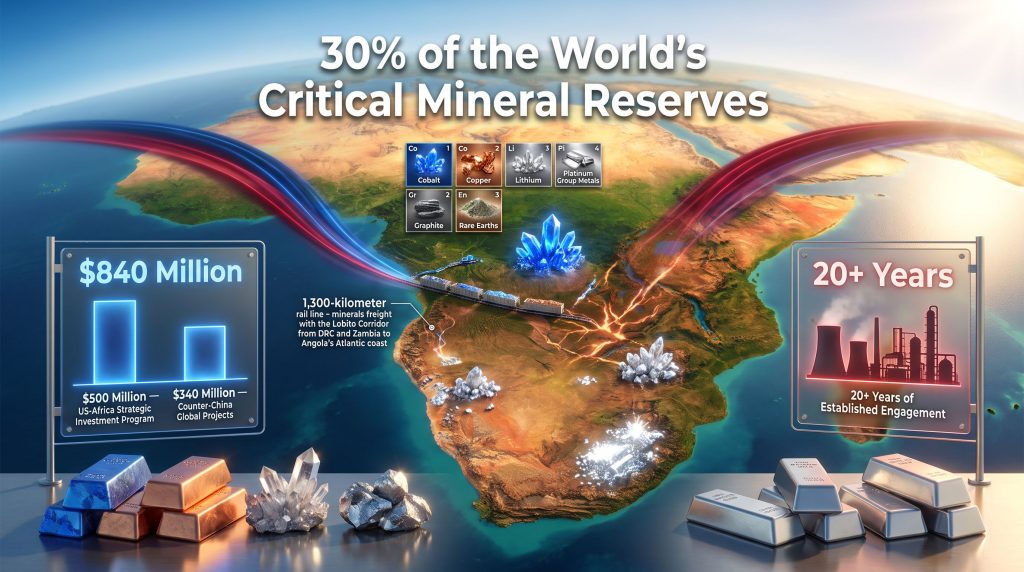
Africa's importance to this rivalry is not rhetorical. According to the United Nations University Institute for Natural Resources in Africa, the continent holds approximately 30% of the world's critical mineral reserves. This concentration spans cobalt, lithium, manganese, copper, nickel, graphite, platinum-group metals, and a growing portfolio of rare earth deposits across the eastern and southern mineral belts.
The numbers at the country level are equally striking. The DRC mineral wealth alone positions the country as arguably the most strategically important mineral nation on the planet:
- The Democratic Republic of Congo produces approximately 70% of global cobalt supply, a single-country concentration that gives any investor with entrenched DRC relationships disproportionate influence over global battery supply chains
- South Africa leads global platinum production and holds some of the world's largest confirmed reserves of platinum-group metals, which are indispensable for hydrogen fuel cell technology and automotive catalytic systems
- Zambia ranks among Africa's foremost copper producers, supplying a metal that underpins everything from power grid infrastructure to consumer electronics
- Zimbabwe, Namibia, and Ghana are actively developing their lithium industries, with each government implementing increasingly assertive local processing requirements to capture downstream economic value
The Beneficiation Revolution Reshaping Investment Terms
A structural shift is occurring across African mineral economies that both the US and China must now accommodate. For decades, the dominant pattern was straightforward: African nations exported raw ore, Chinese or Western processors refined it, and finished products were reimported at significantly higher cost. African governments are now systematically dismantling this model.
Zimbabwe banned raw lithium ore exports in 2022 and has signalled its intention to prohibit lithium concentrate exports from 2027 onward, compelling investors to establish in-country processing infrastructure rather than simply extracting and shipping unprocessed material.
Namibia has moved further, restricting exports of multiple unprocessed critical minerals including lithium, cobalt, manganese, graphite, and certain rare earth minerals, though exceptions can apply in specific circumstances. Ghana has taken a parallel path, requiring local processing of lithium as a condition of export permission.
"This continent-wide beneficiation push fundamentally alters the investment calculus for any foreign party seeking African mineral access. The era of extracting raw ore and processing it elsewhere is ending, and the nation or bloc that builds the most credible in-country processing partnerships will gain the most durable long-term supply chain relationships."
Decoding the US Africa Critical Minerals Strategy Against China
Five Instruments Driving Washington's Approach
The US approach to competing in Africa's mineral sector is structurally distinct from China's model in ways that create both advantages and limitations. Rather than deploying state-owned enterprises to acquire direct equity in mining assets, Washington relies on a framework built around five interlocking instruments:
- Targeted mineral partnerships with resource-rich African governments, prioritising nations with significant reserves of battery and defense-critical minerals
- Offtake agreements and government-backed financing designed to secure future supply for US-aligned markets without requiring direct American operational involvement in high-risk extraction environments
- Blended finance and de-risking mechanisms deployed through the US International Development Finance Corporation (DFC), the US Trade and Development Agency (USTDA), the Export-Import Bank (EXIM), and the State Department
- Infrastructure co-investment in transport, port, and power systems that makes mineral projects commercially viable and reduces logistical barriers for American and allied-nation partners
- Midstream processing and beneficiation support to help African nations build in-country refining capacity, aligning with African development priorities while diversifying supply chains away from Chinese processing dominance
Breaking Down the $840 Million Commitment
Two parallel financial commitments define the current scale of US engagement:
| Program | Funding Level | Primary Mechanism | Target Outcome |
|---|---|---|---|
| Counter-China Global Projects | $340 million | Government grants and project financing | Reduce Chinese influence across Africa, Americas, and Asia |
| US-Africa Strategic Investment Program | $500 million | Grants of $5M-$50M to private-sector partners | Increase private investment, strengthen US commercial ties |
The $500 million US-Africa Strategic Investment Program, administered by the State Department's Bureau of African Affairs, is structured to fund approximately ten awards across priority areas. These include geological mapping and mineral data infrastructure, customs system modernisation, regulatory framework strengthening, and local workforce development. Grants are expected to range from $5 million to $50 million per award, directed toward private-sector partners and qualifying organisations operating in African mineral economies.
While the program is not officially described as a counter-China initiative, its design directly addresses the supply chain vulnerabilities created by China's entrenched position in African mineral processing. Independent analysts widely interpret it as serving both development and strategic objectives simultaneously, a framing that creates different expectation sets for African partner governments than it does for American policymakers.
How China Built a 20-Year Head Start
State Capital, Infrastructure, and Patience
China's current position across Africa's mineral sector was not assembled through short-term financial engineering. It reflects a multi-decade strategy that combined state-backed financing, large-scale infrastructure construction, and progressive acquisition of mining and processing assets across the continent. China's rare earth strategy has been particularly consequential, with Chinese entities building substantial interests in mining and mineral processing operations in the DRC, Zambia, Zimbabwe, and beyond.
Chinese companies and state-backed institutions financed and built ports, railways, power generation facilities, and telecommunications networks across multiple African nations, establishing economic relationships well before Washington treated Africa as a strategic priority in the minerals context. The Belt and Road Initiative amplified this engagement from approximately 2013 onward, though China's involvement in African resource sectors both predates and extends beyond that framework in scope and geography.
The most durable element of China's advantage is its control over the transformation stage between raw ore and finished industrial material. According to research from Africa Center, by occupying the refining and processing layer, Chinese companies remain indispensable across multiple stages of the global supply chain regardless of whether African mineral export policies shift in the years ahead.
The Lobito Corridor: Infrastructure as Geopolitical Instrument
Why a 1,300-Kilometre Railway Matters to US Strategy
Among the infrastructure investments central to the US Africa critical minerals strategy against China, the Lobito Corridor represents the most tangible example of Washington using physical infrastructure to create alternative mineral export pathways. The corridor is a 1,300-kilometre rail and port infrastructure network linking the mineral-producing regions of Zambia and the Democratic Republic of Congo to Angola's Atlantic coastline.
By providing direct Atlantic access for cobalt, copper, and other critical minerals, the corridor addresses a longstanding logistical bottleneck that has historically constrained export efficiency from landlocked mineral regions. Its strategic significance goes beyond logistics:
- It creates an export route for critical minerals that does not depend on Chinese-controlled logistics infrastructure
- It strengthens US-Angola economic and diplomatic ties, drawing Angola further into the orbit of Washington's African engagement framework
- It demonstrates to other African governments that the US is prepared to invest in the physical infrastructure that makes mineral partnerships commercially viable, not merely in the financing of extraction activity
- It provides a replicable model for infrastructure-as-diplomacy that the US can apply to other mineral-critical corridors across the continent
The next major ASX story will hit our subscribers first
Comparing the Two Strategies: A Framework Analysis
| Dimension | US Strategy | China's Approach |
|---|---|---|
| Primary instrument | Diplomacy, DFI, private-sector partnerships | State-owned enterprise investment, BRI financing |
| Mining asset ownership | Indirect (offtake agreements, financing) | Direct (equity stakes in mines and processors) |
| Infrastructure investment | Targeted (Lobito Corridor, port upgrades) | Broad (railways, ports, telecoms, power) |
| Processing and refining | Supports in-country beneficiation | Controls global refining capacity |
| Governance standards | Emphasises transparency, ESG, rule of law | Lower conditionality on governance |
| Timeline of engagement | Accelerating from 2022 onward | Established over 20-plus years |
| African government perception | Newer entrant, higher conditionality | Established partner, faster delivery |
Africa's Strategic Agency: More Than a Passive Arena
Why African Governments Are the Third Actor in This Rivalry
Academic research by Dr. Lina Benabdallah of the Department of Politics and International Affairs at Wake Forest University challenges the prevailing framing of Africa as a passive venue for US-China competition. Her work demonstrates that analysing China-Africa ties purely through the lens of superpower rivalry reduces African leaders to bystanders in a contest they are actively shaping to serve their own national interests.
This perspective carries practical implications. With two major powers actively competing for mineral partnerships, African governments can compare investment offers across multiple dimensions and push for materially improved terms:
- Greater local employment and skills transfer requirements
- Technology transfer commitments embedded in investment agreements
- In-country processing and refining infrastructure as a condition of access
- More favourable revenue-sharing arrangements that retain greater fiscal value domestically
The risks of this leverage, however, cut both ways. Over-dependence on either power risks recreating at the sovereign level exactly the supply-chain concentration that Washington is trying to escape. Rapid mineral sector expansion without adequate institutional capacity can generate revenue volatility, environmental stress, and governance fragility. Consequently, competing investment frameworks from two major powers may include conditionalities that constrain domestic policy flexibility in ways that African governments will need to negotiate carefully.
"Research from the Brookings Institution suggests the US would strengthen its competitive position in Africa by concentrating on a smaller set of priority minerals, improving coherence across its multiple financing agencies, and aligning commercial and development objectives more explicitly. A fragmented multi-agency approach risks creating confusion among African partner governments and diluting the strategic effectiveness of US capital deployment."
The Minerals Security Partnership and What Comes Next
Multilateral Architecture for a Multipolar Mineral Market
Beyond bilateral partnerships, the Minerals Security Partnership (MSP) represents Washington's attempt to pool diplomatic influence, financing capacity, and technical expertise across allied nations to build a credible, collectively scaled alternative to Chinese-dominated supply chains. The US-Congo minerals partnership exemplifies this approach, targeting the full mineral value chain, from geological mapping and exploration through extraction, processing, and end-use manufacturing.
The planned meeting between President Trump and Chinese President Xi Jinping in September 2026 adds complexity to the strategic calculus. Even as the mineral competition intensifies, the fact that diplomatic channels between the two powers remain open suggests the rivalry will continue to unfold through economic and institutional instruments rather than direct confrontation, making Africa's role as the primary arena for this contest more enduring, not less.
For success in this contest, Washington would need to demonstrate several measurable outcomes: secured offtake agreements for cobalt, copper, and lithium channelled through non-Chinese processing infrastructure; operational midstream facilities in Africa supported by US development finance; strengthened institutional capacity in partner nations; and a more coherent, agency-aligned financing architecture capable of competing with China's established speed and scale of capital deployment.
Ultimately, energy security and critical minerals will remain inseparable concerns as the global economy deepens its reliance on electrification and advanced technologies. As analysts at the Stimson Center have noted, Africa's minerals are not simply commodities — they are the physical substrate of the next industrial era, and the nation that most effectively partners with African governments to process and move those minerals will hold a structural advantage across defense, clean energy, and advanced technology for decades to come.
This article incorporates analysis from publicly available research including reports from the United Nations University Institute for Natural Resources in Africa, the Brookings Institution, the US State Department, and academic work published by Wake Forest University. Statements about future investment programs, policy outcomes, and geopolitical trajectories involve inherent uncertainty and should not be interpreted as financial or investment advice.
Want to Capitalise on the Next Major Mineral Discovery Before the Broader Market?
The critical minerals race reshaping Africa's geopolitical landscape is also driving significant ASX exploration activity across cobalt, copper, lithium, and rare earths — and Discovery Alert's proprietary Discovery IQ model scans every ASX announcement in real time, delivering instant alerts when significant mineral discoveries are made, so subscribers can act on actionable opportunities ahead of the crowd. Explore Discovery Alert's discoveries page to see the historic returns major mineral discoveries have generated, and begin a 14-day free trial to gain an immediate market-leading edge.