August 1, 2026
When Bombs Target Barrels: The Strategic Logic of Striking Iran's Energy Sector
Modern warfare rarely confines itself to the battlefield. Over the past century, the deliberate targeting of economic infrastructure — particularly energy systems — has emerged as one of the most consequential and contested strategies available to military planners. The logic is straightforward: destroy the financial engine powering an adversary's war machine, and the conflict becomes unsustainable regardless of military resolve. However, the consequences of pursuing this approach extend far beyond the immediate combat zone, rippling outward into global commodity markets, diplomatic relationships, and the daily lives of civilian populations thousands of kilometres from the front lines.
Reports emerging in late July and early August 2026 indicate that US and Israel planning to bombard energy targets in Iran has moved into an active operational phase, with potential strikes described as possible throughout the weekend of August 1–2, 2026. CBS News, citing multiple sources, reported that the campaign would represent one of the harshest strikes yet against Iranian energy infrastructure during the ongoing conflict. Presidential authorisation from Donald Trump had not been confirmed as of the reporting date, and discussions were reportedly underway about concluding any strikes before financial markets opened on Monday — a detail that reveals as much about the nature of modern strategic planning as any military doctrine.
This article presents geopolitical scenario analysis and does not constitute financial advice. All price projections, escalation scenarios, and strategic assessments are speculative in nature and subject to significant uncertainty.
When big ASX news breaks, our subscribers know first
Why Iran's Energy Infrastructure Has Become the Strategic Centre of Gravity
The shift from targeting military hardware to targeting economic capacity reflects a deeper evolution in how states pursue strategic objectives. Battlefield attrition destroys equipment and personnel. Economic coercion, by contrast, targets the system that reproduces military capacity — the revenue flows, the fuel supply chains, the industrial base.
For Iran, petroleum revenue sits at the core of state financing. Oil and gas exports have historically accounted for between 40% and 70% of government budget revenues, depending on the price environment and sanctions exposure, according to data from the U.S. Energy Information Administration. Furthermore, even under heavily sanctioned conditions, Iran has continued to export crude oil — primarily to China and, to a lesser extent, India — generating the foreign currency earnings that sustain both civilian government functions and military spending.
This dual dependency creates a strategic vulnerability of the first order. Disrupt the energy export system comprehensively enough, and you simultaneously:
- Drain the foreign currency reserves financing weapons procurement and proxy support
- Destabilise the domestic economy, creating internal political pressure on the regime
- Signal credible escalatory capability to regional adversaries and allies alike
- Force Iran into an impossible resource allocation choice between military capacity and civilian stability
The escalation sequence matters here. Strikes on Iranian energy infrastructure in 2026 would not occur in isolation. They represent a progression along an escalation ladder that has already included strikes on military facilities, missile production sites, and command infrastructure. Consequently, energy targeting occupies a qualitatively different rung on that ladder — one that crosses from military suppression into economic warfare with genuinely global consequences, heightening the geopolitical risk landscape considerably.
Mapping Iran's Critical Energy Infrastructure: What Is Actually at Risk?
Kharg Island: The Single Point of Failure in Iranian Export Architecture
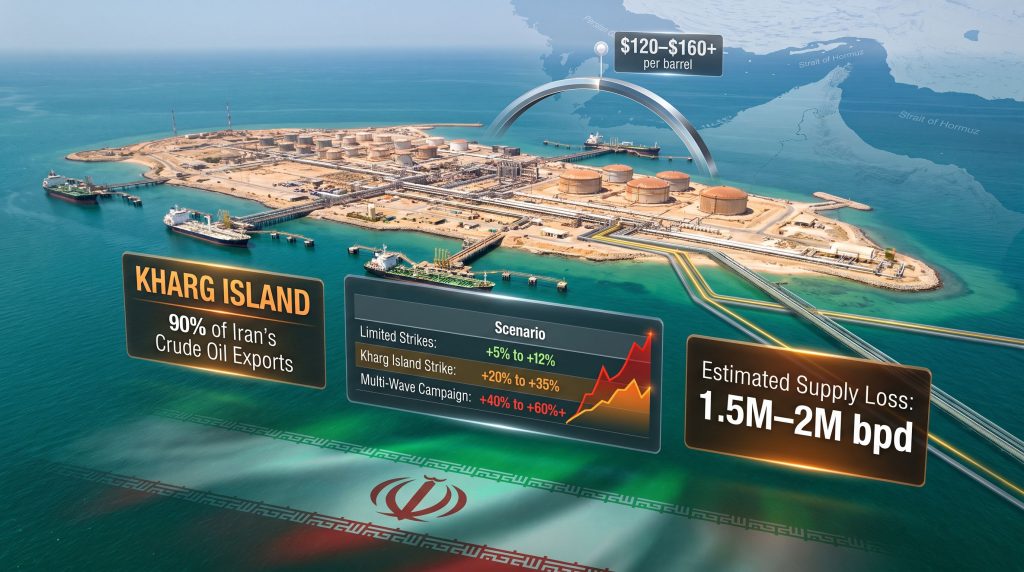
Understanding why Kharg Island dominates any strategic analysis of Iranian energy vulnerability requires appreciating just how concentrated Iran's export architecture actually is. The offshore terminal, located approximately 25 kilometres off Iran's southwestern coast in the Persian Gulf, handles an estimated 90% of Iran's crude oil exports, according to the U.S. Energy Information Administration. No other single facility comes close to this level of strategic significance within Iran's export system.
Kharg Island's infrastructure includes multiple single-point mooring buoys capable of loading very large crude carriers (VLCCs), storage tank farms with a combined capacity exceeding tens of millions of barrels, and subsea pipeline connections to onshore production fields. The terminal's offshore positioning creates both a logistical vulnerability and a complicating factor for any strike planning that seeks to minimise environmental damage to the Persian Gulf.
Historical precedent underscores the terminal's resilience but also its vulnerability. During the Iran-Iraq War between 1980 and 1988, Kharg Island was struck repeatedly by Iraqi aircraft, temporarily reducing throughput on multiple occasions. However, the technology and precision of 2026-era strike capabilities differ fundamentally from 1980s-era Iraqi air power, and the scale of potential damage from modern munitions against specifically targeted infrastructure components could extend recovery timelines substantially beyond historical precedents.
Downstream Infrastructure: Refineries, Gas Processing, and Distribution Networks
Beyond Kharg Island, Iran operates a network of refineries and gas processing facilities that serve both domestic fuel needs and export functions. The Abadan refinery complex, historically one of the largest in the world before the Iran-Iraq War, has been partially restored over subsequent decades. The Bandar Abbas refinery and the Arak complex represent additional significant nodes in the downstream network.
The strategic calculus around refinery targeting involves a difficult humanitarian trade-off. Unlike export terminals, which primarily serve revenue-generating functions, domestic refineries provide fuel for civilian transportation, heating, and industrial activity. Striking refinery capacity creates immediate civilian hardship in ways that offshore export terminal strikes do not, raising the legal and ethical threshold considerably.
Gas processing facilities present a different profile again. Iran holds the world's second-largest proven natural gas reserves, according to BP's Statistical Review of World Energy, and gas processing infrastructure feeds both domestic consumption and limited export capacity. Targeting these facilities would compound energy deprivation across multiple sectors simultaneously.
Pipeline Corridors and the Repair Timeline Question
A factor frequently underestimated in public discussion of energy infrastructure strikes is the differential repair timeline between above-ground and buried pipeline systems. Above-ground infrastructure — storage tanks, pumping stations, loading equipment — can be damaged or destroyed with precision munitions but can also be repaired or replaced within timelines ranging from weeks to months. Buried pipeline networks, by contrast, are substantially harder to strike but also harder to repair under active conflict conditions.
Iranian engineers demonstrated considerable ingenuity in maintaining partial production capacity during the Iran-Iraq War period, routing flows through backup systems and constructing temporary bypass infrastructure. Any realistic assessment of strike effectiveness must account for this adaptive capacity.
The Market-Timing Dimension: A New Variable in Military Planning
Perhaps the most revealing detail in the reported planning discussions is the consideration of financial market open times as an operational variable. The reported discussion about concluding strikes before Monday's market open represents something genuinely noteworthy in the evolution of military-strategic decision-making.
Military operations have always carried economic consequences, but the deliberate incorporation of market timing into operational planning suggests that financial market reactions are now treated as a primary strategic output — not merely a secondary effect to be managed after the fact.
This reflects a sophisticated understanding of how oil price shock dynamics propagate through the global economy. An oil price spike that emerges during thin weekend trading can be amplified by algorithmic trading systems and thin liquidity before human market participants and policymakers can respond. Completing strikes before market open on Monday would theoretically allow for coordinated communication strategies — releases from strategic petroleum reserves, OPEC+ coordination calls, diplomatic messaging — to be positioned alongside market open rather than scrambling to respond to a spike already in motion.
The Camp David consultations reported on July 31, 2026, involving President Trump and Cabinet members, fit the profile of a final strategic review before an operational go/no-go decision. The involvement of senior economic and energy advisors alongside military and national security figures in such a consultation signals the degree to which economic impact modelling is integrated into the authorisation process.
Three Stress-Test Scenarios: How Global Oil Markets Could Respond
Any projection of market impact requires scenario differentiation. The range of possible outcomes spans from a manageable short-term spike to a potentially structurally transformative disruption of global energy supply architecture.
| Scenario | Primary Targets | Estimated Supply Loss | Short-Term Price Impact | Recovery Timeline |
|---|---|---|---|---|
| Limited Precision Strikes | Secondary refineries, gas processing nodes | 300K–600K bpd | +5% to +12% | 2–3 weeks |
| Kharg Island Strike | Primary export terminal | 1.5M–2M bpd | +20% to +35% | 4–8 weeks |
| Sustained Multi-Wave Campaign | Full energy sector | 2M–3.5M bpd | +40% to +60%+ | 6–18 months |
Scenario 1 — Limited Precision Strikes: Targeting secondary facilities while leaving Kharg Island operational would remove a portion of Iran's export and refining capacity without triggering catastrophic supply disruption. OPEC+ maintains an estimated 3 to 4 million barrels per day of spare production capacity — primarily concentrated in Saudi Arabia and the UAE — that could be mobilised to offset partial Iranian supply losses.
Scenario 2 — Direct Strikes on Kharg Island: Removing the primary export terminal from operation would immediately eliminate approximately 1.5 to 2 million barrels per day from global supply, a volume large enough to overwhelm OPEC+ spare capacity buffers and trigger sustained upward price pressure. The International Energy Agency coordinates emergency Strategic Petroleum Reserve releases among member nations for precisely this type of supply shock, with combined IEA member reserves exceeding 1.5 billion barrels according to IEA data.
Scenario 3 — Sustained Multi-Wave Campaign: A systematic, multi-phase degradation of Iran's entire energy export architecture would represent a supply shock with no historical parallel in the modern oil era. Brent crude price projections under this scenario range into $120 to $160+ per barrel territory, with consequent inflationary pressure driving global economic fallout across every economy dependent on petroleum-based transportation and manufacturing.
Iran's Retaliatory Playbook: The Hormuz Variable and Beyond
The Strait of Hormuz: Geography as a Strategic Weapon
Approximately 20% of global oil supply transits the Strait of Hormuz daily, according to the U.S. Energy Information Administration, making it the single most strategically significant maritime chokepoint on earth. Iran has repeatedly signalled willingness to threaten Hormuz transit as a retaliatory instrument, and it possesses credible capability to do so — not through a formal naval closure, but through targeted harassment of commercial tanker traffic using mines, fast-attack craft, anti-ship missiles, and drone strikes.
Trump's threats against Iran's power plants and the broader Strait of Hormuz situation have already heightened tensions in the region to a critical degree. Even a partial degradation of Hormuz transit confidence — one that causes commercial shipping insurers to raise war-risk premiums dramatically — can produce supply disruption effects without a single tanker being destroyed. The threat itself reshapes market behaviour.
The Gulf Cooperation Council member states — Saudi Arabia, UAE, Kuwait, Qatar, Bahrain, and Oman — all depend on Persian Gulf and Hormuz transit for their own energy exports. Saudi Arabia has invested significantly in the East-West Pipeline system providing an alternative route to Red Sea export terminals, with a capacity of approximately 5 million barrels per day, but this alternative cannot fully absorb a comprehensive Hormuz disruption scenario.
Proxy Network Activation and the Multi-Front Pressure Strategy
Iran's network of regional proxy forces represents a distributed retaliatory capability that cannot be neutralised by strikes on Iranian territory alone. The reported drone targeting of a US military base in Kuwait on July 31, 2026 — attributed to Iranian military forces — demonstrates that retaliatory escalation was already underway before any energy infrastructure strikes had occurred.
Iran's proxy infrastructure spans:
- Iraqi militia networks with demonstrated capability to strike US military and commercial targets
- Houthi forces in Yemen with ballistic missile and drone reach across the Arabian Peninsula
- Hezbollah in Lebanon with a documented arsenal exceeding 100,000 rockets and missiles
- Syrian-based forces providing geographic depth and additional strike corridors
Simultaneous activation across multiple proxy networks would confront US and allied forces with a multi-front response requirement, consuming defensive resources and creating escalation dynamics that could prove difficult to contain within pre-planned operational boundaries.
Cyber and Asymmetric Responses: The SCADA Threat
One dimension of Iranian retaliatory capability that receives insufficient attention in mainstream analysis is the country's developed cyber warfare capacity, particularly against industrial control systems. The 2012 Shamoon malware attack on Saudi Aramco, widely attributed to Iran by US intelligence assessments, destroyed data on approximately 35,000 computers within Aramco's network — at the time one of the most destructive cyber attacks on a private company ever recorded.
Iran has continued developing and refining its offensive cyber capabilities in the years since Shamoon. SCADA systems managing pipeline flows, refinery operations, and power grid infrastructure across Gulf states represent potential targets for cyber escalation that could amplify the oil market disruption extending from kinetic strikes. Unlike missile attacks, successful cyber intrusions into energy control systems can cause physical damage that is difficult to attribute, hard to defend against, and potentially more disruptive than direct strikes on hardened physical infrastructure.
The next major ASX story will hit our subscribers first
The International Law Framework: Contested Territory
When Energy Infrastructure Becomes a Lawful Military Objective
International humanitarian law, as codified in the Geneva Conventions and their Additional Protocols, establishes three core principles governing attacks on infrastructure: distinction (separating civilian from military objectives), proportionality (anticipated military advantage must not be excessive relative to expected civilian harm), and military necessity (the attack must make a genuine contribution to military objectives).
The legal threshold for classifying energy infrastructure as a lawful military objective is genuinely contested. The argument for lawfulness rests on the chain connecting petroleum revenue to military financing: if oil exports demonstrably fund weapons procurement, proxy support, and military operations, then export infrastructure arguably constitutes a legitimate military objective. The counterargument emphasises that the same infrastructure serves civilian populations — providing domestic fuel, employment, and economic stability.
Legal analysts have noted that the dual-use characterisation of energy infrastructure creates a genuine grey zone under existing IHL frameworks. The burden of demonstrating clear military necessity is substantial, and post-conflict accountability mechanisms have grown increasingly willing to scrutinise targeting decisions that result in widespread civilian economic harm.
Post-conflict accountability through the International Criminal Court and ad hoc tribunals has established precedents making energy infrastructure targeting one of the more legally exposed categories of decision-making for military planners.
How Regional and Global Actors Are Positioning
Gulf State Exposure: Between Alliance Obligations and Economic Self-Preservation
Saudi Arabia, the UAE, Kuwait, and Qatar occupy a structurally uncomfortable position in any escalation scenario involving US and Israel planning to bombard energy targets in Iran. As US allies and hosting nations for US military assets, they are embedded in the alliance architecture supporting the campaign. As major energy exporters whose own revenues depend on stable Persian Gulf transit conditions, they bear disproportionate exposure to Iranian retaliation.
This creates a diplomatic positioning challenge: supporting the campaign openly risks drawing retaliatory strikes on their own energy infrastructure, while distancing themselves from the campaign risks damaging strategic relationships with Washington at a moment of maximum regional tension.
China and India: The Captive Importers
China has been estimated to import approximately 1 million barrels per day of Iranian crude oil through various intermediary arrangements, according to tanker tracking data compiled by multiple independent shipping analytics firms. India has similarly maintained a partial import relationship with Iran, though at lower volumes.
A sustained disruption of Iranian supply would force both nations to compete more aggressively for alternative supplies in an already tightened global market. Furthermore, this competition would amplify upward price pressure and potentially accelerate their respective national energy diversification strategies, adding another dimension to the geopolitical oil risks already reshaping global commodity flows.
Russia's Perverse Incentive Structure
Among the major powers with interests in the conflict's trajectory, Russia occupies perhaps the most strategically ambiguous position. Western sanctions have significantly constrained Russian oil export revenues since 2022. A sustained elevation of global oil prices driven by Iranian supply disruption would partially offset this sanctions pressure, improving Russia's fiscal position without requiring any Russian action.
This creates a perverse incentive structure in which Russia has limited motivation to use its diplomatic relationships with Tehran to de-escalate the conflict. Analysts tracking the US-Iran confrontation note that higher prices benefit Moscow regardless of how the military campaign ultimately unfolds, making Russian mediation unlikely in the near term.
Frequently Asked Questions: US and Israel Planning to Bombard Energy Targets in Iran
What energy targets in Iran are reportedly under consideration?
Reporting from CBS News, cited by Arab News and Reuters, indicates that energy-related infrastructure broadly — including oil terminals, refining capacity, and fuel distribution nodes — is under active planning consideration. Kharg Island, handling the vast majority of Iranian crude exports, represents the highest-consequence potential target.
Has presidential authorisation been confirmed?
As of August 1, 2026 reporting, final authorisation from President Trump had not been confirmed. The operation remained in a planning and deliberation phase, with US and Israel planning to bombard energy targets in Iran still subject to senior-level review.
Why does the timing before Monday's market open matter?
Completing strikes before global energy markets open Monday would allow coordinated policy responses — including strategic reserve releases and diplomatic messaging — to be positioned alongside the market open rather than reacting to a spike already underway.
What is Iran's most credible retaliatory option?
Analysts broadly assess Hormuz transit harassment as Iran's most immediately deployable and consequential retaliatory instrument, capable of reshaping global shipping risk perceptions and amplifying supply disruption effects beyond direct strike impacts.
What are the international law concerns?
Strikes on infrastructure serving civilian populations face a high legal threshold under international humanitarian law. The proportionality and military necessity assessments are complex and legally contested, particularly for facilities with significant civilian dependency.
For ongoing regional coverage, Arab News at arabnews.com provides continuous updates on developments across the Middle East and the US-Israel-Iran conflict. This resource is offered for supplementary reading purposes only.
Want to Track the Commodity Market Ripples From Geopolitical Flashpoints Like This One?
When energy infrastructure becomes a military target, the downstream effects on commodity markets can be swift and substantial — Discovery Alert's proprietary Discovery IQ model scans ASX announcements in real time, identifying significant mineral discoveries and actionable opportunities before the broader market catches on. Explore historic discovery returns on Discovery Alert's discoveries page and begin your 14-day free trial to position yourself ahead of the next major market shift.