August 1, 2026
How the Strait of Hormuz Fracture Is Redrawing Global Crude Trade Routes
Energy trade corridors rarely shift overnight. The infrastructure, contracts, and geopolitical relationships that underpin global crude flows tend to calcify over decades, making sudden pivots the exception rather than the rule. Yet when a chokepoint controlling roughly one-fifth of the world's traded oil and natural gas faces sustained disruption, the entire architecture of energy supply chains is forced to adapt. That is precisely the dynamic now playing out across the Eastern Mediterranean, and a single US crude shipment to Israel is one of its most telling early signals.
When big ASX news breaks, our subscribers know first
A Three-Year Gap and What It Reveals
The fact that a US crude shipment to Israel qualifies as notable news speaks volumes about how irregular this trade relationship has historically been. According to Kpler shipping data, the previous confirmed US crude cargo destined for Israel departed in October 2023. In the nearly three years that followed, direct crude flows from the United States to Israel effectively ceased, with bilateral energy trade instead concentrated in refined petroleum products and military-specification jet fuel.
This pattern is not unusual for Israel's crude import profile. Historically, the country has sourced raw crude from a diverse mix of origins including Russian-origin grades, Caspian Basin production, and North Sea blends, with the United States occupying only a marginal position in its crude supply mix. What has changed is the fundamental economics and geopolitics underpinning that supply architecture.
The US-Israel military conflict with Iran, which escalated from February 28, 2026, introduced a structural rupture into the crude supply chains serving the broader Middle East and Eastern Mediterranean regions. Understanding these crude oil trade impacts is essential, as traffic through the Strait of Hormuz historically facilitated approximately one-fifth of globally traded crude oil and natural gas, and contracted sharply as a direct consequence of that conflict. The ripple effects of that contraction are now visibly reshaping where crude originates, how it moves, and who pays for it.
The Captain John Cargo: What the Data Shows
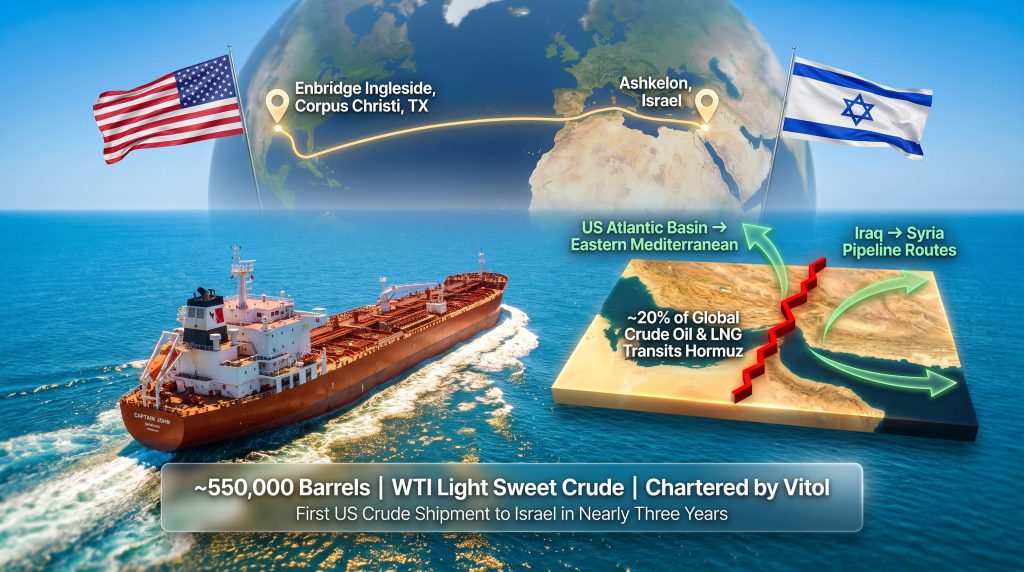
Ship tracking data published by LSEG confirmed that the Malta-flagged Aframax tanker Captain John loaded a cargo of US West Texas Intermediate crude at Enbridge's Ingleside Energy Center near Corpus Christi, Texas, before signalling Israel's southern port of Ashkelon as its destination. The vessel was carrying approximately 550,000 barrels, operating below its maximum Aframax capacity of up to 750,000 barrels.
The cargo was chartered by Vitol, one of the world's largest independent energy trading houses, a detail that carries significant analytical weight. Vitol's participation confirms this was a commercially driven transaction rather than a state-directed intervention. Trading houses of Vitol's scale make chartering decisions based on arbitrage economics, which means the WTI-to-Mediterranean price differential and current freight rates must have aligned sufficiently to make a transatlantic crude voyage economically rational.
| Metric | Detail |
|---|---|
| Vessel Type | Malta-flagged Aframax tanker |
| Vessel Name | Captain John |
| Cargo Grade | US West Texas Intermediate (WTI) |
| Estimated Volume | ~550,000 barrels |
| Maximum Aframax Capacity | Up to 750,000 barrels |
| Loading Terminal | Enbridge Ingleside, Corpus Christi, Texas |
| Destination | Ashkelon, Israel |
| Chartered By | Vitol |
| Data Source | LSEG ship tracking |
Vitol did not respond to requests for comment at the time of reporting, consistent with the firm's customary discretion around individual cargo transactions. The LSEG data nonetheless provides sufficient detail to analyse the trade's commercial logic and its broader implications.
Why WTI Grade Crude Matters for Israeli Refiners
Not all crude grades are interchangeable. The quality characteristics of a crude stream directly determine its compatibility with a given refinery's configuration, and the economics of processing vary significantly across grades. WTI is classified as a light sweet crude, defined by its relatively low sulfur content and high API gravity, typically around 39–40 degrees API. These properties make it one of the most desirable grades for modern refineries designed to maximise output of high-value products like gasoline, jet fuel, and diesel.
Israel's refinery infrastructure at Ashkelon is configured to handle light sweet grades, making WTI technically compatible with the country's downstream processing capacity. In practical terms, receiving a cargo of WTI represents a quality step up from some of the heavier, higher-sulfur Middle Eastern blends that have historically moved through regional supply chains. For Israeli refiners, processing lighter sweet crude typically translates to better product yields and lower processing costs per barrel.
Ashkelon's strategic importance extends beyond its refinery function. The port serves as the Mediterranean terminus for the Trans-Israel Pipeline, known as the Tipline, which connects Ashkelon to Eilat on the Red Sea coast. This infrastructure allows Israel to receive crude from multiple geographic origins and redistribute it internally, providing a degree of supply chain flexibility that many neighbouring nations lack.
The Hormuz Shock and Its Cascading Effects
How Significant Is the Strait of Hormuz Disruption?
Understanding the full significance of this US crude shipment to Israel requires appreciating the scale of the disruption that has reshaped crude flows across the region since February 2026. Furthermore, monitoring current crude oil prices helps illustrate just how dramatically these events have moved global benchmarks.
The Strait of Hormuz, a narrow waterway separating the Omani and Iranian coastlines at its narrowest point of roughly 21 nautical miles, has historically functioned as the world's single most critical energy transit chokepoint. Pre-conflict, it facilitated the movement of an estimated 20 to 21 million barrels per day of crude oil and refined products, plus substantial volumes of liquefied natural gas from Qatar.
When the US-Israel conflict with Iran materially reduced Hormuz traffic, several cascading effects were set in motion:
- Supply vacuum formation: Nations previously reliant on Hormuz-transiting crude faced immediate sourcing gaps that required urgent alternatives.
- Price dislocation: The premium between Gulf-origin grades and Atlantic Basin alternatives narrowed or inverted as Hormuz-dependent supply became less reliable.
- Alternative corridor activation: Iraq moved to export crude and naphtha through Syrian territory, bypassing Gulf routing entirely, according to Arab News reporting.
- Freight market distortion: Vessel availability in the Persian Gulf tightened, pushing Aframax and VLCC day rates higher in the affected zone while potentially improving economics on transatlantic routes.
- Strategic supply diversification: Energy-importing nations accelerated efforts to reduce their exposure to any single geographic corridor.
The Hormuz disruption represents something qualitatively different from previous supply shocks. Unlike price-driven demand adjustments or OPEC production decisions, a physical chokepoint restriction creates structural trade route realignment that can persist long after the triggering event resolves.
Arbitrage Economics: Why This Route Makes Commercial Sense
Do the Numbers Stack Up?
For a transatlantic crude voyage to be commercially viable, several conditions must align simultaneously. The price differential between WTI and competing Mediterranean-origin grades must be wide enough to cover freight costs, port fees, and the trading house's required margin. Given current market conditions shaped by the Hormuz disruption, it appears those conditions have been met. These oil market trade effects are being felt well beyond the immediate conflict zone.
Aframax freight rates on transatlantic routes are influenced by vessel supply and demand dynamics that have been significantly altered by the conflict. As tanker availability in the Persian Gulf contracts due to conflict-related risk premiums and reduced Hormuz throughput, vessels that would ordinarily operate in that basin are potentially being redeployed to safer Atlantic Basin routes, affecting the relative economics of different voyage options.
The ~550,000-barrel cargo at prevailing WTI prices represents a transaction value in the range of tens of millions of dollars, depending on the precise pricing date. At roughly $70–80 per barrel, the cargo value sits in the $38 million to $44 million range, a meaningful but routine transaction size for a firm of Vitol's scale.
For energy market analysts, the key question is not whether this single cargo is significant in isolation, but whether the WTI-to-Mediterranean arbitrage window remains open long enough to attract follow-on cargoes and potentially regularise a new trade corridor.
The next major ASX story will hit our subscribers first
Historical Timeline of US-Israel Crude Trade
| Period | Trade Characteristic |
|---|---|
| Pre-2020 | Sporadic US crude exports; Israel sourced primarily from Russia, Caspian, and North Sea |
| 2020–2022 | Limited US crude flows; refined product trade more active |
| October 2023 | Last confirmed US crude shipment to Israel prior to August 2026 |
| November 2023 to July 2026 | Gap in direct US crude exports; trade concentrated in refined products |
| August 2026 | Resumption of US crude exports — first shipment in nearly three years |
Geopolitical Dimensions: Energy Flows as Strategic Instruments
The commercial logic of this US crude shipment to Israel exists within a broader geopolitical frame that cannot be ignored. The United States liberalised its crude export policy in December 2015, ending a four-decade ban on most crude exports. That legislative shift transformed the US from a protected domestic market into an active global crude exporter, with total US crude exports averaging well above 3 million barrels per day in recent years.
This export capacity has gradually become part of the United States' strategic energy diplomacy toolkit. The Enbridge Ingleside terminal at Corpus Christi, one of the largest crude export facilities on the US Gulf Coast with the capacity to load Very Large Crude Carriers as well as Aframax vessels, represents critical infrastructure in that framework.
Iran's capacity to threaten Hormuz transit has long been a central component of its asymmetric deterrence strategy. The current conflict has activated that lever with measurable real-world consequences. A US crude shipment reaching Israel via the Atlantic Basin effectively operates outside Iran's zone of leverage, supplying an allied nation through a route that Hormuz disruption cannot touch.
This dynamic has broader regional implications worth tracking:
- Jordan and Egypt, which have historically sourced crude through Gulf-adjacent routes, are reassessing supply chain resilience in light of Hormuz contraction.
- Southern European refiners that process Middle Eastern grades are monitoring alternative sourcing options as supply reliability from Gulf producers fluctuates.
- OPEC+ production strategy faces mounting tension as member states navigate between maintaining output discipline and capitalising on disruption-driven price premiums. Indeed, OPEC market influence remains a decisive factor in how these supply gaps are ultimately filled.
- Iraq's Syria pipeline pivot illustrates how quickly alternative infrastructure can be brought into service when primary routes face disruption.
Indicators to Watch for Follow-On Analysis
Which Signals Matter Most?
Whether this represents a one-off arbitrage opportunity or the beginning of a regularised trade corridor depends on the evolution of several observable market variables. In addition, the geopolitical oil price factors at play here will continue to shape how quickly new supply corridors become entrenched.
- Hormuz transit volume data: Any recovery toward pre-conflict throughput levels would reduce the economic incentive for transatlantic routing to the Eastern Mediterranean.
- WTI-Brent price spread: A sustained WTI discount to Brent favours US crude competitiveness on transatlantic routes.
- LSEG and Kpler vessel tracking: Follow-on Aframax or VLCC loadings at Corpus Christi or Houston Ship Channel terminals with Ashkelon or other Israeli port destinations would confirm corridor formation.
- Vitol and peer trading house chartering activity: Subsequent chartering decisions by major commodity traders will signal whether arbitrage economics remain favourable.
- Israeli energy import diversification policy: Any formal announcements regarding supply agreements with Atlantic Basin exporters would indicate strategic intent beyond opportunistic cargo procurement.
The emergence of a regularised US-to-Israel crude corridor, if it materialises, would represent a meaningful structural shift in Eastern Mediterranean energy trade. It would also reinforce the broader pattern of Atlantic Basin crude producers gaining market share in regions previously dominated by Gulf-origin supply chains.
What This Means for Eastern Mediterranean Energy Security
Israel's energy import infrastructure provides the country with more supply flexibility than is commonly appreciated. The Tipline pipeline system, connecting the Mediterranean at Ashkelon to the Red Sea at Eilat, was originally constructed in partnership with Iran during the Shah era in the 1960s and subsequently repurposed following the 1979 Islamic Revolution. Today it functions as a bidirectional crude transport corridor that enables Israel to receive crude from diverse origins and potentially serve as a transit route for third-party crude.
The absorption of Atlantic Basin crude, including WTI-grade shipments from the United States, does not require significant capital investment in new infrastructure. Ashkelon's existing berth capacity and the Tipline's throughput capability are sufficient to accommodate increased volumes from western origins. This gives Israel the ability to respond to Hormuz-driven supply disruption with commercial agility rather than infrastructure constraint.
Furthermore, it is worth noting that Venezuela's recent crude movements toward Israel have also attracted considerable market attention, underscoring that Israel is actively diversifying its crude sourcing across multiple Atlantic Basin origins simultaneously.
For energy market participants tracking the geopolitical evolution of Middle East crude flows, the Captain John cargo is a data point worth far more than its 550,000 barrels of WTI crude. It marks a measurable, commercially validated response to the Hormuz shock — one that may be the first of many as global energy trade continues its slow but unmistakable adaptation to a fundamentally altered regional security environment.
This article draws on ship tracking data reported by Arab News and LSEG, and reflects market conditions as of August 2026. Energy price estimates and freight rate assessments are indicative and subject to market volatility. Readers should conduct independent research before making investment or commercial decisions based on energy trade flow analysis.
Want to Capitalise on the Commodity Market Shifts Reshaping Global Energy Trade?
When geopolitical shocks redraw crude trade routes overnight, identifying the next major resource opportunity demands real-time intelligence — Discovery Alert's proprietary Discovery IQ model instantly scans ASX announcements across 30+ commodities, alerting subscribers to significant mineral discoveries the moment they emerge. Explore how historic discoveries have generated substantial returns on Discovery Alert's dedicated discoveries page, and begin your 14-day free trial today to position yourself ahead of the market.