August 1, 2026
When Energy Becomes a Diplomatic Weapon: Understanding the Stakes for Spain
Energy security has historically been understood through the lens of physical supply chains, infrastructure redundancy, and contract diversification. However, a more unsettling dynamic has emerged across the 2020s: the deliberate weaponisation of energy access as a tool of geopolitical coercion. When a major supplier signals its willingness to disrupt trade flows for political ends, the vulnerability calculus for dependent nations shifts dramatically, regardless of whether formal action ever materialises.
Spain finds itself navigating precisely this terrain. The Trump trade threat and Spain energy security question has moved from theoretical concern to pressing policy challenge, shaped by a confluence of factors that make the country's position more precarious than its surface-level diversification statistics suggest. Furthermore, broader pressures such as the US-China trade war are reshaping global energy and commodity flows in ways that compound Spain's exposure.
When big ASX news breaks, our subscribers know first
Spain's Two-Tier Energy Exposure: Crude Oil Versus Natural Gas
Analysing Spain's vulnerability through a single lens obscures a critical distinction. The country faces two structurally different risk profiles depending on whether the conversation centres on crude oil or natural gas, and conflating them leads to misleading conclusions about national resilience.
Crude Oil: Diversified but Not Painless
On the crude oil side, the United States supplied approximately 250,000 barrels per day to Spain in 2025, representing close to 20% of total crude imports from a national intake of roughly 1.2 million b/d. This is a meaningful share, but not an insurmountable one. Spain's broader crude slate draws from Brazil, Nigeria, Libya, Kazakhstan, and Mexico, which provides a degree of structural buffer.
What makes U.S. crude particularly embedded in Spain's refining system is not just volume but quality and pricing. WTI Midland's light, sweet characteristics align closely with the configurations of Spain's domestic refinery network. Spain's largest refiner operates five domestic refineries with approximately 896,000 b/d of distillation capacity, accounting for roughly 62% of national refining throughput. Those facilities are calibrated to process a carefully balanced blend of light sweet and heavier sour grades, meaning substitution is a precision exercise, not a simple cargo swap.
The complexity deepens when accounting for heavier U.S. grades. Canadian Cold Lake Blend and Southern Green Canyon, both routed through U.S. Gulf terminals, serve Spain's more complex refining facilities where processing margins depend on discounted heavy sour feedstock. Removing U.S. supply from that equation requires sourcing not just replacement volume but replacement quality across multiple crude categories simultaneously.
How the Strait of Hormuz Crisis Reshaped Spain's Import Slate
The 2026 Strait of Hormuz disruptions accelerated Spain's dependence on non-Middle Eastern supply in ways that now complicate the geopolitical picture. Spanish crude imports rose 15.8% year-on-year in April 2026 as refiners scrambled to replace disrupted Middle Eastern barrels. By June 2026, total crude intake had climbed to approximately 1.25 million b/d, up from 1.07 million b/d a year earlier.
The compositional shift was significant:
- Iraqi barrels, previously averaging close to 100,000 b/d, effectively disappeared from Spain's import slate in April 2026
- Kazakh CPC Blend arrivals quadrupled to approximately 140,000 b/d
- Mexican supply rose sharply from 90,000 b/d to 155,000 b/d
- U.S. WTI Midland became a structural pillar, valued for its abundance, Atlantic Basin accessibility, and pricing against WTI benchmarks rather than distorted Middle Eastern markets
| Energy Type | U.S. Share of Spanish Imports (2025) | Primary Alternative Suppliers |
|---|---|---|
| Crude Oil | Brazil, Nigeria, Libya, Kazakhstan, Mexico | |
| Natural Gas (LNG) | ~30% | Algeria (pipeline, ~40%), Russia (Yamal, until Jan 2027) |
Can Spain Replace U.S. Crude? The Substitution Reality
Crude substitution is technically feasible, but each alternative pathway carries its own set of trade-offs that accumulate over time.
Analyst Note: Substitution is not about finding a single replacement barrel. It is about reconstructing the full quality matrix of an integrated refinery system under time pressure and cost constraints.
The four most commonly cited substitution pathways each present specific challenges:
| Substitute Crude | Key Advantage | Key Risk |
|---|---|---|
| Brazilian grades | Short Atlantic shipping distance, growing upstream supply | Premium pricing in high-demand periods |
| West African grades (Nigeria, etc.) | Similar quality profile to WTI Midland | Longer freight routes, logistics cost |
| CPC Blend (Kazakhstan) | Already flowing at elevated volumes | Deepens exposure to Russian Black Sea corridor |
| Mexican grades | Established trade relationship | Declining mature field output, domestic refinery priority |
Brazilian grades are widely regarded as the most viable near-term alternative for Atlantic Basin refiners. Recent upstream discoveries have expanded available supply, and the relatively short shipping distance to Spain minimises freight cost escalation. West African grades such as Nigerian Bonny Light carry a quality profile broadly comparable to WTI Midland but introduce longer voyage times and logistics complexity.
Additional CPC Blend sourcing from Kazakhstan is less attractive than it appears. While volumes are already flowing at elevated levels following the Hormuz disruptions, CPC Blend transits the Russian Black Sea export corridor, creating a geopolitical liability that would deepen rather than reduce Spain's exposure to third-party political risk.
Mexican supply, which surged to 155,000 b/d during the 2026 crisis, faces structural constraints. Mature field decline rates and the Mexican government's prioritisation of domestic refinery supply limit the volume available for export, making meaningful incremental growth from this source unlikely.
Natural Gas: Where the Real Vulnerability Lies
If crude oil represents a manageable, if costly, substitution problem, natural gas is the domain where Spain's energy security position is genuinely fragile. The Trump trade threat and Spain energy security debate cannot be understood without grasping the depth of this exposure. In addition, green transition materials and the infrastructure underpinning them are increasingly entangled with the same geopolitical pressures now bearing on gas supply chains.
The Scale of U.S. LNG Dependency
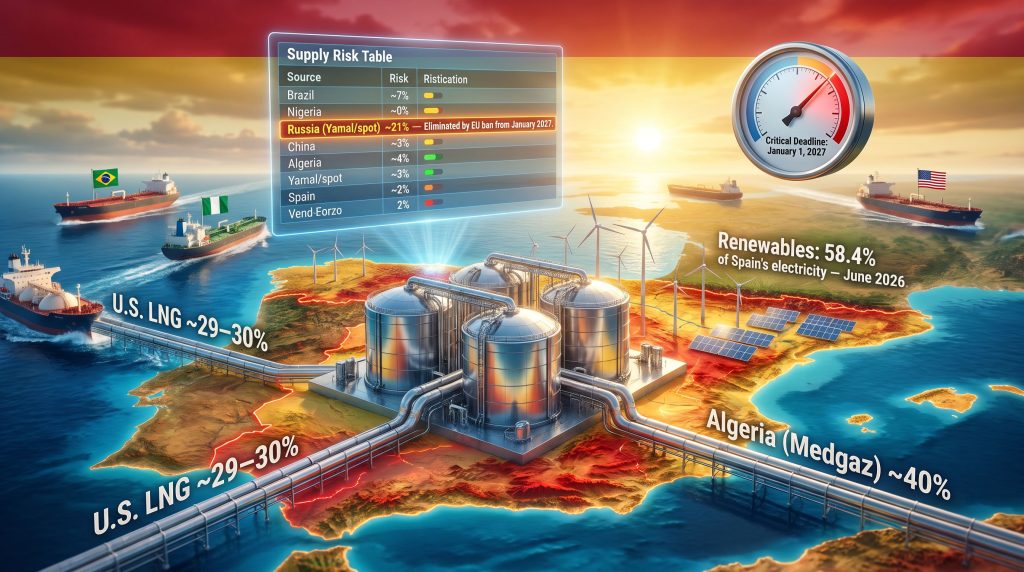
U.S. LNG supplied approximately 30% of Spain's total gas imports in 2025, nearly doubling its 2024 market share. This share held at 29% through the first half of 2026, placing the United States as the second-largest gas supplier after Algeria, whose pipeline exports held approximately 40% of the market.
What distinguishes U.S. LNG supply from other sources is its commercial structure. American cargoes combine long-term offtake agreements with flexible portfolio and spot volumes that respond dynamically to global price signals. During the 2026 crisis months, this flexibility benefited Spain. However, the same commercial logic means U.S. sellers can redirect those flexible cargoes toward Asian markets whenever the Japan-Korea Marker (JKM) price offers a superior netback, without any government directive required.
Critical Distinction: The most immediate threat to Spain's gas supply may not arise from formal U.S. trade restrictions, which face substantial legal barriers, but from commercially motivated cargo diversions by U.S. LNG portfolio operators responding to Asian price premiums.
Spain's LNG Infrastructure: A Buffer, Not a Solution
Spain operates one of Europe's most extensive LNG regasification networks. This infrastructure provides meaningful physical buffer against short-term supply disruption and gives Spain optionality that landlocked European countries lack. However, regasification terminals process incoming cargoes; they do not generate supply. If fewer cargoes arrive, the terminals sit underutilised while gas balances tighten.
June 2026 illustrated both the system's strength and its limits:
- Total gas imports: approximately 2.45 bcm
- Domestic demand: approximately 2.26 bcm
- LNG share of supply: 51%
- Pipeline gas share: approximately 49% (up from 31% year-on-year)
- Algeria's Medgaz pipeline alone delivered 0.94 bcm in June
The January 2027 Deadline: Russia's Exit and Its Compounding Effect
Spain's gas security picture changes materially on January 1, 2027, when the EU's full ban on Russian LNG takes effect. As recently as June 2026, Russian supply covered 21% of Spanish gas imports, partly through Naturgy's 2013 Yamal contract, a take-or-pay agreement covering 3.2 bcm per year through 2041.
Naturgy faces an estimated €10.95 billion in remaining Russian purchase commitments and may need to invoke force majeure provisions to exit the contract without catastrophic financial exposure. The legal and financial resolution of this situation will materially shape Spain's gas balance sheet through 2027 and beyond.
The timing is acutely problematic. The Russian LNG supply buffer is disappearing precisely as U.S. supply faces political uncertainty. Consequently, Spain is entering 2027 with its two largest sources of flexible gas supply simultaneously under pressure.
| Gas Supply Source | 2026 Share | Post-January 2027 Status |
|---|---|---|
| Algeria (Medgaz pipeline) | ~40% | Stable, limited upside from compression |
| U.S. LNG | ~29-30% | Politically uncertain; commercially divertible |
| Russia (Yamal/spot) | ~21% (June 2026) | Eliminated by EU ban from January 1, 2027 |
| Other LNG (Nigeria, Qatar, etc.) | Remainder | Subject to global competition and spot pricing |
Can Algeria Close the Gap?
Madrid and Algiers began discussions in March 2026 on a potential 10% increase in Medgaz pipeline deliveries. Naturgy indicated in July 2026 that compression upgrades could add approximately 0.6 to 1 bcm of annual capacity before winter. The Medgaz pipeline currently operates at approximately 10 bcm per year, a level already achieved through pressure increases via additional compression equipment.
The constraint is physical, not political. The pipeline's diameter sets an absolute ceiling on throughput that cannot be overcome through compression alone. Further meaningful capacity expansion would require significant infrastructure investment with multi-year lead times, making Algeria a partial solution rather than a full replacement for lost Russian and potentially redirected U.S. volumes.
The Legal Architecture: Why a Spain-Specific Embargo Is Harder Than It Sounds
The EU operates a common trade policy framework under which individual member states cannot be isolated by third-country trade actions without triggering bloc-wide legal and diplomatic responses. EU customs rules make it structurally impermissible to apply bilateral tariffs or embargoes to a single member state independently of the broader European trade architecture.
Any formal U.S. trade restriction targeting Spain alone would constitute a challenge to EU trade law, requiring a collective European response rather than a bilateral negotiation between Washington and Madrid. This legal reality creates meaningful friction for any administration seeking to use trade as a precision political instrument against individual EU members. For context, Trump tariff plans have already demonstrated how swiftly such measures can reshape allied trade relationships across multiple sectors.
What Washington can do without crossing that legal threshold is more targeted:
- Apply export licensing restrictions on U.S. LNG, theoretically redirecting supply away from Spanish buyers through regulatory mechanisms
- Allow market-driven cargo diversion, where U.S. LNG portfolio operators redirect flexible volumes to Asian buyers at superior netback pricing with no government involvement required
- Apply tariffs on non-energy Spanish exports such as agricultural products or manufactured goods, avoiding direct confrontation with EU energy trade rules
- Use sustained political signalling to reshape investment decisions, long-term contract negotiations, and diplomatic posture without requiring formal enforcement
The July 8, 2026 directive represented the second such threat since March 2026, linked specifically to Spain's refusal to commit 5% of GDP to NATO defence spending and its non-support for U.S. operations against Iran. Whether it translates into formal action or remains in the domain of political leverage, the signal itself is altering Spain's strategic calculus.
The next major ASX story will hit our subscribers first
Scenario Mapping: Spain's Gas Position Entering 2027
Three plausible scenarios frame Spain's energy security outlook as 2027 approaches:
Scenario A – Managed Continuity: U.S. LNG flows continue without disruption, Medgaz compression upgrades deliver incremental capacity, and Spain absorbs the Russian LNG exit through a combination of Algerian pipeline gas and alternative spot procurement at manageable cost premiums.
Scenario B – Commercial Cargo Diversion: U.S. LNG sellers redirect flexible volumes toward Asian buyers as JKM pricing strengthens. Spain enters spot markets to compete for Nigerian, Qatari, or other Atlantic Basin cargoes at elevated replacement costs, pressuring household and industrial gas prices through winter.
Scenario C – Political Escalation: Washington applies formal export licensing restrictions or targeted trade measures. Spain activates EU solidarity mechanisms, accelerates Algerian pipeline negotiations, and enters emergency procurement for alternative LNG at significant cost premiums, while Madrid and Brussels coordinate a collective European diplomatic response.
Strategic Assessment: The core danger entering 2027 is not physical supply exhaustion. It is that Spain arrives at a structurally constrained moment with fewer supply options, higher replacement costs, and a counterpart in Washington increasingly willing to treat energy access as a variable in a broader political negotiation.
Renewable Growth: Real Progress, Incomplete Protection
Spain's economy ministry has pointed to accelerating renewable deployment as evidence of strengthening energy sovereignty. Renewable generation rose 12% in June 2026 and covered 58.4% of Spain's electricity, a structurally significant milestone. Gas-fired combined-cycle plants contributed 15.7% of electricity generation in June 2026, declining from prior-year levels as wind and solar capacity expanded.
This progress is genuine but needs careful contextualisation. Electricity generation resilience and gas import security are distinct risk categories that operate on different timescales and across different end-use markets.
Gas serves Spain's energy system in multiple roles beyond baseload power generation:
- Industrial process heat for manufacturing and chemical production
- Residential and commercial heating, particularly during winter demand peaks
- Flexible grid balancing during periods when wind, solar, hydro, and interconnection capacity collectively underperform
- Peaking capacity to manage electricity demand spikes that renewable generation cannot fully absorb
Renewable growth reduces Spain's aggregate gas consumption and shrinks the total import volume required for system stability. However, it does not eliminate gas from the energy mix or remove the strategic vulnerability created by concentrated supply from politically uncertain sources.
Policy Levers and the Path Forward
Several concrete actions are available to Madrid to improve its position ahead of the 2027 supply inflection point:
- Accelerate Medgaz compression investment to extract maximum incremental capacity from the Algerian corridor before the winter demand season
- Diversify LNG offtake contracts toward Nigerian, Qatari (subject to Hormuz resolution), and other Atlantic Basin suppliers under medium-term agreements that reduce reliance on spot market competition
- Engage EU solidarity mechanisms proactively to ensure any U.S. trade action triggers a coordinated bloc-level response rather than isolating Spain diplomatically
- Advance renewable capacity and grid-scale storage deployment to further compress the volume of gas imports required for system balancing
- Resolve the Naturgy Yamal contract position through force majeure proceedings or renegotiation, clarifying Spain's net gas balance sheet before January 2027
These measures align with the broader direction of European raw materials supply policy, which similarly seeks to reduce exposure to politically concentrated sources through diversification and domestic investment. Furthermore, Spain's efforts echo the strategic mining revival underway across the EU, as member states work to insulate critical sectors from external geopolitical leverage.
The Trump trade threat and Spain energy security challenge ultimately reflects a deeper structural reality: energy diversification strategies built for a stable geopolitical environment require fundamental reassessment when the rules governing trade relationships are themselves under active revision. Spain's regasification infrastructure, crude slate breadth, and renewable buildout provide genuine resilience. What they cannot fully offset is the political risk premium now embedded in supply relationships with the world's largest LNG exporter.
The path forward will require not just technical solutions but sustained diplomatic engagement at both the bilateral and European level. As the International Energy Agency has consistently emphasised, energy security in an era of geopolitical fragmentation demands proactive policy, not reactive crisis management.
This article is intended for informational purposes only and does not constitute financial, investment, or energy policy advice. Figures and projections cited reflect available data and analysis as of the publication period and are subject to revision as market and geopolitical conditions evolve.
Want to Stay Ahead of the Market Shifts Reshaping Global Commodity and Energy Flows?
Discovery Alert's proprietary Discovery IQ model delivers real-time alerts on significant ASX mineral discoveries, instantly translating complex commodity data into actionable investment insights — explore historic discoveries and their remarkable returns to understand the scale of opportunity these moments can create, then begin your 14-day free trial at Discovery Alert to position yourself ahead of the broader market.