August 1, 2026
When Sea Lanes Become Battlegrounds: The Structural Shift Rewriting Energy Logistics
Chokepoints have always defined the geometry of global trade. The Strait of Malacca, the Strait of Gibraltar, the Suez Canal — each represents a geographic pinch point where the density of commercial traffic creates both efficiency and extreme vulnerability. For most of the post-Cold War era, the assumption embedded in energy markets was that these corridors, however narrow, would remain functionally open. Naval deterrence, diplomatic norms, and the mutual interest of trading nations provided an informal guarantee. That assumption is now under sustained pressure in ways that are reshaping how governments, energy companies, and shipping operators plan for the future.
The formation of the Saudi Arabia Red Sea shipping coalition in late July 2026 is the most visible institutional expression of this shift. It represents a regional power concluding that waiting for existing security frameworks to resolve the problem is no longer a viable strategy.
When big ASX news breaks, our subscribers know first
The Red Sea Threat Is Not Episodic — It Is Structural
The distinction between episodic and structural disruption matters enormously for how markets price risk. Episodic disruptions — a single attack, a brief closure, a temporary spike in insurance premiums — tend to be absorbed by the market relatively quickly. Structural disruptions, by contrast, alter the baseline operating assumptions for entire industries.
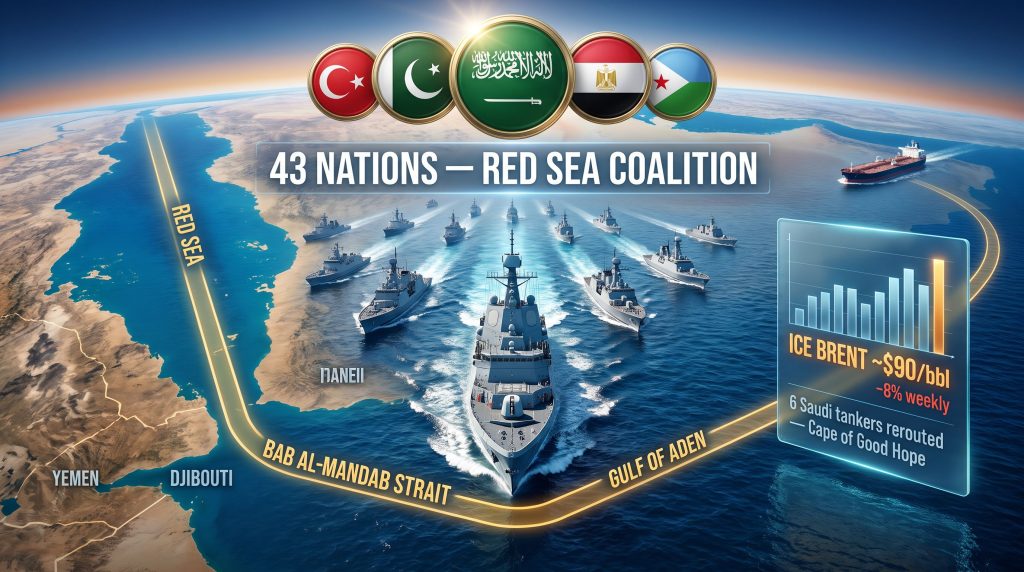
Houthi attack campaigns against Red Sea shipping have crossed the threshold from episodic to structural. The evidence is not merely in the frequency of incidents but in the behavioural changes they have triggered across the commercial shipping sector. The clearest signal: at least six Saudi Arabian oil tankers have rerouted their voyages around the Cape of Good Hope rather than transit the Red Sea corridor, accepting thousands of additional nautical miles, higher fuel consumption, and extended delivery timelines as preferable to the risk of attack.
When a sovereign wealth-backed oil exporter routes its own fleet away from its own region's primary export corridor, the message to markets is unambiguous. This is no longer a risk management footnote — it is an operational reality requiring a structural response. Furthermore, this kind of oil market disruption compounds pre-existing vulnerabilities in global energy supply chains.
Compounding this, a Houthi strike forced the shutdown of a Saudi Aramco refinery processing 400,000 barrels per day, demonstrating that the threat extends beyond vessel safety to the physical infrastructure underpinning Saudi Arabia's export capacity. The attack exposed a vulnerability that goes to the heart of Riyadh's commercial exposure: not just tanker routes, but the onshore assets that feed them.
Architecture of the Saudi Arabia Red Sea Shipping Coalition
Saudi Arabia announced the formation of a multinational maritime security alliance with Riyadh designated as the founding state, lead nation, and permanent headquarters host. According to Reuters, the scope of initial diplomatic engagement was significant: 43 countries and the European Union attended the inaugural consultative meeting in Riyadh, whilst 14 countries issued a formal joint statement endorsing the initiative.
The reported membership spans multiple regions and naval traditions:
| Region | Reported Participating Nations |
|---|---|
| Gulf / Middle East | Saudi Arabia, Kuwait, Bahrain, Qatar, Jordan, Yemen |
| North Africa | Egypt, Sudan |
| East Africa / Horn of Africa | Djibouti, Somalia |
| South Asia | Pakistan, Bangladesh |
| Sub-Saharan Africa | Nigeria |
| Europe / NATO Adjacent | Turkey |
The geographic breadth of this membership is itself strategically significant. A coalition spanning the Middle East, South Asia, East Africa, and West Africa carries considerably more legitimacy as a global trade protection mechanism than a sub-regional Gulf arrangement would. Full membership had not been finalised at the time of the coalition's announcement, with additional nations expected to complete domestic ratification procedures before formally acceding.
The coalition's stated mandate covers three interconnected maritime zones:
- The Red Sea — the primary westward corridor for Gulf oil exports and Asia-Europe container trade
- The Bab al-Mandab Strait — a 29-kilometre-wide chokepoint connecting the Red Sea to the Gulf of Aden, adjacent to Houthi-controlled territory
- The Gulf of Aden — the eastern approach linking the corridor to the broader Indian Ocean
How This Framework Differs from Earlier Maritime Operations
The Saudi-led coalition is institutionally distinct from Operation Prosperity Guardian, the US-led naval initiative established in late 2023 to address earlier Houthi maritime threats. The critical difference is not operational but architectural: in the Saudi-led framework, a regional power holds the founding leadership role rather than a Western naval superpower. This matters because it changes both the diplomatic legitimacy of the institution and the ownership dynamics of decision-making within it.
Turkey's inclusion is particularly notable. As a NATO member with an independent foreign policy track record in Middle Eastern affairs and a substantial naval capability, Turkey's participation signals the coalition has cross-bloc appeal that transcends the Gulf Cooperation Council's usual orbit. Pakistan similarly brings meaningful naval assets and a direct economic stake in Red Sea stability, given its dependence on the corridor for energy imports. Egypt's involvement aligns the operator of the Suez Canal — whose revenues are directly impacted by Red Sea disruption — with the coalition's objectives.
What is less commonly appreciated is that Pakistan's inclusion may reflect a quiet diplomatic exchange: the Al Areesh LNG carrier, owned by QatarEnergy, was permitted to exit the Strait of Hormuz for the first time in nearly three weeks following Islamabad's lobbying of Tehran to ease Pakistan's acute energy shortages. This illustrates how the broader regional security environment is creating new bilateral dependencies that feed into coalition dynamics.
Who Is Missing — And Why It Matters
The United States, United Kingdom, and other Western naval powers are not reported as members of the Saudi-led initiative. India, a major Indian Ocean naval power with deep Red Sea trade exposure, has also not been reported as a participant, representing a potential coverage gap in the coalition's eastern flank.
The absence of Iran from any regional maritime dialogue is the structural fault line beneath all of this. Tehran's rejection of Oman's proposal for joint management of the Strait of Hormuz, combined with the absence of active US-Iran diplomatic talks, means the fundamental geopolitical tension driving corridor insecurity has no near-term diplomatic resolution pathway. These dynamics are further explored through the lens of geopolitical oil logistics that continue to define energy market behaviour in 2025 and beyond.
A Multi-Front Disruption Environment Unlike Any Previous Crisis
The Saudi Arabia Red Sea shipping coalition does not exist in isolation. It is one institutional response within a broader simultaneous disruption of global energy logistics that has no clear modern precedent in its geographic breadth.
| Disruption | Impact |
|---|---|
| Red Sea / Bab al-Mandab (Houthi attacks) | Tanker rerouting via Cape of Good Hope; six Saudi tankers diverted; 400,000 bpd Aramco refinery shutdown |
| Strait of Hormuz (IRGC interdictions) | LNG and crude tanker rerouting; Iran rejects Oman joint-management proposal; no US-Iran talks scheduled |
| Caspian Pipeline Consortium Black Sea terminal | Oil loadings suspended after drone strikes; suppliers considering indefinite halt pending safety guarantees |
| Egypt's Damietta LNG port | Drone attack caused fire on two vessels including the Energos Winter FSRU; affects 1.5 million tonnes of LNG inflows in 2026 |
| Rhine River (Kaub chokepoint, 25 cm water level) | Severe inland fuel distribution disruption across Northwest Europe; freight rates at multi-year highs |
The convergence of these simultaneous disruptions across four distinct geographic theatres is what gives the current environment its unusual character. Energy markets have historically managed individual chokepoint crises with localised rerouting and inventory drawdowns. Managing four simultaneously strains the adaptive capacity of the system in ways that are difficult to model with conventional risk frameworks. In addition, the broader consequences are actively reshaping global trade in ways that extend well beyond the energy sector.
Oil Price Dynamics: Reading the $90 Floor
Despite ICE Brent recording an approximately 8% weekly decline through late July 2026, prices remained anchored near $90 per barrel. This price floor is not an expression of supply tightness in conventional terms — it reflects a market pricing in the structural impairment of two of the world's most critical maritime corridors simultaneously.
Several dynamics underpin this price support:
- Tanker supply tightness caused by Cape of Good Hope rerouting, which adds roughly 3,500 to 4,000 nautical miles per voyage and consumes 7 to 10 additional days of vessel time, effectively reducing the working fleet's productive capacity
- VLCC and Suezmax freight rate elevation as the effective supply of available tankers tightens
- Insurance premium surges for vessels transiting high-risk corridors, adding a direct cost layer to delivered energy prices
- Absence of diplomatic resolution — with no US-Iran talks scheduled and Tehran having rejected Oman's Hormuz joint-management proposal, the risk premium has no near-term catalyst for removal
An instructive parallel: South Korean refiners are actively evaluating Venezuelan crude imports for the first time in years as Middle Eastern supply disruptions prompt diversification of feedstock sourcing. Venezuelan exports to the United States reached a record 715,000 barrels per day in July 2026. This kind of behavioural shift at the refinery procurement level signals that market participants are no longer treating current disruptions as temporary — they are redesigning supply chains around the assumption of continued corridor impairment. Understanding these shifts requires careful attention to the underlying oil market dynamics at play.
Furthermore, the broader consequences of these disruptions on producer nations are already emerging. The oil price shock felt across North American energy sectors underscores how corridor insecurity in one region transmits volatility globally.
Infrastructure Designed Around Worst-Case Scenarios
Perhaps the most telling signal of how seriously energy sector planners are treating the current environment is the investment decisions being made in response. A US-Saudi consortium has announced plans for a $5 billion Gulf refinery positioned outside the Strait of Hormuz — a direct infrastructure response to the risk that Hormuz disruption could permanently curtail access to existing refining capacity located within the strait's operational shadow.
Simultaneously, ADNOC has expanded its supertanker fleet, acquiring five additional vessels as the Hormuz crisis tightens shipping logistics for UAE LNG and crude exports. These are not hedging decisions — they are structural capital allocation choices reflecting a fundamental reassessment of corridor security risk.
The logic connecting these investments to the Saudi Arabia Red Sea shipping coalition is the same underlying strategic conviction: the era in which open sea lanes could be taken as a planning assumption has ended.
The next major ASX story will hit our subscribers first
Three Scenarios for Coalition Outcomes
The coalition's ultimate impact on shipping security and energy markets depends on one critical variable: whether declaratory membership translates into committed naval assets and operational coordination.
Scenario 1 — Credible Deterrence: The coalition deploys coordinated naval escort corridors, establishes consistent patrol presence, and Houthi attack economics shift unfavourably. Commercial operators return to Red Sea routing; freight rates normalise; the risk premium gradually drains from oil prices.
Scenario 2 — Declaratory Without Operational Depth: Member states contribute diplomatic endorsement but limited naval commitment. Houthi attacks continue; Cape of Good Hope routing remains the commercial default; the coalition functions as a diplomatic signal with limited market impact.
Scenario 3 — Escalatory Response: Houthi forces escalate in direct response to coalition formation, specifically targeting vessels from member states. The coalition becomes a friction point for broader regional tension. Energy market disruption deepens; oil prices test levels above $90 per barrel as multiple chokepoints remain simultaneously compromised.
Disclaimer: The scenarios above represent analytical frameworks for understanding possible outcomes and do not constitute investment advice. Energy market dynamics involve significant uncertainty, and actual outcomes may differ materially from any projection.
The Deeper Shift: From Security Consumer to Security Provider
There is a geopolitical dimension to the Saudi Arabia Red Sea shipping coalition that extends well beyond the immediate Houthi threat. For decades, Gulf states operated within a security architecture largely designed, funded, and operationally led by Western naval powers. As Al Jazeera reports, the formation of a regionally led, regionally headquartered maritime security institution represents a meaningful departure from that model.
This shift aligns with Saudi Arabia's Vision 2030 framework, which explicitly seeks to diversify the kingdom's geopolitical role beyond oil production. Leading a 14-nation maritime security coalition, hosting its permanent headquarters, and positioning Riyadh as an indispensable security partner to Eastern and Western trading nations alike is precisely the kind of multilateral institutional leadership that Vision 2030's geopolitical pillar envisions.
Whether the coalition achieves its security objectives or not, its formation has already accomplished one strategic goal: it has established Saudi Arabia as the architect of a new regional security institution at a moment when the old architecture is visibly under stress.
Key Figures at a Glance
| Metric | Figure |
|---|---|
| Countries attending Riyadh coalition meeting | 43 + EU |
| Countries signing formal joint statement | 14 |
| Saudi tankers rerouted via Cape of Good Hope | 6 |
| Aramco refinery capacity shut by Houthi strike | 400,000 bpd |
| ICE Brent weekly decline (late July 2026) | ~8% |
| ICE Brent price floor | ~$90/barrel |
| US-Saudi Gulf refinery investment planned | $5 billion |
| Rhine River water level at Kaub chokepoint | 25 cm |
| Damietta LNG inflows affected (2026 to date) | 1.5 million tonnes |
| Venezuelan crude exports to US (July 2026 record) | 715,000 bpd |
Want to Stay Ahead of the Resource Opportunities Emerging From Global Energy Disruption?
As shifting sea lanes and chokepoint crises reshape commodity supply chains, Discovery Alert's proprietary Discovery IQ model instantly identifies significant ASX mineral discoveries — from energy commodities to critical metals — delivering real-time alerts so subscribers can act on actionable opportunities before the broader market catches on. Explore how historic discoveries have generated exceptional returns and begin a 14-day free trial to secure a market-leading edge.