August 1, 2026
The Carbon Cost Inflection Point Reshaping European Aluminium Pricing
For decades, physical aluminium premiums in Europe operated within a relatively stable pricing architecture. Buyers and sellers negotiated around LME base prices, regional delivery differentials, and alloy conversion costs. The arrival of the Carbon Border Adjustment Mechanism's definitive implementation phase has fundamentally altered that architecture, introducing a new cost layer that sits between raw metal production and finished product delivery. The result is a pricing environment where transparency is no longer optional for import-oriented participants.
The aluminium 6063 extrusion billet premium CIF Rotterdam benchmark represents a direct response to this shifted landscape. It is not simply a new price series; it is an acknowledgement that the cost of importing fabricated aluminium into Europe now includes a carbon compliance obligation that must be quantified, reported, and reflected in traded prices.
When big ASX news breaks, our subscribers know first
Understanding AA6063: Why Alloy Specification Commands a Separate Premium Series
The Chemistry Behind the Premium
Not all aluminium is priced the same. The gap between commodity-grade P1020A ingot and AA6063 extrusion billet is not just a matter of processing costs; it reflects a tightly specified chemical composition that must be consistently delivered for downstream manufacturing to function.
The Aluminium Association specification for AA6063 defines a precise elemental window:
| Element | Specification Range |
|---|---|
| Silicon (Si) | 0.20 to 0.60% |
| Magnesium (Mg) | 0.45 to 0.90% |
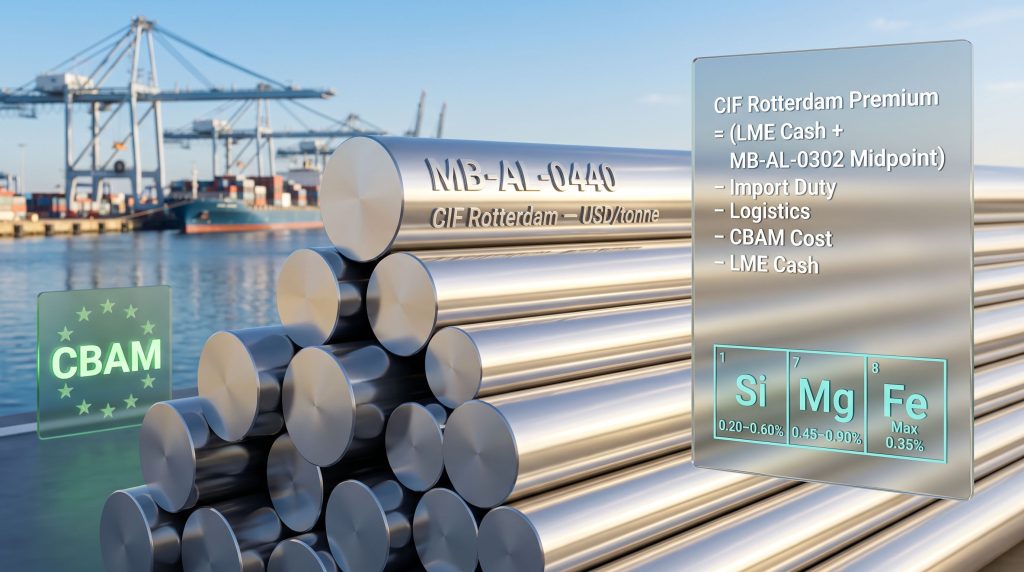
| Iron (Fe) | Max 0.35% |
| Copper (Cu) | Max 0.10% |
| Chromium (Cr) | Max 0.10% |
| Zinc (Zn) | Max 0.10% |
| Titanium (Ti) | Max 0.10% |
| Other elements (each) | Max 0.05% |
| Other elements (total) | Max 0.15% |
The silicon-magnesium balance is the defining feature of the AA6063 family. Silicon and magnesium combine during heat treatment to form Mg2Si precipitates, which give the alloy its characteristic strength after ageing. Getting this balance wrong by even a fraction of a percentage point can compromise extrudability, surface finish quality, and dimensional consistency. Producers supplying architectural curtain wall systems, window frame profiles, or automotive heat exchangers cannot absorb that variability.
Why AA6063 Dominates European Extrusion Demand
The alloy's mechanical and surface characteristics make it the default choice across a remarkably broad set of end markets:
- Construction and architecture: Curtain wall systems, window frames, door profiles, and structural glazing components rely on AA6063's combination of corrosion resistance and anodisability.
- Automotive components: Structural cross-members, battery housing elements, and heat management profiles increasingly specify AA6063 due to its crash absorption properties and lightweight characteristics.
- Consumer electronics enclosures: Premium laptop chassis, tablet housings, and display frames frequently use extruded AA6063 profiles for their fine surface finish compatibility.
- Solar mounting systems: The rapid expansion of photovoltaic installations across Europe has created sustained demand for lightweight, corrosion-resistant mounting profiles made from AA6063 billet.
Compared with AA6061, which contains more copper and silicon for enhanced strength, or AA6082, which is optimised for structural load-bearing applications, AA6063 occupies the high-volume, mid-specification segment where surface aesthetics and extrudability take priority over ultimate tensile strength. This distinction matters for pricing because the production volumes and trading liquidity for AA6063 billet are substantially greater than for the structural alloy grades.
Furthermore, Southeast Asia's 6063 aluminium billet market has undergone notable price system segmentation in recent periods, reflecting how origin-specific dynamics increasingly influence global billet premiums.
The standard tradeable specification covers billet with outside diameters of 6 inches, 7 inches, and 8 inches, reflecting the most common press tooling configurations found in European extrusion facilities. A minimum lot size of 100 tonnes is required, consistent with the minimum volumes at which physical traders and producers typically contract.
Decoding the MB-AL-0440 Calculation: Every Deduction Explained
Why Calculation Rather Than Direct Assessment?
In markets with deep transaction volumes, price reporters can observe sufficient trades to directly assess a benchmark. Thin physical markets present a different challenge. When observable spot transactions are infrequent, a calculated approach anchored to verified inputs provides greater statistical credibility than attempting to interpolate a direct assessment from sparse data.
The MB-AL-0440 benchmark uses exactly this logic. Rather than attempting to directly observe CIF Rotterdam trades, the methodology works backwards from the most liquid and well-established reference in the European aluminium market, the DDP North Germany (Ruhr region) premium (MB-AL-0302), and deducts each verifiable cost component systematically.
The calculated methodology provides market participants with an auditable result. Each deduction is independently assessable, meaning a sophisticated buyer or seller can cross-check the benchmark against their own logistics and compliance cost observations.
Step-by-Step Calculation Walkthrough
The full formula published by Fastmarkets is:
CIF Rotterdam Billet Premium = (LME Cash + MB-AL-0302 Midpoint) minus Import Duty minus Logistics minus CBAM Cost minus LME Cash
Breaking this into sequential steps:
- Establish the all-in price. The LME aluminium cash price is combined with the midpoint of the MB-AL-0302 DDP North Germany premium on the Friday publication date. Using the midpoint of a bid-offer spread removes directional bias that could arise from using either the bid or the offer alone.
- Deduct the EU import tariff. The standard 6% European Union tariff applied to aluminium billet imports from non-preferential origins is subtracted. This step converts a duty-paid price into a pre-duty equivalent.
- Deduct logistics costs. A Fastmarkets price reporter assesses weekly freight and trucking costs from the North Germany (Ruhr region) to Rotterdam port, drawing on market participant data. These costs are deducted as average assessments rather than spot rates to reduce week-on-week volatility.
- Deduct warehousing, financing, and port handling costs. An average assessment of the costs associated with receiving, storing, and processing billet at Rotterdam port is also deducted.
- Deduct CBAM certificate costs. This is the most structurally novel component of the calculation. Carbon Border Adjustment Mechanism certificate costs, expressed in EUR per tonne of CO2 equivalent and converted to USD per tonne, are deducted using the CB-CC-0042 CBAM Certificate Index.
- Subtract LME cash to isolate the premium. The result, expressed in USD per tonne, is the standalone CIF Rotterdam billet premium above LME cash.
The Role of MB-AL-0302 as the Anchor Reference
The Ruhr region is not an arbitrary choice as the anchor geography. North Germany represents the densest concentration of aluminium extrusion capacity in Europe, making it the primary physical consumption centre for AA6063 billet. The DDP Ruhr premium is the most widely referenced and liquidly observed benchmark in European physical aluminium billet trade. Using its midpoint as the starting point for the CIF calculation means the derived CIF Rotterdam premium inherits the observational credibility of the best-established European reference.
An important operational detail: MB-AL-0440 is published only after MB-AL-0302 has been finalised on the same Friday session. This sequential dependency ensures the anchor input is fully settled before the derived calculation is released, protecting the integrity of the output. These European metals pricing trends reflect a broader pattern of calculation-based benchmarking gaining traction across base metal categories.
CBAM: The Regulatory Variable Now Embedded in a Published Benchmark
What the Carbon Border Adjustment Mechanism Actually Does
The Carbon Border Adjustment Mechanism is a European regulatory instrument that imposes a carbon cost on specific imported goods from countries without equivalent domestic carbon pricing. Its purpose is to prevent carbon leakage, the risk that European manufacturers move production or source from regions where carbon is unpriced, undermining EU climate objectives.
Aluminium sits near the top of the CBAM exposure list. The reason is straightforward: aluminium smelting is extraordinarily energy intensive, requiring roughly 13 to 15 megawatt-hours of electricity per tonne of primary metal produced. In countries where that electricity comes from coal-fired generation, the embedded carbon intensity is dramatically higher than in regions powered by hydroelectricity or renewables. CBAM closes that competitive cost gap for European importers.
The distinction between the transitional phase (primarily a reporting exercise) and the definitive phase (which introduces actual financial obligations linked to purchased CBAM certificates) is commercially critical. Under the definitive phase, importers must acquire certificates proportional to the embedded carbon content of their imports above the threshold accounted for by the exporting country's own carbon pricing regime. This is a real cash cost, not an administrative formality.
How CBAM Costs Enter the CIF Rotterdam Calculation
The CB-CC-0042 CBAM Certificate Index provides the carbon cost input. Its design is worth understanding in detail:
- The index combines auctioned EU Allowance values with spot and forward EUA prices, drawing from both primary and secondary carbon market data.
- This forward-looking construction means the index reflects expected certificate costs at the end of the reporting period rather than purely historical carbon prices.
- Fastmarkets uses a volume-weighted average of default emissions values for the five largest aluminium billet importing origins under HS code 7601 (unwrought aluminium).
- These default emissions values are reviewed on a six-month cycle, balancing regulatory accuracy with the practical need for stable cost inputs in commercial contracts.
As CBAM reporting matures and verified emissions data from specific production facilities becomes available, the methodology includes a pathway to replace default emissions values with verified figures. This evolution will likely increase premium precision but may also introduce greater volatility between specific supply origins. For context, alumina market pressures upstream are compounding these downstream compliance cost dynamics, particularly for producers reliant on high-carbon smelting inputs.
The carbon intensity gap between, for example, hydropower-sourced Gulf Cooperation Council smelters and coal-heavy Central Asian producers is consequently becoming more explicitly priced.
Lesser-Known Market Dynamic: Default CBAM emissions values represent an average across all imports from a given country of origin. Producers operating low-carbon smelters in high-average-emissions countries can face a significant commercial disadvantage under default values. As verified reporting becomes mandatory, this creates a potential structural premium shift favouring demonstrably low-carbon billet origins, even from markets currently perceived as high-emission.
The Deliberate Absence of a Duty-Free Reference
Fastmarkets has explicitly chosen not to publish a separate duty-free version of the CIF Rotterdam benchmark. This reflects a practical reality: the overwhelming majority of non-EU aluminium billet imports are subject to the standard 6% tariff. Publishing a duty-free variant would create a reference with limited real-world applicability while potentially introducing confusion about the true landed cost for most market participants.
Navigating the European Aluminium Premium Landscape: A Structural Comparison
Choosing the Right Price Reference
European aluminium billet participants encounter several distinct premium structures, each suited to different trading and procurement purposes:
| Pricing Basis | Duty Included | Logistics to Buyer | CBAM Included | Primary User Group |
|---|---|---|---|---|
| CIF Rotterdam (MB-AL-0440) | No (deducted in calc) | To port only | Yes | Importers, cross-border traders |
| DDP North Germany / Ruhr (MB-AL-0302) | Yes | Full delivery | Variable | Extrusion producers |
| In-Warehouse Rotterdam | No | Partial | No | Spot traders, warehouse operators |
| LME Cash (P1020A base) | No | None | No | Financial hedgers, index users |
Who Benefits Most from CIF-Based References?
The market participants with the clearest use case for MB-AL-0440 include:
- Import-origin buyers sourcing billet from the Middle East, Southeast Asia, or North Africa who need a transparent landed-cost reference before customs clearance is applied.
- Commodity traders managing arbitrage between low-cost billet origins and European consumer demand, where the CIF level determines whether import economics are viable before duty and final delivery costs are layered on.
- Procurement teams at European extrusion companies who want to independently verify whether supplier offers from non-EU origins are competitive against a published, independently calculated benchmark.
- Contract structuring professionals embedding price review clauses in multi-year supply agreements who require a published weekly reference that explicitly accounts for evolving carbon compliance costs.
The structural difference between a CIF and a DDP reference is not trivial. A buyer relying solely on DDP Ruhr pricing to assess import competitiveness may not fully understand which cost components are driving premium movements at any given time. The CIF Rotterdam benchmark disaggregates those components systematically. In addition, aluminium tariffs impact from outside Europe continues to redirect global billet flows, further affecting the arbitrage calculations that CIF references are designed to support.
Publication Mechanics and What Market Participants Should Know
Operational Specifications at a Glance
| Parameter | Detail |
|---|---|
| Benchmark code | MB-AL-0440 |
| Publication frequency | Weekly |
| Publication day and time | Friday, 4:30pm London time |
| Quotation unit | USD per tonne |
| Basis | Premium above LME aluminium cash price |
| Minimum transaction size | 100 tonnes |
| Delivery location | CIF Rotterdam port |
| Delivery window | Within 3 months of pricing date |
| Payment terms | Cash against documents, 7 days after bill of lading date |
Methodology Evolution and Market Consultation
The benchmark documentation published by Fastmarkets for CIF Rotterdam billet explicitly provides for future methodology evolution. Two specific pathways are identified:
- Transition from default to verified emissions data. As CBAM's reporting infrastructure matures and importers accumulate facility-level emissions data, it becomes technically possible to replace volume-weighted default values with verified figures. This would improve accuracy but introduce origin-specific pricing differentiation.
- Response to third-country carbon pricing developments. If major billet-exporting nations implement domestic carbon pricing mechanisms that qualify for CBAM adjustments, the methodology will need to account for the offset, reducing the effective certificate cost for imports from those origins.
Any changes to methodology components will be subject to public consultation before implementation, maintaining the transparency principle that underpins the benchmark's design.
The next major ASX story will hit our subscribers first
Frequently Asked Questions: Aluminium 6063 Extrusion Billet Premium CIF Rotterdam
What exactly is the aluminium 6063 extrusion billet premium CIF Rotterdam?
It is a weekly calculated price differential, expressed in USD per tonne, representing the cost of AA6063 specification extrusion billet delivered to Rotterdam port on a CIF basis. It is published as a premium above the LME aluminium cash price, under the Fastmarkets code MB-AL-0440.
How does MB-AL-0440 differ from the DDP North Germany premium?
The DDP North Germany premium (MB-AL-0302) covers full delivery costs to the buyer's facility including import duty. MB-AL-0440 is mathematically derived from MB-AL-0302 by stripping out the import tariff, inland logistics, warehousing, and CBAM costs to arrive at a port-level CIF price before customs clearance.
Why does CBAM affect this specific premium?
AA6063 billet is heavily sourced from non-EU producers in regions that typically lack equivalent domestic carbon pricing. Under CBAM's definitive phase, European importers incur real certificate costs proportional to the embedded carbon content of each tonne they bring across the border. Excluding this cost from a CIF benchmark would produce a reference price that understates actual import economics.
Is there a duty-free version published alongside MB-AL-0440?
No. The methodology does not include a duty-free variant, reflecting the practical reality that the 6% EU tariff applies to virtually all commercially relevant non-EU billet import origins.
How frequently are the CBAM emissions values reviewed?
The volume-weighted average default emissions values used in the CBAM cost deduction are reviewed every six months. This cycle provides enough stability for contract use while ensuring the inputs remain aligned with evolving emissions data from major importing origins.
What the New Benchmark Signals for European Metals Pricing
The launch of a calculated CIF Rotterdam aluminium 6063 billet premium benchmark marks more than an incremental expansion of a price series catalogue. It represents the first time that CBAM certificate costs have been structurally embedded into a regularly published, independently administered commodity benchmark in the European metals space. The precedent this sets may extend well beyond aluminium.
Steel, cement, fertiliser, and hydrogen are all within CBAM's scope. As the mechanism's definitive phase deepens its financial impact across these product categories, the demand for price references that reflect post-CBAM landed costs will grow. Green steel pricing dynamics are already being reshaped by comparable carbon cost pressures, suggesting that the MB-AL-0440 architecture may serve as a broader template for carbon-adjusted benchmark design.
The architecture developed for MB-AL-0440, combining an established anchor premium with systematic cost deductions including a forward-looking carbon index, provides a replicable framework for other commodity categories facing the same pricing transparency gap.
For European aluminium market participants specifically, the practical takeaways are clear:
- Procurement teams using only DDP-based references should assess whether they fully understand the carbon cost component embedded in their supplier negotiations.
- Traders managing import arbitrage positions now have a transparent, published CIF reference against which to test position economics before committing to cross-border flows.
- Contract negotiators embedding price review mechanisms in long-term supply agreements should evaluate whether a CBAM-adjusted CIF reference better captures their actual cost exposure than legacy DDP-anchored formulas.
- As verified emissions data replaces default values in future methodology iterations, origin-specific carbon intensity will become an increasingly explicit driver of premium differentiation. Consequently, aluminium supply leaders with demonstrably low-carbon production credentials may command structural price advantages in CIF-benchmarked contracts.
This article is intended for informational purposes only and does not constitute financial, investment, or trading advice. Commodity premiums and regulatory frameworks are subject to change. Market participants should consult current Fastmarkets methodology documentation and relevant regulatory guidance before making commercial decisions based on benchmark references.
Want to Stay Ahead of Major ASX Mineral Discoveries Before the Broader Market Does?
Discovery Alert's proprietary Discovery IQ model delivers real-time alerts on significant ASX mineral discoveries, transforming complex commodity data across more than 30 sectors into clear, actionable investment insights — ideal for traders and investors seeking an immediate market edge. Explore Discovery Alert's dedicated discoveries page to understand how historic mineral discoveries have generated substantial returns, and begin your 14-day free trial today to position yourself ahead of the market.