July 31, 2026
The Benchmark That Refused to Bend: Understanding the Fastmarkets Iron Ore 65% Fe Brazil-Origin Fines Index Decision
Commodity benchmarks are not simply price numbers published at the end of a trading day. They are the contractual backbone of global supply chains, the settlement anchors for financial derivatives, and the trust infrastructure that makes large-scale physical trade possible across borders. When a Price Reporting Agency considers modifying the Fastmarkets iron ore 65% Fe Brazil-origin fines index, it is not adjusting a metric; it is potentially reshaping the financial architecture that thousands of counterparties have built their commercial relationships upon. That tension between market evolution and benchmark stability sits at the heart of a significant decision made at the close of July 2026.
When big ASX news breaks, our subscribers know first
What the Fastmarkets Iron Ore 65% Fe Brazil-Origin Fines Index Actually Measures
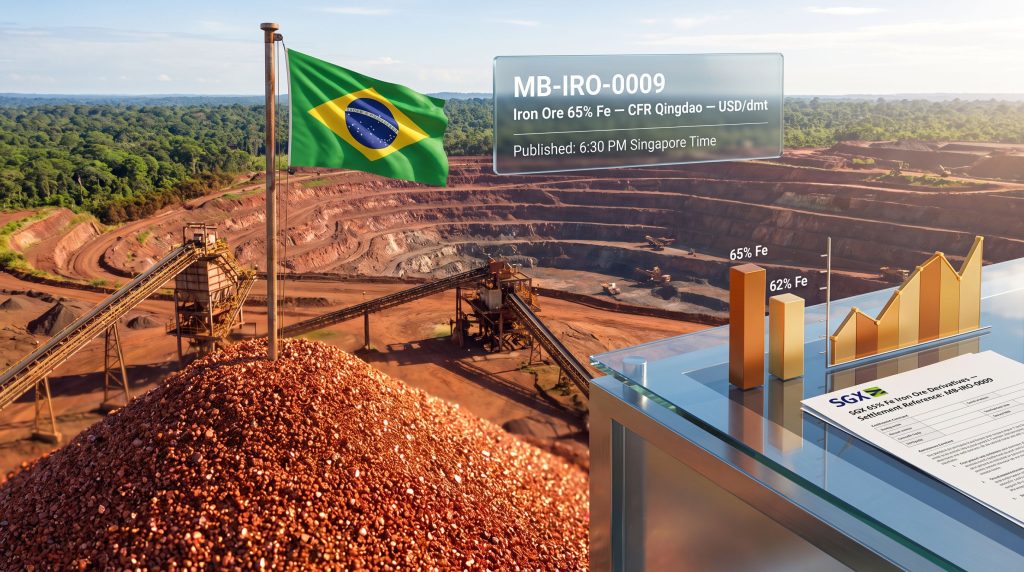
The MB-IRO-0009 is Fastmarkets' daily price assessment for Brazil-origin high-grade iron ore fines, priced on a CFR Qingdao basis in USD per dry metric tonne (dmt). It is published each business day at 6:30 pm Singapore time, capturing spot-market conditions for material assessed against a 65% Fe base specification, with an accepted quality range of 63.5% to 66% Fe.
The index is not simply a headline number. Its specification framework includes defined parameters for silica content, with a base of 2.7% SiO₂, alongside minimum and maximum thresholds for both silica and alumina that are calibrated to reflect the quality profile of actual traded cargoes rather than theoretical product ideals.
Beyond physical trade, the MB-IRO-0009 serves as the settlement reference for the Singapore Exchange (SGX) 65% Fe iron ore derivatives contract. This dual function, anchoring both physical procurement agreements and financial hedging instruments, means that any modification to the index carries consequences that extend far beyond the spot market into the derivatives ecosystem used by mills, miners, traders, and financial institutions managing iron ore price trends and risk.
CFR Qingdao explained: Under Cost and Freight terms, the seller arranges and pays for ocean freight to deliver cargo to Qingdao port in China's Shandong province. Risk transfers to the buyer once goods are loaded onto the vessel at the port of origin. Qingdao is chosen as the reference destination because it is one of China's largest iron ore import terminals, handling a substantial share of the country's seaborne iron ore imports annually.
Why Brazil's Carajás Fines Define the 65% Fe Segment
The origin restriction embedded in the MB-IRO-0009 is not arbitrary. Brazil's Carajás iron ore system, operated from the Carajás mining complex in the state of Pará, produces what the market widely recognises as the definitive reference product for the high-grade iron ore segment. Carajás fines consistently deliver Fe grades at or above 65% with characteristically low alumina and phosphorus content, making them the preferred feedstock for blast furnace operators seeking to reduce slag generation and coke consumption simultaneously.
From a geological standpoint, understanding iron ore types and deposits helps contextualise why the Carajás deposit, classified as a high-grade itabirite and jaspilite-hosted iron formation, is so significant. Its mineralogy, dominated by hematite rather than magnetite, allows for relatively straightforward beneficiation to consistently high Fe grades with minimal reprocessing. This geological advantage underpins the product uniformity that makes Carajás fines amenable to index normalisation.
The practical consequence for steelmakers is measurable. High-grade fines reduce the coke rate per tonne of hot metal in blast furnace operations, which has a direct bearing on energy costs and, increasingly, on carbon intensity metrics that Chinese mills are required to report and manage under evolving environmental compliance frameworks.
How Fastmarkets Builds and Governs a Price Assessment
Fastmarkets operates as a Price Reporting Agency (PRA) aligned with the principles established by the International Organization of Securities Commissions (IOSCO). Under this framework, iron ore price assessments must be grounded in verifiable transactional data collected from a diverse pool of market participants, rather than derived from proprietary modelling or algorithmic inference alone.
The daily assessment process draws on submissions from steel mills, commodity traders, and mining companies, combining verified spot transactions with bids, offers, and market intelligence to construct a representative price for the specified product. Crucially, the methodology requires that material included in an index calculation meets a normalisation threshold, meaning the data must be sufficiently consistent, voluminous, and representative to produce a reliable price signal.
The normalisation concept is one of the least understood aspects of benchmark governance among non-specialist observers. A product's physical availability in the market is a necessary but insufficient condition for index inclusion. The following table outlines the criteria that must be satisfied before new material types or origins can be incorporated into an existing index:
| Normalisation Criterion | What It Requires |
|---|---|
| Spot-market transaction volume | Recurring, verifiable trades across multiple independent counterparties |
| Specification stability | Consistent Fe%, SiO₂, Al₂O₃ parameters across cargoes and shipments |
| Transaction structure | Standardised deal mechanics including agreed moisture adjustments and delivery terms |
| Market participant consensus | Broad alignment among mills, miners, and traders on pricing norms for the material |
This framework is designed to protect index integrity. A benchmark built on thin, inconsistent, or counterparty-concentrated data becomes unreliable as a pricing reference and potentially manipulable as a financial settlement instrument.
The June 2026 Proposal and Why It Was Withdrawn
On 15 June 2026, Fastmarkets formally proposed three interconnected changes to the MB-IRO-0009 index, driven by market feedback indicating that the seaborne high-grade iron ore supply base was beginning to diversify beyond Brazil:
- Removing the Brazil-origin restriction, allowing high-grade sinter fines from other producing regions to qualify for inclusion in the index
- Broadening the specification range to accommodate the distinct quality profiles of emerging non-Brazil supply sources
- Renaming the index from its current Brazil-specific designation to a geographically neutral title reflecting a broader universe of high-grade CFR Qingdao fines
The commercial logic behind the proposal was sound at a macro level. Non-Brazil producers in regions including West Africa and Canada are expanding output of high-grade sinter fines, and the long-term trajectory of seaborne supply diversification is well established. A benchmark that remains anchored to a single origin in a diversifying market risks becoming increasingly narrow as a price discovery tool.
However, the consultation process, which ran through June and July 2026 and drew responses from steel mills, miners, and commodity traders, revealed a clear consensus that the market was not yet ready for this transition. Furthermore, Fastmarkets confirmed on 31 July 2026 that it would not proceed with any of the three proposed changes.
Three specific deficiencies were identified as the basis for withdrawal:
- Insufficient spot-market transaction volume for non-Brazil high-grade sinter fines, with trading activity too limited and too concentrated to support consistent data normalisation
- Unstable quality specifications across non-Brazil origins, with Fe%, silica, and alumina parameters varying materially between cargoes and not yet converging on a universally accepted standard
- Incomplete production ramp-up among emerging high-grade suppliers, meaning that spot-market activity, deal structures, and counterparty relationships are still in early-stage development
An important distinction for market participants: The withdrawal does not signal that non-Brazil high-grade fines are absent from the market. It signals that the spot-market infrastructure around those materials, including standardised specifications, recurring bilateral trades, and agreed deal mechanics, has not yet reached the maturity level required by Fastmarkets' normalisation methodology.
The Geological and Quality Dimension: Why Specifications Matter So Much
One dimension of this debate that rarely receives adequate attention is the mineralogical variability of emerging high-grade iron ore sources. Unlike the Carajás system, where decades of mine development have produced tightly controlled product specifications, high-grade deposits in newer jurisdictions often exhibit more variable ore body characteristics.
For blast furnace operators, even modest variation in alumina content carries significant operational consequences. Alumina is a slag-forming element; elevated Al₂O₃ levels increase slag viscosity, reduce furnace productivity, and increase energy consumption. A specification that shifts by even 0.2 to 0.3 percentage points in Al₂O₃ between cargo deliveries forces mill metallurgists to adjust burden blending strategies, potentially disrupting production schedules.
This is why the market's insistence on specification standardisation before index inclusion is not conservatism for its own sake. It reflects a technically grounded understanding of how iron ore quality variations propagate through blast furnace operations and ultimately affect steel production economics. In addition, considerations around hydrogen iron ore reduction technologies further reinforce why consistent Fe grades and low impurity profiles are increasingly critical to future steelmaking strategies.
What the Decision Means for Different Market Participants
Steel Mills
Mills that reference the MB-IRO-0009 in long-term procurement contracts retain the pricing clarity and specification certainty they need to plan blast furnace burden structures. A premature index change could have introduced basis risk, the gap between the index price and the actual cost of the specific material being delivered, at precisely the point when mills are under pressure to manage input costs and carbon intensity targets simultaneously.
Brazil-Origin Producers
Vale and the broader network of Carajás-system producers retain the exclusive benchmark status of their high-grade fines under the MB-IRO-0009 for the foreseeable future. In commercial terms, this means their material continues to command the pricing authority that comes with being the sole reference product for a widely used derivatives settlement index.
Emerging Non-Brazil Producers
Producers in West Africa, Canada, and other high-grade development jurisdictions face a clear and actionable mandate from this decision: build spot-market track records, standardise cargo specifications, and establish the counterparty relationships needed to generate consistent, normalisation-worthy transaction data. The path to index inclusion exists; it simply requires market infrastructure that does not yet exist at sufficient scale.
Derivatives Market Participants
Traders and financial institutions using SGX 65% Fe iron ore derivatives benefit from index continuity. A change in the underlying physical specification of a settlement index creates immediate basis risk for existing hedged positions, a disruption that the market has now been spared until conditions genuinely warrant reconsideration. Consequently, those monitoring global iron ore tariff impacts will recognise how benchmark stability becomes even more critical when external trade pressures are already creating volatility.
The next major ASX story will hit our subscribers first
Three Scenarios for the Index's Future
Scenario 1: Non-Brazil Integration Within 12 to 24 Months
If West African and Canadian producers successfully scale spot-market activity and stabilise cargo specifications, Fastmarkets is positioned to reopen the consultation with a stronger evidentiary foundation. A phased approach, in which non-Brazil material is first captured as supplementary reference data before formal incorporation into the index calculation, remains the most methodologically conservative pathway.
Scenario 2: A Parallel Index for Non-Brazil High-Grade Fines
Rather than modifying the MB-IRO-0009, Fastmarkets may ultimately determine that the cleanest solution is a separate benchmark for non-Brazil 65% Fe fines once sufficient liquidity develops. This would preserve the integrity of the Carajás-origin benchmark while creating a new pricing layer that reflects emerging supply. Parallel indices for similar but origin-differentiated products are not unprecedented in commodity markets.
Scenario 3: Status Quo Persists Beyond 2027
Infrastructure constraints, permitting timelines, and potential demand softening tied to the China steel and iron ore sector could delay non-Brazil supply ramp-ups significantly. In this scenario, the Fastmarkets iron ore 65% Fe Brazil-origin fines index continues to reflect Brazil's structural dominance of the high-grade seaborne market well into the second half of the decade, with the Carajás premium over 62% Fe benchmark material remaining a persistent feature of iron ore pricing.
Frequently Asked Questions
What is the MB-IRO-0009?
It is Fastmarkets' daily benchmark price assessment for Brazil-origin iron ore fines with a 65% Fe specification, priced CFR Qingdao in USD per dry metric tonne, published at 6:30 pm Singapore time each business day. You can access the live MB-IRO-0009 price data directly through Fastmarkets.
Why is the index restricted to Brazil-origin material?
Carajás fines represent the most liquid and specification-stable product in the 65% Fe segment. The origin restriction ensures the index reflects a homogeneous, well-understood reference product, a prerequisite for reliable price discovery and derivatives settlement.
What were the proposed 2026 changes, and why were they withdrawn?
Fastmarkets proposed removing the origin restriction, widening the specification range, and renaming the index in June 2026. Following consultation, all three changes were withdrawn because non-Brazil high-grade sinter fines lack sufficient spot-market liquidity, stable specifications, and settled deal structures to meet normalisation requirements.
How can market participants engage with Fastmarkets on this index?
Feedback and data submissions can be directed to steelrawmaterials@fastmarkets.com and pricing@fastmarkets.com with the subject line re: 65% Fe iron ore index. Participants may indicate whether their submissions are confidential.
Key Takeaways for Iron Ore Market Participants
- Physical availability does not equal index eligibility. Spot-market maturity, specification consistency, and transaction normalisation are the governing criteria for benchmark inclusion.
- The MB-IRO-0009 remains unchanged, preserving pricing continuity for procurement contracts and SGX derivatives positions that reference it.
- Brazil's high-grade benchmark dominance is structurally intact in the near term, underpinned by the geological consistency and market liquidity of the Carajás system.
- Non-Brazil producers have a clear roadmap: establish recurring spot trades, standardise cargo specifications, and build the transactional track record that Fastmarkets' methodology requires.
- The iterative, consultation-driven approach taken by Fastmarkets reflects IOSCO-aligned PRA governance standards, where benchmark changes follow evidence rather than anticipate it.
This article is intended for informational purposes only and does not constitute financial or investment advice. Commodity markets are subject to significant price volatility and uncertainty. Readers should conduct independent research and seek professional advice before making trading or investment decisions based on benchmark index developments.
Want to Stay Ahead of Significant ASX Mineral Discoveries Before the Broader Market Does?
Discovery Alert's proprietary Discovery IQ model delivers real-time alerts on significant ASX mineral discoveries, transforming complex commodity data across more than 30 minerals into clear, actionable insights for both short-term traders and long-term investors — explore historic discovery returns on the Discovery Alert discoveries page to see what early positioning can deliver, and begin your 14-day free trial today to secure your market-leading advantage.