
July 31, 2026
The Hidden Mechanics Behind LPG Contract Pricing: Why Crude Rules and Fundamentals Often Don't
Energy commodity markets have a persistent quirk that catches even experienced buyers off guard: the price posted on a contract can tell you almost nothing about the physical market it supposedly reflects. Nowhere is this more visible than in the structure of crude-linked LPG contract benchmarks, where geopolitical shocks and oil price swings can push headline figures sharply higher even as the underlying supply and demand balance remains deeply soft.
Understanding this disconnect is not just an academic exercise. For term buyers, traders, and procurement teams operating across the Mediterranean and Atlantic basin, misreading a contract price movement as a demand signal can lead to poor hedging decisions and costly procurement strategies. Reviewing LPG pricing benchmarks before making procurement decisions can help frame expectations more accurately.
When big ASX news breaks, our subscribers know first
What Is Sonatrach's SPS and Why Does It Function as a Regional Benchmark?
Algeria's state-owned hydrocarbon company, Sonatrach, publishes a monthly Selling Price Schedule (SPS) covering both propane (C3) and butane (C4). These postings serve as the reference price for term supply contracts between Sonatrach and buyers across southern Europe, the eastern Mediterranean, and North Africa. The SPS is not a spot market assessment and should not be read as one.
It is a formally set monthly contract price, posted in advance for the following delivery month, and it functions as a pricing anchor for a substantial volume of term LPG trade in the western Mediterranean basin.
What makes the SPS particularly influential is Algeria's geographic position and production profile. Algeria ranks among the world's significant LPG exporting nations, and its Mediterranean loading terminals provide efficient access to European and North African buyers who would otherwise need to source from the Middle East or the US Gulf Coast at considerably higher freight cost.
For buyers in Spain, Italy, France, Morocco, and Tunisia, Sonatrach SPS postings are not background noise. They are a direct input into procurement cost models.
It is worth understanding how Sonatrach's pricing fits into the broader global LPG benchmark landscape:
| Benchmark | Grade | Region | Pricing Basis |
|---|---|---|---|
| Sonatrach SPS | Propane / Butane | Mediterranean / Atlantic | Monthly contract |
| Saudi Aramco CP | Propane / Butane | Asia-Pacific / Global | Monthly contract |
| Mont Belvieu LST | Propane / Butane | North America | Daily spot |
| ARA Large Cargo | Propane / Butane | Northwest Europe | Daily spot |
A critical distinction that is frequently overlooked in market reporting is the difference between the SPS and Sonatrach's Official Selling Price (OSP) mechanisms, which can apply to specific destinations or cargo types. Reports that appear to quote conflicting Sonatrach LPG prices for the same month often reflect different pricing series rather than data errors.
Buyers and analysts should always confirm whether a cited figure references the SPS contract series, a destination-specific OSP, or a spot market assessment before drawing conclusions.
Sonatrach August LPG Contract Prices: The Numbers in Full Context
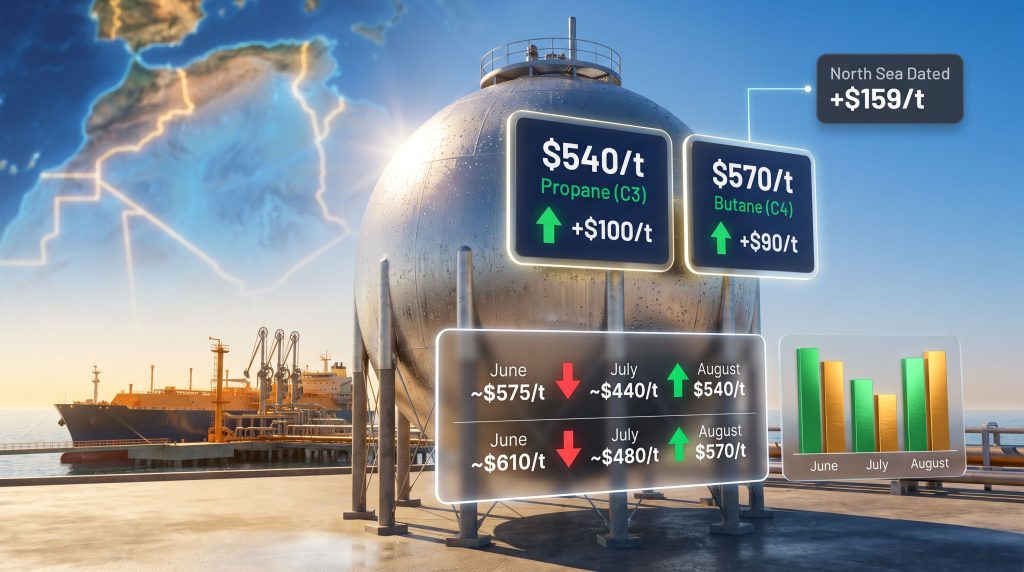
Sonatrach set its August 2026 LPG contract prices at $540/t for propane and $570/t for butane, representing month-on-month increases of $100/t and $90/t respectively, according to Argus Media. These gains followed a sharp correction in July, when propane dropped $135/t and butane fell $130/t from their June levels.
The three-month price trajectory for both grades illustrates the scale of volatility in crude-linked LPG benchmarks:
| Grade | June SPS (approx.) | July SPS | August SPS | July Change | August Change |
|---|---|---|---|---|---|
| Propane (C3) | ~$575/t | ~$440/t | $540/t | -$135/t | +$100/t |
| Butane (C4) | ~$610/t | ~$480/t | $570/t | -$130/t | +$90/t |
Note: June figures are indicative, derived from reported movement deltas. Exact June SPS values are based on disclosed price changes rather than independently confirmed postings.
Key analytical observation: The August rebound recovers roughly 74 per cent of propane's July loss and around 69 per cent of butane's decline. Both grades remain below their June peaks, confirming that the August SPS is a partial recovery, not a new high.
The $30/t premium of butane over propane in August reflects persistently different supply and demand dynamics between the two grades. Butane has a broader range of end uses across the Mediterranean basin, including household cooking fuel blending in North Africa, octane blending for gasoline, and petrochemical feedstock applications. This tends to give it a modest premium over propane in the Mediterranean context, though the spread varies significantly through the year.
Why the August Price Rebound Is Crude-Driven, Not Demand-Driven
The single most important insight embedded in the Sonatrach August LPG contract prices is one that contradicts the instinctive interpretation of a $100/t price rise as market tightening. It is not. The August SPS increase is almost entirely a mechanical product of crude oil prices rising sharply in the period between Sonatrach's July and August posting windows.
North Sea Dated, the Atlantic basin crude benchmark to which Sonatrach's SPS postings are structurally linked, rose by approximately $159/t between the two posting periods, according to Argus Media. Because Sonatrach's pricing formula tracks crude movements, this translated directly into higher SPS postings regardless of what was happening in the physical LPG market.
In effect, buyers linked to SPS contracts absorbed a crude-driven cost increase in a month when the spot LPG market around them was moving in the opposite direction. Furthermore, monitoring crude oil price trends is therefore essential for any buyer operating under crude-linked contract structures.
This crude-linkage structure is a deliberate design feature of many national oil company LPG pricing frameworks, not an anomaly. It ensures price stability for the seller and provides a predictable formula for buyers. The trade-off is that term contract holders are exposed to oil price volatility even when LPG-specific supply and demand conditions would suggest a different price outcome.
The US-Iran Conflict as a Geopolitical Price Catalyst
The crude price surge that drove August SPS higher was itself a product of rapidly escalating geopolitical risk in the Middle East. US President Donald Trump declared the US-Iran ceasefire over on 8 July 2026. What followed was a significant escalation: Iranian cruise missiles struck UAE oil tankers on 14 July, Tehran declared the Strait of Hormuz closed, and US military strikes on Iranian assets intensified through the 11–14 July window.
Washington subsequently announced a resumption of its naval blockade on Iranian shipments from the Gulf. The oil geopolitical risks surrounding the Strait of Hormuz have historically proven to be among the most disruptive to global energy pricing.
Northeast Asian propane prices on the Argus Far East Index (AFEI) reflected the shock immediately, rising by more than $55/t to $650.25/t over 7–13 July before jumping a further $63/t to $713.50/t on 14 July alone, tracking sharp moves in front-month Brent crude, according to Argus Media.
The AFEI propane premium over Mont Belvieu hub prices widened to $273/t from $228/t across the same period, while Houston-to-Chiba VLGC freight rates rose by $34/t to $229/t.
These figures highlight a critical distinction that sophisticated LPG market participants track closely: flat-price support from crude and geopolitical risk premiums versus relative price performance against crude. Atlantic basin LPG, including the ARA large cargo market, largely failed to replicate the AFEI's gains. Northwest European large cargo propane firmed by only $14.50/t to approximately $542.25/t over 7–13 July, meaning it actually lost ground against AFEI and naphtha benchmarks despite nominal price gains.
Atlantic Basin LPG Fundamentals: A Market Moving in the Opposite Direction
Strip away the crude-linked mechanics and the geopolitical overlay, and what remains is an Atlantic basin LPG market characterised by substantial physical weakness across both propane and butane.
The demand-side picture is structurally weak for this time of year:
- Residential heating demand for propane across northern and southern Europe is entirely absent during summer months, removing the largest seasonal demand driver from the market
- North African household butane demand, which peaks during cooler months for cooking and heating applications, is running at subdued levels through the summer period
- Industrial and petrochemical buyers remain active but are not sufficient to absorb the available supply surplus
The supply side, however, compounds this weakness from multiple directions simultaneously:
- European refineries have been running at elevated throughput rates to capture strong refining margins, generating higher-than-normal LPG output as a refinery by-product
- North Sea LPG production recovered from a period of lower output and has returned to levels consistent with the prevailing five-year seasonal average
- Transatlantic imports of US LPG into Europe have remained robust, with American barrels continuing to flow east despite strong competing demand from Asian buyers
The result is a market that, in spot assessment terms, has been moving inversely to the SPS headline. Benchmark cif ARA large cargo assessments and Mediterranean coaster cargo assessments have both been losing ground against crude benchmarks, according to Argus Media, with the widening spread between physical LPG prices and crude-linked reference prices reflecting the extent of regional oversupply.
Logistical Chokepoints Trapping Atlantic LPG Supply in the Western Basin
One of the less immediately obvious factors reinforcing Atlantic basin LPG weakness is the role of shipping economics and geopolitical logistics in keeping supply concentrated in the western market rather than flowing east to where demand is stronger.
Several interconnected constraints are at work:
- Panama Canal transit costs have remained elevated, making the transpacific LPG arbitrage route less attractive for Atlantic basin sellers attempting to reach Asian buyers
- Cape of Good Hope rerouting is the alternative, but Argus Media estimates that diverting a Long Range 2 tanker from the Mediterranean to Japan around the Cape adds approximately 19 additional days to the voyage and close to $600,000 in additional fuel costs at current prices
- Red Sea disruption risk from Houthi threats against Saudi-linked shipping through the Bab el-Mandeb strait is creating uncertainty about east-west commodity flows more broadly, with European naphtha market participants already pricing in this risk, as reflected in the east-west naphtha swap spread reaching $72.75/t on 21 July, wider by $30/t on the week, according to Argus Media
These oil market disruptions have consequential knock-on effects for LPG logistics that extend well beyond crude pricing alone. For LPG, the practical consequence is that Atlantic basin volumes that might otherwise seek higher-priced Asian markets are instead remaining in the western basin, adding to regional supply and putting downward pressure on spot assessments even as SPS contract prices rise.
High VLGC freight rates are simultaneously deterring Asian buyers from aggressively sourcing US Gulf Coast cargoes. With Houston-to-Chiba rates at $229/t, the economics of spot purchases from the US become challenging for buyers already holding adequate inventories, particularly when major importing countries including China, India, and Southeast Asian nations entered this period with higher stock levels.
The next major ASX story will hit our subscribers first
Global Benchmark Snapshot: How August Sonatrach Prices Compare
Placing the Sonatrach August LPG contract prices alongside other concurrent benchmarks reveals the full extent of the regional pricing divergence:
| Benchmark / Assessment | Grade | Price (approx.) | Direction |
|---|---|---|---|
| Sonatrach SPS (August) | Propane | $540/t | Up +$100/t |
| Sonatrach SPS (August) | Butane | $570/t | Up +$90/t |
| ARA Large Cargo (mid-July) | Propane | ~$542/t | Modest gain vs. crude |
| AFEI (14 July) | Propane | $713.50/t | Sharp upward move |
| Mont Belvieu LST (mid-July) | Propane | ~$382.60/t | Moderate increase |
The $171.50/t gap between AFEI propane at $713.50/t and ARA large cargo propane at approximately $542/t reflects both the geopolitical risk premium embedded in Asian-facing prices and the structural freight barrier that prevents Atlantic supply from easily arbitraging into the Pacific basin. For Mediterranean sellers like Sonatrach, this east-west price differential is largely inaccessible given the logistics economics described above.
Industry observers tracking Saudi Aramco's concurrent LPG postings have noted a broadly similar pattern of crude-driven price movements across major national oil company benchmarks, reinforcing the view that contract pricing in this cycle is being led by oil markets rather than LPG-specific fundamentals.
What This Means for Buyers, Traders, and Procurement Strategy
The current configuration of Sonatrach August LPG contract prices relative to spot market conditions presents a set of distinct strategic considerations depending on market participation type.
For term contract holders linked to Sonatrach SPS:
- The August posting confirms that crude-linked contracts transmit oil market volatility directly into LPG procurement costs, irrespective of physical LPG market conditions
- Buyers who have not implemented hedging strategies using ARA or Mont Belvieu paper markets are carrying full flat-price exposure to crude movements; exploring commodity hedging strategies is therefore increasingly prudent in the current environment
- The geopolitical risk environment suggests this volatility is unlikely to dissipate quickly, given the ongoing US-Iran conflict dynamic
For spot buyers and traders active in the Mediterranean:
- The divergence between SPS-linked contract prices and weaker physical spot assessments creates potential value for buyers able to operate on a spot basis
- A backwardated forward curve in northwest European LPG indicates that near-term supply is more abundant relative to forward months, which may support storage-play strategies if economics allow
- Mediterranean coaster traders may find spread opportunities between the SPS contract level and actual spot assessment prices in the coaster market
Seasonal demand recovery timeline:
- Northern European residential propane demand typically begins its seasonal recovery in September and October as heating season approaches
- North African butane demand for household use is expected to increase through the autumn months, providing some physical demand support
- Any further escalation in US-Iran tensions or disruptions to Strait of Hormuz transit could sustain elevated crude prices and therefore keep SPS postings high even as physical LPG fundamentals remain soft
Analysts monitoring ICE propane futures linked to the Sonatrach CP benchmark have also noted that forward curve positioning reflects ongoing uncertainty about whether physical fundamentals will reassert themselves before seasonal demand recovery begins.
Risk note: The analysis presented here reflects market conditions based on data available through late July 2026. Energy markets are subject to rapid change, particularly in periods of elevated geopolitical risk. This content is for informational purposes only and does not constitute financial or trading advice.
Frequently Asked Questions: Sonatrach August LPG Contract Prices
What does SPS stand for in Sonatrach LPG pricing?
SPS refers to Sonatrach's Selling Price Schedule, the monthly official contract price posted by Algeria's state hydrocarbon company for propane and butane exports. These postings serve as the pricing reference for term supply agreements with European and Mediterranean buyers and are published in advance for the following delivery month.
Why did Sonatrach's August LPG prices rise sharply despite weak physical demand?
The August SPS increase was mechanically driven by a rise of approximately $159/t in North Sea Dated crude, the Atlantic basin benchmark to which Sonatrach's postings are structurally linked. Physical LPG market fundamentals in the Atlantic basin remained weak across both grades, but the crude-linked pricing formula overrode those signals in the contract posting.
What is the difference between propane (C3) and butane (C4) in Sonatrach's pricing?
Propane and butane are distinct hydrocarbon fractions within the LPG category with different physical properties and end uses. Sonatrach prices them separately. In August 2026, butane was priced $30/t above propane, reflecting different supply and demand balances and application profiles across the two grades in Mediterranean markets.
How does the US-Iran conflict affect Sonatrach LPG prices?
The conflict affects Sonatrach SPS prices indirectly by driving crude oil benchmarks higher through geopolitical risk premiums. As North Sea Dated rises in response to supply disruption fears and shipping uncertainty, Sonatrach's crude-linked postings follow mechanically, even when Atlantic basin LPG supply and demand conditions do not independently support higher prices.
Are Sonatrach SPS prices the same as Mediterranean spot LPG prices?
No. SPS prices are monthly contract postings for term buyers and do not directly correspond to spot market assessments. Mediterranean spot cargo prices, including coaster assessments, can trade at significant discounts to SPS levels depending on prevailing physical supply and demand conditions, as is the case in the current market environment.
What logistical factors are keeping Atlantic LPG from flowing east?
The primary constraints are elevated Panama Canal transit costs, the substantially higher expense and voyage time involved in Cape of Good Hope rerouting, and uncertainty around Red Sea passage given Houthi activity near the Bab el-Mandeb strait. High VLGC freight rates on the US Gulf Coast-to-Asia route are also suppressing the economic incentive for Asian buyers to aggressively source western hemisphere cargoes.
Want To Stay Ahead of the Next Major Commodity Discovery Before the Market Moves?
Discovery Alert's proprietary Discovery IQ model delivers real-time alerts on significant ASX mineral discoveries, cutting through complex market data to surface actionable opportunities the moment they are announced — explore historic discovery returns to understand what early positioning can mean, and begin your 14-day free trial at Discovery Alert to secure your market-leading edge.