July 31, 2026
The Infrastructure Logic Behind the World's Largest Green Ammonia Project
The global energy transition has produced many ambitious announcements, but relatively few projects that combine genuine scale, near-complete construction, and a credible commercial distribution framework. Green ammonia, once dismissed as a niche fuel of the distant future, is rapidly moving into the realm of tradeable commodity. Understanding why requires a close look not just at individual project announcements, but at the structural mechanics that determine whether large-scale clean energy molecules can actually reach buyers at competitive cost.
The Yara green ammonia deal with Neom in Saudi Arabia represents one of the clearest examples yet of how the upstream-to-market value chain for this emerging commodity is being assembled in real time. What makes it analytically interesting is not simply the volume involved, but the layered structure of roles played by different companies across the production, offtake, and distribution functions. Furthermore, this deal coincides with a broader wave of Saudi Arabia mining expansion and resource development that is reshaping the kingdom's economic footprint.
When big ASX news breaks, our subscribers know first
What the NEOM Green Hydrogen Project Actually Involves
Scale, Technology, and the Conversion Chain
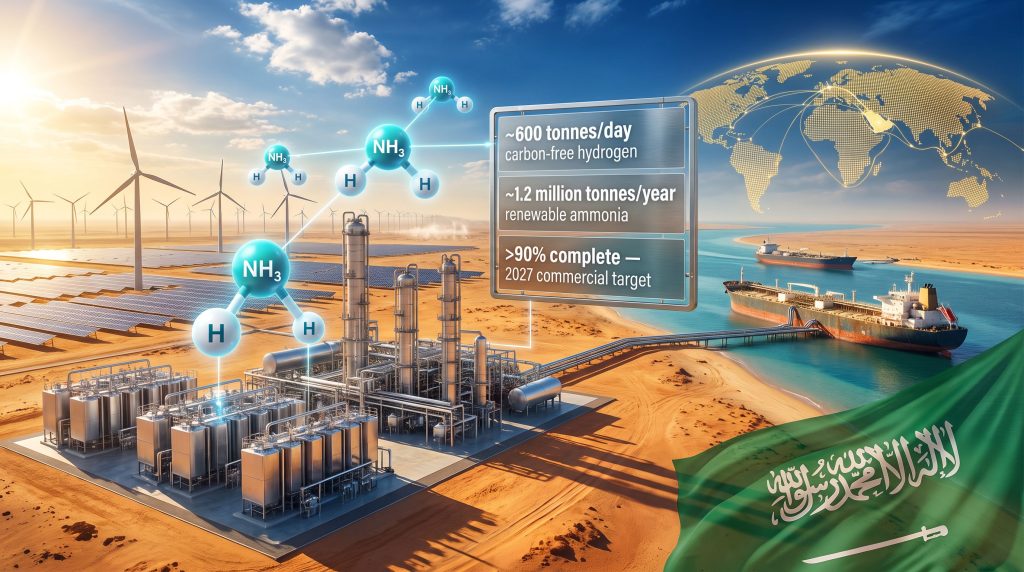
At the core of this deal sits the NEOM Green Hydrogen Project, a facility located within Saudi Arabia's NEOM gigaproject development zone. The plant is designed to convert electricity generated from solar and wind resources into green hydrogen through water electrolysis, then synthesize that hydrogen into ammonia using the Haber-Bosch process for global export.
The production specifications set this project apart from virtually every other green hydrogen facility currently under development:
- Targeted hydrogen output of approximately 600 tonnes per day of carbon-free hydrogen
- Annual ammonia equivalent production of roughly 1.2 million tonnes per year
- Construction reported at more than 90% complete as of mid-2026
- Commercial production commencement targeted for 2027
To put that output figure in context, global green ammonia production across all operating projects in 2024 was estimated at a fraction of this capacity. A single facility delivering 1.2 million tonnes annually would represent a step-change in available supply, not just an incremental addition.
| Project Metric | Detail |
|---|---|
| Daily hydrogen output | ~600 tonnes/day |
| Annual ammonia equivalent | ~1.2 million tonnes/year |
| Construction completion | >90% (mid-2026) |
| Commercial production target | 2027 |
| Primary EPC contractor | Air Products |
| Exclusive offtaker | Air Products |
Why the Haber-Bosch Process Remains Central
A technical detail often overlooked in green hydrogen coverage is that the Haber-Bosch synthesis process, which combines hydrogen with atmospheric nitrogen to produce ammonia, operates most efficiently at continuous, high-pressure conditions. This creates a fundamental tension with intermittent renewable electricity generation.
The NEOM project addresses this by pairing solar and wind generation with sufficient electrolyzer capacity and buffering to maintain the steady hydrogen feed that Haber-Bosch requires. Achieving that balance at 600 tonnes per day of hydrogen is an engineering challenge that distinguishes this facility from smaller demonstration projects. The fact that construction is more than 90% complete suggests the core technical architecture has been successfully built, even if commissioning and ramp-up risks remain.
Mapping the Value Chain: Who Controls What
Air Products' Unusual Triple Role
Air Products occupies a position in this project that has no precise precedent in conventional energy infrastructure. The company functions simultaneously as the primary engineering, procurement, and construction contractor, the project developer, and the exclusive offtaker of all green hydrogen produced in the form of green ammonia. This vertical integration across build, own, and offtake functions gives Air Products comprehensive control from construction through to first-sale commercialisation.
According to Air Products' official project overview, the NEOM Green Hydrogen Complex is among the most ambitious clean energy infrastructure investments ever undertaken by a single corporate entity. This strategic commitment becomes more significant when viewed alongside Air Products' concurrent decision in July 2026 to exit its Arizona green hydrogen development site.
Rather than maintaining a diversified portfolio of domestic and international green hydrogen bets, the company appears to be concentrating capital and execution focus on the NEOM asset. That kind of deliberate capital concentration signals high conviction in the Saudi project's commercial viability, even as it increases single-asset risk.
The Yara Entry Point: Distribution, Not Production
Yara's involvement addresses a structural gap that Air Products, for all its upstream strength, cannot easily fill alone. Placing 1.2 million tonnes of ammonia annually into fragmented global markets requires something very different from project execution capability. It requires:
- Established relationships with fertiliser producers, chemical manufacturers, and industrial buyers across multiple continents
- Access to ammonia shipping routes, port infrastructure, and storage terminals
- Deep knowledge of regional pricing dynamics and offtake contract structures
- The ability to redirect volumes between markets as price differentials shift
Yara possesses all four of these capabilities at scale. As one of the world's largest ammonia traders and producers, the company operates a logistics network spanning Europe, Asia, and the Americas that took decades to build. This network is the enabling asset that transforms NEOM's output from a production figure into commercially placed tonnes.
Structural Distinction: Yara is not acquiring equity in the project or purchasing ammonia directly from NEOM. The agreement operates at the commercial distribution layer, covering the marketing and logistics of volumes that Air Products does not place through its own end-user channels.
What the Marketing Agreement Actually Covers
Unpacking a Capital-Light Strategy
The Yara-NEOM arrangement, finalised in line with the original first-half-2026 target, reflects a deliberate capital-light strategic orientation from Yara's side. This interpretation is reinforced by Yara's simultaneous decision not to proceed with the acquisition of the Louisiana Clean Energy Complex, a production asset that would have required substantial balance sheet commitment.
Rather than deploying capital into green ammonia production infrastructure, Yara is positioning itself as the commercial intermediary that aggregates, routes, and places supply from third-party producers. In a market where production assets are expensive, technically complex, and carry construction risk, controlling the distribution layer may ultimately be the more defensible competitive position.
The Renewable Ammonia Premium: What Buyers Are Actually Paying For
Green ammonia produced at NEOM carries a near-zero carbon footprint across its entire production chain, from renewable electricity generation through electrolysis and synthesis. This carbon profile has tangible commercial value in several key markets. In addition, the demand for energy transition minerals and clean energy carriers is accelerating simultaneously, reinforcing the broader commercial logic behind projects like NEOM.
- European industrial buyers face increasing pressure from the EU's Carbon Border Adjustment Mechanism, which imposes carbon costs on imported goods with embedded emissions. Fossil-derived grey ammonia carries a significant embedded carbon load, while green ammonia from NEOM could qualify for preferential treatment.
- Japanese and South Korean power and fertiliser buyers are operating under national decarbonisation commitments that explicitly require sourcing clean energy molecules, with ammonia co-firing in coal power plants identified as a near-term transition pathway.
- Shipping sector buyers are increasingly exploring ammonia as a future marine fuel under International Maritime Organization emissions frameworks.
A critical regulatory question that will shape the commercial outcome is whether NEOM-origin ammonia qualifies under the EU's Renewable Fuels of Non-Biological Origin framework. RFNBO certification unlocks the highest available price premium in European markets, but requires strict additionality, geographic correlation, and temporal correlation between the renewable electricity used and the hydrogen produced. Whether the NEOM project's solar and wind generation architecture meets these criteria is not yet publicly confirmed.
Competitive Landscape: NEOM Within the Broader MENA Green Ammonia Race
Saudi Arabia is not pursuing clean energy export ambitions through NEOM alone. In July 2026, ACWA Power was awarded exclusive rights to export Saudi green hydrogen, signalling a parallel national strategy to build multiple export corridors simultaneously. This creates a competitive dynamic within Saudi Arabia itself, as different project vehicles and corporate structures compete for the same European and Asian buyer relationships. Consequently, the Saudi exploration licences framework illustrates just how systematically the kingdom is structuring its resource and energy export ambitions.
| Project | Country | Capacity | Status |
|---|---|---|---|
| NEOM Green Hydrogen Project | Saudi Arabia | ~1.2 Mt/yr ammonia | >90% complete, 2027 target |
| ORNX Morocco Ammonia Project | Morocco | TBD | Pre-FEED stage (US grant, July 2026) |
| ACWA Saudi Green Hydrogen Export | Saudi Arabia | TBD | Exclusive export rights awarded July 2026 |
Competing projects from Australia, Chile, and Oman are also advancing toward market, some of which may reach commercial scale before or around the same time as NEOM. Yara's distribution network, therefore, needs to manage not just NEOM volumes but potentially overlapping supply from multiple green ammonia sources as the market matures through the late 2020s.
Key Risks and Uncertainties Investors Should Track
What the 2027 Target Does and Doesn't Guarantee
Construction completion above 90% is a meaningful milestone, but it does not eliminate commissioning risk. Large-scale hydrogen and ammonia facilities routinely experience extended ramp-up periods after mechanical completion, as electrolyser systems, synthesis loops, and utility integrations are optimised. A delay to 2028 or beyond would not be unprecedented for a project of this complexity.
Risk Flag: The 2027 commercial production target reflects current planning assumptions. Investors and market participants should treat this as a probabilistic estimate, not a contractual delivery date, given the history of timeline slippage in comparable mega-projects.
Additional risk factors that warrant monitoring include:
- Pricing floor uncertainty: The mechanism governing how NEOM-origin green ammonia is priced relative to grey ammonia benchmarks has not been publicly disclosed
- Volume allocation between Air Products and Yara: The proportion of the 1.2 million annual tonnes that Yara will actually market remains unclear
- RFNBO certification status: European premium pricing depends on regulatory certification that has not been confirmed
- Yara balance sheet management: The capital-light distribution strategy reduces upfront risk but also limits Yara's control over production reliability and supply continuity
The next major ASX story will hit our subscribers first
Scenario Pathways: Three Possible Outcomes Through 2029
Scenario A: Smooth 2027 Ramp-Up
NEOM reaches commercial production on schedule. Yara successfully routes volumes into European and Asian premium markets. The Yara-Air Products model becomes a template replicated across other large green ammonia projects globally, accelerating the commoditisation of clean ammonia as a traded energy carrier.
Scenario B: Production Delays Push Timeline to 2028 or Later
Commissioning complexity extends the ramp-up period. Competing projects from Australia and Oman begin delivering volumes first, partially capturing the buyer relationships Yara had anticipated serving with NEOM supply. Air Products faces investor pressure to demonstrate returns on its substantial capital commitment.
Scenario C: European Regulatory Friction Compresses Margins
RFNBO certification delays or non-compliance findings force redirection of volumes from premium European markets to Asian buyers at lower price points. The commercial case for the distribution agreement weakens, potentially triggering renegotiation of volume commitments and pricing structures between Yara and Air Products.
What This Deal Signals for Clean Energy Market Structure
The Yara green ammonia deal with Neom in Saudi Arabia is most usefully understood not as a headline supply contract, but as evidence of how the clean ammonia value chain is beginning to professionalise. The separation of production, primary offtake, and distribution functions into distinct corporate roles mirrors the maturation pattern seen in liquefied natural gas markets over the 1970s and 1980s, where specialised traders eventually created the pricing transparency and liquidity that made LNG a genuinely global commodity.
Green ammonia is not yet at that stage. However, the NEOM-Yara-Air Products structure suggests the architecture for that future market is being assembled now, with individual companies occupying defensible niches rather than competing to control the entire chain. Projects exploring renewable energy solutions at an industrial scale are increasingly converging on similar structural models, where specialised distribution capability proves as strategically valuable as production infrastructure itself.
Furthermore, parallel developments such as green hydrogen investment in South Africa demonstrate that the clean molecule economy is taking shape across multiple geographies simultaneously. For market observers, the critical near-term milestone remains the 2027 production commencement date, which will determine whether this architecture is tested under real commercial conditions or remains a forward-looking framework awaiting its first major throughput.
This article is intended for informational purposes only and does not constitute financial or investment advice. Forecasts, timelines, and commercial projections referenced herein involve uncertainty and should not be relied upon as guarantees of future outcomes. Readers are encouraged to consult independent sources and professional advisers before making investment decisions.
Ready to Identify the Next Major Mineral Discovery Before the Broader Market?
Discovery Alert's proprietary Discovery IQ model instantly notifies subscribers of significant ASX mineral discoveries, transforming complex data across more than 30 commodities into clear, actionable investment insights — the same kind of structural market shifts driving deals like NEOM are also reshaping demand for critical minerals on the ASX. Explore historic discoveries and their returns on Discovery Alert's dedicated discoveries page, or start your 14-day free trial today to position yourself ahead of the market.